
What Is an Economic System? How Countries Organize Economic Activity
What Is an Economic System?
Every economy has to answer a few basic questions.
Who decides what gets produced? Who owns businesses and productive resources? How are prices determined? How are workers paid? Who decides where scarce resources should go?
The answers depend heavily on the country’s economic system.
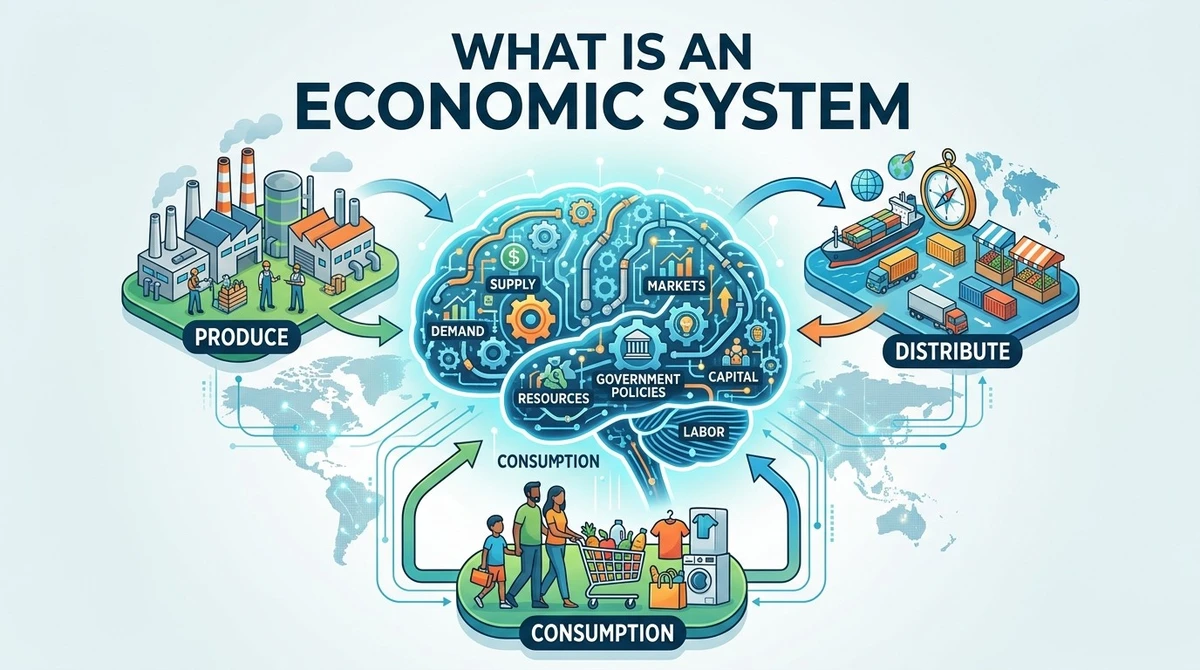
An economic system is the framework a society uses to organize production, consumption, investment, and the allocation of scarce resources. It includes the rules and institutions that determine who owns productive assets, how economic decisions are made, how markets operate, and what role the government plays.
That makes an economic system different from the economy itself. The economy describes the economic activity taking place, while the economic system helps explain how that activity is organized. For a basic introduction to the economy as a whole, see Economic Reader’s guide to What Is the Economy?.
Most modern economies are not purely market-based or completely government-controlled. They combine private ownership, markets, regulation, taxation, public services, and government intervention in different ways.
Understanding those differences helps explain why countries can respond very differently to the same economic problem.
Why Every Economy Needs a System
The starting point is scarcity.
Labor, land, capital, energy, natural resources, and time are limited. At the same time, households, businesses, and governments have competing demands for those resources.
Imagine that a country has limited steel production. That steel could be used for cars, construction, machinery, energy infrastructure, or other products.
Producing more of one may mean producing less of another.
An economic system provides a mechanism for making these choices.
In a market-oriented economy, prices and expected profits help guide those decisions. In a more centrally directed system, government authorities can play a larger role in deciding which activities receive resources.
Neither approach eliminates scarcity. The difference is how decisions about scarcity are coordinated.
The Four Questions Every Economic System Must Answer
Although economic systems can look very different, they have to deal with four fundamental questions.
What Should Be Produced?
An economy needs to determine which goods and services should be produced and in what quantities.
In a market system, consumer demand and business expectations play a major role. If demand for electric vehicles increases, manufacturers may respond by expanding production and investment.
Governments can also influence what gets produced through taxes, subsidies, regulations, public procurement, or direct investment.
How Should It Be Produced?
Production requires decisions about labor, machinery, technology, energy, and raw materials.
A manufacturer might choose between hiring additional workers and investing in automation. Another business might move production closer to customers or suppliers to reduce costs.
The economic system influences the incentives behind those decisions.
Who Receives the Output?
Economic production generates income as well as goods and services.
Workers receive wages. Business owners may receive profits. Lenders receive interest. Governments collect taxes and provide public services.
As a result, the distribution of economic output depends on wages, ownership, prices, taxes, transfers, and access to public services.
Who Makes Economic Decisions?
Economic decisions can be made by consumers, businesses, investors, governments, cooperatives, communities, or combinations of these groups.
The balance between these decision-makers is one of the clearest ways to distinguish different economic systems.
Market Economies: Decisions Through Prices and Competition
A market economy relies primarily on voluntary exchange, private decision-making, competition, and prices to coordinate economic activity.
Businesses decide what they want to produce based partly on expected demand and profitability. Consumers choose what to buy. Workers offer their labor in exchange for wages.
Prices connect those decisions.
Suppose demand for a particular raw material rises while its supply remains limited. Its price may increase. That higher price gives producers an incentive to increase supply, while businesses using the material may look for substitutes or reduce consumption.
Millions of separate decisions can therefore be coordinated without a central authority telling every business what to produce.
Markets can encourage competition, specialization, investment, and innovation. But markets can also produce problems when private decisions create costs for others or when important goods and services are not supplied at socially desirable levels.
Pollution is a simple example. A factory may consider its private production costs without fully accounting for the environmental damage caused by its emissions.
That is one reason market economies usually involve government regulation rather than completely unrestricted markets.
Command Economies: More Central Direction
A command economy relies much more heavily on government decisions to allocate resources and organize production.
Government authorities may determine or heavily influence:
- Production targets
- Investment priorities
- Prices
- Employment
- Resource allocation
- Imports and exports
- Industrial development
Instead of allowing prices and private businesses to make most allocation decisions, the state takes a much larger coordinating role.
One challenge is information.
A modern economy contains an enormous amount of constantly changing information about consumer preferences, production costs, shortages, technology, and business conditions. A central authority may have difficulty processing that information quickly enough to match the decisions generated by decentralized markets.
Incentives can also differ. If businesses face limited competition and have less control over profits, they may have weaker reasons to reduce costs, improve products, or take entrepreneurial risks.
Central direction can nevertheless be useful for mobilizing resources toward specific priorities. The economic question is how effectively the system can coordinate those resources and adapt when conditions change.
Traditional Economic Systems
A traditional economy organizes a significant part of economic activity around customs, established practices, community relationships, and inherited economic roles.
Traditional systems are less common as the dominant framework in large modern economies, but traditional practices continue to exist within many communities.
Agriculture, fishing, crafts, and local production can still be shaped by family knowledge, community institutions, and long-established practices while also interacting with markets.
This is important because real economies rarely fit perfectly into a single category.
Mixed Economies Are the Modern Norm
Most modern economies are mixed economies, combining market mechanisms with government involvement.
Private companies can own businesses, hire workers, compete for customers, and make investment decisions. Governments collect taxes, provide public services, regulate markets, and sometimes own or operate enterprises.
The balance varies considerably.
A country may have private banks alongside a central bank, private hospitals alongside public healthcare, private schools alongside public education, and competitive markets alongside environmental or consumer regulations.
The IMF’s explanation of capitalism and mixed economies notes that mixed economies combine markets with government intervention, including regulation aimed at addressing market failures and providing public goods.
This is why simply describing a country as “capitalist” does not tell the entire economic story.
A more useful question is: How does the country combine markets, government, and other institutions?
Capitalism and Socialism Are Broader Ideas
Capitalism and socialism are often used as labels for economic systems, but they describe broader approaches to ownership, markets, and economic organization.
Capitalism generally places greater emphasis on private ownership, markets, voluntary exchange, and private decision-making.
Socialist traditions generally place greater emphasis on social or public ownership of productive resources and a larger role for collective decision-making.
There are many variations within both traditions.
A country can have private businesses and markets while also providing extensive public services, regulating industries, and operating state-owned enterprises.
The labels therefore provide a starting point, but the actual structure of an economy depends on the institutions and policies operating underneath them.
Why Prices Matter
Prices are one of the most important coordination mechanisms in a market-oriented system.
A price can communicate information about scarcity and demand.
Suppose a drought reduces the supply of coffee beans. If demand remains relatively strong, coffee prices may rise. Producers have an incentive to find ways to increase supply, while consumers may reduce consumption or switch to alternatives.
The price system connects decisions made by people who may never interact directly.
Farmers respond to expected prices. Manufacturers adjust production plans. Consumers decide what they can afford. Investors decide where capital may earn an attractive return.
Prices are not perfect signals, however.
They may fail to reflect costs imposed on third parties, such as pollution. Markets can also underprovide goods whose benefits extend beyond the individual buyer, such as certain forms of public infrastructure.
That is where institutions and government policy enter the picture.
Property Rights Shape Investment
Property rights determine who has legal control over assets and how those assets can be used, transferred, or sold.
Consider a piece of land.
If ownership is clearly established and legally protected, the owner may be able to develop it, rent it, sell it, or use it as collateral.
That can affect investment decisions. Someone who is uncertain whether they will retain control over an asset has less incentive to spend money improving it.
The World Bank identifies secure property rights and reliable land administration as factors that can support investment, access to credit, functioning property markets, and economic development. (World Bank)
Property rights therefore involve more than simply deciding who owns something. The legal system also needs to make ownership enforceable.
Markets Depend on Institutions
Markets do not operate in isolation.
A functioning market economy requires rules governing contracts, property, competition, taxation, corporate activity, and financial transactions.
Imagine two businesses signing a contract for a major equipment purchase.
If both sides expect the contract to be enforced, they can transact with greater confidence. If enforcement is unreliable, businesses may avoid agreements, demand additional protection, or require higher compensation for taking the risk.
The World Bank notes that institutions governing areas such as firm entry, licensing, competition, inspections, and property rights can affect the costs and risks businesses face and influence investment and productivity. (World Bank)
This is one reason economists pay attention to institutions when comparing economic performance across countries.
How an Economic System Affects Businesses
Businesses operate within the incentives created by an economic system.
When deciding whether to build a factory, open a store, hire workers, or develop a new product, a company may consider:
- Taxation
- Labor regulations
- Property rights
- Access to finance
- Competition
- Infrastructure
- Trade rules
- Consumer demand
- Regulatory stability
These factors affect the expected return from investment.
For example, secure property rights can make long-term investment easier because businesses have greater confidence that they can use and benefit from the assets they acquire.
Clear regulations can also reduce uncertainty. At the same time, regulation can impose costs on businesses, which means the design of rules matters as much as their existence.
An economic system therefore shapes business decisions through a combination of incentives, restrictions, and opportunities.
Workers Experience the System Through the Labor Market
Workers encounter an economic system through wages, employment opportunities, taxes, labor protections, education, and social programs.
In a market-oriented labor market, wages are influenced by the supply and demand for different types of workers.
If businesses need more software engineers than are available, competition for workers can push wages higher. If demand for a particular occupation falls while the supply of workers remains large, wage growth may weaken.
Government policy can affect these outcomes through minimum-wage laws, immigration rules, employment regulations, education, training, unemployment benefits, and taxation.
The labor market is therefore not controlled entirely by either businesses or governments. Market forces operate within an institutional framework.
Economic Systems Also Shape Inequality
Economic systems influence how income and wealth are distributed, although they are not the only factor.
People earn different incomes because of differences in skills, occupations, hours worked, business ownership, investment returns, bargaining power, and access to opportunities.
Governments can modify the resulting distribution through taxation, social insurance, public education, healthcare programs, housing assistance, and other transfers.
Technology and globalization can also change the distribution of economic gains.
This means inequality cannot be explained simply by asking whether an economy is capitalist or socialist. The details of ownership, labor markets, taxation, education, competition, and social policy all matter.
Economic Systems Can Change Without Being Completely Replaced
Economic systems are not fixed forever.
A country can change the balance between markets and government without abandoning its broader economic framework.
Governments may privatize state-owned enterprises, introduce competition into regulated industries, change tax incentives, expand social programs, tighten financial regulation, or invest more heavily in infrastructure.
Technological change can also force economic institutions to adapt.
Artificial intelligence, automation, digital platforms, cryptocurrencies, and new financial technologies have created economic activities that older regulatory frameworks were not designed to handle.
The result is often gradual adjustment rather than a complete replacement of one system with another.
Why Economic Systems Involve Trade Offs
No economic system removes every economic problem.
Markets can coordinate large numbers of decisions and provide strong incentives for innovation, but they can also produce externalities, unequal outcomes, or underinvestment in certain public goods.
Central planning can direct resources toward national priorities, but it can face information and incentive problems.
Mixed economies attempt to combine different mechanisms, but government intervention can also create unintended effects when policies are poorly designed.
The important economic question is therefore not simply whether markets or governments should exist.
Both already exist in most modern economies.
The more useful question is which decisions should be coordinated through markets, which require public institutions, and how should the two interact?
Economic Systems and Economic Policies Are Different
An economic system is the broader framework within which economic activity takes place.
An economic policy is a specific government action designed to influence that economy.
For example:
- A market economy is an economic system.
- A corporate tax change is an economic policy.
- A mixed economy is an economic system.
- An interest-rate decision is monetary policy.
- A government subsidy for a particular industry is an economic policy.
This distinction matters because governments can change individual policies without fundamentally changing the economic system.
For example, the Federal Reserve can change interest rates without changing the United States’ broader market-based economic structure. Economic Reader’s guide to What Is Monetary Policy? explains how central banks use monetary policy to influence inflation, employment, and economic activity.
How Economic Systems Connect to Economic Growth
The effects of an economic system ultimately show up in production, investment, employment, productivity, and living standards.
A country with secure property rights, functioning legal institutions, competitive markets, and predictable rules may create stronger incentives for businesses and households to invest.
Investment can increase the capital available to workers. Better technology can raise productivity. Greater productivity can allow an economy to produce more with the same amount of labor and resources.
That connection is important when interpreting measures such as GDP. GDP explained by Economic Reader covers how GDP measures the value of final goods and services produced within an economy.
GDP, however, is an outcome measure. It does not by itself explain why an economy produces more or less. The institutional and economic system helps provide part of that explanation.
The Economic System Is the Framework Behind Economic Activity
An economy is made up of production, consumption, investment, employment, trade, and other economic activity.
An economic system helps determine how those activities are organized.
It influences who owns resources, how prices are formed, how businesses respond to incentives, how workers participate in labor markets, how governments intervene, and how economic gains and costs are distributed.
Most modern economies are mixed. They use markets to coordinate a large share of economic decisions while relying on governments and institutions to enforce rules, provide public services, address market failures, and pursue broader economic and social objectives.
That is why economic systems are better understood through their institutions and incentives than through simple labels.
When economists examine an economy, the deeper question is not merely whether it is capitalist, socialist, or mixed. It is how the rules of the system influence decisions about resources, investment, work, production, and consumption and how those decisions shape economic performance over time.