How Contractionary Policies Can Hamper Economic Growth
When inflation rises too quickly, policymakers may try to slow the economy down.
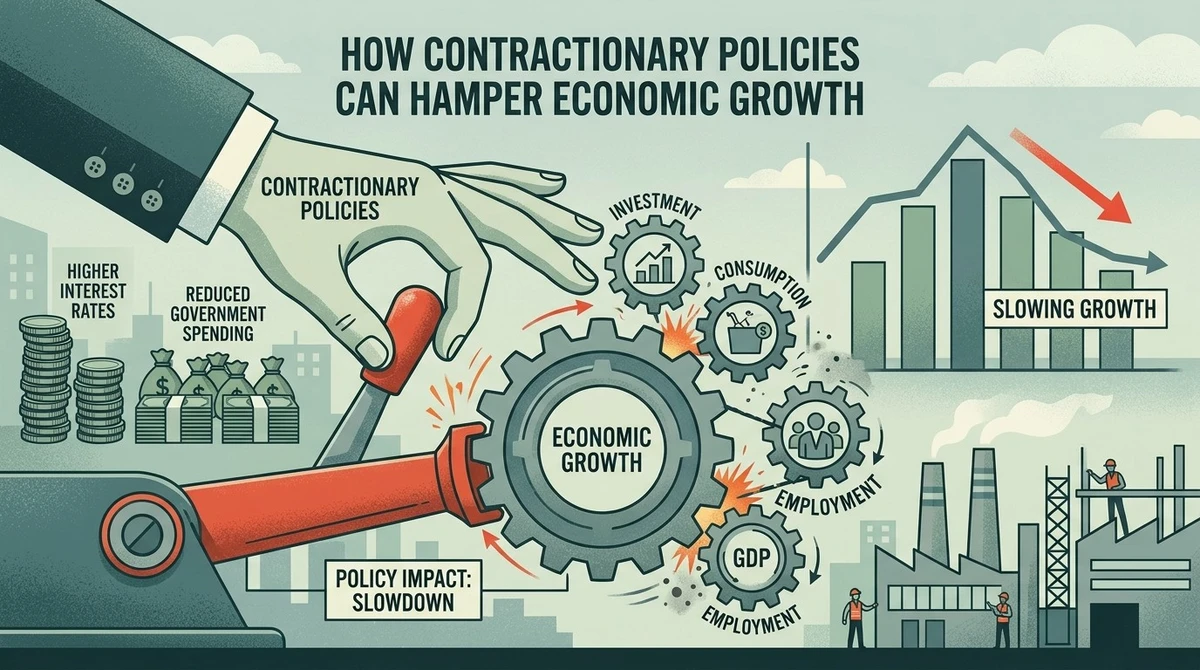
Central banks can raise interest rates and tighten financial conditions. Governments can reduce spending or increase taxes. These measures are known as contractionary policies because they are intended to reduce aggregate demand and slow the pace of economic activity.
That can help bring inflation under control. But the same process can also weaken economic growth.
The basic mechanism is straightforward:
Contractionary policy → weaker demand → lower spending and investment → slower production → weaker employment growth → slower economic growth
The actual effect is more complicated. It depends on why inflation is rising, how strong demand is, how much households and businesses depend on borrowing, and how restrictive the policy becomes.
This is why contractionary policy creates one of the central trade-offs in macroeconomics: reducing inflation pressure without unnecessarily weakening economic activity.
What Are Contractionary Policies?
Contractionary policies are measures designed to reduce economic demand.
They mainly operate through two areas: monetary policy and fiscal policy.
Contractionary monetary policy is generally carried out by a central bank. Raising policy interest rates can make borrowing more expensive and tighten broader financial conditions. The Federal Reserve explains that changes in its policy rate can affect other interest rates, credit conditions, spending, employment, output, and prices. (Federal Reserve)
Contractionary fiscal policy works through government taxation and spending. A government can reduce spending or raise taxes to lower aggregate demand. The IMF describes fiscal policy as a tool that can influence economic activity through government spending, taxation, transfers, and borrowing. (IMF)
The two approaches are different, but they can produce a similar short-term effect: less demand in the economy.
Why Would Policymakers Want to Slow the Economy?
Slower economic activity is not normally the goal.
Healthy economic growth can mean higher production, stronger business activity, rising incomes, and more employment.
The problem is that demand can sometimes grow faster than an economy’s ability to produce goods and services.
When that happens, businesses may struggle to keep up with orders, labor markets can become unusually tight, and prices can rise more rapidly.
In such circumstances, policymakers may tighten policy to bring demand closer to the economy’s productive capacity.
The Federal Reserve’s monetary policy framework reflects this trade-off. Its mandate focuses on maximum employment and stable prices, and it uses monetary policy to influence overall financial conditions and economic demand. (Federal Reserve)
So, the purpose of contractionary policy is not simply to reduce growth.
It is generally to slow demand enough to address an economic imbalance, particularly excessive inflation pressure.
Higher Interest Rates Can Reduce Borrowing
The clearest example comes from monetary policy.
When a central bank raises its policy interest rate, borrowing generally becomes more expensive across the economy.
The change in the policy rate does not automatically determine every interest rate paid by consumers and businesses. But it influences broader financial conditions, including short-term rates, longer-term rates, credit conditions, and asset prices. (Federal Reserve)
For households, higher rates can increase the cost of:
- Mortgages
- Auto loans
- Credit cards
- Personal loans
- Other forms of consumer credit
For businesses, financing can become more expensive for:
- Equipment purchases
- New facilities
- Technology investments
- Inventory
- Expansion projects
Some borrowers will continue with their plans. Others may delay them.
That difference is important because economic growth depends partly on continuous household consumption and business investment.
Economic Reader’s How Interest Rates Affect the Economy explains this broader interest-rate transmission process in more detail.
Consumer Spending Can Weaken
Consumer spending is one of the largest sources of economic demand.
Higher interest rates can affect consumption in several ways.
A household planning to buy a home may postpone the purchase because the monthly mortgage payment has become too expensive. Someone considering a new vehicle may delay the purchase because financing costs are higher.
Higher rates can also encourage some households to save more because interest-bearing assets offer better returns.
The result can be slower growth in consumer spending.
A simplified chain looks like this:
Higher interest rates → more expensive credit → less borrowing → slower consumption → weaker business revenue
The effect is not identical for everyone.
A household with significant savings may receive more interest income, while a heavily indebted household may face higher financing costs.
This means monetary tightening can affect households differently depending on their debt, savings, income, and spending patterns.
Business Investment Can Slow
Business investment is another major transmission channel.
Suppose a company is considering a large expansion. Management compares the expected return from the project with the cost of financing it.
If borrowing costs rise significantly, some projects may no longer appear attractive.
The company might:
- Delay a factory expansion
- Purchase less equipment
- Reduce planned hiring
- Postpone technology upgrades
- Wait before entering a new market
This matters beyond the immediate investment decision.
Lower investment today can also mean less additional productive capacity in the future.
Federal Reserve research has found that firms facing stronger financing constraints can respond more sharply to monetary tightening, including through larger reductions in investment. The specific study is research by Federal Reserve economists and does not represent an official Federal Reserve policy position. (Federal Reserve)
This illustrates why interest-rate policy can influence both current demand and business decisions about future production.
Weaker Demand Can Reduce Production
Businesses respond to changes in customer demand.
If consumers and other businesses purchase fewer goods and services, companies may not need to maintain the same level of production.
Imagine a manufacturer receiving fewer orders after higher borrowing costs weaken consumer demand.
The company may first reduce overtime or slow new hiring. If weaker demand continues, it may cut production or postpone expansion.
When similar decisions occur across many industries, overall economic activity can slow.
The Federal Reserve describes this broader transmission process as monetary policy affecting financial conditions and spending decisions, which then influence output, employment, and inflation. (Federal Reserve)
This is the point at which a change in an interest rate becomes a change in the real economy.
Employment Usually Responds With a Lag
Employment does not necessarily decline immediately after contractionary policy begins.
Businesses may initially respond to weaker demand by reducing overtime, slowing recruitment, or leaving vacant positions unfilled.
If weaker sales continue, companies may eventually reduce their workforce.
That can create another feedback effect:
Lower demand → weaker sales → slower production → slower hiring → weaker income growth → slower spending
The size of this effect depends on the starting conditions.
If the economy is growing strongly and employers are struggling to find workers, moderate tightening may mainly reduce the pace of hiring.
If the economy is already fragile, stronger tightening can produce a more significant decline in employment and output.
Fiscal Policy Can Slow Growth Too
Contractionary policy is not limited to central banks.
Governments can also reduce aggregate demand through fiscal policy.
The main tools include:
- Lower government spending
- Higher taxes
- Reduced transfers
- Delayed public investment
Government spending directly contributes to aggregate demand. Taxes and transfers influence the amount households and businesses have available to spend or invest. The IMF notes that fiscal policy can affect GDP directly through government spending and indirectly through consumption, investment, and net exports. (IMF)
Consider a government that reduces infrastructure spending.
Construction companies may receive fewer contracts. Suppliers may receive fewer orders. Businesses that depend on those projects may reduce hiring or investment.
A tax increase can work differently.
If households pay more in taxes, disposable income may fall, reducing consumption. If businesses face higher taxes, some investment projects may become less attractive.
The transmission mechanism therefore depends on which fiscal measures are used and who is affected.
Housing Shows the Transmission Mechanism Clearly
Housing is particularly sensitive to interest rates.
When mortgage rates rise, the cost of financing a home purchase increase. Some potential buyers may postpone purchases or reduce the amount they are willing to borrow.
Developers can also become more cautious.
If expected housing demand weakens while construction financing becomes more expensive, some projects may be delayed.
The effects can then spread across the economy through:
- Construction employment
- Building materials
- Mortgage lending
- Real estate services
- Furniture
- Appliances
- Home improvement
This is one reason interest-rate changes can influence economic activity far beyond banks and financial markets.
At the same time, the effect is uneven. Existing homeowners with long-term fixed-rate mortgages may be less immediately exposed than new buyers or borrowers refinancing at higher rates.
Inflation Control Can Come with a Growth Cost
This is the central trade-off.
Suppose inflation is being driven partly by strong demand.
Policymakers tighten monetary or fiscal conditions.
Demand slows.
Businesses face less pressure from excessive orders, and inflationary pressure can gradually ease.
But weaker demand also means households may spend less and businesses may invest less.
Economic growth can therefore slow while inflation is being brought under control.
That does not automatically mean the policy has failed.
Persistent inflation can itself create economic problems by reducing purchasing power, increasing uncertainty, and making long-term planning more difficult.
The policy challenge is therefore to determine how much demand needs to be reduced and for how long.
Short Term Growth Is Not the Same as Long Term Growth
A key distinction is between short-term economic activity and long-term productive capacity.
Contractionary policy primarily affects demand.
Long-term economic growth depends more heavily on factors such as:
- Productivity
- Technology
- Capital accumulation
- Labor supply
- Skills and education
- Infrastructure
- Innovation
A temporary slowdown in spending does not automatically reduce an economy’s long-run growth potential.
In some circumstances, restoring price stability can support more sustainable economic conditions over time.
The risk becomes greater if restrictive policy is maintained after the original inflation problem has weakened.
If businesses repeatedly cancel productive investments, unemployment remains elevated, or financial stress becomes widespread, a temporary slowdown can have more persistent consequences.
That is why policymakers monitor more than inflation alone.
Why Timing Matters
Contractionary policies do not affect the economy instantly.
A central bank may raise interest rates today, but households and businesses have existing loans, contracts, savings, and investment plans.
Some borrowers may already have locked in financing at an earlier rate. Some companies may continue projects that were approved months earlier.
Over time, however, new borrowing becomes more expensive and existing financing arrangements expire or reset.
The effects can therefore build gradually.
This creates a policy challenge: policymakers have to consider where the economy is heading, not just the conditions visible at the moment a policy decision is made.
The Federal Reserve’s policy framework explicitly considers economic and financial conditions when determining the appropriate stance of monetary policy. (Federal Reserve)
The Same Tightening Can Produce Different Outcomes
There is no fixed amount of GDP growth that will be lost from a particular rate increase or tax increase.
The response depends on economic conditions.
Important factors include:
- Household debt
- Business debt
- Financial conditions
- Consumer confidence
- Investment demand
- Global economic conditions
- Supply constraints
- Inflation expectations
- Exchange rates
The source of inflation matters too.
If inflation is mainly caused by excessive demand, reducing demand can directly address part of the problem.
If inflation is being driven primarily by a supply shock, such as a sudden increase in energy prices, higher interest rates cannot directly create more energy supply.
Tighter policy can still reduce overall demand and inflation pressure, but doing so may involve a larger reduction in economic activity.
This is why the cause of inflation matters when evaluating the likely effects of contractionary policy.
When Contractionary Policy Becomes Too Restrictive
The economic consequences become more serious when policy tightening is significantly stronger than required or remains restrictive after economic conditions have changed.
For example, if inflation is already falling while demand and employment are weakening, additional tightening could put more pressure on output.
The same policy that may be appropriate during an overheating economy can have a different effect during a fragile expansion.
This does not mean policymakers can precisely identify the perfect level of tightening in real time.
Economic data are revised, policy effects arrive with lags, and unexpected shocks can change the outlook.
That uncertainty is one reason monetary and fiscal policy decisions involve judgment rather than a mechanical formula.
Contractionary Policy Is Not Simply “Bad” for the Economy
It would be misleading to describe contractionary policy as inherently harmful.
Its immediate purpose is to restrain demand.
That can slow economic growth in the short run, but the broader objective may be to restore price stability or prevent an economy from overheating.
If inflation remains persistently high, the resulting uncertainty and loss of purchasing power can also damage economic activity.
The relevant economic question is therefore not simply:
“Does contractionary policy slow growth?”
In many circumstances, it can.
The more useful question is:
“How much growth is likely to be sacrificed to achieve greater macroeconomic stability, and is that trade-off appropriate for the economic conditions at the time?”
That depends on the source of inflation, the strength of demand, the condition of the labor market, financial vulnerabilities, and the size and duration of the policy response.
The Full Transmission Chain
The clearest way to understand how contractionary policies can hamper economic growth is to follow the process from the initial policy decision to the real economy.
For monetary policy:
Higher policy rates → tighter financial conditions → more expensive borrowing → weaker consumption and investment → lower demand → slower production → slower employment growth → weaker GDP growth
For fiscal policy:
Higher taxes or lower government spending → weaker household, business, or government demand → lower consumption or investment → weaker production → slower economic growth
These chains are simplified. Exchange rates, asset prices, expectations, trade, financial markets, and supply conditions can change the outcome.
But the central mechanism remains important.
Contractionary policies can hamper economic growth because they deliberately reduce some forms of economic demand. That can help control inflation, particularly when excessive demand is part of the problem, but it can also cause households to spend less, businesses to invest less, companies to produce less, and employers to slow hiring.
The economic challenge is therefore a matter of balance: bringing demand back toward a sustainable level without creating an unnecessarily deep or prolonged slowdown.
Understanding that trade-off helps explain why contractionary policy is one of the most closely watched forces in macroeconomics.