
What Is Visa? Understanding the Global Payment Network Behind the Digital Economy
What Is Visa?
When you tap a Visa card at a store, enter your card details online, or pay with a phone connected to a Visa account, the transaction can appear almost effortless.
A payment terminal approves the purchase. An online checkout confirms the order. The merchant eventually receives the money.
Behind that simple experience is a large network connecting consumers, merchants, banks, payment processors, and financial institutions across countries.
That network is Visa.
But Visa is often misunderstood. It is not the bank that normally provides your credit card, holds your deposit, or sets the interest rate on your loan. Its core role is operating payment infrastructure that helps different participants complete electronic transactions.
Understanding that distinction explains why Visa has become an important part of the modern digital economy.
Visa Is Not a Bank
Visa is a global payments technology company. Its network helps financial institutions and merchants authorize, process, and settle electronic payments.
If a bank issues you a Visa credit card, the bank generally provides the credit. If you use a Visa debit card, the money generally comes from your bank account.
Visa provides the network connecting the transaction.
That means the Visa logo on a card does not necessarily identify the institution holding your money or lending you money.
For example, a customer might have a Visa card issued by Bank A and use it at a business whose payment relationship is handled by Bank B. Visa’s network helps connect the transaction between those institutions.
The basic distinction is simple:
The bank provides the financial account. Visa provides the payment network.
That network model is the foundation of Visa’s business.
What Happens When You Pay With Visa?
Consider a customer buying a $100 product.
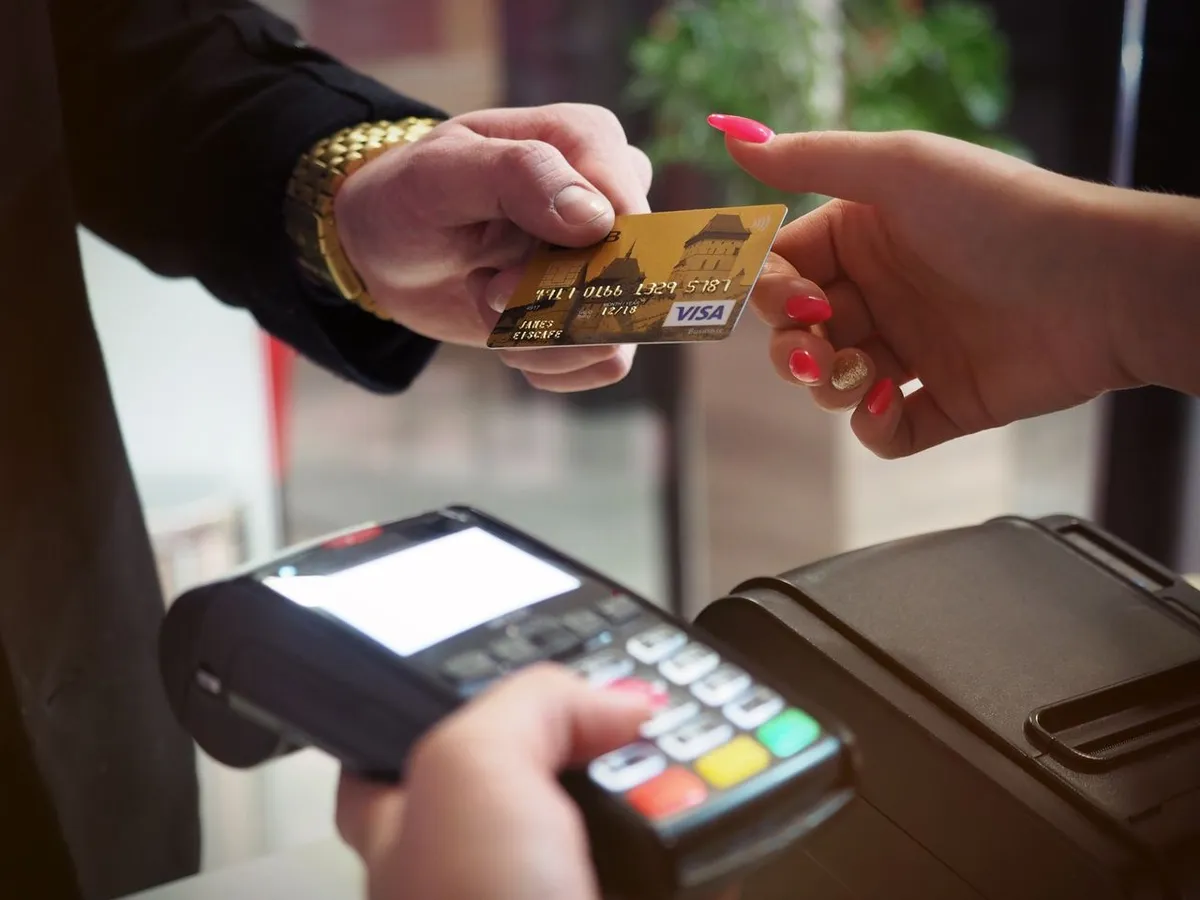
The customer taps a Visa card. The merchant’s terminal sends the transaction information into the payment system. The request ultimately reaches the institution that issued the card.
The issuer checks information such as the account’s status, available funds or credit, and potential fraud indicators. It then approves or declines the transaction.
The payment process does not end with that approval.
Visa describes the broader process through authentication, authorization, clearing, and settlement. After authorization, transaction details are exchanged during clearing, while settlement transfers funds between the relevant financial institutions. (Visa Corporate)
A simplified version looks like this:
Customer → Merchant → Payment network → Card issuer → Approval → Clearing → Settlement
This distinction matters because a payment can appear instant to the customer even though the financial system continues processing the transaction behind the scenes.
The Four Participants Behind a Card Payment
A traditional card transaction involves four core participants:
Cardholder: The person making the purchase.
Merchant: The business selling the product or service.
Issuer: The financial institution that provides the card to the customer.
Acquirer: The institution or provider that handles card acceptance for the merchant.
Visa’s network connects these participants.
This creates a powerful network effect. A Visa card becomes more useful when more merchants accept Visa, while merchants benefit when more customers can use Visa credentials.
Visa reported 4.9 billion payment credentials and 257.5 billion transactions processed on its networks in fiscal 2025. Payments volume reached $14.2 trillion. (Visa Annual Report)
That scale is important because a payment network becomes more useful as participation expands.
How Visa Makes Money
Visa’s business model is different from that of a bank.
It does not primarily earn revenue by charging consumers interest on credit-card balances. The issuing bank generally handles that side of the relationship.
Visa earns revenue from operating its payment network and providing related services.
Two important drivers are payment volume and the number of transactions processed. Visa’s annual report explains that payments volume is a major driver of service revenue, while processed transactions are an important driver of data-processing revenue. (Visa Annual Report)
That creates an unusual economic model.
Visa does not need to manufacture the products consumers purchase. It does not need to own restaurants, airlines, online stores, or supermarkets.
Instead, its business is connected to the activity happening across those businesses.
When consumers make more electronic purchases, payment volume can increase. When businesses and consumers make more individual transactions, the number of transactions processed can increase.
Visa reported $40 billion in net revenue in fiscal 2025, alongside $16.7 trillion in total volume. (Visa Annual Report)
The model therefore benefits from the growth and digitization of commerce without requiring Visa to own the underlying businesses.
Why Scale Matters So Much
Payments have a strong network-effect characteristic.
Imagine a payment network accepted by only a few thousand merchants and used by a small number of customers. Its usefulness would be limited.
Now consider a network accepted by millions of businesses and connected to billions of payment credentials.
The value of the network is much greater because participants can use it in more places.
This also creates a significant barrier for new competitors. Building a payments app is one thing. Building a global network requires relationships with banks, merchants, processors, technology providers, regulators, and consumers.
The network must also operate reliably at enormous scale while managing fraud, authentication, settlement, and security.
Visa’s 257.5 billion processed transactions in fiscal 2025 illustrate the size of that infrastructure. (Visa Annual Report)
Visa’s Role in the Digital Economy
The importance of Visa becomes clearer when payments are viewed as economic infrastructure.
A payment system reduces friction between the moment a customer wants something and the moment a business gets paid.
Consider an online business selling software subscriptions.
The customer may be in the United States, the company may be incorporated in another country, its servers may operate across several regions, and the payment may come from a customer using a bank in yet another jurisdiction.
Without digital payment infrastructure, completing that transaction would require much more coordination.
Payment networks help turn that complicated financial relationship into a checkout process that can take seconds.
The same infrastructure supports e-commerce, travel bookings, food delivery, subscriptions, mobile commerce, and many other digital activities.
For a broader explanation of how international transactions connect economies, see How Does International Trade Work?.
From Plastic Cards to Digital Payments
Visa is no longer simply a company associated with plastic cards.
Its network can operate behind contactless cards, smartphones, wearable devices, online checkouts, and digital wallets.
One important technology behind this transition is tokenization.
Instead of repeatedly exposing a card’s underlying number during a digital transaction, tokenization can replace sensitive payment credentials with a different token.
Visa says its tokenization technology is designed to reduce exposure of sensitive payment information and support more secure digital payments. Its current data shows that about 50% of e-commerce transactions are tokenized. (Visa)
This matters because digital commerce creates a different security environment from traditional face-to-face payments.
A customer might save payment credentials on dozens of websites and apps. Protecting those credentials becomes increasingly important as more purchases move online.
Visa’s tokenization system is therefore part of the infrastructure behind digital commerce, rather than merely an additional feature on a card. (Visa Corporate)
Why Cross Border Payments Matter
International payments add another layer of complexity.
A domestic transaction may involve one currency, one regulatory environment, and a relatively small number of financial institutions.
A cross-border transaction can involve different currencies, banks, regulations, payment systems, and risk controls.
Global payment networks can help connect these separate systems.
This is especially relevant to international travel and global e-commerce. A consumer can purchase something from a business overseas without needing to understand the banking infrastructure connecting the two countries.
Visa reported strong growth in cross-border activity in fiscal 2025, reflecting the importance of international commerce to its business. (Visa Annual Report)
For businesses, efficient cross-border payments can reduce friction when selling to customers outside their home market.
That makes payment infrastructure part of the broader system that enables businesses to expand internationally. For more on that process, see How Businesses Expand Globally.
Visa vs Mastercard, Banks and Digital Wallets
Visa is often compared with Mastercard because both operate major global payment networks.
But neither should be confused with the banks that issue many of the cards carrying their brands.
Digital wallets make the distinction even more important.
A consumer might add a Visa card to a smartphone wallet and pay with the phone. The wallet becomes the interface the customer sees, while the underlying payment credentials and network infrastructure can still involve Visa and the issuing bank.
The modern payments ecosystem is therefore better understood as a stack:
Customer interface → Wallet or payment app → Payment processor → Network → Issuing bank
Different companies can occupy different layers of the same transaction.
That is why a single tap at a checkout can involve several businesses even though the customer sees only one payment screen.
The Competition Is Changing
Visa’s scale is significant, but the payments industry is not standing still.
One important development is the growth of account-to-account payments, often called pay-by-bank. Instead of using a card network, these systems can move money directly from a customer’s bank account to a merchant’s account.
The Federal Reserve has noted the growth of instant payments and open-banking innovations in the U.S. payments landscape, while its research has examined pay-by-bank as a potential alternative to traditional card payments. (Federal Reserve)
Real-time payment systems can also change what consumers expect from payments. If money can move directly between bank accounts quickly and at potentially lower cost, merchants may have reasons to adopt alternatives to cards for some transactions.
That does not make card networks obsolete. Cards remain deeply integrated into consumer payments, and Visa’s scale gives it a substantial existing network.
But the competitive question is changing.
The future of payments may not be about replacing cards with one new technology. It may involve several systems competing and cooperating across different types of transactions.
Security Is Part of the Product
A payment network has to do more than move transaction data.
It also has to help maintain trust.
Fraud detection, authentication, tokenization, dispute management, and transaction monitoring are increasingly important as commerce becomes more digital.
Visa’s 3-D Secure technology, for example, can add customer authentication to online transactions before authorization. (Visa Corporate)
Tokenization is another part of this security infrastructure. Visa reports lower fraud rates for tokenized transactions compared with non-tokenized credentials, although results can vary by transaction environment and merchant. (Visa)
This creates an important economic trade-off.
Payments need to be secure enough to prevent fraud, but not so restrictive that legitimate customers are constantly rejected.
For merchants, a false decline can mean a lost sale. For consumers, excessive authentication can make checkout frustrating.
Payment technology therefore has to balance security, speed, reliability, and convenience.
What Visa’s Business Model Reveals About the Modern Economy
Visa’s business provides a useful example of how economic value increasingly comes from infrastructure rather than from the products consumers directly see.
A restaurant sells a meal.
An airline sells a flight.
An online retailer sells a product.
Visa does not provide those goods or services. It helps create the infrastructure through which the financial side of those transactions can occur.
That distinction explains why payment networks can become extremely large businesses without directly owning the underlying commerce.
It also explains why technological changes in payments matter beyond the financial sector.
If payments become faster, safer, cheaper, and easier to use, businesses can sell across more channels and consumers can transact with less friction.
At the same time, new payment systems can challenge established networks by changing how money moves between buyers and sellers.
The Bigger Picture
Visa is best understood not as a credit-card company, but as a global payment network and financial technology infrastructure provider.
Its importance comes from connecting millions of businesses and financial institutions with consumers through a system capable of processing enormous volumes of transactions.
The company processed 257.5 billion transactions in fiscal 2025 and had 4.9 billion payment credentials on its network. (Visa Annual Report)
Those figures show why scale matters in payments. But scale alone does not guarantee that today’s payment model will remain unchanged.
Digital wallets, tokenization, real-time payments, account-to-account transfers, open banking, and emerging blockchain-based payment technologies are changing the competitive environment.
For consumers, these developments may simply mean more ways to pay.
For businesses, they can affect transaction costs, conversion rates, international sales, and access to customers.
And for the broader economy, the evolution of payment infrastructure can determine how easily money moves between people and businesses.
That is ultimately what makes Visa significant: it operates one of the networks that helps turn economic activity into digital transactions.