What Is WTO? How the World Trade Organization Shapes Global Trade
When a country raises tariffs, restricts imports, or challenges another country’s trade policy, the consequences can spread far beyond its borders.
Businesses may face higher costs. Consumers may pay more for imported products. Supply chains can become less predictable. Companies may delay investment because they are unsure what trade rules will look like next year.
Behind many of these issues is an international institution most people rarely think about: the World Trade Organization (WTO).
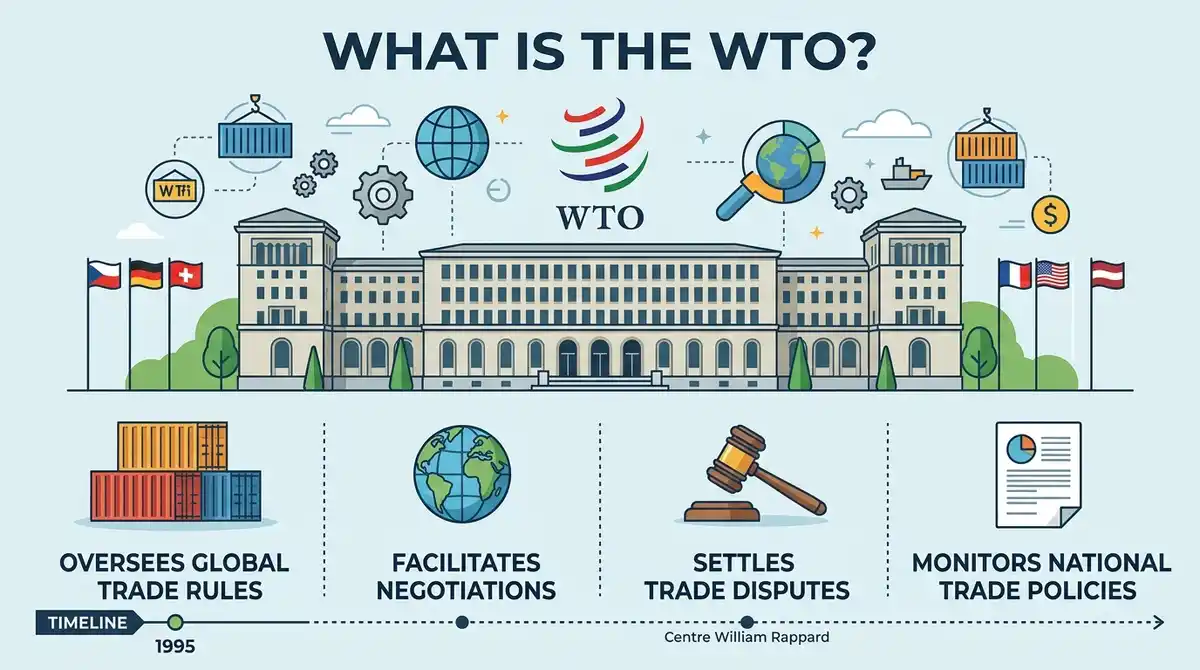
The WTO is the main international organization dealing with the rules of trade between countries. Its purpose is not simply to promote more trade. It provides a framework in which countries negotiate trade rules, make commitments, monitor trade policies, and address disputes.
The organization currently has 166 members, representing about 98% of world trade. (World Trade Organization)
Understanding what the WTO does helps explain why tariffs, trade agreements, import restrictions, subsidies, and trade disputes can have consequences for the wider global economy.
What Is WTO?
The World Trade Organization is an international organization that provides the legal and institutional framework for global trade.
It was established on January 1, 1995, following the Uruguay Round of trade negotiations. It replaced the General Agreement on Tariffs and Trade (GATT) as the main institution governing the multilateral trading system.
The WTO covers more than trade in physical goods.
Its agreements also cover:
- Trade in services
- Intellectual property
- Tariffs and market access
- Agricultural trade
- Technical standards
- Subsidies
- Trade-related investment measures
- Dispute settlement
The basic idea is straightforward:
Countries trade more effectively when they know the rules, understand the commitments of their trading partners, and have mechanisms for addressing disagreements.
The WTO itself does not control global trade or force countries to eliminate all tariffs.
Instead, its members negotiate and agree to a system of rules and commitments.
Why Was the WTO Created?
The roots of today’s trading system go back to the period following the Great Depression and World War II.
During the 1930s, countries increasingly used tariffs and other protectionist measures to shield domestic industries. This contributed to a fragmented international trading environment and made international economic cooperation more difficult.
After World War II, policymakers sought to build a more open and predictable international economic system.
The General Agreement on Tariffs and Trade (GATT) was created in 1947 as the foundation for international negotiations on reducing trade barriers.
Over several decades, countries negotiated successive rounds of tariff reductions and expanded the scope of trade rules.
The Uruguay Round eventually produced the WTO, which began operating in 1995.
The system has expanded dramatically since then. What began with 23 GATT contracting parties eventually developed into a near-universal organization with 166 WTO members.
The WTO’s latest World Trade Report estimates that the multilateral trading system has supported an almost 50-fold expansion in global trade over roughly eight decades. (World Trade Organization)
What Does the WTO Actually Do?
The WTO has several important functions, but four are particularly important for understanding its economic role.
1. It Provides Rules for International Trade
Countries need rules when they trade with one another.
Without common rules, governments could change tariffs or impose discriminatory restrictions whenever political conditions changed.
WTO agreements establish commitments covering areas such as tariffs, services, intellectual property, agriculture, subsidies, and technical regulations.
These rules do not eliminate disagreements. Instead, they create a framework within which countries can conduct trade.
The WTO describes its core role as dealing with the global rules of trade between nations and helping trade flow as smoothly, predictably, and freely as possible. (World Trade Organization)
That predictability matters to businesses.
A company considering a new factory may need to invest millions of dollars and operate for decades. It is much easier to make that decision when the international trading environment is relatively predictable.
2. It Provides a Forum for Trade Negotiations
Countries use the WTO as a forum for negotiating trade rules.
Trade negotiations can involve tariffs, market access, agricultural policies, services, subsidies, environmental issues, and other subjects.
The basic economic logic is that countries can exchange concessions.
For example, one country may agree to reduce a tariff on imported machinery while another provides improved market access for agricultural or manufactured products.
The result can be greater access to foreign markets for businesses on both sides.
This is different from a system where each country negotiates entirely on its own terms with every other country.
The multilateral approach is designed to make trade relationships more predictable and to spread agreed trade benefits across members under WTO principles.
The Most-Favoured-Nation Principle
One of the WTO’s most important principles is Most-Favoured-Nation (MFN) treatment.
Despite the name, it does not mean giving one country special treatment.
In general, if a WTO member gives another member a particular trade advantage, it must extend that advantage to other WTO members, subject to specific exceptions.
The purpose is to prevent countries from arbitrarily discriminating between trading partners.
This creates a more predictable trading environment.
According to the WTO’s 2026 Annual Report, around 72% of global goods trade continues to take place under core MFN tariff terms committed by WTO members. (World Trade Organization)
There are exceptions, including certain free-trade agreements and preferential arrangements for developing economies.
But MFN remains a central principle of the multilateral trading system.
The WTO Does Not Mean “Free Trade at Any Cost”
This is an important distinction.
The WTO does not require every country to eliminate all tariffs or abandon domestic economic policies.
Countries can maintain tariffs within their agreed commitments and can use certain trade measures under specific WTO rules.
The objective is not simply to make every country completely open to imports.
The broader goal is to create rules-based trade.
That means governments retain policy space while accepting international commitments designed to make trade more predictable and prevent certain forms of discrimination and protectionism.
This distinction also helps explain why the WTO can exist even though many countries continue to use tariffs.
How the WTO Deals With Trade Disputes
Countries do not always agree about whether a trade policy follows WTO rules.
A government may believe that another country’s tariff, subsidy, import restriction, or other measure unfairly harms its exporters.
The WTO provides a framework for resolving such disputes.
Typically, the process begins with consultations between the countries involved. If the disagreement cannot be resolved, formal dispute procedures can follow.
The objective is not simply to punish a country.
The system is designed to determine whether a measure is consistent with WTO obligations and, where appropriate, encourage the member concerned to bring the measure into conformity.
The WTO also allows members to pursue mutually agreed solutions, mediation, conciliation, and other forms of dispute resolution. (World Trade Organization)
This function is economically important because trade disputes can otherwise escalate into repeated rounds of retaliatory tariffs.
Why Trade Disputes Matter to Businesses
Imagine a company that imports a critical component for its products.
If a trade dispute suddenly results in a 25% tariff on that component, the company has several choices.
It could:
- Absorb the additional cost
- Raise prices
- Find another supplier
- Move part of its production
- Reduce investment
- Accept lower profit margins
None of these options is necessarily painless.
This is why trade policy matters even to companies that have never heard of the WTO.
International trade is built from thousands of individual business decisions involving suppliers, manufacturers, distributors, retailers, and consumers.
Economic Reader’s How Does International Trade Work? explains how goods and services move across borders and how businesses and consumers are connected through global trade.
How the WTO Affects Consumers
The WTO can also affect ordinary consumers.
Trade rules influence the conditions under which products enter domestic markets.
Lower trade barriers can increase competition and give consumers access to products from more suppliers.
That can potentially improve choice and put downward pressure on prices.
But trade also creates adjustment costs.
Domestic industries facing stronger foreign competition may lose market share. Some workers and regions may experience job losses or wage pressure even when the economy as a whole benefits from greater trade.
This is one reason the economic effects of trade are not distributed equally.
The WTO’s 2026 World Trade Report acknowledges that the gains from global trade have been substantial but unevenly distributed across economies, workers, firms, and regions. (World Trade Organization)
That is an important part of understanding the WTO.
Trade can create overall economic gains without ensuring that every individual or industry benefits equally.
WTO Rules and Tariffs
Tariffs are taxes imposed on imported goods.
Suppose a country places a 20% tariff on imported steel.
An importer purchasing $1 million of steel could face an additional $200,000 in tariff costs, assuming the tariff is applied to the full customs value.
The importer may absorb the cost, pass it to manufacturers, or eventually contribute to higher prices for final consumers.
WTO agreements provide rules governing tariff commitments.
Members negotiate maximum tariff levels, known as bound tariffs, for many products.
A country can apply a tariff below its bound rate, but raising it above the committed level can create a WTO issue unless the relevant rules provide an exception or the commitment is renegotiated.
This system gives businesses a degree of certainty about the maximum level of tariff protection their trading partners have committed to.
The WTO Also Covers Services and Intellectual Property
Modern trade is not just about containers arriving at ports.
Businesses sell software, financial services, consulting, tourism, telecommunications, transportation, digital services, and other intangible products across borders.
The WTO’s agreements therefore include trade in services.
The organization also administers rules covering trade-related intellectual property through the TRIPS Agreement.
That matters for industries such as pharmaceuticals, technology, entertainment, software, and branded products.
As economies become more digital, these areas are becoming increasingly important to global commerce.
Why WTO Rules Matter for Supply Chains
Modern supply chains often cross multiple borders.
A smartphone may involve design in one country, semiconductors from another, assembly somewhere else, and customers across dozens of markets.
A vehicle can contain components produced in many different countries before the finished product reaches consumers.
That means trade policy uncertainty can affect investment decisions far beyond the country introducing a tariff.
Companies may respond by:
- Diversifying suppliers
- Moving production
- Holding more inventory
- Building new factories
- Changing transportation routes
- Redesigning products
These changes can be expensive.
Stable trade rules therefore have value even when companies do not directly use the WTO.
The rules help create the environment in which international supply chains operate.
Why the WTO Is Facing Challenges
The WTO remains important, but it is not free from problems.
Global trade has changed significantly since 1995.
The world economy now includes much larger emerging economies, complex global value chains, digital trade, artificial intelligence, major industrial policies, environmental concerns, and heightened geopolitical tensions.
At the same time, governments increasingly use subsidies and industrial policies to support strategic industries.
The WTO’s 2026 World Trade Report says the organization is at a critical juncture because its rules must adapt to a global economy that has changed considerably since the system was created. (World Trade Organization)
This creates a difficult question:
How can a global trade system created for an earlier economic era adapt to today’s much more complex world?
That is one of the biggest challenges facing the WTO.
Why the WTO Still Matters
Despite these challenges, the WTO remains deeply embedded in the global trading system.
Its 166 members account for approximately 98% of world trade, meaning the organization covers almost the entire international trading economy. (World Trade Organization)
Its importance is not that it can prevent every trade dispute.
It cannot.
Its importance is that it provides a common framework in which countries can negotiate, make commitments, monitor policies, and manage disagreements.
Without some form of common framework, countries would have greater incentives to use unilateral trade measures.
That could lead to repeated retaliation:
Tariff → retaliation → higher tariff → more retaliation
Businesses would face greater uncertainty, supply chains could become more expensive, and consumers could eventually bear part of the cost.
The WTO’s rules are designed to reduce the likelihood of that kind of uncontrolled escalation.
What Would Happen If Global Trade Became More Fragmented?
The risk of fragmentation is one reason the WTO matters today.
If countries increasingly divided global trade into competing geopolitical blocs, businesses might have to maintain separate supply chains for different markets.
That could reduce efficiency and increase costs.
The WTO’s 2026 World Trade Report estimates that a highly fragmented global trading system could produce significant economic losses. Its modelling suggests global GDP could fall by about 5.1% in a scenario where the multilateral system splits into geopolitical blocs, while global exports could fall by around 18.6%. (World Trade Organization)
These are scenario estimates, not predictions of what will happen.
But they illustrate the economic value of maintaining broad international cooperation.
WTO and the Global Economy: The Bigger Picture
The WTO is sometimes described simply as an organization that promotes free trade.
That description is incomplete.
Its more important role is to provide a rules-based framework for international commerce.
It helps countries negotiate trade commitments, establishes principles such as non-discrimination, provides transparency around trade policies, and offers mechanisms for addressing disputes.
The benefits can be easy to overlook because successful trade often looks ordinary.
A manufacturer receives components from another country.
A retailer imports products.
A software company sells services overseas.
A consumer buys goods made on another continent.
Behind these transactions is a network of trade rules and agreements that makes cross-border commerce more predictable.
The WTO is not the only institution shaping global trade. Regional trade agreements, national governments, customs authorities, businesses, and other international organizations all play important roles.
But the WTO remains the central multilateral institution for global trade rules.
Its future therefore matters well beyond Geneva.
As geopolitical tensions, industrial policies, tariffs, digital commerce, and supply-chain concerns reshape the world economy, the central question is no longer simply whether countries should trade.
It is how countries can continue trading with each other under rules that are predictable, credible, and capable of adapting to a changing global economy.
That is ultimately why the WTO matters.