
What Is GSP+? A Complete Guide to EU Trade Benefits
If you have ever looked at where a shirt, seafood product, or food item was made, you may have noticed that some developing countries sell a large share of their products to Europe.
Getting those products into the European market is not always simple. Exporters have to deal with shipping costs, product standards, paperwork, competition, and customs duties. Even when a company can produce a good at a competitive price, an import duty can make that product more expensive once it reaches its destination.
This is where GSP+ becomes important.
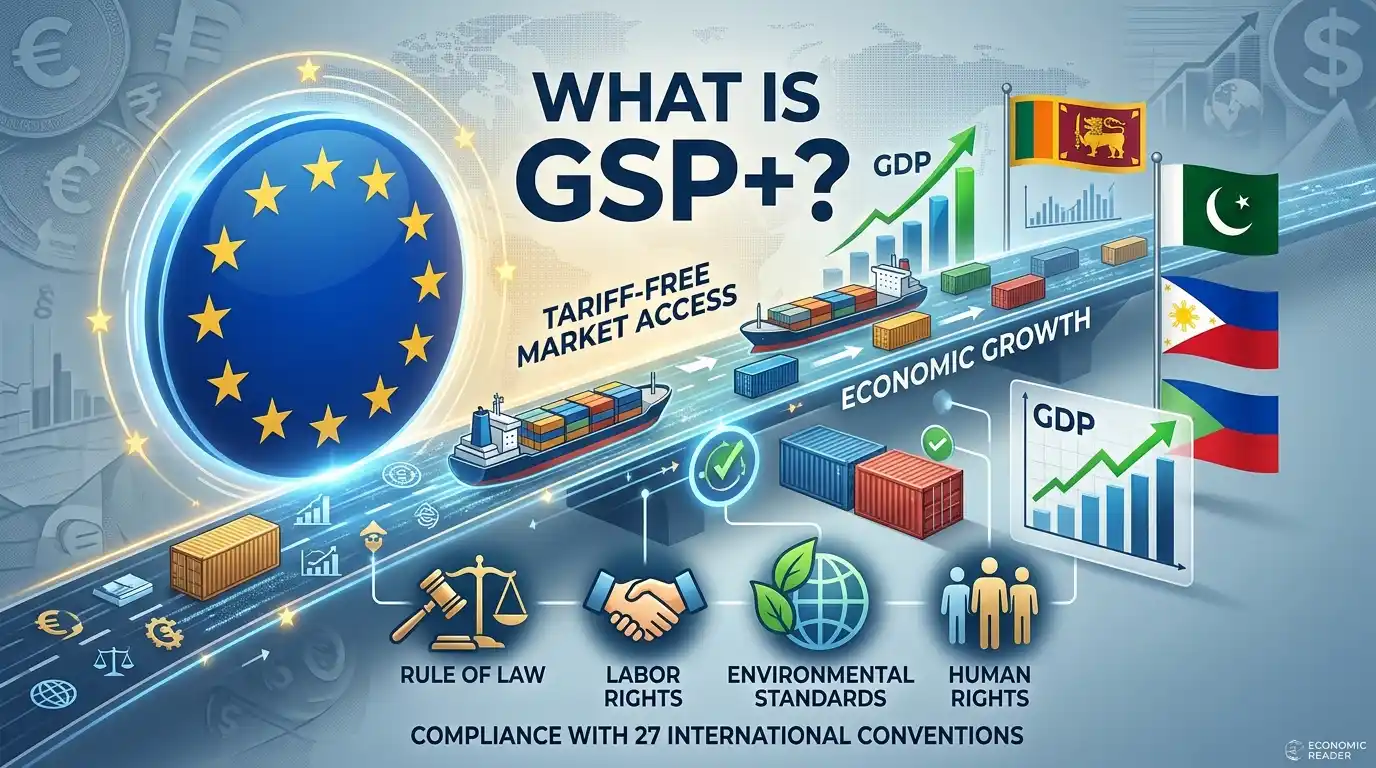
What Is GSP+? In simple terms, it is a special trade arrangement offered by the European Union to certain developing countries. It gives eligible countries better tariff treatment for many products, but there is a condition. Those countries must also commit to implementing international agreements covering areas such as human rights, labor rights, environmental protection, climate protection, and good governance.
That may sound like a government-level issue, but it can have very practical effects.
A tariff preference can influence how competitive an exporter is. If a clothing company can bring its products into Europe at a lower tariff cost, that may affect the price it can offer to European buyers. More orders can then affect factories, workers, suppliers, shipping companies, and other businesses connected to that industry.
So, GSP+ is not simply about reducing a tax on imports. It is part of a much bigger relationship between trade and economic development.
What Is GSP+?
GSP+ stands for Generalized Scheme of Preferences Plus. It is an EU trade preference arrangement that gives eligible developing countries deeper tariff preferences on a wide range of products in return for commitments to implement international conventions related to human rights, labor rights, environmental protection, climate protection, and good governance.
The easiest way to understand it is to think about two sides of the arrangement.
On one side, developing countries receive improved access to the European market through lower or zero tariffs on eligible products.
On the other side, those countries agree to meet and maintain certain international commitments.
The “Plus” is important because GSP+ provides stronger preferences than the standard GSP arrangement for eligible countries.
It is also worth clearing up one common misunderstanding. GSP+ is not a free trade agreement. The EU provides the preference under its own trade policy framework. It does not work in exactly the same way as a negotiated free trade agreement between two trading partners.
What Does GSP Stand For?
GSP stands for Generalized Scheme of Preferences.
The European Union uses the scheme to give developing countries better access to its market. The basic idea is fairly simple. If goods from an eligible developing country normally face an import duty, a GSP arrangement can reduce that duty.
There are different parts of the EU’s GSP system.
Standard GSP provides tariff preferences to eligible developing countries. GSP+ provides deeper preferences to countries that meet additional conditions. Everything But Arms, meanwhile, is designed for least developed countries.
You can think of GSP+ as one part of a larger system rather than a completely separate trade policy.
Why Does GSP+ Matter?
Trade preferences matter because the cost of entering a foreign market can influence whether a company is competitive.
Consider a small clothing manufacturer.
The company pays for fabric, wages, electricity, packaging, transportation, and other operating expenses. It then sells its finished products to an overseas buyer.
Now imagine another supplier offers a similar product at a similar factory cost. If one supplier receives better tariff treatment when its goods enter Europe, that difference can become important when the buyer compares the two offers.
The tariff advantage does not guarantee a sale. The buyer may still care more about quality, delivery time, reliability, production capacity, and other factors.
But it can give the exporter some additional room to compete.
That is one reason GSP+ can matter to developing economies.
How Does GSP+ Work?
The process is easier to understand when you look at what happens from the country’s side and then from the exporter’s side.
A Country First Has to Meet the Requirements
Not every developing country automatically qualifies.
The EU has specific eligibility requirements for GSP+. These include economic and vulnerability-related conditions, along with commitments to the international conventions covered by the scheme.
A country seeking GSP+ must also agree to effectively implement those conventions rather than simply signing them and forgetting about them.
The Country Receives Preferential Market Access
Once a country qualifies, exporters can potentially receive preferential tariff treatment for products covered by the arrangement.
For eligible products, the tariff can be reduced to zero.
That can make a noticeable difference for businesses selling into the EU.
The Benefits Come with Ongoing Responsibilities
This is where GSP+ differs from a simple trade discount.
The beneficiary country is expected to continue implementing the relevant international commitments. The EU monitors implementation and can take action when serious problems arise.
So, the arrangement is ongoing rather than being a one-time benefit.
What Are the Main Benefits of GSP+?
The benefits can vary depending on the country, industry, and product, but several advantages stand out.
Lower Tariff Costs
This is usually the first benefit people think about.
If an eligible product can enter the EU at a lower tariff, the exporter does not have to absorb the same level of customs cost.
That can help with pricing.
For a business operating in a competitive industry, even a relatively small cost difference can matter.
Better Export Opportunities
The EU is a major global market.
Preferential access gives companies in beneficiary countries an opportunity to sell to European customers under more favorable tariff conditions for covered products.
For some businesses, this can make the European market more attractive.
Stronger Export Competitiveness
Suppose a company in a developing country is competing with suppliers from several other countries.
Its production costs may already be reasonable, but it still needs to deliver an attractive final price to the buyer.
A tariff preference can improve its position.
It does not remove competition, but it can make the numbers work a little better.
Support for Employment
Exports can support employment in many different ways.
Take the apparel industry as an example.
A large clothing order does not only affect the people sewing garments. It can also involve fabric suppliers, packaging companies, transport providers, warehouse workers, port services, and other businesses.
When export activity grows, the economic impact can spread beyond the company that received the original order.
Potential Investment Benefits
Market access can also influence where companies decide to invest.
An investor looking at a developing country may consider labor costs, infrastructure, political stability, skills, energy costs, and access to foreign markets.
Preferential access to the EU can be another factor in that decision.
It is not enough by itself to attract investment, but it can make a location more interesting when combined with other advantages.
What Conditions Come With GSP+?
This is probably the most important part of the arrangement that beginners should understand.
GSP+ is not simply “lower tariffs for developing countries.”
There are responsibilities attached to it.
The current EU framework links GSP+ to 27 international conventions covering human rights, labor rights, environmental protection, climate protection, and good governance.
Human Rights
Beneficiary countries are expected to uphold important international human rights commitments.
These include protections connected with fundamental freedoms and other basic rights.
The idea is that economic development should not be separated completely from the way people are treated within a country.
Labor Rights
Worker protection is another major part of the arrangement.
International labor standards cover areas such as workers’ rights, forced labor, and other conditions surrounding employment.
This matters for export industries because products sold internationally are increasingly connected to questions about how they are made.
A European buyer may not only ask, “How much does this product cost?”
They may also ask, “Where did it come from, and under what conditions was it produced?”
Environmental Protection
Environmental issues are also part of the GSP+ framework.
Countries are expected to implement relevant international environmental agreements.
For exporters, this can become increasingly important as buyers and consumers pay more attention to sustainability.
A factory that wants long-term access to international buyers may have to think about waste, energy use, production practices, and other environmental concerns.
Climate Protection
Climate-related commitments are also included.
This reflects a broader change in international trade.
Trade policy used to be discussed mainly in terms of tariffs, imports, and exports. Today, environmental and climate issues are much more closely connected to global supply chains.
Good Governance
GSP+ also covers good governance.
That includes commitments related to international standards, institutions, and the rule of law.
The basic thinking is that trade benefits are more useful when they support broader and more sustainable development.
Which Products Can Benefit From GSP+?
GSP+ covers a wide range of products, although the exact tariff treatment depends on the product and the applicable rules.
Industries that can be relevant include:
- Clothing and textiles
- Fisheries
- Agricultural products
- Processed food
- Manufactured goods
- Other eligible products
An important point is that not every product automatically receives the same benefit.
An exporter has to check the specific product, tariff classification, origin requirements, and current EU rules.
That is especially important for businesses making real export decisions.
Knowing that a country receives GSP+ treatment is useful, but it is not enough to calculate the final cost of an individual shipment.
How GSP+ Can Affect a Clothing Business
The apparel industry is a good everyday example.
Imagine a factory that makes shirts for European retailers.
The factory has to compete with manufacturers from several countries. Its European customer wants good quality, reliable delivery, and a competitive price.
If the company’s products qualify for preferential tariff treatment, that can reduce one of the costs involved in getting the products into Europe.
The company could potentially use that advantage in several ways.
It might offer a more competitive price. It might protect its profit margin. Or it might use the additional room to invest in equipment, workers, quality control, or production capacity.
The important point is that the tariff benefit becomes part of the company’s overall business calculation.
It does not guarantee success.
A company with poor quality or unreliable delivery can still lose customers even if its tariff treatment is favorable.
GSP+ and Fisheries
Fisheries provide another useful example.
A seafood exporter selling to European customers has to deal with more than tariffs.
The business may need to meet food safety requirements, documentation rules, traceability requirements, and other standards.
If the product also qualifies for preferential tariff treatment, the exporter can benefit from lower customs costs while still having to meet the other EU requirements.
This distinction is important.
GSP+ does not mean that a product can enter Europe without meeting normal import requirements.
It mainly provides preferential tariff treatment.
Businesses still need to comply with the rules that apply to their products.
What Is GSP+ Compared With a Free Trade Agreement?
The two are often confused, but they are not the same.
A free trade agreement is a negotiated agreement between trading partners. It can cover tariffs as well as areas such as services, investment, intellectual property, customs procedures, and other trade rules.
GSP+ works differently.
The EU provides the preferences through its GSP framework to qualifying developing countries.
| GSP+ | Free Trade Agreement |
| EU trade preference arrangement | Negotiated agreement between trading partners |
| Focuses on eligible developing countries | Can involve different types of economies |
| Provides preferential tariff treatment | Usually covers broader trade commitments |
| Connected to development conditions | Based on negotiated terms |
| Linked to international conventions | May include many different areas of trade policy |
| Preferences can be changed or withdrawn under the applicable rules | Rights and obligations are defined by the agreement |
So if someone says that a country “has GSP+” it does not mean that the country has a free trade agreement with the EU.
What Are the Challenges of GSP+?
Trade preferences can be valuable, but they are not without challenges.
Countries Must Maintain Their Commitments
The conditions are an important part of the arrangement.
A country that wants to continue benefiting from GSP+ needs to keep working on the commitments connected to the scheme.
That requires ongoing attention from governments and public institutions.
Businesses Still Face International Competition
Having tariff preferences does not make an exporter automatically competitive.
A company still needs to offer something buyers want.
That could mean better quality, competitive prices, faster delivery, reliable service, or stronger production capacity.
The tariff advantage is helpful, but it is only one piece of the puzzle.
Dependence Can Create Risk
If an industry becomes highly dependent on preferential access to one major market, changes in trade policy can create uncertainty.
For that reason, businesses often need to think beyond today’s tariff advantage.
Building strong products, finding multiple customers, improving productivity, and developing different markets can make a company more resilient.
How Does GSP+ Affect Everyday Life?
Trade policy can seem far removed from everyday life.
It really is not.
Think about someone working in a clothing factory.
That person’s job may depend partly on orders from an overseas customer. The customer may be willing to place those orders because the supplier can produce the right quality at a competitive price.
Tariffs are only one part of that calculation, but they can influence it.
The same chain can extend to the worker’s household.
The worker earns income and spends it on rent, groceries, transportation, education, and other expenses. Local businesses receive some of that money. Those businesses then pay their workers and suppliers.
This is one way international trade can become part of a local economy.
The effect is not always positive, and trade preferences cannot guarantee job creation. But they can create opportunities when businesses are able to take advantage of them.
What Is GSP+ Going to Look Like After 2026?
There is another reason to pay attention to this topic right now.
The European Union has adopted a new GSP Regulation that will apply from January 1, 2027. The European Commission says the new framework will continue the GSP system for another ten years while strengthening its social, environmental, climate, and monitoring provisions.
The new framework also changes some of the conditions for GSP+.
Existing GSP+ beneficiaries will need to reapply under the new admission rules. The European Commission says current GSP+ beneficiaries will continue receiving preferences during a two-year transition period while they prepare their applications.
The updated framework also increases the number of international conventions connected with GSP+ and strengthens the mechanisms available when serious and systemic violations occur.
This is important for exporters and policymakers because trade arrangements do not stay unchanged forever.
A business that relies on preferential access should check the current rules before making long-term decisions.
What Should an Exporter Check Before Using GSP+?
If you are an exporter in a beneficiary country, knowing about GSP+ is a good starting point.
It should not be the final step.
Before assuming that a shipment will receive a preferential tariff, check:
- The exact product classification
- Applicable tariff rates
- Rules of origin
- Required documents
- Customs procedures
- Product standards
- Labeling rules
- Health and safety requirements
- Environmental requirements
Rules of origin deserve particular attention.
A product does not necessarily qualify just because it was shipped from a country that receives GSP+ benefits. It must meet the applicable origin rules.
For that reason, businesses should check current EU trade information before pricing a shipment or signing a long-term supply agreement.
Why GSP+ Matters for Developing Economies
There is a bigger economic story behind the program.
Developing countries often want to increase exports because exports can bring foreign income into the economy and create opportunities for businesses.
But getting access to major markets is only part of the challenge.
Companies need to become good enough to compete internationally.
That can encourage improvements in production, quality, worker training, packaging, logistics, and business management.
Over time, those improvements can make businesses more capable of serving customers outside the EU as well.
This is where trade preferences can have an effect beyond the tariff itself.
The preference creates an opportunity. What businesses and governments do with that opportunity determines how much value the economy actually gets from it.
Frequently Asked Questions
1. What Is GSP+?
GSP+ is an EU trade preference arrangement that gives eligible developing countries deeper tariff preferences on many products while requiring commitments related to human rights, labor rights, environmental protection, climate protection, and good governance.
2. What is the main benefit of GSP+?
The main benefit is preferential access to the European Union market. Eligible products can receive lower or zero tariffs, which can help exporters compete on price.
3. Is GSP+ a free trade agreement?
No. GSP+ is a trade preference arrangement provided through the EU’s GSP system. A free trade agreement is a negotiated agreement that normally covers a broader set of trade rules.
4. Does GSP+ apply to every product?
No. The exact benefit depends on the product and the applicable rules. Exporters should check tariff classifications and origin requirements before assuming that a product qualifies.
5. Which industries can benefit from GSP+?
Depending on the country and product, industries can include apparel, textiles, fisheries, agriculture, food processing, and manufacturing.
6. Can GSP+ benefits be withdrawn?
Yes. GSP+ is conditional, and the EU monitors the implementation of the relevant international commitments. Serious failures can result in action under the applicable rules, including withdrawal of preferences.
7. Will GSP+ rules change?
Yes. A new EU GSP framework will apply from January 1, 2027. Existing GSP+ beneficiaries will need to reapply under the new rules, with a transition period provided under the new framework.
8. Does GSP+ remove all EU import requirements?
No. Preferential tariffs do not remove other requirements. Exporters still need to meet applicable customs, product, safety, documentation, and other EU rules.
9. Why is GSP+ important?
GSP+ can help eligible developing countries compete in the European market, support export businesses, and create opportunities for wider economic development while encouraging commitments to international standards.
Final Thoughts
GSP+ becomes much easier to understand once you stop looking at it as just another trade abbreviation.
It is essentially a trade opportunity tied to a set of responsibilities.
Eligible developing countries can receive better tariff treatment when selling certain products to the EU. In return, they are expected to maintain important international commitments covering areas such as human rights, labor rights, environmental protection, climate protection, and good governance.
For exporters, the benefit can be very practical. A lower tariff can affect the price of a product and its ability to compete for European orders.
But there is no guarantee of success.
Businesses still need good products, reliable delivery, competitive pricing, and the ability to meet EU requirements. Countries also need to maintain the commitments connected with the program.
And because the EU’s GSP framework is changing in 2027, this is an area where current information matters.
For anyone interested in international trade, GSP+ is a useful example of how a government trade policy can eventually reach businesses, workers, consumers, and the wider economy.
Continue Learning
If you’d like to explore this topic further, check out these related guides from Economic Reader:
- What Is a 401(k)? – What Is a 401(k)? How Workplace Retirement Plans Work
- Who Is a Freelancer? – A Beginner’s Guide to Freelancing, Skills, Income, and How to Start
- What Is Entrepreneurship? – A Complete Beginner’s Guide to Building a Successful Business
Author Note: This article is crafted by “The Economic Reader editorial team”, dedicated to analyzing the latest market trends, financial updates, and global economic shifts to keep you informed with accurate and comprehensive insights.
Disclaimer: The information provided on this website is for educational and informational purposes only and should not be construed as professional financial, investment, or legal advice. Always consult with a certified financial advisor or professional before making any financial decisions based on this content.