
What Is the Strait of Hormuz? Why It Is Important to the World Economy
What Is the Strait of Hormuz?
The Strait of Hormuz is a narrow waterway that can influence the price of oil, natural gas, shipping, inflation, and even monetary policy around the world.
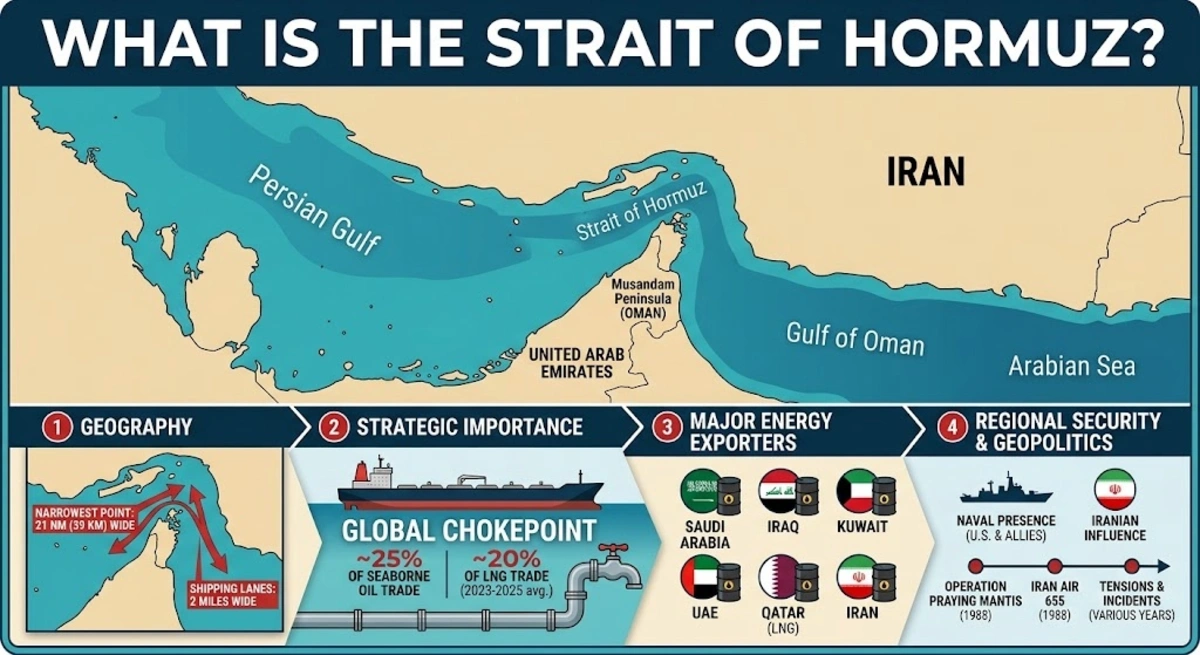
Located between Iran and the Arabian Peninsula, the Strait connects the Persian Gulf with the Gulf of Oman and the Arabian Sea. At its narrowest point, it is only about 21 nautical miles (39 kilometers) wide, with much narrower designated shipping channels. (IEA)
Its size is small compared with the global economy. Its importance is not.
The Strait of Hormuz is one of the world’s most important energy chokepoints because a huge volume of oil and LNG must pass through it to reach international markets. In 2025, around 20 million barrels per day of crude oil and petroleum products moved through the Strait, representing roughly one-quarter of global seaborne oil trade. (IEA)
That creates a powerful economic connection:
Persian Gulf energy → Strait of Hormuz → Global markets
When that connection is disrupted, the effects can travel far beyond the Middle East.
Why Is the Strait of Hormuz So Important?
Several major energy exporters are located around the Persian Gulf, including Saudi Arabia, Iraq, Kuwait, Iran, Qatar, the United Arab Emirates, and Bahrain.
For many of these countries, the Strait is the main route through which their energy exports reach international customers.
Saudi Arabia and the UAE have some alternative export infrastructure, but those routes cannot replace the full volume normally transported through Hormuz. Other producers depend even more heavily on the Strait. (IEA)
This is what makes Hormuz an energy chokepoint.
A chokepoint does not have to be completely closed to create economic problems. If a route normally carries enormous volumes but alternative routes can handle only a fraction of that traffic, even a partial disruption can tighten global supply and increase uncertainty.
That uncertainty can affect prices before a physical shortage becomes obvious.
Hormuz Is Also Critical for LNG
Oil receives most of the attention, but the Strait is equally important to global natural gas markets.
More than 110 billion cubic meters of LNG passed through Hormuz in 2025, representing almost one-fifth of global LNG trade. Almost 90% of LNG exported through the Strait was destined for Asia. (IEA)
Qatar is particularly important because it is one of the world’s largest LNG exporters, and most of its LNG exports must pass through Hormuz.
This means a disruption can affect not only gasoline and diesel prices, but also natural gas markets and electricity costs in importing countries.
The economic chain can become:
Hormuz disruption → tighter LNG supply → higher gas prices → higher energy costs → pressure on businesses and consumers
Unlike some oil exports, there are no simple alternative routes that can replace Qatar and UAE LNG volumes moving through the Strait. (IEA)
Why Asia Is Especially Exposed
One of the most important facts about Hormuz is where the energy goes.
About 80% of oil and oil products passing through the Strait in 2025 were destined for Asia. Around 90% of the LNG exported through the Strait also went to Asian markets. (IEA)
That makes major Asian energy importers particularly sensitive to disruptions.
Countries such as China, India, Japan, and South Korea can be affected through higher energy costs, tighter supply, and increased competition for alternative cargoes.
But the impact does not stop in Asia.
Oil and LNG are globally traded commodities. When a major supply route becomes uncertain, international prices can rise even in countries that do not directly import energy through Hormuz.
This is why a regional disruption can become a global economic event.
Why Oil Prices Can Rise Before Oil Actually Runs Out
Oil prices respond not only to current supply and demand but also to expectations about future supply.
Suppose traders believe that shipping through Hormuz could remain restricted for several weeks.
Even before a large physical shortage develops, buyers may become more aggressive, producers may adjust sales plans, and traders may add a geopolitical risk premium to prices.
That distinction matters.
A temporary risk premium can disappear if shipping normalizes and the threat declines.
A prolonged physical supply shortage is much more serious because it can force countries to draw down inventories and compete for alternative supplies.
Recent 2026 data demonstrate how significant the difference can be. EIA estimates show that oil flows through Hormuz averaged 21.6 million barrels per day in the fourth quarter of 2025, but fell to just 4.9 million barrels per day in the second quarter of 2026 during the disruption. (U.S. Energy Information Administration)
The result was not simply a change in shipping patterns. EIA reported that the disruption contributed to higher and more volatile crude oil prices during the second quarter. (U.S. Energy Information Administration)
Can Oil Simply Go Around the Strait?
Only partly.
Saudi Arabia and the UAE have infrastructure that can move some oil through alternative routes, reducing their dependence on Hormuz.
But these alternatives have limited capacity.
That leads to an important distinction:
Can some oil bypass Hormuz? Yes.
Can enough oil bypass Hormuz to completely replace normal flows? No.
This capacity constraint is one of the main reasons the Strait remains strategically important.
Alternative routes can reduce the size of a disruption, but they cannot instantly recreate the normal flow of more than 20 million barrels per day.
The alternatives can also be more expensive or take longer, which can add further pressure to global energy markets. EIA’s 2026 analysis notes that Saudi Arabia has used alternative routes, while constraints on Hormuz traffic have continued to affect regional production and trade flows. (U.S. Energy Information Administration)
How Hormuz Can Affect the World Economy
The biggest economic risk is not simply an increase in the price of crude oil.
Energy is an input into almost every modern economy.
Higher oil prices can increase:
- Transportation costs
- Shipping costs
- Airline fuel expenses
- Manufacturing costs
- Agricultural costs
- Petrochemical costs
- Consumer prices
For example, a trucking company facing higher diesel costs may eventually increase freight rates. A manufacturer paying more for transportation and energy may see its profit margin shrink or raise prices.
Those changes can then spread through supply chains.
Economic Reader’s How Does International Trade Work explains how transportation, suppliers, businesses, and consumers are connected through the global trading system.
This is why an energy shock can become a broader economic shock.
Why Hormuz Can Create Inflation Pressure
Higher energy prices can feed into inflation through both direct and indirect channels.
The direct effect is easy to see: gasoline, diesel, and other energy products become more expensive.
The indirect effect can be larger.
Businesses pay more to:
- Transport goods
- Operate machinery
- Heat or cool facilities
- Produce materials
- Move products between countries
Those higher costs can eventually reach consumers.
Economic Reader’s What Is Inflation? explains how rising prices reduce purchasing power and affect household finances.
This creates a wider economic problem because consumers facing higher fuel and food costs have less money available for discretionary spending.
Why Central Banks Pay Attention to Oil Prices
A prolonged oil shock can create a difficult problem for central banks.
Higher energy prices can push inflation higher at the same time that expensive fuel and transportation weaken consumer purchasing power and business activity.
In other words:
Higher oil prices → higher inflation
but also:
Higher oil prices → higher costs → weaker demand
That combination can create stagflationary pressure.
For a central bank, this is difficult because higher interest rates cannot produce more oil or reopen a shipping route.
Policymakers may still need to respond if an energy shock causes inflation expectations to rise or begins spreading into broader prices.
This is why geopolitical developments around Hormuz can become relevant to interest-rate expectations and financial markets.
Economic Reader’s Historical Fed Decisions provides additional context on how monetary policy can respond to very different economic shocks.
What Happens When Hormuz Is Disrupted?
The economic impact depends heavily on the severity and duration of the disruption.
A short disruption may mainly create:
- Higher oil prices
- Higher shipping and insurance costs
- Greater market volatility
- Higher LNG prices
- Temporary inflation pressure
A prolonged disruption is more serious.
Countries may begin drawing down inventories, energy importers may compete for alternative supplies, and producers outside the region may struggle to replace the missing volumes quickly.
Businesses may also change purchasing and inventory strategies.
The longer the disruption continues, the more likely an initial energy shock becomes a broader economic problem.
This is particularly important in 2026 because EIA’s September outlook assumes that constraints on Hormuz traffic will continue through the fourth quarter, leaving some Middle Eastern oil production below pre-conflict levels into 2027. (U.S. Energy Information Administration)
Why Hormuz Matters to Businesses and Investors
Investors do not need to own oil futures to be affected by events in the Strait.
Different businesses experience an energy shock differently.
An oil producer may benefit from higher crude prices.
An airline may face significantly higher operating costs.
A shipping company may benefit from stronger freight demand but face higher fuel and insurance expenses.
A manufacturer may see its margins squeezed if it cannot pass higher costs to customers.
A consumer company may face weaker demand if households spend more of their income on fuel and utilities.
This is why investors should look beyond the headline:
“Oil prices are rising.”
The more useful question is:
“Who benefits from higher energy prices, who absorbs the cost, and how long can the shock last?”
That distinction can matter more for individual companies than the oil price itself.
Why the Strait of Hormuz Matters to the Global Economy
The importance of Hormuz comes down to one basic problem:
A very large amount of global energy trade depends on a route with limited alternatives.
The Strait is geographically small, but its economic role is enormous.
It connects major energy producers with some of the world’s largest energy consumers. It also connects regional production with global oil and LNG prices.
When the Strait operates normally, most consumers never think about it.
When flows are disrupted, the connection becomes visible through higher fuel prices, shipping costs, business expenses, inflation expectations, and financial-market volatility.
That is what makes an economic chokepoint different from an ordinary shipping route.
Hormuz does not have to remain completely closed to matter. A significant reduction in traffic can be enough to change expectations about supply, push up energy prices, alter shipping patterns, and force businesses and governments to adjust.
For investors, the key lesson is that the Strait of Hormuz is not simply a geopolitical issue.
It is part of the infrastructure of the global economy.
As long as the world remains heavily dependent on Persian Gulf oil and LNG, developments around this narrow waterway will continue to influence energy markets, international trade, inflation, corporate costs, and economic policy far beyond the Middle East.