Why Is the IMF Facing Challenges Today? Problems and Criticism of the International Monetary Fund
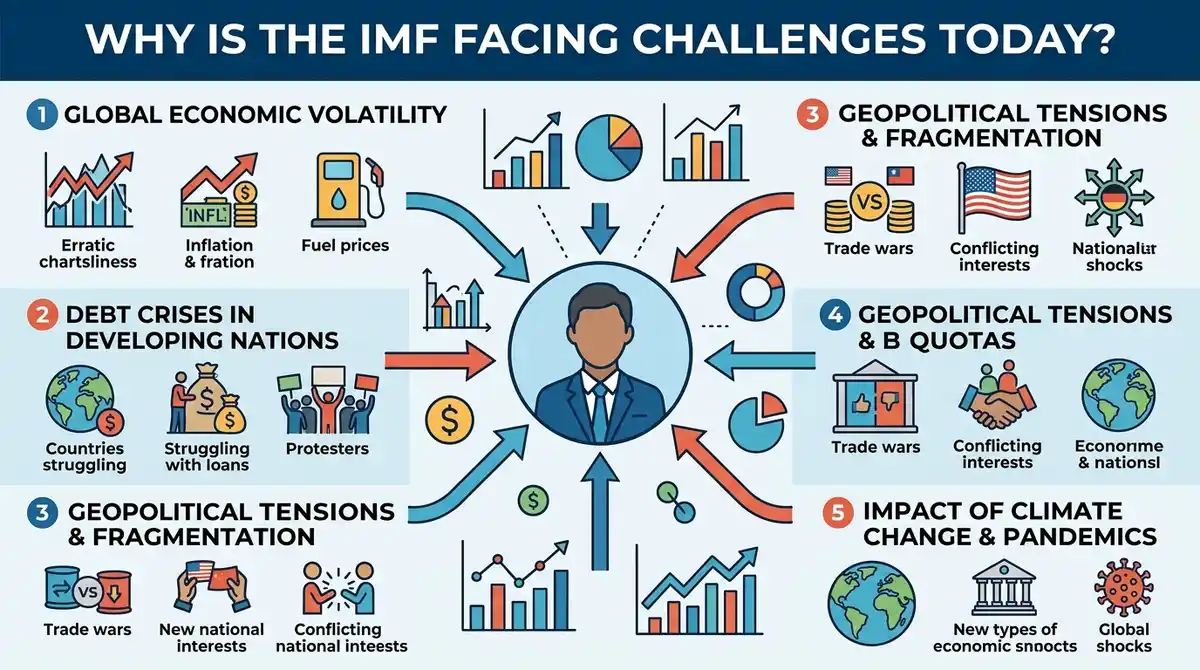
Why Is the IMF Facing Challenges Today?
The International Monetary Fund (IMF) was created to help countries maintain economic and financial stability, particularly when they face serious balance-of-payments problems or lose access to international financing.
That role has not disappeared. If anything, it has become more important as countries face high debt, expensive borrowing, geopolitical conflicts, trade disruptions, energy shocks, and increasingly volatile financial conditions.
But the IMF is also facing a difficult question: Can an institution designed for a different global economy adapt quickly enough to the problems of today?
The criticism surrounding the IMF is not limited to one issue. Some concerns involve the conditions attached to IMF loans. Others focus on austerity, debt restructuring, borrowing costs, representation, climate policy, and the institution’s ability to operate in an increasingly divided global economy.
At the same time, the IMF has changed some of its policies in response to these criticisms.
That makes the debate more complicated than simply asking whether the IMF helps or hurts countries.
The more useful question is whether the IMF can maintain the financial discipline that makes its lending credible while becoming more flexible, representative, and effective in a much more complicated economic environment.
Why Is the IMF Important?
The IMF provides financial assistance to countries experiencing external financing problems.
A country can run short of foreign currency for many reasons. It may have large external debts, falling exports, capital outflows, a sharp increase in energy costs, a currency crisis, or a loss of investor confidence.
Once foreign-exchange reserves become insufficient, the government may struggle to pay for essential imports or service external debt.
An IMF program can provide financing while giving the country time to implement policies intended to restore economic stability.
The IMF also conducts economic surveillance, provides technical assistance, and advises governments on macroeconomic and financial policies. Its official overview of IMF lending explains how the Fund provides different types of financial support to member countries.
Its role is therefore broader than simply lending money.
But lending is where many of the institution’s most controversial decisions arise.
1. IMF Loan Conditions Remain a Major Source of Criticism
IMF loans usually come with conditionality.
In simple terms, a country receiving IMF financing may need to implement specific economic policies before receiving funds or additional disbursements.
The reasoning is straightforward.
If a country has a large fiscal deficit, weak foreign-exchange reserves, or an unsustainable debt position, providing financing without addressing the underlying problem may only postpone the crisis.
But conditionality becomes controversial when the required reforms impose significant economic costs.
Governments may have to raise taxes, reduce subsidies, control public spending, reform state-owned enterprises, change exchange-rate policies, or strengthen financial-sector regulations.
Critics argue that these measures can sometimes be too aggressive, particularly when an economy is already experiencing recession, unemployment, or falling household incomes.
The IMF has been reviewing this issue itself. Its 2026 Review of Program Design and Conditionality is the first major review since the COVID-19 pandemic and is intended to assess whether IMF-supported programs remain appropriate in a much more uncertain international environment. (IMF’s 2026 Review of Program Design and Conditionality)
That is an important distinction.
The debate is not simply whether IMF conditions should exist. It is whether they are appropriately designed, realistically timed, and sufficiently tailored to the country receiving assistance.
2. The Austerity Debate Is Really About Timing and Trade Offs
A related criticism concerns austerity.
When a government has an unsustainable deficit, reducing spending or increasing revenue can be necessary to restore fiscal credibility.
But fiscal adjustment can also weaken economic activity in the short term.
Imagine a country already experiencing a recession. If the government cuts spending sharply and raises taxes at the same time, households may have less disposable income and businesses may face weaker demand.
That can make the downturn worse.
On the other hand, refusing to address a large fiscal deficit can cause borrowing costs to rise, increase debt-service payments, weaken the currency, and eventually force an even more painful adjustment.
This is the difficult trade-off.
Too little adjustment can create a larger crisis later. Too much adjustment too quickly can damage the economy today.
There is no single fiscal formula that works equally well for every country.
A country with strong institutions, substantial reserves, and access to international capital markets has more room to maneuver than one facing a currency crisis and severe foreign-exchange shortages.
This is why the quality of IMF program design matters as much as the existence of conditionality itself.
3. Global Debt Is Making the IMF’s Job Harder
The IMF is operating in a world with historically high public debt.
Its April 2026 Fiscal Monitor estimated that global public debt rose to just under 94% of GDP in 2025 and could reach 100% of GDP by 2029. The IMF said rising interest burdens and spending pressures on areas such as social needs, defense, and strategic autonomy are putting additional strain on public finances. (IMF Fiscal Monitor)
This creates a fundamental challenge.
The IMF can provide financing to countries experiencing financial stress, but it cannot solve a global debt problem simply by providing more loans.
If a country’s debt is fundamentally unsustainable, additional borrowing may only delay the adjustment.
That is where debt restructuring becomes important.
Yet restructuring sovereign debt can be extremely complicated because a country’s creditors may include commercial banks, bondholders, governments, China and other bilateral lenders, and multilateral institutions.
Getting all of them to agree on how the losses should be distributed can take considerable time.
During that period, the country may remain under severe economic pressure.
The IMF can analyze debt sustainability and provide financing, but it cannot independently force every creditor to accept identical restructuring terms.
This limits what the institution can accomplish on its own.
4. IMF Borrowing Costs Have Also Attracted Criticism
Another issue is the cost of IMF financing.
IMF lending is not necessarily free. Some borrowers can face charges and, when borrowing is particularly large or prolonged, additional surcharges.
The IMF argues that these charges are part of its financial risk-management framework. They help cover lending costs, build precautionary reserves, and encourage countries to use Fund resources prudently and temporarily. The Fund explains the structure in its charges and surcharge policy.
Critics, however, argue that surcharges can become especially difficult for countries that are already struggling with high debt.
The IMF responded to these concerns in 2024.
It reduced the margin on its basic lending rate, raised the threshold at which level-based surcharges apply, reduced the rate on time-based surcharges, and introduced more regular reviews. The reforms were expected to reduce IMF borrowing costs by about $1.2 billion annually, or roughly 36% in the relevant payments. (IMF review of charges and surcharge policy)
This is an important example of how criticism has influenced IMF policy.
The institution has not eliminated the surcharge system, because it argues that charges are necessary to protect the IMF’s financial strength.
But it has reduced the burden.
The continuing question is whether further changes will be necessary if global interest rates and sovereign debt pressures remain elevated.
5. Representation Inside the IMF Is Still Controversial
The IMF’s governance structure is another longstanding source of criticism.
Voting power is linked largely to members’ quotas, which also play an important role in determining their financial contributions and access to IMF resources.
The current voting structure gives the United States 16.49% of total IMF voting power, compared with 6.14% for Japan and 6.08% for China, according to IMF data updated September 11, 2026. (IMF Executive Board voting power)
The underlying issue is that the global economy has changed substantially since the IMF was established.
Emerging economies now account for a much larger share of global economic activity, trade, and investment than they did in the middle of the twentieth century.
Yet many developing and emerging economies argue that their influence within major international financial institutions has not increased enough to reflect their economic importance.
This creates a difficult political problem.
Increasing the voting share of one group of countries necessarily changes the relative influence of others.
As a result, IMF governance reform is not simply an economic calculation. It is also a negotiation over power.
6. Geopolitical Fragmentation Is Testing the IMF’s Original Mission
The IMF was built around international economic cooperation.
Today, that cooperation is under pressure.
Trade disputes, military conflicts, sanctions, energy disruptions, supply-chain changes, and strategic competition between major powers are making the global economy more fragmented.
The IMF’s April 2026 World Economic Outlook identified geopolitical fragmentation, renewed trade tensions, high public debt, and tighter financial conditions among the major downside risks facing the global economy. (IMF World Economic Outlook)
For a broader explanation of how international economic connections work, see Economic Reader’s How Does International Trade Work?
This matters because economic crises do not respect geopolitical boundaries.
A war can increase energy prices.
Higher energy prices can increase inflation.
Higher inflation can keep interest rates elevated.
Higher interest rates can increase government debt-service costs.
Higher debt-service costs can weaken fiscal positions in countries that were already financially vulnerable.
The IMF may be asked to respond to the consequences even when the original shock is geopolitical rather than purely economic.
That makes international cooperation more important but also harder to achieve.
7. Climate Change Has Expanded the IMF’s Responsibilities
Climate change presents another complicated issue.
The IMF is not primarily a climate institution. Its core responsibilities remain monetary, fiscal, external, and financial stability.
Yet climate-related events can directly affect those areas.
Floods, droughts, storms, and rising temperatures can damage infrastructure, reduce agricultural production, weaken government revenues, increase public spending, and affect financial institutions.
That gives the IMF a legitimate economic reason to analyze climate risks.
The institution has therefore expanded its climate-related work.
A 2026 Independent Evaluation Office assessment found that the IMF’s climate work had provided substantial value, while also identifying areas where the institution could improve implementation, coordination, and resource use. IMF directors broadly supported continued engagement while emphasizing the need for clearer implementation and attention to resource constraints. (IMF policy paper on the climate change evaluation)
This creates a different kind of criticism.
Some observers argue that climate change is clearly relevant to macroeconomic stability and therefore belongs within the IMF’s work.
Others worry that expanding the IMF’s mandate too far could divert resources from its core responsibilities.
The challenge is finding the boundary between economic risks created by climate change and policies that are better handled by other international institutions.
8. The IMF Must Handle More Complex Crises
The nature of economic crises has changed.
A modern crisis rarely fits into one category.
A country can face capital outflows, currency depreciation, high inflation, expensive energy imports, rising government debt, and banking-sector stress at the same time.
One problem can amplify another.
For example, a weaker currency can increase the local cost of foreign debt. Higher debt costs can weaken government finances. Fiscal uncertainty can reduce investor confidence, leading to further capital outflows.
This interconnectedness makes crisis management much harder.
The IMF therefore needs increasingly sophisticated economic models, financial-sector analysis, real-time data, and a strong understanding of international capital markets.
Its challenge is not simply providing enough money.
It is identifying which problem is causing the crisis, which problems are consequences, and which policies can address both without creating new vulnerabilities.
Is the IMF Still Necessary?
Despite these criticisms, it would be difficult to argue that the IMF has become unnecessary.
When a country suddenly loses access to international financing, private investors may not be willing to provide emergency funds.
Foreign-exchange reserves can disappear quickly.
Imports can become difficult to finance.
The currency can come under severe pressure.
Banks and businesses can struggle to obtain foreign currency.
In such circumstances, an IMF program can provide financing and a framework for restoring economic stability.
The IMF also provides economic surveillance, technical assistance, and policy analysis that many countries cannot easily replicate on their own.
Its importance is therefore closely connected to the existence of financial crises themselves.
As long as countries can face severe external financing problems, there will be a need for some form of international financial safety net.
The debate is about how that safety net should operate.
What Should Change at the IMF?
The most important reforms are not necessarily about making the IMF larger.
They are about making it more adaptable.
Conditionality should remain focused and country-specific. Policies should address the causes of a crisis without imposing unnecessary adjustment costs.
Debt restructuring should become more predictable. Countries should not remain trapped for years between debt-service obligations and negotiations with multiple creditor groups.
Lending costs should remain compatible with debt sustainability. The 2024 surcharge reforms were significant, but borrowing costs will remain an important issue when countries are already under financial stress.
Governance should better reflect the modern world economy. Emerging and developing countries need meaningful representation while the IMF maintains the financial strength necessary to respond to crises.
The institution should keep its mandate focused. Climate change, financial instability, geopolitical fragmentation, and other issues matter, but the IMF must prioritize areas where its macroeconomic expertise provides the greatest value.
These changes would not eliminate every criticism.
They would, however, make the institution better equipped for the environment in which it now operates.
The Bigger Problem Facing the IMF
The IMF’s biggest challenge is not any single policy.
It is the growing complexity of the global economy.
The institution is being asked to help countries navigate high debt, expensive financing, inflation, currency instability, wars, energy shocks, trade disruptions, climate risks, and fragmented international relations.
Many of these problems can occur simultaneously.
At the same time, the IMF itself depends on cooperation among its member countries. It cannot completely redesign its governance, lending rules, or mandate without agreement from the governments that control the institution.
That is why the IMF debate should not be reduced to “IMF good” versus “IMF bad.”
The institution can provide essential financing when a country is facing a severe crisis. Its programs can help restore confidence and create a path toward economic stability.
But the conditions attached to that assistance can also create real social and economic costs if adjustment is poorly designed or badly timed.
The IMF has already responded to some of these concerns. Its review of program design and conditionality, reforms to lending charges, and continuing evaluation of its climate-related work show that the institution is adapting rather than standing still.
For readers who want to understand how monetary-policy decisions can interact with economic conditions and financial markets, Economic Reader’s FOMC Meeting Explained provides useful background. For the broader effects of rising prices and inflation on economies and households, see What Is Inflation?
The real test is whether those reforms can keep pace with the changing global economy.
The IMF was created for a world where international economic cooperation was seen as essential to financial stability. That principle has not become less relevant.
If anything, today’s combination of high debt, geopolitical conflict, financial integration, and economic fragmentation makes cooperation more important.
The question is whether the IMF can remain credible enough to enforce financial discipline, flexible enough to respond to very different national circumstances, and representative enough for its members to continue seeing it as a legitimate part of the global financial system.
That will determine whether the IMF can meet the next generation of economic crises as effectively as it handled those of the past.