
What Is a Trade Surplus? A Complete Beginner’s Guide to Understanding Trade Surplus
Introduction
Countries around the world participate in international trade by buying and selling goods and services. To better understand how foreign trade affects a country’s economy, it is important to learn what is a trade surplus and how it influences global business.
Some countries import more products than they export, creating a trade deficit.
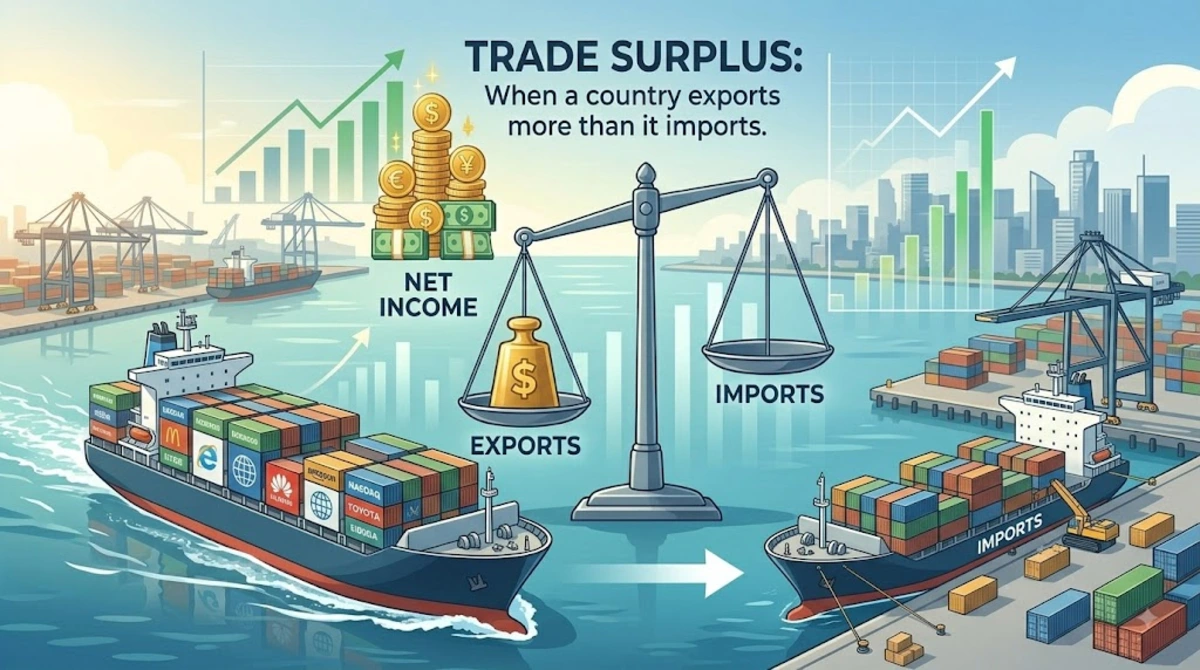
Other countries export more products than they import, creating a trade surplus.
A trade surplus is often associated with strong export industries, competitive businesses, and international demand for a country’s products.
However, like trade deficits, trade surpluses have both advantages and challenges.
The simple explanation is:
A trade surplus occurs when a country sells more goods and services to other countries than it buys from them.
What Is a Trade Surplus?
A trade surplus happens when:
Exports > Imports
This means the value of products and services a country sells internationally is greater than the value of products and services it purchases from foreign countries.
Example:
A country exports:
- $700 billion worth of goods and services
and imports:
- $500 billion worth of goods and services
The difference is:
$700 billion − $500 billion = $200 billion trade surplus
The country has a $200 billion trade surplus.
What Is International Trade?
International trade is the exchange of goods and services between countries.
It includes:
Products and services sold to foreign customers.
Examples:
- Cars
- Electronics
- Software
- Agricultural products
Products and services purchased from foreign countries.
Examples:
- Oil
- Machinery
- Food
- Consumer goods
Understanding Trade Balance
The trade balance measures the difference between exports and imports.
The formula is:
Trade Balance = Exports − Imports
There are two possible outcomes.
Trade Surplus
When:
Exports > Imports
The country sells more internationally than it buys.
Trade Deficit
When:
Imports > Exports
The country buys more from other countries than it sells.
How Is a Trade Surplus Calculated?
Example:
A country’s annual trade data:
Exports = $900 billion
Imports = $650 billion
Calculation:
$900 billion − $650 billion = $250 billion
The country has a:
$250 billion trade surplus
How Do Countries Create Trade Surpluses?
Countries achieve trade surpluses through several factors.
1. Strong Export Industries
Countries with competitive industries can sell more products internationally.
Examples:
- Advanced manufacturing
- Technology
- Energy
- Agriculture
Strong export industries create global demand.
2. Competitive Production Costs
Countries that produce goods efficiently can compete internationally.
Advantages may include:
- Skilled workers
- Advanced technology
- Efficient infrastructure
- Lower production costs
This helps businesses sell products globally.
3. High Global Demand
A country can achieve a trade surplus when other countries strongly want its products.
Example:
If global demand for a country’s technology products increases, exports may rise significantly.
4. Specialization
Countries often focus on industries where they have advantages.
Examples:
- Germany → Industrial machinery and vehicles
- Japan → Technology and automobiles
- Some countries → Energy exports
Specialization improves export performance.
5. Currency Competitiveness
Currency values can influence trade.
A relatively weaker currency may make exports cheaper for foreign buyers.
This can increase international demand.
However, currency values depend on many factors.
Why Do Countries Export More Than They Import?
Countries may have trade surpluses because:
They Produce High-Value Products
Advanced industries can create products with strong global demand.
They Have Strong Manufacturing Capacity
Countries with efficient factories can produce large quantities for international markets.
They Have Valuable Natural Resources
Resource-rich countries may export:
- Oil
- Gas
- Minerals
Their Companies Are Globally Competitive
Successful companies can sell products worldwide.
Benefits of Trade Surplus
A trade surplus can provide several economic benefits.
1. Economic Growth
Exports contribute to economic activity.
When companies sell more internationally:
- Production increases
- Businesses expand
- GDP may increase
2. More Foreign Currency
Export earnings bring foreign currencies into an economy.
This can help countries:
- Pay for imports
- Support financial stability
- Increase foreign reserves
3. Stronger Businesses
Export-focused companies often become:
- More competitive
- More innovative
- More efficient
International markets encourage improvement.
4. Job Creation
Export industries create employment opportunities.
Jobs can grow in:
- Manufacturing
- Transportation
- Technology
- Agriculture
- Logistics
5. Increased Investment
Successful export economies often attract foreign investment.
Investors may invest in:
- Factories
- Infrastructure
- Businesses
How Trade Surplus Affects GDP
Exports are included in GDP calculations.
The formula is:
GDP = Consumer Spending + Investment + Government Spending + Net Exports
Where:
Net Exports = Exports − Imports
When exports are higher than imports:
- Net exports become positive.
- GDP receives a positive contribution.
However, GDP growth depends on many other factors as well.
How Trade Surplus Affects Currency Value
A trade surplus can increase demand for a country’s currency.
Why?
Foreign buyers need the country’s currency to purchase its products.
Higher demand may strengthen the currency.
However, exchange rates are also affected by:
- Interest rates
- Inflation
- Investor confidence
- Government policies
How Trade Surplus Affects Businesses
Export businesses often benefit from trade surpluses.
Benefits include:
- Larger markets
- Higher sales opportunities
- More investment
- Business expansion
However, companies must continue competing globally.
How Trade Surplus Affects Consumers
Trade surpluses can have mixed effects on consumers.
Possible benefits:
- More employment opportunities
- Stronger industries
- Economic stability
Possible challenges:
- Heavy export focus may reduce attention on domestic consumption.
- Currency appreciation may make exports more expensive.
Trade Surplus vs Trade Deficit
| Trade Surplus | Trade Deficit |
| Exports exceed imports | Imports exceed exports |
| More foreign income enters. | More money spent on foreign goods |
| Strong export industries | Strong import demand |
| Can support economic growth | Can provide cheaper products |
Real-World Examples of Trade Surplus
Germany
Germany is known for its strong export economy.
Major exports include:
- Automobiles
- Industrial machinery
- Chemical products
Its manufacturing sector has helped create strong international demand.
China
China became a major global exporter through:
- Manufacturing
- Global supply chains
- Large-scale production
Major exports include:
- Electronics
- Machinery
- Consumer goods
Japan
Japan has historically achieved strong export performance through:
- Automobiles
- Electronics
- Advanced technology
Japanese companies became globally recognized brands.
Export-Led Economic Growth Explained
Some countries use exports as a major growth strategy.
The process works like this:
More Exports → More Production → More Jobs → Higher Income → Economic Growth
Export-led growth focuses on:
- International competitiveness
- Manufacturing development
- Global market expansion
Potential Problems of Trade Surplus
Although trade surpluses provide benefits, they can also create challenges.
1. Overdependence on Exports
Countries that rely heavily on exports may become vulnerable to global demand changes.
Example:
If foreign demand falls, export industries may slow down.
2. Lower Domestic Consumption
An economy focused heavily on exports may have weaker domestic consumer spending.
Balanced growth usually requires both:
- Export strength
- Domestic demand
3. Trade Conflicts
Large trade surpluses can create tensions between countries.
Other countries may argue that trade relationships are unfair.
This can lead to:
- Tariffs
- Trade restrictions
- Negotiations
4. Currency Pressure
Large export surpluses can increase demand for a country’s currency.
A stronger currency may make exports more expensive internationally.
How Governments Support Trade Surpluses
Governments may encourage exports through:
1. Investing in Infrastructure
Better:
- Roads
- Ports
- Technology systems
help businesses trade internationally.
2. Supporting Innovation
Technology investment improves competitiveness.
3. Trade Agreements
Countries create agreements to improve market access.
4. Developing Skilled Workers
Education and training help create competitive industries.
Trade Surplus vs Current Account Surplus
These concepts are related but different.
| Trade Surplus | Current Account Surplus |
| Focuses on goods and services trade | Includes trade plus other international payments |
| Narrower measurement | Broader economic measurement |
A country can have a trade surplus but still have other financial outflows.
Future of Global Trade Balance
Global trade is changing because of:
Digital Services
Countries increasingly export:
- Software
- Online services
- Digital products
AI may improve:
- Production efficiency
- Global logistics
- Business competitiveness
Sustainable Trade
Future exports may focus on:
- Renewable energy
- Green technology
- Sustainable products
Frequently Asked Questions (FAQ)
1. What is a trade surplus in simple words?
A trade surplus happens when a country exports more goods and services than it imports.
2. Is a trade surplus always good?
A trade surplus can provide benefits, but excessive dependence on exports can create risks.
3. What causes a trade surplus?
Strong industries, competitive production, global demand, and specialization can create trade surpluses.
4. What is the difference between trade surplus and trade deficit?
A trade surplus means exports are higher than imports, while a trade deficit means imports are higher than exports.
5. Which countries often have trade surpluses?
Countries such as Germany, China, and Japan have historically experienced periods of significant trade surpluses.
Final Thoughts
A trade surplus is an important concept in understanding global trade and economic development.
It occurs when a country sells more goods and services internationally than it purchases.
Trade surpluses can support:
- Economic growth
- Business expansion
- Job creation
- Foreign investment
However, countries need a balanced economy that includes strong exports, healthy domestic demand, and sustainable growth.
Understanding trade surpluses helps investors, entrepreneurs, and consumers better understand how global economies compete and grow.
If you want to learn what ESG investing is, read our full guide; click here
Author Note: This article is crafted by “The Economic Reader editorial team”, dedicated to analyzing the latest market trends, financial updates, and global economic shifts to keep you informed with accurate and comprehensive insights.
Disclaimer: The information provided on this website is for educational and informational purposes only and should not be construed as professional financial, investment, or legal advice. Always consult with a certified financial advisor or professional before making any financial decisions based on this content.