
What Is Supply? A Beginner’s Guide to Meaning, Law of Supply, Factors, Types, and Importance
Introduction
What Is Supply and why is it so important? Supply is one of the most essential concepts in economics that plays a major role in determining how markets work.
Every product we buy exists because businesses and producers decide how much they are willing and able to provide.
From smartphones and cars to food and services, supply influences:
- Product availability
- Market prices
- Business decisions
- Economic activity
Businesses constantly analyze supply because producing too much or too little can affect profitability.
For example:
- If a company produces too many products, it may face excess inventory.
- If supply is too low, prices may increase, and customers may look for alternatives.
The simple idea is:
Supply refers to the amount of a good or service that producers are willing and able to offer for sale at different prices during a specific period of time.
In this guide, we will explain what supply is, how it works, the law of supply, factors affecting supply, types of supply, and why supply is important for businesses and economies.
What Is Supply?
Supply is the quantity of a product or service that sellers are willing and able to provide to the market at a specific price and time.
In simple words:
Supply means how much businesses are ready to produce and sell.
Examples:
- A farmer supplies crops to markets.
- A manufacturer supplies electronic products.
- A software company supplies digital services.
How Does Supply Work?
Supply is created when producers make decisions about production and sales.
Businesses consider:
- Production costs
- Customer demand
- Market prices
- Available resources
- Future expectations
Example:
If the price of electric vehicles increases and companies can earn higher profits, manufacturers may increase production.
This creates higher supply.
The Law of Supply
The Law of Supply is a basic principle in economics.
It states:
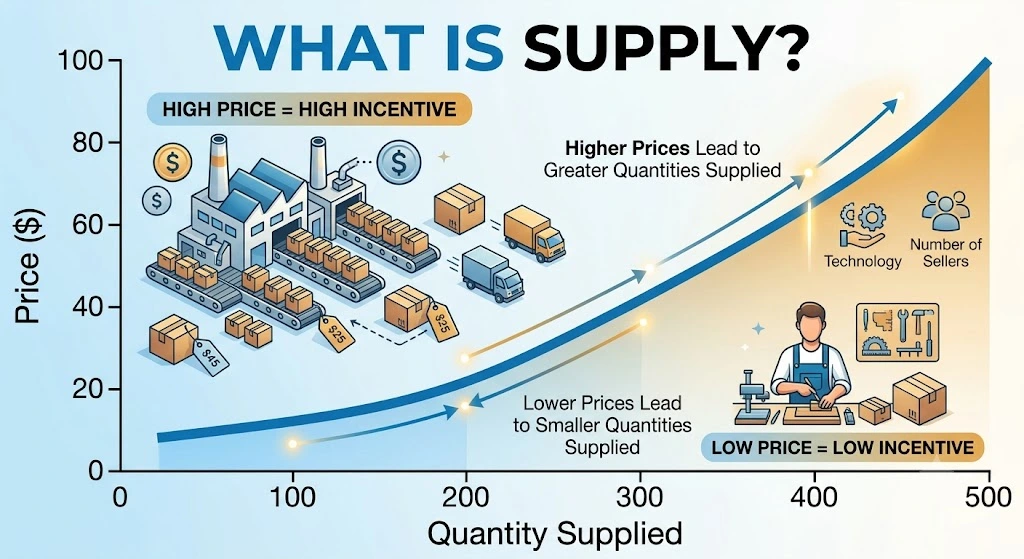
When the price of a product increases, producers usually supply more of that product. When the price decreases, producers usually supply less, assuming other factors remain unchanged.
In simple words:
Higher price → Higher supply
Lower price → Lower supply
Example of the Law of Supply
Imagine farmers growing coffee.
If coffee prices increase:
- Farmers can earn more profit.
- More farmers may grow coffee.
- Production may increase.
As a result, supply rises.
Supply Curve Explained
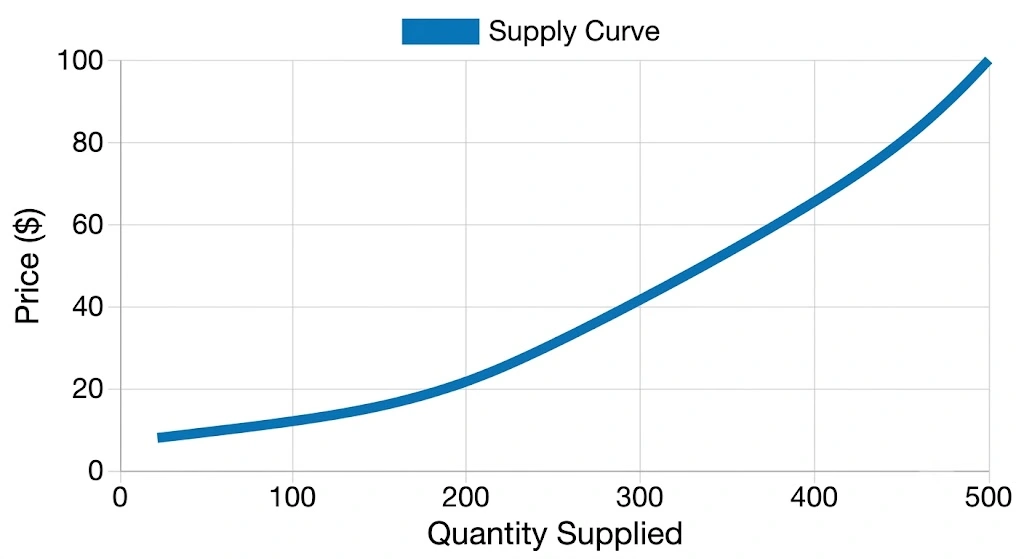
A supply curve shows the relationship between price and quantity supplied.
Generally:
- Price is shown on the vertical axis.
- Quantity supplied is shown on the horizontal axis.
The supply curve usually slopes upward because producers are encouraged to supply more when prices increase.
Factors That Affect Supply
Supply is influenced by several factors beyond price.
1. Price of the Product
The selling price strongly affects supply decisions.
When prices increase:
- Businesses may produce more.
- Profit opportunities increase.
When prices decrease:
- Businesses may reduce production.
2. Production Costs
The cost of producing goods affects supply.
Production costs include:
- Raw materials
- Labor costs
- Energy expenses
- Transportation costs
Example:
If fuel prices increase, transportation costs rise, which may reduce supply.
3. Technology
Technology can improve production efficiency.
Better technology allows businesses to:
- Produce more goods
- Reduce costs
- Improve quality
Example:
Automation can help factories increase production.
4. Number of Sellers
The number of businesses in a market affects total supply.
More sellers usually mean:
- Greater market supply
- More competition
Example:
If many companies enter the smartphone market, the supply of smartphones increases.
5. Government Policies
Government decisions can influence supply.
Examples:
- Taxes
- Subsidies
- Regulations
A tax increase may increase production costs and reduce supply.
A subsidy may encourage businesses to produce more.
6. Availability of Resources
Businesses need resources to produce goods.
Resources include:
- Raw materials
- Labor
- Land
- Capital
Limited resources can reduce supply.
7. Producer Expectations
Businesses consider future market conditions.
Example:
If companies expect prices to rise in the future, they may reduce current supply and store inventory.
Types of Supply
Economists classify supply into different categories.
1. Individual Supply
Individual supply refers to the amount supplied by one producer.
Example:
One farmer’s supply of rice.
2. Market Supply
Market supply refers to the total supply from all producers in a market.
Example:
The total supply of smartphones from all companies.
3. Short-Term Supply
Short-term supply refers to supply that can change quickly.
Examples:
- Restaurant meals
- Retail products
4. Long-Term Supply
Long-term supply involves changes that require more time.
Examples:
- Building factories
- Expanding production capacity
Supply vs Demand
Supply and demand work together to determine market outcomes.
| Supply | Demand |
| Represents sellers | Represents buyers |
| Shows willingness to produce | Shows willingness to purchase |
| Influenced by production factors | Influenced by consumer behavior |
| Affects product availability | Affects purchasing decisions |
Markets work through the interaction between supply and demand.
Change in Supply vs Change in Quantity Supplied
These concepts are different.
Change in Quantity Supplied
This happens because the product price changes.
Example:
A higher price encourages producers to supply more.
Change in Supply
This happens because other factors change.
Examples:
- Technology improvement
- Lower production costs
- Government policies
Example:
A new manufacturing technology increases production capacity.
How Supply Affects Prices
Supply plays a major role in price determination.
High Supply
When supply is high:
- Products become more available.
- Competition may increase.
- Prices may decrease.
Example:
A large harvest can reduce food prices.
Low Supply
When supply is limited:
- Products become harder to find.
- Prices may increase.
Example:
A shortage of oil can increase energy prices.
Importance of Supply for Businesses
Businesses depend on supply management.
1. Production Planning
Supply analysis helps businesses decide:
- How much to produce
- When to produce
- How many resources are needed
2. Inventory Management
Companies need to balance inventory levels.
Too much inventory:
- Increases storage costs.
Too little inventory:
- Can lead to missed sales opportunities.
3. Pricing Decisions
Supply conditions influence pricing strategies.
Companies analyze:
- Production costs
- Competitor supply
- Market availability
4. Business Expansion Decisions
Businesses study supply before expanding.
They consider:
- Resource availability
- Production capacity
- Market opportunities
Importance of Supply in the Economy
Supply affects the entire economy.
1. Determines Market Availability
Supply ensures products and services are available to consumers.
2. Influences Inflation
Low supply combined with strong demand can cause prices to rise.
Example:
Supply shortages of energy or food can increase inflation.
3. Supports Economic Growth
Higher production capacity can contribute to economic expansion.
Businesses producing more goods and services increase economic activity.
4. Creates Employment
When companies increase production, they often need more workers.
Real-Life Examples of Supply
Example 1: Oil Market
If oil production decreases:
- Global supply falls.
- Energy prices may increase.
Example 2: Food Production
If a country experiences a poor harvest:
- Food supply decreases.
- Prices may rise.
Example 3: Technology Products
When companies improve manufacturing capacity:
- Product supply increases.
- Availability improves.
Common Supply Management Mistakes
1. Producing Without Understanding Demand
Businesses may create excess inventory if they ignore customer needs.
2. Poor Resource Management
Inefficient use of resources can increase costs.
3. Ignoring Market Changes
Supply decisions must adapt to:
- Consumer trends
- Technology changes
- Competition
4. Overdependence on One Supplier
Businesses may face problems if they rely on a single source for important materials.
Frequently Asked Questions (FAQ)
1. What is supply in simple words?
Supply is the amount of a product or service producers are willing and able to sell at a certain price.
2. What is the law of supply?
The law of supply states that producers usually supply more when prices increase and less when prices decrease.
3. What factors affect supply?
Production costs, technology, government policies, resources, number of sellers, and expectations affect supply.
4. Why is supply important?
Supply affects prices, product availability, business decisions, and economic activity.
5. What is the difference between supply and demand?
Supply represents sellers and production, while demand represents buyers and purchasing decisions.
Final Thoughts
Supply is a fundamental economic concept that explains how businesses decide what to produce and how much to sell.
It influences:
- Prices
- Market competition
- Business strategies
- Economic stability
A strong understanding of supply helps entrepreneurs, investors, and consumers better understand how markets operate.
Together with demand, supply creates the foundation of market economics.
Understanding supply and demand allows businesses to make smarter decisions and helps individuals understand why prices change over time.
If you want to know What Is Demand, read our full Article; click here.
If you want to know What Is the Federal Reserve is, read our full Article; click here.
If you want to know the USA Economy New Trends 2026, read our full Article; click here.
Author Note: This article is crafted by “The Economic Reader editorial team”, dedicated to analyzing the latest market trends, financial updates, and global economic shifts to keep you informed with accurate and comprehensive insights.
Disclaimer: The information provided on this website is for educational and informational purposes only and should not be construed as professional financial, investment, or legal advice. Always consult with a certified financial advisor or professional before making any financial decisions based on this content.