Federal Reserve Raises Interest Rates After Three Years: What It Means for the U.S. Economy
Federal Reserve Raises Interest Rates After Three Years
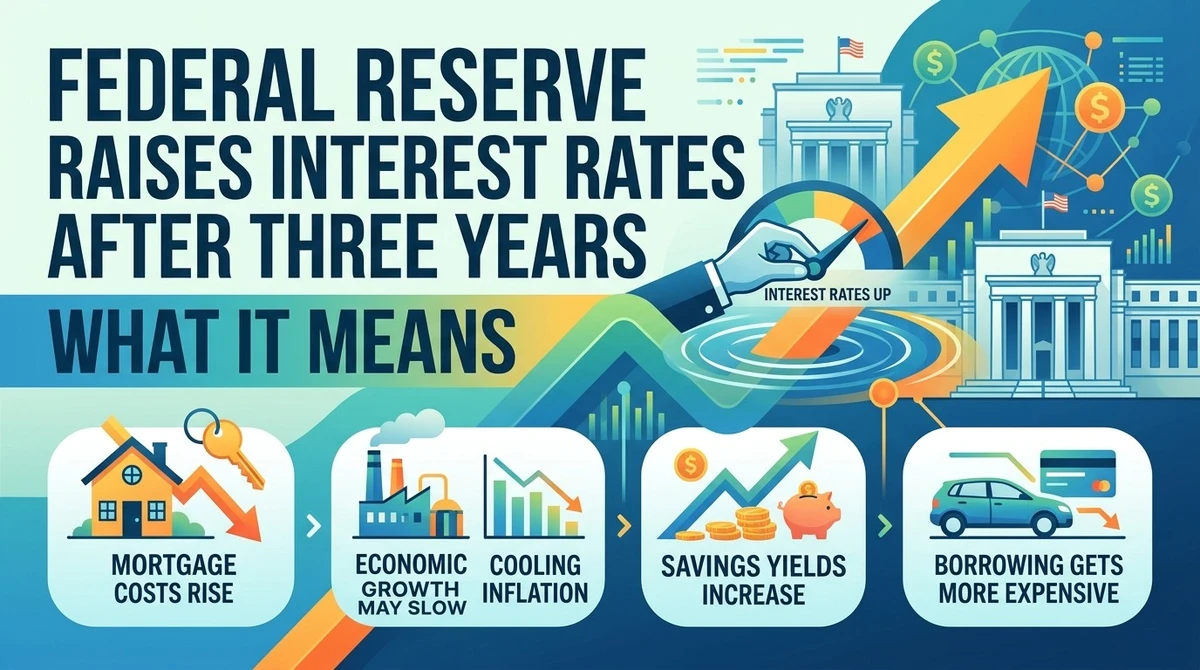
The Federal Reserve has raised U.S. interest rates for the first time since 2023, ending a more than three-year stretch without a rate increase and signaling that inflation remains a significant concern for the U.S. economy.
At its September 15-16, 2026 meeting, the Federal Open Market Committee (FOMC) increased the federal funds target range by 25 basis points to 3.75%-4.00%. The decision was unanimous, with a 12-0 vote. (Federal Reserve)
The move comes at an unusual point in the economic cycle. The labor market is no longer showing the rapid job growth seen during earlier stages of the expansion, yet economic activity remains resilient. At the same time, inflation is still above the Federal Reserve’s 2% target, while higher energy prices have added another source of pressure.
The rate hike therefore matters beyond the borrowing cost set by the Fed. It can affect mortgages, credit cards, business investment, Treasury yields, stock valuations, the U.S. dollar and the pace of economic growth.
What Happened at the September 2026 Fed Meeting?
The Federal Reserve raised its benchmark federal funds target range from 3.50%-3.75% to 3.75%-4.00%.
This was the first rate increase since July 2023. The Fed said economic activity was expanding at a solid pace, domestic spending remained resilient, productivity growth was strong and capital investment was robust. It also noted that job gains had kept pace with the workforce while the unemployment rate had changed little. (Federal Reserve)
The central bank’s other concern was inflation.
The Fed stated that inflation remained elevated and said the latest policy action was intended to support a timelier return to its 2% inflation goal. (Federal Reserve)
That combination is important. The Fed was not responding to an economy that had suddenly collapsed. Instead, it was tightening monetary policy while economic activity remained relatively strong because inflation had not fallen far enough.
For readers who want to understand how the central bank’s decisions have changed over time, Economic Reader’s historical Fed decisions guide provides additional context.
Why Did the Fed Raise Rates After More Than Three Years?
The simplest explanation is that inflation has remained too high relative to the Fed’s target.
The latest August 2026 Consumer Price Index showed consumer prices rising 3.4% over the previous 12 months. Core CPI, which excludes food and energy, increased 2.4% over the same period. On a monthly basis, headline CPI rose 0.4% in August. (Bureau of Labor Statistics)
Those numbers show why the Fed still has work to do. Inflation is considerably lower than its peak during the earlier inflation shock, but it has not yet returned sustainably to the central bank’s 2% objective.
The U.S. Bureau of Labor Statistics CPI data provides the underlying inflation statistics used to measure these changes.
The Fed also has to consider the possibility that strong economic demand could keep price pressures from falling quickly. When households continue spending and businesses continue investing, demand can remain strong enough to support higher prices.
That does not mean higher interest rates automatically eliminate inflation. Monetary policy works with a delay, and some inflation drivers particularly energy prices or supply disruptions are outside the Fed’s direct control.
Why Oil and Energy Prices Matter to the Fed
Energy prices have become an important part of the inflation picture in 2026.
According to the August CPI report, the gasoline index increased 3.9% in August, accounting for more than one-third of the month’s overall CPI increase. (Bureau of Labor Statistics)
Energy prices create a complicated problem for monetary policymakers.
A higher gasoline price directly raises household expenses. But energy is also an input into transportation, manufacturing, logistics, agriculture and many other businesses.
For example, a trucking company facing higher diesel costs may eventually raise freight rates. A manufacturer may face higher transportation and production expenses. Retailers can then face higher costs for moving goods.
The Fed cannot directly produce more oil or lower gasoline prices. What monetary policy can influence is the broader demand environment.
If higher energy prices begin pushing inflation higher while demand remains strong, the central bank may have less room to reduce interest rates.
The Labor Market Is Also Part of the Decision
The labor market gives the Fed another reason to avoid moving too quickly toward lower rates.
The August 2026 Employment Situation showed that U.S. employers added 162,000 jobs, while the unemployment rate remained at 4.1%. Average hourly earnings increased 3.1% over the year. (Bureau of Labor Statistics)
That is not the kind of labor-market deterioration that would automatically force the Fed to stimulate the economy.
At the same time, the employment picture is not identical to the extremely strong labor market of earlier years. The Fed therefore faces a balancing problem: keep monetary conditions tight enough to contain inflation without creating unnecessary weakness in employment.
The next major labor-market report is scheduled for October 2, 2026, covering September employment. (Bureau of Labor Statistics)
That report will be important because policymakers will have another month of labor-market information before their next meeting.
The Fed’s 2026 Projections Point to Another Possible Hike
The September meeting also produced a new set of economic projections.
The median Fed projection puts the federal funds rate at 4.1% at the end of 2026, compared with the current 3.75%-4.00% target range. The median projections also show:
- Real GDP growth: 2.3% in 2026
- Unemployment: 4.1% in 2026
- PCE inflation: 3.7% in 2026
- PCE inflation: 2.3% in 2027
- PCE inflation: 2.1% in 2028
The Fed’s projections put the median federal funds rate at 4.1% at year-end 2026, which is consistent with the possibility of another quarter-point increase, although the projections are not a promise of future policy. (Federal Reserve)
The distinction matters.
The Fed does not decide future rates simply because a projection says 4.1%. Future decisions will depend on incoming inflation, employment, economic activity and financial conditions.
In other words, the September rate hike is a policy decision for current conditions; the projected year-end rate is an indication of where policymakers currently think appropriate policy may need to be.
What Does a Higher Fed Rate Mean for Consumers?
The federal funds rate does not directly determine every consumer loan rate. But it influences broader short-term borrowing costs and financial conditions.
Credit Cards
Credit-card interest rates can remain elevated when the Fed tightens monetary policy.
For consumers carrying a balance, even a relatively small increase in borrowing costs can make debt more expensive over time because interest compounds on unpaid balances.
The effect is much smaller for someone who pays the full credit-card balance each month.
Auto Loans
Higher market interest rates can increase financing costs for new and used vehicle purchases.
The impact depends on the lender, loan term, credit profile and other market conditions. A borrower taking a large loan over several years can feel the difference between even modest changes in interest rates.
Mortgages
Mortgage rates are influenced by broader bond-market conditions rather than simply moving one-for-one with the federal funds rate.
However, a Fed tightening cycle can contribute to higher borrowing costs across financial markets.
That means prospective homebuyers may face a different affordability environment even if mortgage rates do not move by exactly the same amount as the Fed’s policy rate.
For existing homeowners with fixed-rate mortgages, the direct impact is much smaller because their contractual interest rate generally does not change.
What Does the Rate Hike Mean for Businesses?
Businesses also respond to interest rates through borrowing and investment decisions.
A company financing a factory, data center, equipment purchase or acquisition may face higher financing costs when market interest rates rise.
That can change the economics of a project.
Consider a company deciding whether to invest $100 million in a new facility. If financing becomes more expensive, the expected return required to justify the project may rise. Some projects may still make sense because they generate strong cash flows. Others may be delayed.
This is one-way monetary policy affects the real economy: not simply by making loans more expensive, but by changing which investments businesses consider financially attractive.
The effect can be particularly important for smaller companies that rely more heavily on bank financing.
What Does the Rate Hike Mean for Stocks?
Interest rates influence stock markets through several channels.
One is valuation.
The value investors place on future corporate earnings depends partly on the return available from other investments. When interest rates and Treasury yields rise, the discount rate used to value future cash flows can also rise.
Growth-oriented companies can be particularly sensitive because a larger portion of their expected value may come from earnings far into the future.
The second channel is corporate financing.
Higher borrowing costs can reduce profit margins or discourage investment. Companies with strong balance sheets and large amounts of cash may be less exposed than heavily indebted businesses.
The third channel is economic demand.
If higher rates eventually slow household spending and business investment, corporate revenue growth can weaken.
The effect is therefore not simply “higher rates are bad for stocks.” The outcome depends on why rates are rising, how quickly they rise, how earnings are performing and what investors have already priced into markets.
How Did the Stock Market React?
The immediate market reaction on September 16 showed how sensitive investors were to the Fed’s new policy direction.
According to Reuters, U.S. stocks moved lower after the rate decision. The Dow Jones Industrial Average fell about 1.21%, while the S&P 500 declined about 0.45% and the Nasdaq slipped roughly 0.01%. Treasury yields moved higher as investors assessed the possibility of further tightening. (Reuters)
The market reaction was not simply about the 25-basis-point increase itself.
Investors were also interpreting what the decision could mean for the path of monetary policy over the rest of 2026.
That distinction is important because financial markets tend to react not only to what the Fed does today, but also to changes in expectations about what it might do next.
What Does the Decision Mean for Treasury Bonds?
Treasury markets are especially important because government bond yields influence borrowing costs throughout the U.S. financial system.
Following the Fed decision, Treasury yields moved higher. Reuters reported that the two-year Treasury yield rose about 7.5 basis points to 4.738%, while the 10-year yield reached 5%. (Reuters)
Short-term Treasury yields are particularly sensitive to expectations about Fed policy.
Longer-term yields are influenced by a wider range of factors, including expected inflation, economic growth, government borrowing and the global demand for U.S. debt.
That means a Fed rate hike does not mechanically push every Treasury yield higher by the same amount.
For investors, the more important question is whether the market believes higher rates will persist or whether inflation will eventually fall enough to allow monetary policy to ease again.
What Could Happen to the U.S. Dollar?
Interest rates can also influence the U.S. dollar.
Higher U.S. interest rates can make dollar-denominated assets more attractive relative to assets in countries with lower rates, all else equal. That can support demand for the dollar.
The September 16 market reaction included a stronger dollar against major currencies, according to Reuters. (Reuters)
But exchange rates are driven by much more than the Fed.
Investors also consider economic growth, inflation, government finances, geopolitical risk, interest-rate expectations in other countries and global demand for safe-haven assets.
A single Fed decision can therefore influence the dollar without determining its longer-term direction.
Could Higher Rates Slow the U.S. Economy?
Yes, and that is one of the central trade-offs facing monetary policymakers.
Higher interest rates make borrowing more expensive. Over time, that can reduce demand for housing, vehicles, business investment and other interest-sensitive spending.
But the effect does not arrive immediately.
A household refinancing debt, a company planning a capital project or a buyer considering a home may adjust behavior gradually. Financial markets can react within minutes, while the effects on employment and economic activity can take considerably longer to appear.
The Fed’s September projections suggest policymakers currently expect continued economic growth rather than an immediate contraction. The median projection for real GDP growth in 2026 is 2.3%, while the unemployment-rate projection is 4.1%. (Federal Reserve)
That combination helps explain the current policy stance: inflation is still too high, but the economy has enough momentum for policymakers to tolerate tighter financial conditions.
What Should Investors and Households Watch Next?
The September rate hike changes the financial environment, but the next important signals will come from economic data.
Inflation
The next CPI report will show whether August’s inflation pressure was temporary or part of a broader trend. The BLS has scheduled the September 2026 CPI release for October 14. (Bureau of Labor Statistics)
Employment
The September jobs report, scheduled for October 2, will help show whether the labor market is maintaining its current level of resilience. (Bureau of Labor Statistics)
Consumer spending
Consumer spending remains important because resilient demand can make it harder for inflation to fall quickly. Strong spending can also give businesses greater ability to pass higher input costs on to customers.
Energy prices
Oil and gasoline prices deserve close attention because they can quickly influence headline inflation and household purchasing power.
Treasury yields and financial conditions
Investors should also watch whether bond yields remain elevated and whether tighter financial conditions begin affecting business investment, housing activity and credit growth.
The Fed’s next decisions will depend on how these indicators evolve rather than on any single data release.
What This Rate Hike Really Changes
The Federal Reserve’s September 2026 decision is significant because it marks a return to rate increases after more than three years, but the broader story is more complicated than the headline.
The U.S. economy is still expanding. The labor market remains relatively resilient. Business investment and productivity are strong. Yet inflation remains above the Fed’s target, and energy prices have added another layer of pressure. (Federal Reserve)
That combination leaves policymakers trying to manage two risks at once.
Keeping rates too low for too long could allow inflation to become more persistent. Tightening too aggressively could weaken spending, investment and employment.
For households, the immediate issue is the cost of borrowing. For businesses, it is the return required to justify new investment. For investors, the key question is how much higher rates are already reflected in asset prices and whether the Fed’s policy path changes again.
The September hike is therefore not just a change in the federal funds rate. It is a signal that the Federal Reserve is willing to keep financial conditions tighter while it waits for clearer evidence that inflation is moving back toward 2%.
What happens next will depend heavily on the data.