What Is BRICS? Members, History, Goals and Why It Matters
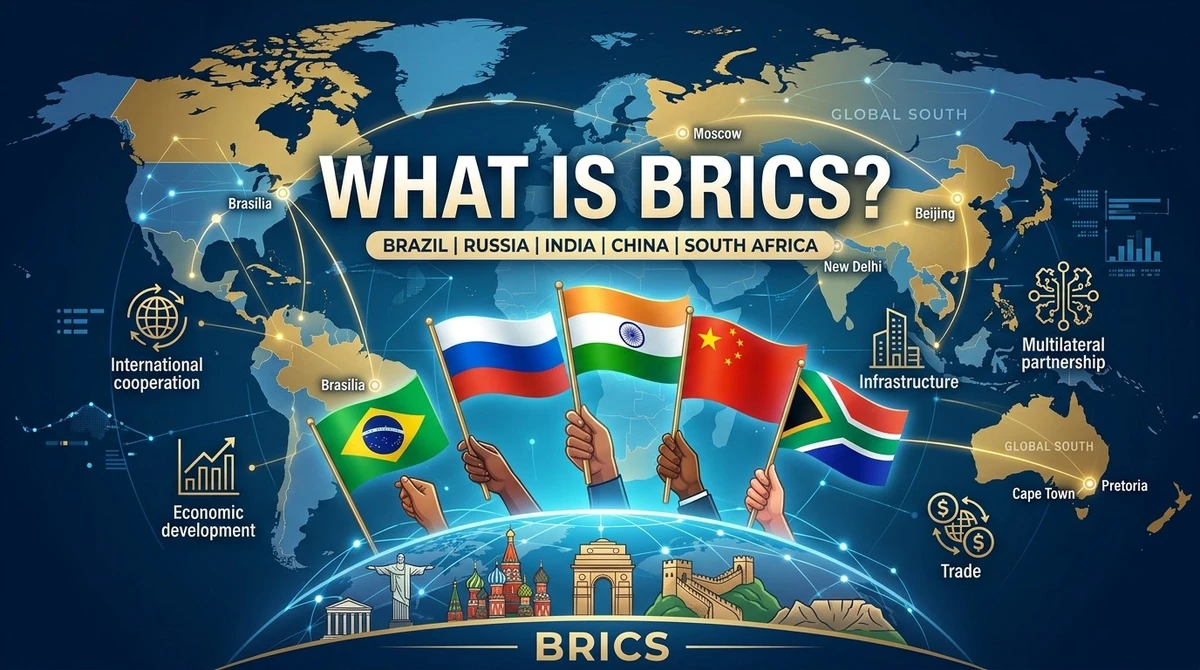
What Is BRICS?
BRICS has evolved from a small group of emerging economies into a much larger platform for cooperation among countries from the Global South.
Its expansion has attracted attention because the group now represents a significant share of the world economy, population, trade, and natural resources. At the same time, BRICS is often misunderstood. It is sometimes described as a unified economic bloc or as a direct alternative to the U.S.-led international financial system, even though its members have different economic structures, currencies, political systems, and national interests.
So what exactly is BRICS, who belongs to it, and what does the group actually do?
Understanding those questions is important before looking at bigger issues such as BRICS expansion, local-currency trade, and the future role of the U.S. dollar.
What Does BRICS Stand For?
BRICS originally referred to Brazil, Russia, India, China, and South Africa.
The name began as BRIC, referring to Brazil, Russia, India, and China. South Africa joined in 2011, turning BRIC into BRICS.
Since then, the group has expanded considerably.
Today, BRICS has 11 full member countries:
- Brazil
- Russia
- India
- China
- South Africa
- Egypt
- Ethiopia
- Iran
- Saudi Arabia
- United Arab Emirates
- Indonesia
The current BRICS framework also includes a separate partner-country category. Partner countries are not the same as full members and do not have the same role in BRICS decision-making.
Official BRICS material states that the 11 full members participate in meetings where decisions are made by consensus, while partner countries have a different participation status.
That distinction matters because the growing number of countries associated with BRICS does not mean that all of them have identical rights or obligations.
Who Are the BRICS Members?
The current membership gives BRICS a geographically broad composition.
Brazil is the largest economy in Latin America and provides BRICS with a major presence in South America.
Russia contributes substantial energy and commodity resources and remains an important participant in global energy markets.
India is one of the world’s largest economies and a major center for services, technology, manufacturing, and a large domestic consumer market.
China is the group’s largest economy and one of the world’s most important manufacturing and trading powers.
South Africa gives BRICS a long-standing institutional presence in Africa.
The expanded membership also includes Egypt, Ethiopia, Iran, Saudi Arabia, the United Arab Emirates, and Indonesia, increasing the group’s representation across the Middle East, Africa, and Southeast Asia.
Indonesia’s entry was particularly significant because it added another major Southeast Asian economy to the group.
However, the economic weight of BRICS should not be interpreted as evidence that the members operate as a single economy. They do not.
Their currencies, trade patterns, economic policies, financial systems, and relationships with other countries remain different.
That diversity is one of BRICS’ defining characteristics.
How Did BRICS Develop?
The original BRIC concept emerged from an economic analysis published by Goldman Sachs in 2001. At that stage, BRIC was not an international political organization.
The four countries gradually developed political and economic cooperation, eventually holding their first formal leaders’ summit in 2009.
South Africa joined in 2011.
A much larger expansion came after the 2023 BRICS summit in Johannesburg, when leaders agreed to expand membership. Egypt, Ethiopia, Iran, Saudi Arabia, and the United Arab Emirates were invited to join, while Indonesia later became a full member.
BRICS therefore did not begin as a large institutional bloc. Its current structure developed gradually as cooperation expanded into additional areas.
The group also introduced a partner-country category in 2024, creating another level of participation below full membership.
In 2026, India holds the BRICS presidency, with the 18th BRICS Summit taking place in New Delhi on September 12–13 under India’s chair ship. The summit focused on resilience, innovation, cooperation, and sustainability. (NDB)
Is BRICS an International Organization Like the IMF?
Not exactly.
This is one of the most important things to understand about BRICS.
The International Monetary Fund (IMF) is a formal international financial institution with a defined institutional structure, membership framework, financial resources, and lending functions.
BRICS operates differently.
It is primarily a political, diplomatic, and economic cooperation platform. Its members coordinate positions, hold meetings across different policy areas, develop initiatives, and support institutions such as the New Development Bank.
Decisions within the BRICS framework are based on consensus among its members rather than being imposed through a centralized authority.
That structure gives individual countries considerable room to pursue their own national interests.
It also explains why BRICS can expand its agenda without becoming a single economic policy bloc.
What Does BRICS Actually Do?
BRICS cooperation covers a much wider range of subjects than trade alone.
Member governments work together through different ministerial meetings, working groups, and initiatives covering areas such as:
- Trade and investment
- Finance
- Infrastructure
- Agriculture
- Energy
- Technology
- Health
- Education
- Science and innovation
- Climate and sustainable development
- Cross-border payments
The objective is not necessarily to create one common policy for all members.
Instead, BRICS provides a platform where countries can coordinate interests and develop practical forms of cooperation.
That difference becomes particularly important in areas such as finance and infrastructure.
The New Development Bank: BRICS’ Most Important Financial Institution
One of BRICS’ most concrete achievements is the creation of the New Development Bank (NDB).
The bank was established in 2015 by the original BRICS members to finance infrastructure and sustainable development projects.
Its role is different from that of the IMF.
The IMF primarily focuses on macroeconomic stability and balance-of-payments support, while the NDB is designed around development financing.
Its projects can involve areas such as:
- Transport
- Energy
- Water and sanitation
- Urban infrastructure
- Digital infrastructure
- Social infrastructure
- Sustainable development
The NDB’s 2022–2026 strategy set a target for 30% of its financing to be denominated in local currencies, reflecting the institution’s effort to expand local-currency financing. (NDB)
The bank has continued to emphasize local-currency financing in 2026. Its current work includes financing and bond issuance in member-country currencies, while its leadership has highlighted the role of local currencies in reducing foreign-exchange risks and developing domestic capital markets. (NDB)
This is one of the clearest examples of BRICS cooperation moving beyond political statements into financial infrastructure.
Why Does Local Currency Financing Matter?
International borrowing can create a currency mismatch.
Imagine a company or government earns most of its revenue in its domestic currency but borrows in U.S. dollars.
If the domestic currency falls sharply against the dollar, the real cost of servicing that debt can rise.
Local-currency financing can reduce part of that currency risk because the borrower can match financing more closely with domestic revenues.
The NDB has explicitly linked local-currency financing with reducing foreign-exchange risk and strengthening domestic capital markets. (NDB)
This does not mean BRICS is eliminating the dollar from international finance.
It means member countries are developing additional financing channels.
That distinction is important.
Does BRICS Have Its Own Currency?
No.
BRICS does not currently have a single common currency comparable to the euro.
The idea of a BRICS currency has received significant attention because some member countries have discussed reducing dependence on the U.S. dollar. But discussion of alternative settlement arrangements is not the same as creating a common currency.
A shared currency would require far deeper financial and institutional integration, including monetary coordination, financial-market integration, and mechanisms for managing economic differences between participating countries.
BRICS has not created such a system.
The more immediate focus has been on using national currencies in trade and finance, improving payment connectivity, and expanding financial cooperation.
This is one reason it is useful to distinguish de-dollarization from the creation of a BRICS currency.
Why Are BRICS Countries Interested in Local Currencies?
There is no single reason.
For some countries, local-currency trade can reduce exposure to exchange-rate movements and lower dependence on foreign-currency financing.
For others, it can support domestic financial markets and make cross-border transactions more flexible.
There is also a strategic dimension.
The international financial system has historically been heavily centered on the U.S. dollar. Countries seeking greater financial diversification may therefore see local-currency settlement as one way to reduce concentration around a single currency.
But reducing the role of the dollar in some transactions is not the same as replacing the dollar globally.
The dollar remains deeply embedded in international trade, banking, financial markets, foreign-exchange transactions, and central-bank reserves.
BRICS and Global Trade
BRICS matters economically partly because its members account for a large portion of global economic activity.
But the significance of the group is not simply its combined GDP.
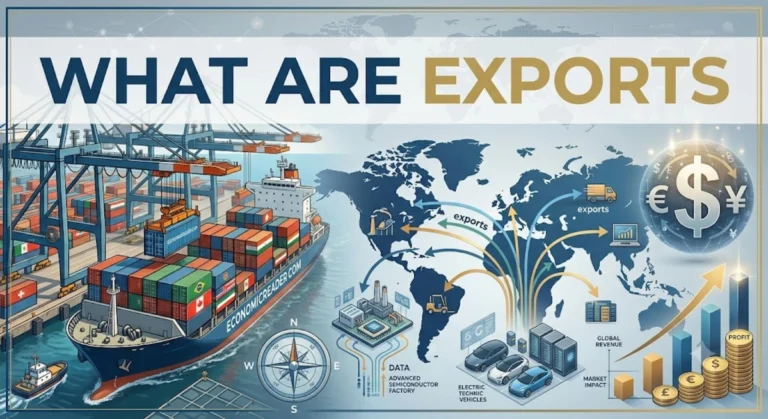
Its members include major exporters of manufactured goods, energy, agricultural commodities, raw materials, and services.
China is a major manufacturing and trading power.
Brazil is an important exporter of agricultural and commodity products.
Russia and the Middle Eastern members are major participants in global energy markets.
India has a large services sector and a rapidly expanding domestic market.
Indonesia adds another major economy and manufacturing base in Southeast Asia.
This combination gives BRICS relevance across multiple parts of global supply chains.
To understand how those connections work at the transaction level, Economic Reader’s guide to How Does International Trade Work? is useful.
BRICS cooperation can also affect investment flows. When companies build factories, acquire businesses, or establish operations in another member country, they are participating in the broader system of cross-border investment known as What Is Foreign Direct Investment (FDI)?
BRICS and Global Economic Governance
Another major reason BRICS matters is its role in discussions about global economic governance.
The members have argued for greater representation of emerging and developing economies in international institutions and decision-making.
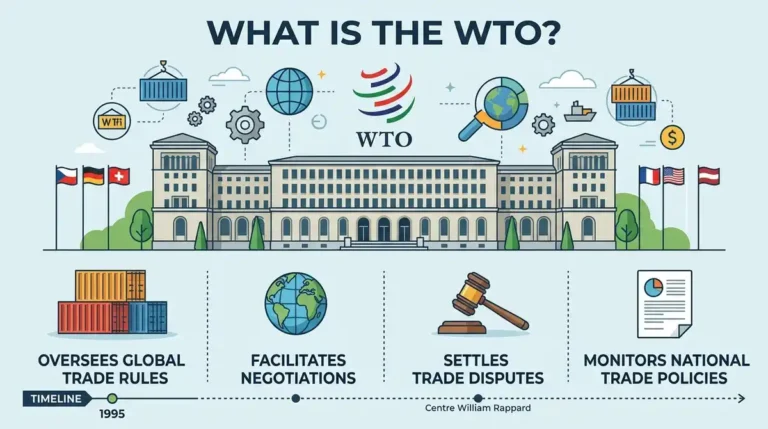
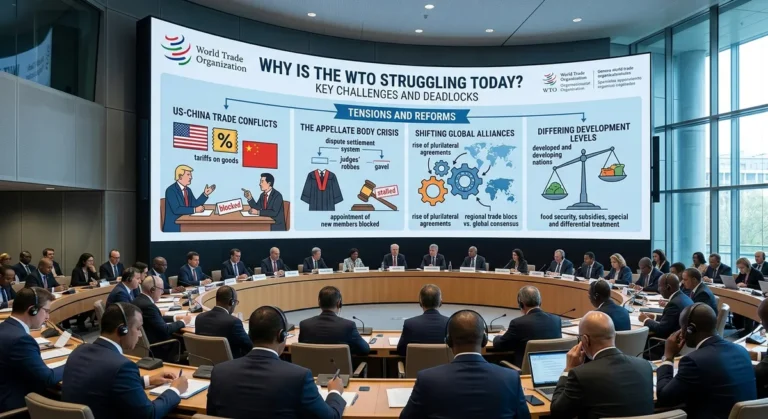
This does not mean BRICS is replacing institutions such as the IMF, World Bank, or World Trade Organization.
Instead, BRICS gives its members another platform for coordinating positions and promoting reforms they consider important.
That distinction helps explain why the group’s influence cannot be measured simply by whether it creates a new global institution.
Influence can also come from coordination, voting positions, trade relationships, financial institutions, and the ability to bring different countries together around common interests.
BRICS Is Not a Single Economic Policy Bloc
The size of BRICS can make the group appear more unified than it actually is.
Its members have significant differences in:
- Economic structure
- Income levels
- Currency systems
- Trade relationships
- Energy policies
- Foreign-policy priorities
- Financial-market development
- Domestic economic conditions
These differences can limit how far collective policies can go.
For example, a country that is heavily integrated into Western financial markets may have different priorities from a country seeking to reduce exposure to those same systems.
The same applies to trade.
BRICS members can cooperate in one area while competing in another.
That is normal for a group made up of sovereign economies.
What Are the Main Limitations of BRICS?
BRICS’ expansion creates greater economic weight, but it also makes coordination more complicated.
The first challenge is diversity.
Eleven countries with different economic systems and national priorities will not automatically agree on every issue.
The second is institutional depth.
BRICS has developed important initiatives, but it does not have the centralized economic governance structure of a monetary union.
The third is financial integration.
Using local currencies for selected transactions is much easier than creating a fully integrated alternative to the existing international financial system.
The fourth is trade imbalance.
BRICS members do not all trade with one another at the same scale or in the same products. China, for example, plays a very different role in global manufacturing and trade from Brazil or South Africa.
These constraints do not make BRICS insignificant. They help define what the group can realistically accomplish.
What Does BRICS Mean for Businesses?
For businesses, BRICS expansion can create both opportunities and new considerations.
A larger BRICS network can support:
- Access to new consumer markets
- Cross-border investment
- Alternative suppliers
- Infrastructure projects
- New financing channels
- Greater regional trade
- Technology partnerships
A company considering expansion into a BRICS economy may also need to understand currency risk, local regulations, trade rules, taxation, political conditions, and supply-chain infrastructure.
That is why BRICS membership by itself does not tell a business whether a particular country is attractive.
The practical question is how the country’s market, institutions, infrastructure, workforce, trade relationships, and investment environment fit the company’s strategy.
For a broader look at the process, see Economic Reader’s guide to How Businesses Expand Globally.
What Does BRICS Mean for Investors?
Investors can view BRICS through several different economic channels rather than treating it as one investment category.
The expansion of BRICS can affect:
- Commodity markets
- Energy markets
- Infrastructure investment
- Emerging-market equities
- Currency markets
- Cross-border capital flows
- Financial institutions
- International trade
But the impact will differ considerably between countries and industries.
For example, a major commodity exporter may experience different economic effects from BRICS cooperation than a manufacturing-heavy economy or a large technology-services economy.
That makes country-level analysis more useful than assuming every BRICS member will experience the same outcome.
BRICS and the U.S. Dollar
The relationship between BRICS and the U.S. dollar is one of the most discussed parts of the group’s development.
Some BRICS initiatives aim to increase the use of national currencies in trade and finance and improve cross-border payment arrangements.
The NDB has also expanded its use of local-currency financing. At its 2026 annual meeting, the bank continued to identify local currencies and deeper domestic capital markets as strategic priorities. (NDB)
But these developments should not automatically be interpreted as the end of dollar dominance.
The dollar’s international role is supported by the size and liquidity of U.S. financial markets, its use in international finance, and the depth of the broader financial infrastructure surrounding it.
That makes the transition, if it occurs, more likely to involve greater diversification than a simple replacement of one currency by another.
Why BRICS Matters Beyond Its Membership Numbers
The most important question about BRICS is not simply how many countries belong to it.
The more meaningful question is what those countries can build together.
The NDB provides one example. Local-currency financing provides another. Cross-border payment discussions, trade cooperation, infrastructure investment, and coordination in international institutions represent other parts of the same process.
None of these developments automatically creates a unified alternative to the existing global economic system.
But together, they can gradually create more choices for participating countries.
That is where the long-term significance of BRICS may lie.
Its influence could come less from replacing existing institutions and more from giving emerging and developing economies additional ways to finance projects, conduct trade, coordinate policies, and strengthen their position in global economic discussions.
The Bigger Picture
BRICS is best understood as an evolving platform rather than a single economic bloc with one common policy.
Its expansion has increased the group’s economic and geographic reach, while institutions such as the New Development Bank have given cooperation a more concrete financial dimension. At the same time, the differences between members place clear limits on how unified the group can become.
For businesses, BRICS can create new markets, investment opportunities, suppliers, and financing channels.
For investors, it provides another lens through which to examine emerging markets, commodities, currencies, infrastructure, and global capital flows.
For the international economy, BRICS is part of a broader shift toward a more diversified global economic landscape.
The important point is not that BRICS has already replaced the institutions or currencies that dominate global finance. It has not. Its significance is that a growing group of major economies is building additional channels for cooperation and financial interaction.
That process is still developing, and its eventual importance will depend less on the size of BRICS on paper than on whether its members can turn political coordination into durable economic and financial systems.