

What Is ADB? How the Asian Development Bank Supports Growth in Asia
Asia has become one of the most important engines of global economic growth. The region contains major manufacturing economies, rapidly expanding cities, large consumer markets, and some of the world’s most important trade routes.
But economic progress across Asia remains uneven.
Some economies have sophisticated financial systems and modern infrastructure, while others still face shortages of reliable electricity, transportation, clean water, healthcare, education, and access to finance.
This is where the Asian Development Bank (ADB) plays an important role.
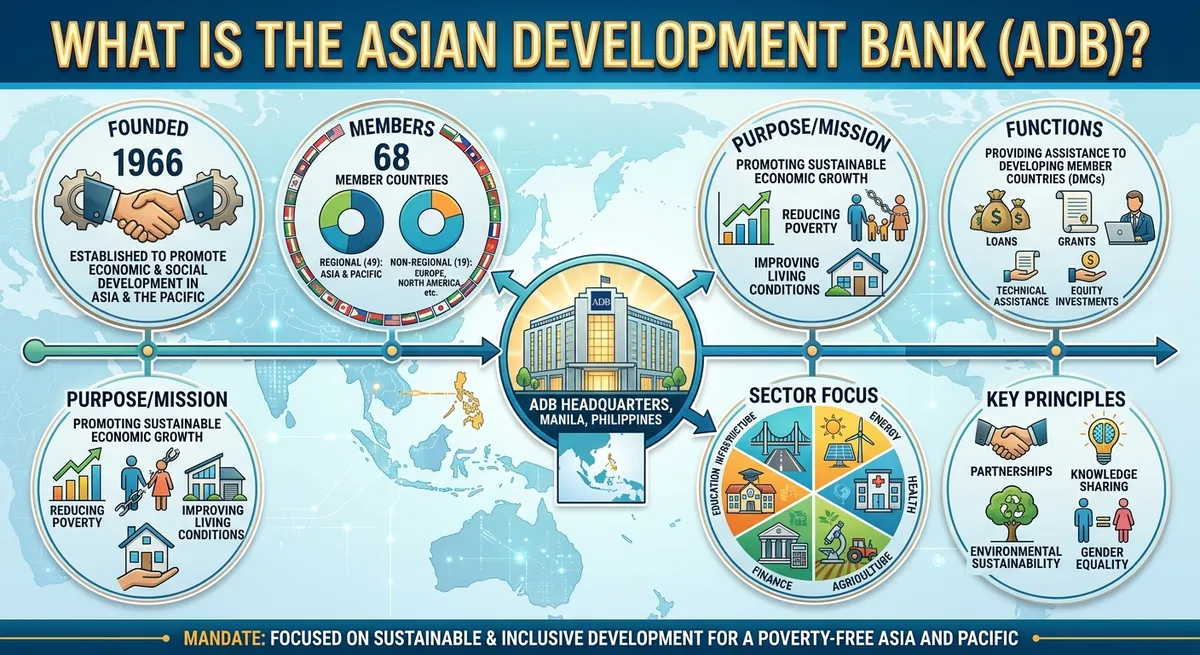
Founded in 1966, ADB is a multilateral development bank that supports sustainable, inclusive, and resilient growth across Asia and the Pacific. It is owned by 69 members, including 50 from the region. Its work combines public- and private-sector financing with technical assistance, policy support, and development knowledge. (Asian Development Bank)
But describing ADB simply as an institution that lends money to developing countries misses the bigger economic picture.
Its broader purpose is to help remove structural barriers that can prevent economies from reaching their potential.
That can mean financing infrastructure, attracting private investment, strengthening financial systems, improving regional connectivity, supporting climate resilience, or helping governments design better policies.
The important question, therefore, is not simply “What does ADB lend money for?”
It is:
How can development finance help countries build the foundations for long-term economic growth?
What Is ADB (Asian Development Bank)?
The Asian Development Bank is an international development institution focused on developing member countries across Asia and the Pacific.
Unlike a commercial bank, ADB’s primary objective is not to maximize profits from ordinary banking customers.
Its purpose is development.
That allows it to support projects that can produce significant economic or social benefits but may be difficult to finance entirely through commercial markets.
ADB’s work covers areas including:
- Transport and infrastructure
- Energy and electricity
- Water and urban development
- Education and healthcare
- Agriculture and food security
- Financial-sector development
- Climate change and disaster resilience
- Digital technology
- Regional cooperation and trade
- Private-sector investment
ADB says its operations are delivered through public- and private-sector financing, advisory services, and knowledge support. (Asian Development Bank)
That combination is important because development problems rarely have a purely financial solution.
A country may need money to build a road, but it may also need better institutions to manage the project, technical expertise to design it, and private investment to develop businesses around it.
Why Does Asia Need a Development Bank?
Economic growth depends on more than natural resources or a large population.
Businesses need reliable infrastructure. Workers need skills. Financial systems need to allocate capital efficiently. Governments need the capacity to provide essential services.
When those foundations are weak, they can create a chain reaction:
Weak infrastructure → higher business costs → lower investment → fewer productive jobs → slower economic growth
Development finance can help break that cycle.
Consider transportation.
If goods take too long to reach a port because roads, railways, or logistics systems are inefficient, businesses face higher costs. That can make local producers less competitive and discourage investment.
Improve the transport network, and the effect can extend beyond the infrastructure itself.
Lower logistics costs can improve business competitiveness, encourage investment, expand trade, and create employment.
The same principle applies to electricity, water, digital infrastructure, and financial services.
Economic Reader’s guide to economic growth provides broader context on why investment, productivity, infrastructure, and human capital matter to long-term prosperity.
How ADB Turns Financing Into Economic Impact
The most useful way to understand ADB is to look at what happens after the money is provided.
Suppose ADB helps finance a major transport project.
The immediate result is construction.
But the longer-term economic effects can be much broader:
Infrastructure → lower costs → higher productivity → more investment → more jobs → higher incomes
This is why development-bank financing is different from an ordinary commercial loan.
The economic value of the financing is often determined by what the project enables.
A power project can make electricity more reliable for businesses.
A water project can improve public health.
A digital project can expand access to financial services.
A regional transport project can make international trade easier.
The financing is therefore a tool. The development impact is the ultimate objective.
Infrastructure Remains One of ADB’s Core Roles
Infrastructure is the physical foundation of economic activity.
Factories need electricity.
Businesses need roads and ports.
Cities need water and sanitation.
Consumers and companies increasingly need reliable digital networks.
For developing economies, infrastructure gaps can become a direct constraint on productivity.
A manufacturer that faces unreliable electricity may need backup generators. A company located far from a major port may face high transportation costs. A rapidly growing city without adequate public transport can lose productivity through congestion.
These problems can make an economy less attractive to investors.
ADB therefore finances infrastructure projects across sectors including transport, energy, water, and urban development. Its current development priorities also include climate resilience, digital transformation, and regional connectivity. (Asian Development Bank)
This connects infrastructure directly with international trade.
Economic Reader’s guide to how international trade works explains why trade depends not only on tariffs and agreements but also on the infrastructure that allows goods and services to move efficiently.
ADB Is Increasingly Focused on Private Investment
Governments alone cannot finance all of Asia’s development needs.
Private businesses are essential because they invest capital, create jobs, develop products, and increase productive capacity.
This is why private-sector development has become an increasingly important part of ADB’s strategy.
ADB says it wants to strengthen its role as a catalyst for private-sector participation and has set a 2030 target of $13 billion in its own-account private-sector financing, alongside direct private-capital mobilization. (Asian Development Bank)
The idea is important because ADB does not necessarily need to finance an entire project itself.
Its participation can help make a project more attractive to commercial investors by improving project structures, sharing risks, providing expertise, or helping governments work with private companies.
This creates a potentially powerful effect:
ADB involvement → greater investor confidence → additional private capital → larger investment → wider economic impact
ADB also provides transaction advisory services to help governments structure deals with private companies, assess risks, and manage procurement processes. (Asian Development Bank)
That means ADB can influence investment even when it is not the only source of financing.
Supporting Small and Medium Sized Businesses
Large corporations usually have more options when they need capital.
They can borrow from banks, issue bonds, attract institutional investors, or raise money internationally.
Small and medium-sized businesses often have fewer choices.
Limited collateral, shorter operating histories, weaker financial records, or higher perceived risk can make borrowing more difficult.
ADB works with financial institutions and development programs to improve access to finance and strengthen financial systems across the region.
Its finance-sector work focuses on building stable, competitive financial systems that can mobilize capital, expand financial inclusion, and support sustainable development. (Asian Development Bank)
This matters because small businesses are not simply individual companies.
Collectively, they represent a significant source of employment, entrepreneurship, and local economic activity.
Better access to finance can allow businesses to purchase equipment, expand production, adopt technology, hire workers, or enter new markets.
Climate Change Is Now an Economic Issue
Climate change has changed the nature of development finance.
Floods, droughts, extreme heat, storms, and other climate-related events can destroy infrastructure, disrupt agriculture, reduce productivity, and place additional pressure on government budgets.
For developing economies, these shocks can be particularly damaging because resources for rebuilding may already be limited.
ADB therefore places climate action and resilience at the center of its current strategy.
Under its Strategy 2030 framework, ADB aims for climate finance to reach 50% of its total committed financing volume by 2030, with more than $100 billion in cumulative climate finance from its own resources during 2019-2030. (Asian Development Bank)
This is not simply an environmental objective.
It is an economic one.
A flood-resistant road protects transportation and trade.
A more resilient power system reduces business disruption.
Better water management can protect agriculture and urban communities.
Climate resilience can therefore protect future economic growth.
Economic Reader’s analysis of how El Niño affects global business provides another example of how climate conditions can move through agriculture, supply chains, prices, and business activity.
Digital Development Is Becoming More Important
Development is no longer only about physical infrastructure.
Digital infrastructure increasingly determines how easily people and businesses can participate in the economy.
Internet access, digital payments, online government services, digital banking, and technology-enabled businesses can reduce geographic barriers and improve productivity.
ADB identifies digital transformation as one of its strategic focus areas, with the aim of increasing operations supporting digital transformation across both sovereign and non sovereign activities. (Asian Development Bank)
The potential benefits are significant.
A small business can reach customers outside its local market.
A consumer can access financial services without visiting a physical branch.
A government can deliver services more efficiently.
A worker can access education and training remotely.
But digital development also creates new risks, including cybersecurity, unequal access, data protection, and differences in digital skills.
That means investment in technology needs to be accompanied by appropriate institutions and regulation.
ADB Supports Regional Integration Too
Asia’s economies are deeply interconnected.
A factory in one country may depend on components from several others. Agricultural producers may rely on cross-border transportation. Businesses may use regional supply chains to manufacture products for global markets.
That makes regional infrastructure and cooperation particularly important.
ADB supports regional cooperation and integration through projects involving connectivity, trade, infrastructure, and other shared economic priorities. (Asian Development Bank)
The economic logic is straightforward.
A modern port becomes more valuable when roads and railways connect it efficiently to production centers.
A border crossing becomes more useful when customs procedures are efficient.
A regional energy network can provide benefits that an isolated national system cannot.
This is one area where a regional development institution can provide value that individual governments may find difficult to achieve independently.
ADB, IMF, and World Bank: What Is the Difference?
ADB is sometimes confused with the International Monetary Fund and World Bank because all three are international financial institutions.
Their roles, however, are different.
The IMF primarily focuses on macroeconomic and financial stability, including balance-of-payments problems and economic policy support.
The World Bank has a global development mandate and supports poverty reduction and economic development across regions worldwide.
The Asian Development Bank has a regional development mandate focused on Asia and the Pacific.
These institutions can cooperate on development challenges, but their geographic focus and institutional roles are not identical.
Economic Reader’s analysis of the IMF’s challenges and criticism provides useful context for understanding how the IMF’s role differs from that of development banks such as ADB.
What Are the Limitations of ADB?
ADB financing can support development, but financing alone cannot guarantee successful economic outcomes.
Large projects can face delays, cost overruns, environmental concerns, or implementation problems.
Loans also create obligations for governments.
If a project does not generate the expected economic benefits, the debt still has to be managed.
There can also be legitimate disagreements about which projects deserve priority, how benefits should be distributed, and how environmental and social risks should be handled.
These limitations are important because development is ultimately about more than the amount of money invested.
Good financing needs good institutions.
Transparent procurement, effective governance, careful project selection, environmental safeguards, and strong implementation all influence whether development spending produces lasting results.
ADB maintains accountability, environmental and social requirements, anticorruption measures, and independent evaluation mechanisms as part of its institutional framework. (Asian Development Bank)
Why ADB Matters to Asia’s Long Term Growth
ADB’s importance is easier to understand when its different activities are viewed together.
Infrastructure can reduce business costs.
Financial-sector development can improve access to capital.
Private-sector financing can attract additional investment.
Digital infrastructure can expand economic participation.
Climate investment can protect productive capacity.
Regional cooperation can make trade and supply chains more efficient.
These effects can reinforce one another.
For example, a new transport network may reduce logistics costs, but the full economic benefit becomes much larger if businesses can access finance, electricity is reliable, digital systems work efficiently, and regional markets are accessible.
That is why ADB’s role is broader than simply providing loans.
It is helping build some of the conditions under which private investment, productivity, trade, and employment can grow.
The Bigger Picture
Asia’s future economic growth will depend on how successfully the region responds to several structural challenges at the same time.
Countries need better infrastructure, stronger financial systems, greater digital access, more resilient economies, and deeper regional connections.
ADB’s current strategy reflects that broader challenge. Its priorities include climate action, private-sector development, regional cooperation, digital transformation, and resilience and inclusion. (Asian Development Bank)
The institution cannot create economic growth by itself.
Governments still need effective policies. Businesses need to invest. Workers need skills. Financial institutions need to allocate capital efficiently. And development projects need to be implemented well.
But ADB can help remove some of the constraints that prevent those forces from working effectively.
That is ultimately why the Asian Development Bank matters.
Its most important contribution is not simply the money it provides. It is the economic capacity that well designed financing can help create.
When a development project lowers costs, improves productivity, attracts private investment, strengthens resilience, or connects businesses to larger markets, its impact can continue long after the original financing has been provided.
For a region as economically important and diverse as Asia, that role will remain significant as countries move from simply pursuing growth toward building economies that are more productive, resilient, inclusive, and sustainable.