What Is the Russell 2000 Index? Understanding the U.S. Small-Cap Stock Market
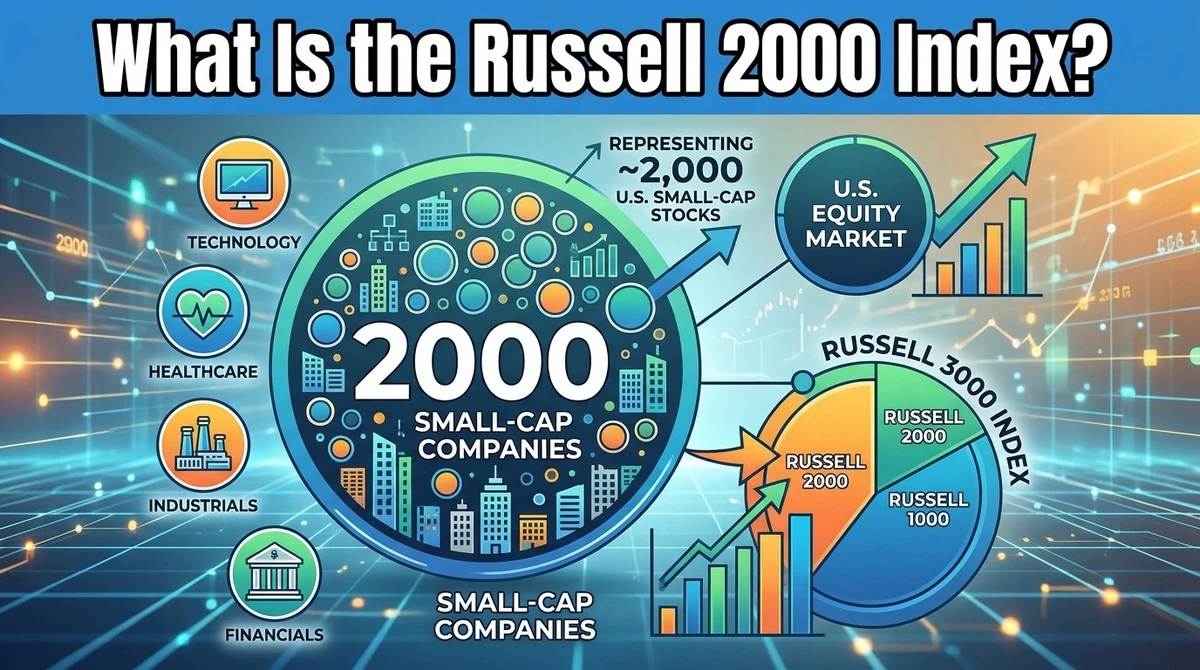
The Russell 2000 Index is one of the best-known benchmarks for U.S. small-cap stocks. It measures the performance of approximately 2,000 companies that represent the small-cap segment of the U.S. equity market. (LSEG)
Unlike the Nasdaq or NYSE, the Russell 2000 is not a stock exchange. It is an index designed to track a particular segment of the market.
That distinction is useful when reading financial news. A headline about the Russell 2000 is generally referring to the performance of smaller publicly traded companies as a group, rather than the shares traded on a particular exchange.
The index is part of the broader Russell U.S. index family, which uses market capitalization and rules-based eligibility criteria to divide companies into different segments. Understanding how that process works helps explain what the Russell 2000 actually represents and what it does not.
What Is the Russell 2000 Index?
The Russell 2000 measures the performance of the small-cap segment of the U.S. equity market.
FTSE Russell, part of LSEG, constructs the index from the broader Russell 3000 universe. The Russell 3000 is designed to represent approximately 98% of the investable U.S. equity market by market capitalization. Within that universe, the Russell 1000 covers the largest companies, while the Russell 2000 covers the smaller companies that follow them in the ranking. (LSEG)
The Russell 2000 is therefore a size-based market index.
A company does not enter the index because FTSE Russell considers it a particularly attractive investment. Its membership is determined by the index methodology, including market capitalization, eligibility, investability requirements, and existing membership.
To understand why market capitalization matters in this process, see Economic Reader’s guide to What Is Market Capitalization?.
How Is the Russell 2000 Built and Maintained?
The Russell 2000 begins with the broader Russell U.S. equity universe.
Companies are ranked according to their market capitalization, subject to the methodology’s eligibility and investability requirements. The resulting size ranking is then used to determine which companies belong in the Russell 1000 and Russell 2000.
The dividing line between large-cap and small-cap companies is not permanently fixed. As companies grow, shrink, merge, go public, or otherwise change, the composition of the U.S. equity market changes as well.
FTSE Russell therefore periodically reassesses the index.
Beginning in 2026, Russell U.S. indexes moved to semi-annual reconstitution, with major reconstitution events in June and December. During the process, the breakpoints between large-, mid-, and small-cap segments are recalculated to reflect changes in the market.
Eligible IPOs are also added on a quarterly basis, while other daily index adjustments help keep the indexes aligned with the underlying market.
The methodology also uses rules intended to limit unnecessary turnover around the size breakpoints. As a result, a company close to the boundary between the Russell 1000 and Russell 2000 does not necessarily switch indexes every time its market capitalization moves slightly.
This ongoing maintenance is one reason the Russell 2000 can change over time without changing its basic purpose: measuring the U.S. small-cap market.
What Companies Are in the Russell 2000?
The Russell 2000 is not limited to one industry.
Its constituents can include companies from healthcare, financial services, industrials, technology, consumer businesses, energy, real estate, communications, and other sectors.
The common characteristic is primarily company size, not business type.
That gives the index broad exposure to smaller U.S. businesses. The individual companies can have very different revenue models, profitability levels, balance sheets, growth rates, and competitive positions.
As a result, the Russell 2000 should not be viewed as a collection of companies that all behave in the same way.
The number of constituents can also vary. For example, FTSE Russell’s April 30, 2026 ranking data showed 1,996 securities in the Russell 2000 at that point in the reconstitution process. (LSEG)
The “2000” in the name therefore describes the index’s intended segment rather than guaranteeing exactly 2,000 companies at every moment.
How Is the Russell 2000 Weighted?
The Russell 2000 uses a float-adjusted market capitalization weighting approach.
That means companies with larger eligible market capitalizations generally have greater influence on the index than smaller constituents.
The float adjustment accounts for shares that are actually available to public investors rather than simply counting every outstanding share.
This differs from an equal-weighted index, where every constituent would have roughly the same influence regardless of company size.
The weighting system matters when interpreting index movements. A strong move in a larger Russell 2000 constituent can have a greater effect on the index than the same percentage move in one of its smallest members.
Why Does the Russell 2000 Matter?
The Russell 2000 provides a commonly used reference point for the U.S. small-cap equity market.
Investors, fund managers, researchers, and financial journalists can use the index to examine how smaller publicly traded companies are performing as a group.
For example, suppose a small-cap fund gains 8% over a particular period while the Russell 2000 gains 5%. The index gives investors a reference point for comparing that fund’s performance with the broader small-cap segment.
The comparison does not explain why the difference occurred. A fund may hold different companies, use a different weighting approach, charge fees, or follow a different investment strategy.
The index is simply the benchmark.
The Russell 2000 also provides a way to compare the behavior of smaller companies with larger parts of the U.S. stock market.
For a broader introduction to how stocks and exchanges fit together, see Economic Reader’s What Is the Stock Market?.
Russell 2000 vs. S&P 500
The Russell 2000 and S&P 500 measure different parts of the U.S. equity market.
| Feature | Russell 2000 | S&P 500 |
| Primary focus | Small-cap U.S. companies | Large U.S. companies |
| Number of companies | Approximately 2,000 | Approximately 500 |
| Construction | Russell U.S. index methodology | S&P Dow Jones Indices methodology |
| Company size | Smaller publicly traded companies | Large-cap companies |
| Market exposure | Small-cap segment | Large-cap segment |
Because the two indexes represent different company sizes, their performance can diverge.
Large companies often have broader access to capital, more established revenue streams, and greater international exposure. Smaller companies can have different financing needs, customer bases, competitive positions, and sensitivity to domestic economic conditions.
Neither index represents the entire U.S. market on its own.
The Russell 2000 focuses on the small-cap segment, while the S&P 500 concentrates on large-cap companies. Comparing them can therefore provide information about how different parts of the equity market are behaving.
What Moves the Russell 2000?
Several forces can influence the Russell 2000, and their effects can vary over time.
Interest Rates and Financing Costs
Smaller companies can be more sensitive to borrowing conditions because some rely heavily on external financing to fund expansion, working capital, or investment.
When interest rates rise, the cost of refinancing or raising new capital can increase for companies with significant financing needs.
That does not mean every Russell 2000 company reacts in the same way. Balance sheets and debt structures vary considerably across the index.
Economic Growth
Many smaller companies have significant exposure to the U.S. domestic economy.
Changes in consumer demand, business investment, employment, credit conditions, and economic activity can therefore affect their revenues and earnings.
A stronger economy can support demand for some small-cap businesses, while an economic slowdown can put pressure on companies with weaker financial positions.
Credit Conditions
Access to credit can be particularly relevant for smaller businesses.
When lenders become more cautious, companies with limited cash reserves or greater refinancing requirements may face greater financial pressure.
The opposite can occur when credit becomes more readily available.
Investor Risk Appetite
Investor demand also affects small-cap stocks.
Periods of strong risk appetite can increase demand for companies with greater growth potential but less established business models. During periods of market stress, investors may reassess smaller companies differently depending on their profitability, debt, cash flow, and access to financing.
These are tendencies rather than fixed rules. The Russell 2000 contains nearly 2,000 individual companies with very different financial characteristics.
Why Can Small-Cap Stocks Behave Differently?
Company size can influence how a business responds to changes in the economy and financial markets.
A smaller company may depend heavily on a limited number of products, customers, suppliers, or geographic markets. It may also have fewer financial resources than a large multinational company.
For example, a company with $500 million in annual revenue may have fewer ways to absorb a sudden increase in costs than a multinational generating tens of billions of dollars in sales.
At the same time, smaller companies are not automatically riskier or faster-growing. The Russell 2000 contains profitable mature businesses alongside companies that are still expanding, restructuring, or facing financial challenges.
The index captures that range rather than filtering it out.
What Are the Limitations of the Russell 2000?
The Russell 2000 is useful, but it does not answer every question about small-cap stocks.
First, it does not include every small U.S. company. Eligibility rules determine which securities can enter the Russell index universe.
Second, the composition changes over time. A company can move between the Russell 1000 and Russell 2000 as its market capitalization changes, while new companies can enter through the index maintenance process.
Third, the index does not tell investors whether an individual company is financially strong.
Two Russell 2000 constituents can have completely different:
- Revenue growth
- Profit margins
- Debt levels
- Cash flow
- Valuations
- Competitive advantages
- Business risks
That is why an index can be useful for understanding a market segment without replacing company-level research.
Economic Reader’s guide to How Investors Analyze Stocks explains how investors can examine individual businesses beyond headline market performance.
How to Read Russell 2000 Headlines
Financial headlines can make index movements sound broader than they actually are.
When you see “Russell 2000 rises,” it means the index increased. It does not mean every small-cap stock gained.
When a headline says “small caps outperform,” check the period and benchmark being used. The statement may refer to the Russell 2000 outperforming a large-cap index such as the S&P 500 over a specific period.
If you read “Russell 2000 falls as interest rates rise,” treat the relationship carefully. Higher rates can affect financing costs and valuations, but the index can move because of many factors at the same time.
A headline about companies moving from the Russell 2000 to the Russell 1000 may refer to the reconstitution process rather than a company voluntarily changing its listing or exchange.
Understanding the index’s construction makes these headlines easier to interpret.
Why the Russell 2000 Remains Useful
The Russell 2000 is ultimately a way of measuring a particular part of the U.S. stock market.
Its value comes from the rules behind the index: companies are organized by market capitalization, membership is maintained through a defined process, and the index is weighted to reflect the investable market segment it is designed to represent. FTSE Russell describes it as a measure of the U.S. small-cap equity segment and maintains the broader Russell index family through periodic reconstitution and ongoing index maintenance. (LSEG)
For readers, the most useful way to think about the Russell 2000 is not simply as a number on a financial screen. It is a market benchmark that provides a structured view of smaller U.S. publicly traded companies.
Its movements can offer clues about how investors are pricing the small-cap segment, but the index itself does not explain the financial condition of every company inside it. That distinction is important whenever the Russell 2000 appears in market reports, investment research, or economic commentary.