

What Is Brent Crude Oil? Understanding the Global Oil Benchmark
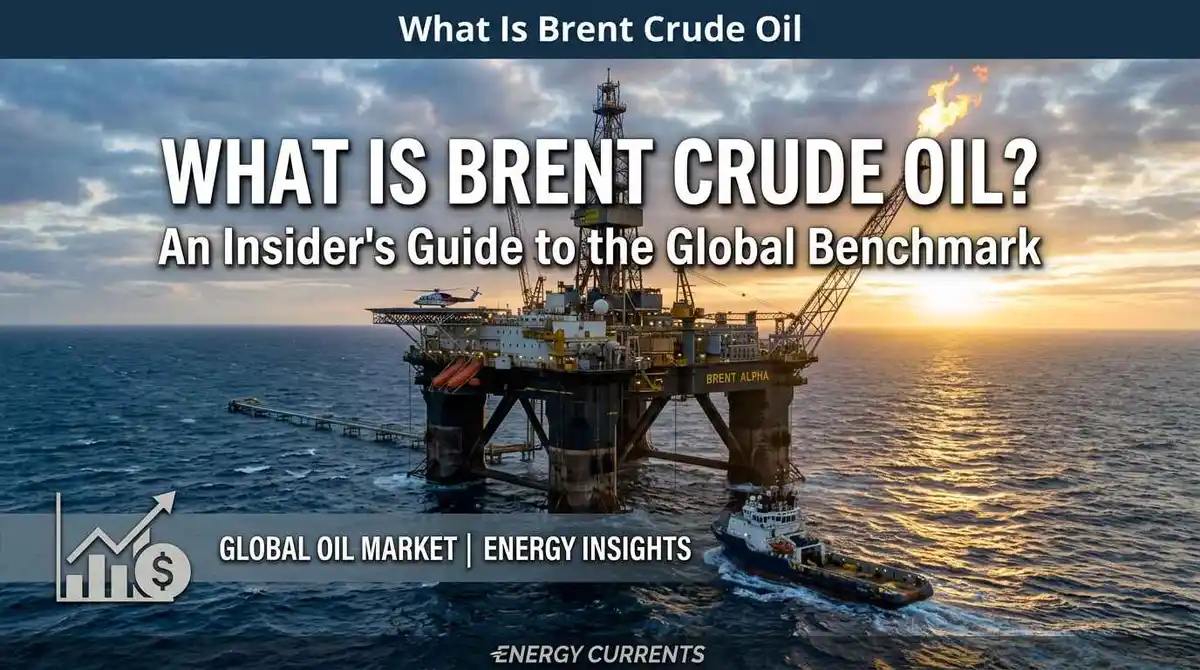
When financial news reports that “oil prices rose,” the price being discussed is often Brent crude.
Brent is one of the most important reference prices in the global oil market. It is used as a benchmark for pricing crude oil traded across international markets and influences the value of many other crude grades.
But Brent crude is not simply one barrel of oil from one field.
The modern Brent benchmark has evolved from crude produced in the North Sea into a broader pricing system that includes several North Sea grades and, since 2023, WTI Midland from the U.S. Gulf Coast. (U.S. Energy Information Administration)
That evolution helps explain why Brent has remained one of the most important benchmarks in the global oil industry.
What Is Brent Crude Oil?
Brent crude is a benchmark used to establish prices for crude oil traded in international markets.
Historically, the benchmark was built around crude from the Brent field in the North Sea. As production from the original field and other North Sea streams declined, additional grades were incorporated to maintain liquidity and keep the benchmark connected to an active physical market.
The traditional North Sea basket included:
- Brent
- Forties
- Oseberg
- Ekofisk
- Troll
These five grades are commonly referred to as BFOET. In 2023, WTI Midland was added to the Brent complex, further expanding the physical supply underpinning the benchmark. (U.S. Energy Information Administration)
For readers who want to explore the benchmark’s history and composition in more detail, the U.S. Energy Information Administration’s explanation of the Brent benchmark provides useful background.
This creates an important distinction.
When people say “Brent crude,” they are often talking about the benchmark price, not crude oil physically produced from the original Brent field.
The original Brent field gave the benchmark its name, but the modern Brent market is much broader.
Why Is Brent Called a Benchmark?
A benchmark provides a common reference point for buyers and sellers.
Crude oil comes in many varieties. Different grades can have different levels of density, sulfur content, transportation costs, and refining characteristics.
Rather than negotiating every crude transaction from scratch, market participants can price a particular crude against a recognized benchmark.
For example, a producer might sell its crude at:
Brent + a premium
or
Brent – a discount
The size of that difference can reflect crude quality, transportation costs, location, refinery demand, and regional or global supply and demand.
The U.S. Energy Information Administration’s overview of crude-oil benchmarks explains how these differentials are used to price other crude grades against benchmarks such as Brent and WTI.
This is what makes Brent more than just another oil price.
It is part of the pricing infrastructure of the global crude market.
How Did the Brent Benchmark Develop?
The story begins with the original Brent field.
Production from the Brent field started in 1976. During the 1980s, transactions involving physical Brent cargoes became the basis for a benchmark price for North Sea crude. (U.S. Energy Information Administration)
But the market eventually faced a problem.
Production from the original Brent field declined. Fewer physical cargoes meant the benchmark needed additional sources of crude to remain liquid and useful.
Forties and Oseberg were added in 2002, followed by Ekofisk in 2007. Troll was added in 2018. (U.S. Energy Information Administration)
Then came another important change.
WTI Midland was added to the Brent complex in 2023 as declining North Sea production increased the need for additional physical volume. ICE says the addition helped strengthen the physical liquidity supporting the benchmark. (ICE Status Center)
The result is a benchmark that has continued to evolve rather than remaining tied to the production of a single oil field.
What Is Dated Brent?
One of the most important terms to understand is Dated Brent.
Dated Brent refers to the physical North Sea crude market used to assess the value of cargoes scheduled for loading during a specified future period.
It is different from simply looking at a futures contract price.
The physical market matters because crude oil is ultimately a physical commodity. Oil must be produced, transported, stored, refined, and delivered somewhere.
Dated Brent connects the benchmark to that physical market.
The ICE Brent Index methodology explains that the ICE Brent Index represents the average price of trading in the prevailing North Sea cash or forward market for the relevant delivery month. The index is then used as the final cash settlement price for the front-month ICE Brent futures contract.
This connection between physical crude and financial trading is one of the reasons Brent can function as a global benchmark.
How Do Brent Futures Work?
Brent crude is also heavily traded through futures contracts.
A futures contract allows market participants to agree on a price for oil associated with a future delivery period.
Futures markets serve several purposes. They provide a place for producers, refiners, traders, financial institutions, and other market participants to manage price risk and discover prices.
The CME Group’s Brent Crude Oil overview describes Brent futures as a major benchmark for the purchase of oil worldwide.
The ICE Brent futures market is closely connected to the underlying physical market through the Brent pricing system and the ICE Brent Index.
This means the Brent market is not simply a financial trading market.
It is connected to actual barrels of crude moving through the international oil system.
That connection matters because a benchmark becomes more useful when its price remains tied to real-world supply and demand.
Why Does Brent Have Global Importance?
Brent’s biggest advantage is its connection to the seaborne oil market.
North Sea crude can be loaded onto tankers and transported to different markets.
That makes Brent particularly useful as a reference point for internationally traded crude.
A landlocked crude market can be heavily influenced by local storage capacity, pipeline infrastructure, and regional bottlenecks. Brent, by contrast, is closely connected to waterborne trade and international shipping.
ICE describes Brent as a waterborne benchmark with access to global shipping, ports, and storage infrastructure.
This global connectivity helps explain why Brent is used to price crude oil well beyond the North Sea.
Crudes from regions such as Africa, Europe, the Middle East, and other exporting markets can be priced using differentials to established benchmarks.
In practical terms, Brent provides a common pricing language for the international oil market.
Brent and WTI: Why Are Both Important?
Brent and West Texas Intermediate (WTI) are often mentioned together, but they represent different parts of the crude oil market.
WTI is strongly associated with the U.S. oil market and the physical pricing system around Cushing, Oklahoma.
Brent is more closely connected to internationally traded, waterborne crude.
That difference can cause the two benchmarks to move by different amounts.
For example, suppose a disruption affects U.S. storage or pipeline infrastructure while international supplies remain relatively stable. WTI could respond differently from Brent.
The opposite can also happen.
A major disruption to international shipping or a geopolitical event affecting a major exporting region may have a stronger immediate impact on Brent.
The difference between the two prices is commonly called the Brent-WTI spread.
This spread can provide information about regional supply conditions, transportation economics, export opportunities, and global versus U.S. crude market conditions.
For readers who want to understand the U.S. benchmark in more detail, Economic Reader’s guide to What Is WTI? covers the U.S. benchmark from a different perspective.
The key point is that Brent and WTI should not be treated as interchangeable prices.
They reflect different physical market structures.
What Determines the Price of Brent?
Brent is influenced by the broad forces that affect crude oil markets worldwide, but the benchmark also reflects conditions in the international physical market.
Several factors matter.
Global Oil Demand
When global economic activity strengthens, demand for transportation, manufacturing, shipping, and other energy-intensive activities can increase.
That can support crude oil demand.
A weaker global economy can have the opposite effect.
The International Energy Agency’s Oil Market Report tracks global oil demand, supply, inventories, refining activity, trade, and benchmark prices, making it a useful reference for understanding these forces.
Supply and Production
Changes in oil production can quickly affect expectations about the availability of crude.
OPEC+ production decisions, U.S. output, North Sea production, and changes in other major producing regions can all influence global supply expectations.
Geopolitical Risk
Oil prices can react before an actual supply shortage occurs.
If traders believe a conflict could disrupt production, pipelines, shipping routes, or export terminals, crude prices may rise because the market is pricing a potential future shortage.
This is one reason geopolitical developments can produce large Brent price movements.
Shipping and Trade Routes
Because Brent is closely connected to internationally traded crude, shipping conditions matter.
Disruptions around major waterways can increase transportation costs or create concerns about whether oil can reach refiners efficiently.
Economic Reader’s Oil Market Monthly Update for August 2026 illustrates how concerns surrounding Middle Eastern supply routes and the Strait of Hormuz can quickly become part of crude oil pricing.
Inventories
Oil inventories provide another important signal.
When inventories rise unexpectedly, markets may interpret the increase as evidence that supply is exceeding current demand.
When inventories fall sharply, the market may see tighter conditions.
The IEA regularly tracks global observed oil inventories alongside supply, demand, and refinery activity.
Inventories therefore influence expectations as well as current physical availability.
How Brent Prices Can Affect the Economy
Brent matters far beyond oil traders because crude oil is an input into transportation, manufacturing, petrochemicals, aviation, shipping, and many other industries.
When crude prices rise substantially, the effects can spread through the economy.
Higher oil prices can increase:
- Gasoline and diesel prices
- Transportation costs
- Airline expenses
- Manufacturing costs
- Shipping costs
- Petrochemical costs
Businesses may absorb some of those increases, but persistent cost increases can eventually reach consumers.
Oil can therefore become an inflation issue.
At the same time, the economic effect depends on why Brent is rising.
A price increase driven by stronger global demand can occur alongside healthy economic activity. A similar increase caused by a supply disruption can instead create higher costs without providing the same demand-side support.
That distinction is important when interpreting oil prices.
Economic Reader’s guide to What Is Inflation? explains how changes in the prices of goods and services affect purchasing power and the wider economy.
What Brent Can Tell Investors
Brent is also an important market signal for investors, but its effect is not the same across every company or industry.
Energy producers may benefit from higher crude prices when their production costs remain relatively stable. Businesses that depend heavily on fuel, transportation, or petrochemical inputs may face greater cost pressure.
That means the same Brent price movement can create different effects across sectors.
Oil prices can also influence inflation expectations and interest-rate expectations, which can feed into broader financial markets.
For investors, the useful question is therefore not simply whether Brent is rising or falling.
It is what is driving the move and which businesses are exposed to it?
A sustained rise caused by tighter physical supply carries a different economic signal from a rise caused by stronger global demand.
Why a Brent Price Move Needs Context
A higher Brent price does not automatically mean that the global economy is becoming stronger.
The reason behind the move matters.
A major geopolitical event may push prices higher because traders fear a future supply disruption. If the disruption never materializes, some of that risk premium can later disappear.
Similarly, a sharp decline in Brent does not necessarily mean that oil demand has permanently weakened. It could reflect a temporary increase in inventories, changing expectations, or easing geopolitical concerns.
This is why looking only at the headline price can be misleading.
A useful oil-market analysis asks:
Why is Brent moving?
Is the market responding to stronger demand, lower production, geopolitical risk, shipping disruptions, OPEC+ decisions, falling inventories, currency movements, or expectations about future economic growth?
The answer can be more informative than the price change itself.
Brent Is a Global Pricing System, Not Just an Oil Field
The biggest misconception about Brent is that it simply represents oil coming from one North Sea field.
The modern Brent benchmark is much broader.
It developed from the original Brent field, expanded to include additional North Sea crude streams, and later incorporated WTI Midland to strengthen the physical supply supporting the benchmark. (U.S. Energy Information Administration)
Its waterborne nature and connection to international crude trade also helped it become a reference point for oil markets far beyond the North Sea.
For anyone following energy markets, understanding Brent is therefore less about memorizing another oil price and more about understanding how the global crude market establishes value.
Brent provides the reference point.
Physical supply and demand determine the underlying economics.
Geopolitics, shipping, production decisions, inventories, and global economic growth then influence where that benchmark trades.
That is why Brent crude remains one of the most important price signals in the global economy.