Commodity Trading vs Stock Trading: Key Differences, Risks and Strategies
Commodity Trading vs Stock Trading
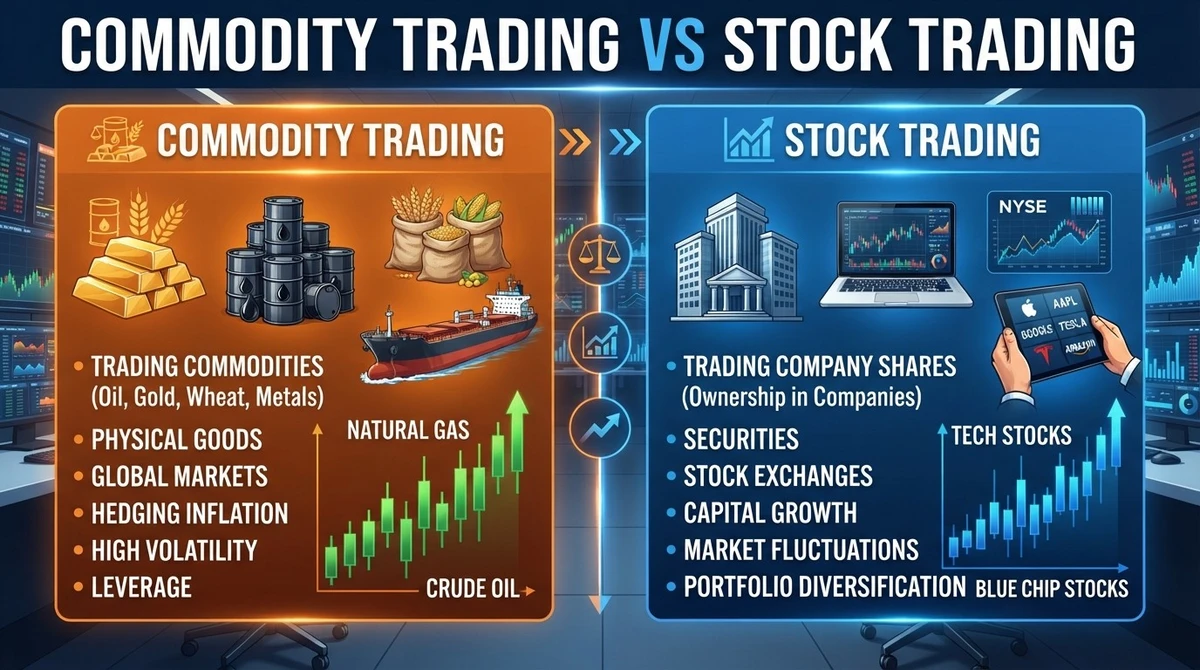
Commodity trading and stock trading can both involve buying and selling financial instruments to profit from price movements. But underneath that similarity, the two markets work very differently.
When you buy a stock, you generally acquire an ownership interest in a company. Your investment is connected to that company’s earnings, assets, competitive position, and future prospects.
Commodity trading is different. The underlying asset is a physical resource such as oil, gold, natural gas, wheat, copper, or coffee. Traders may gain exposure through futures contracts, exchange-traded products, or other instruments rather than owning the physical commodity itself.
That difference changes how traders analyze prices, manage risk, choose trading instruments, and build strategies.
Commodity prices can react sharply to weather, inventories, production disruptions, geopolitical events, and supply shortages. Stock prices can respond to earnings, interest rates, economic growth, management decisions, and investor expectations.
Understanding those differences is essential before deciding how either market fits into a trading strategy.
The Asset Behind the Trade Is Different
The simplest way to understand the difference is to look at what drives the underlying asset.
With stocks, the trader is dealing with a claim on a business.
A company can increase revenue, improve margins, launch new products, gain market share, reduce costs, or return capital to shareholders. Over time, those developments can influence the value of its shares.
Investor.gov describes stocks as securities representing ownership in a company, with potential returns coming from price appreciation and, for some stocks, dividends. (Investor.gov)
With commodities, there is no corporate earnings stream behind the underlying resource.
The price of crude oil, for example, depends heavily on production, inventories, transportation, refinery demand, and consumption. Gold can be influenced by investment demand, interest rates, currency movements, and geopolitical conditions. Agricultural commodities can be particularly sensitive to weather and crop conditions.
That means a commodity trader often has to think about physical supply and demand in a way a stock trader does not.
Commodity Trading Often Means Trading a Contract
One of the biggest differences appears in the way traders gain commodity exposure.
A commodity futures contract is an agreement to buy or sell a particular commodity at a future date under specified terms.
The CFTC explains that futures contracts are time-limited and that most contracts are closed before the delivery date rather than held through physical delivery. (CFTC)
That creates an important distinction from stock ownership.
A stock can generally be held indefinitely.
A futures contract cannot simply be held forever. It has an expiration date.
Commodity traders therefore have to think about contract months, expiration, rolling positions, and the relationship between futures prices and the underlying commodity.
For investors using commodity ETFs or other exchange-traded products, the structure can be different again. Some products use futures or other derivatives rather than directly owning the physical resource. The CFTC warns that the value of these products may not track the underlying commodity perfectly over time. (CFTC)
This is one reason the change in a commodity’s spot price and the return from a futures-based investment are not necessarily identical.
For readers interested in the different ways investors can gain commodity exposure, Economic Reader’s Best Commodity ETFs in the USA provides a broader look at commodity exchange-traded products.
Stock Trading Is More Closely Tied to Business Performance
Stock traders have a different set of information to analyze.
Important variables can include:
- Revenue growth
- Earnings
- Profit margins
- Cash flow
- Debt
- Management decisions
- Competitive advantages
- Industry conditions
- Valuation
- Investor expectations
A company can become more valuable because its underlying business becomes more profitable.
That gives stock traders an additional analytical layer.
They are not only asking:
“Will the price rise?”
They can also ask:
“Is the business becoming more valuable, and is the market price reasonable relative to that outlook?”
Investor.gov notes that stock prices can be affected by company-specific factors as well as broader economic and market conditions. (Investor.gov)
Commodity traders generally do not have an equivalent corporate earnings report to analyze.
Instead, they may focus on inventories, production forecasts, weather, consumption, export flows, transportation, and other supply-and-demand indicators.
Commodity Prices Can Move on Physical Events
A major supply disruption can change a commodity’s price very quickly.
Consider crude oil.
If a major producer experiences an unexpected production interruption while global demand remains strong, traders may immediately reassess available supply.
The same principle applies to agriculture.
A severe drought can reduce expected crop production.
A cold winter can affect natural-gas demand.
A mine disruption can reduce the expected supply of metals.
These events can create sharp price movements even when the broader economy has not changed dramatically.
The CFTC notes that energy commodities can be affected by supply and storage conditions, agricultural commodities by weather, and metals by industrial and macroeconomic factors. (CFTC)
This makes commodity trading particularly sensitive to physical market information.
Stocks Can Move Before the Business Changes
Stocks also respond to expectations.
A company’s shares may rise because investors believe earnings will increase in the future, even before those earnings appear in financial statements.
The reverse can happen too.
A company may report higher profits but see its stock fall if investors had expected an even stronger result.
This makes stock trading heavily dependent on the difference between:
What the market expects
and
What actually happens.
Commodity markets also incorporate expectations, but the information set is different. Traders may be pricing expected production, inventories, consumption, weather, and future supply conditions.
Understanding expectations is therefore important in both markets, but the evidence behind those expectations is different.
Leverage Changes the Risk
Leverage is one of the most important differences between ordinary stock trading and commodity futures trading.
Futures contracts generally require traders to post margin rather than paying the full notional value of the contract.
The CFTC explains that futures margin functions as a performance bond, and futures positions are marked to market as prices change. (CFTC)
That creates leverage.
A relatively small amount of capital can control a much larger market exposure.
Leverage can magnify gains.
It can also magnify losses.
If a futures position moves against the trader, additional funds may be required to maintain the position. The CFTC warns that futures trading can be highly volatile and that losses can exceed the amount initially deposited. (CFTC)
Stocks can also be traded on margin. FINRA notes that borrowing to buy stocks can magnify both gains and losses. (FINRA)
The important distinction is that leverage is built directly into the structure of many futures strategies, whereas a person buying shares outright does not automatically borrow money.
Trading Time Horizons Can Be Different
The two markets can accommodate different time horizons.
A stock investor may hold shares for years because the investment thesis depends on long-term business growth.
A commodity trader may focus on a much shorter price movement.
For example, a trader might position around:
- An inventory report
- A crop forecast
- A production announcement
- A weather event
- A geopolitical disruption
- A major economic release
That does not mean commodities are only for short-term trading.
Investors can hold commodity exposure for longer periods through different structures.
But futures-based exposure introduces additional considerations because contracts expire and may need to be rolled.
The intended holding period therefore matters when choosing the instrument.
Technical Analysis Can Matter More Than Many Traders Expect
Both stock and commodity traders use technical analysis, but commodity markets can produce distinctive price patterns because of their physical supply cycles.
Commodity traders may watch:
- Support and resistance
- Trend direction
- Momentum
- Volatility
- Seasonal patterns
- Open interest
- Futures curves
Stock traders can use many of the same tools while also incorporating company fundamentals.
For example, a stock trader might combine earnings analysis with price trends.
A commodity trader might combine inventory data with futures-market positioning and price structure.
Neither approach guarantees success.
The important point is that the information behind the price movement differs.
Seasonality Has a Different Role in Commodity Markets
Seasonality can be particularly important for some commodities.
Agricultural markets are an obvious example.
Planting and harvest cycles influence supply expectations.
Energy markets can also experience recurring seasonal demand patterns.
Natural gas demand, for example, can be strongly affected by heating and cooling requirements.
Stocks can have seasonal patterns too, but these are generally less directly connected to physical production cycles.
Commodity traders therefore sometimes need to understand the calendar of the underlying physical market, not just the financial market.
Commodity Trading Has a Special Rollover Problem
This is one of the areas where commodity trading becomes more complicated.
Suppose a trader wants continued crude-oil exposure through futures.
The current contract eventually approaches expiration.
The trader may need to close that contract and establish a position in a later contract.
The price difference between those contracts can affect returns.
When a later contract is more expensive than the expiring contract, the market is in contango. Rolling exposure in that environment can create a drag on returns under certain conditions.
When later contracts are cheaper, the market is in backwardation, which can have the opposite effect.
This means the return from a futures-based commodity strategy can differ substantially from the change in the commodity’s spot price.
The CFTC specifically warns that commodity exchange-traded products using futures and other derivatives may not track the underlying commodity’s price over time. (CFTC)
Stock ownership does not have this same futures-contract rollover issue.
Dividends Create Another Difference
Stocks can generate returns in two broad ways:
Capital appreciation and income such as dividends.
A company can distribute part of its profits to shareholders while the share price also changes.
Commodities do not generate corporate earnings or ordinary dividends.
A physical commodity can become more valuable, but it does not produce cash flow simply because an investor owns the underlying resource.
That changes the economics of holding the asset.
For stock traders, dividend expectations can influence valuation.
For commodity traders, returns are more directly connected to changes in the commodity price or to the structure of the instrument used to gain exposure.
The Main Risks Are Different
Both markets can lose money, but the sources of risk differ.
| Risk | Commodity Trading | Stock Trading |
| Price volatility | Can be high | Can be high |
| Business risk | Not applicable to the commodity itself | Major risk |
| Supply shocks | Major factor | Usually indirect |
| Weather risk | Important for some commodities | Usually indirect |
| Earnings risk | Not applicable | Major factor |
| Leverage risk | Significant in futures | Depends on use of margin |
| Expiration risk | Important for futures | Generally not applicable |
| Rollover risk | Important for futures-based exposure | Not applicable |
| Dividend income | No | Possible |
| Long-term fundamental growth | Driven by resource supply and demand | Directly tied to business growth |
The table does not mean one market is universally more risky.
Risk depends heavily on the instrument, strategy, leverage, position size, and holding period.
Investor.gov emphasizes that every investment involves risk and that different products have different combinations of risk, return, liquidity, and potential loss. (Investor.gov)
Commodity Trading Strategies Are Built Around Price Drivers
Commodity strategies can be designed around different market conditions.
Trend Following
A trader may attempt to participate in sustained upward or downward price movements.
This can be useful when a major supply or demand change creates a persistent trend.
But trends can reverse quickly, creating losses when a position is entered too late or maintained too long.
Event-Driven Trading
Some traders focus on events that can change supply or demand expectations.
Examples include:
- Inventory reports
- Crop reports
- Production announcements
- Geopolitical disruptions
- Weather forecasts
The challenge is that markets can react before official information is released or immediately after it becomes public.
Spread Trading
Instead of simply betting that a commodity will rise or fall, a trader can compare related contracts or commodities.
A strategy may focus on the price relationship between different delivery months, for example.
Spread trading can reduce some forms of outright price exposure, but it introduces its own risks and complexities.
Hedging
Commodity futures are not used only for speculation.
Businesses can use futures to manage price risk.
A farmer, for example, may sell futures to reduce exposure to falling crop prices. A company that needs a commodity as an input may use futures to reduce the risk of rising costs.
The CFTC describes hedging as an important economic function of futures markets because it can give producers and consumers greater certainty about future prices. (CFTC)
Stock Trading Strategies Have a Different Foundation
Stock traders can use a wide range of strategies.
Long-Term Investing
An investor buys shares based on expectations for long-term business growth.
The thesis may depend on earnings, cash flow, competitive advantages, or industry expansion.
For a broader introduction to the underlying asset, see Economic Reader’s What Is Stock?, which explains how stock ownership and company performance connect.
Value-Oriented Trading
A trader or investor may look for shares that appear inexpensive relative to their fundamentals.
The central question becomes whether the market is underestimating the business.
Growth-Oriented Trading
A trader may focus on companies with rapidly expanding revenue, earnings, or market opportunities.
Here, expectations and valuation become particularly important.
Momentum Trading
Momentum traders attempt to benefit from existing price trends.
The underlying company can still matter, but the immediate strategy focuses more heavily on price behavior and market participation.
These approaches can overlap, but they require different research and risk controls.
Liquidity and Trading Costs Matter
A strategy can look profitable before costs and become much less attractive after them.
Commodity futures can involve:
- Brokerage commissions
- Exchange fees
- Bid-ask spreads
- Margin requirements
- Financing costs
- Rollover effects
Stock trading can involve:
- Commissions or platform costs
- Bid-ask spreads
- Margin interest
- Taxes
- Fund expenses when using ETFs
Investor.gov notes that fees and costs can materially affect investment results over time, making it important to understand the total cost of an investment or trading strategy. (Investor.gov)
For active traders, transaction costs can become especially important because frequent trading creates more opportunities for costs to reduce returns.
What Information Should Traders Watch?
The research process is different because the economic drivers are different.
A commodity trader may monitor:
Supply: production, inventories, exports, weather, and disruptions.
Demand: industrial activity, transportation, consumer use, and seasonal demand.
Macro factors: interest rates, currencies, inflation, and economic growth.
Market structure: futures curves, open interest, and contract spreads.
A stock trader may focus more heavily on:
Business performance: revenue, earnings, margins, and cash flow.
Valuation: P/E, price-to-sales, free-cash-flow measures, and other valuation metrics.
Corporate developments: products, acquisitions, management changes, and competitive conditions.
Macro conditions: rates, inflation, consumer demand, and credit conditions.
Both markets require research.
But the questions asked by the trader are different.
Choosing Between Commodity and Stock Trading Starts With the Strategy
There is no need to treat commodity trading and stock trading as competing versions of the same activity.
They can serve different purposes.
Commodity trading may appeal to traders who want direct exposure to resource prices and are comfortable analyzing supply-and-demand conditions. It can also be relevant for businesses and market participants seeking hedging tools.
Stock trading may suit strategies built around company fundamentals, earnings growth, valuation, dividends, or long-term ownership.
But the distinction should not become too rigid.
Investors can gain commodity exposure through ETFs or other products without directly trading futures.
Likewise, stock traders can use derivatives and margin, making their strategies considerably more complex than simply buying shares.
The instrument matters as much as the asset class.
Before choosing either market, a trader should understand the specific product, leverage, liquidity, costs, and downside scenarios involved.
Risk Management Starts With the Position, Not the Prediction
The most important question is not simply whether a commodity or stock will rise.
It is how much damage a wrong prediction could cause.
A commodity futures position can expose a trader to leverage, margin requirements, expiration, rollover effects, and rapid price movements. The CFTC describes commodity futures and options as volatile and complex products and warns that losses can exceed the initial amount deposited. (CFTC)
A stock position can lose value because of disappointing earnings, economic weakness, changing valuations, industry disruption, or company-specific events. Investor.gov likewise emphasizes that stock prices can fluctuate and that investors can lose money. (Investor.gov)
That makes position sizing important in both markets.
Before entering a trade, consider:
- How much capital can be lost without damaging the broader financial plan?
- How large should the position be?
- Is leverage necessary?
- What would invalidate the trading thesis?
- How liquid is the position?
- What happens if the market moves sharply?
- Can the position survive a period of extreme volatility?
For a broader framework, Economic Reader’s What Is Risk Management in Investing? explores position sizing, concentration, leverage, liquidity, diversification, and behavioral risk.
The CFTC also advises futures traders to use risk capital money they can afford to lose rather than funds needed for essential expenses or financial obligations. (CFTC)
Can Commodities and Stocks Be Used Together?
Yes.
The two markets are driven by different economic forces, which can make them complementary within a broader portfolio.
Stocks provide exposure to businesses and their earnings.
Commodities provide exposure to resource prices.
The relationship between them can change over time.
For example, rising commodity prices may benefit some energy or mining companies while increasing costs for businesses that consume those commodities as inputs.
That means owning a commodity and owning a company connected to that commodity are not the same trade.
Investor.gov notes that diversification involves spreading investments across different assets and that the appropriate allocation depends on factors such as time horizon and risk tolerance. (Investor.gov)
Economic Reader’s Best Commodity ETFs in the USA provides more detail on one way investors can gain commodity exposure without directly holding physical commodities.
The Key Difference Is What You Are Actually Trading
Commodity trading and stock trading may look similar on a trading screen, but the economic foundations underneath them are very different.
A stock trader is ultimately dealing with a business.
A commodity trader is dealing with a resource market.
That difference affects:
- What moves prices
- What information matters
- How positions are structured
- How leverage works
- How long positions can be held
- How returns are generated
- What risks need to be managed
Stocks can benefit from long-term business growth and dividends, while commodities can respond rapidly to changes in supply, demand, inventories, weather, production, and global economic conditions.
Neither market needs to be treated as universally superior.
The more useful question is what type of exposure, trading instrument, and strategy are you actually trying to create?
A trader who understands that distinction can make a more informed decision about the market, product, position size, and risk before focusing on the potential return.