Commodity vs Stocks vs Bonds: How the Three Asset Classes Differ and When Each Makes Sense
Commodity vs Stocks vs Bonds
Stocks, bonds, and commodities can all appear in the same investment portfolio, but they are not three versions of the same investment.
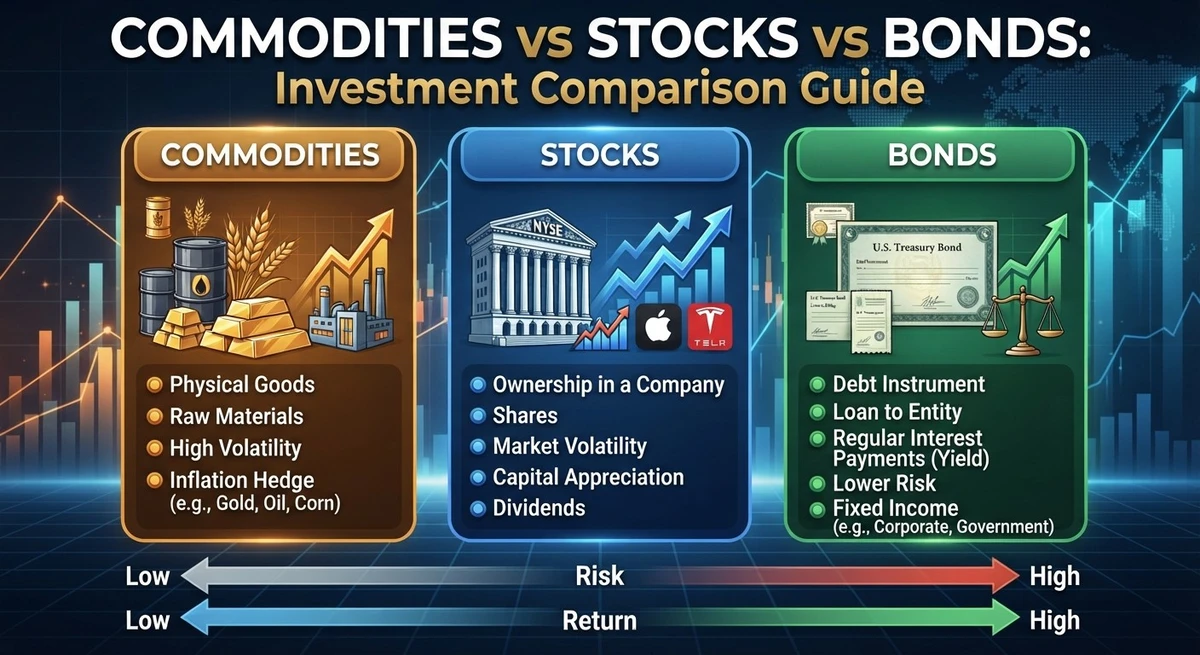
A stock gives you ownership in a business. A bond represents lending to an issuer. A commodity gives you exposure to the price of a physical resource or raw material.
That difference changes almost everything: what drives returns, where income comes from, how an investment reacts to inflation and interest rates, and what can cause it to lose value.
Economic Reader already explains what stocks are and how bonds work. This article takes a different approach. Instead of explaining each asset class from scratch, it looks at the economic exposure an investor is actually buying and the situations in which each type of asset can serve a different portfolio role.
The Three Assets Are Driven by Different Things
The simplest way to understand the difference is to look at what sits underneath each investment.
Stocks are tied to businesses.
When you own stock, you own part of a company. Your potential return depends on factors such as earnings, growth prospects, competitive position, cash flow, dividends, and what investors are willing to pay for future results. (Investor.gov)
Bonds are tied to lending.
When you buy a bond, you are lending money to a government, company, or other issuer. Your return can come from interest payments and changes in the bond’s market price.
Commodities are tied to resources and their prices.
Gold, oil, copper, wheat, natural gas, and other commodities are influenced by supply, demand, inventories, production, weather, geopolitics, and global economic activity.
So an investor is not simply choosing between three products.
They are choosing between three different economic exposures.
Stocks: A Claim on Business Growth
The return engine behind stocks is the business itself.
If a company increases sales, expands margins, generates more cash, and becomes more valuable, shareholders can benefit.
That gives stocks an important long-term growth characteristic.
A successful company can grow without requiring the investor to sell the underlying asset. It can reinvest in new products or markets and may eventually return cash to shareholders through dividends or share repurchases.
But that growth comes with uncertainty.
A company can lose market share, face higher costs, experience weak demand, accumulate too much debt, or fail to grow as investors expected.
Stock prices can also fall even when a business remains profitable if investors decide its future earnings are worth less than previously assumed.
Stocks are therefore closely connected to earnings, growth, and expectations.
For a deeper introduction, see Economic Reader’s What Is Stock?.
Bonds: A Claim on Cash Flows
Bonds work differently.
The investor is not buying ownership of a company. The investor is lending money to an issuer under defined terms.
That changes the return profile.
A bond may provide scheduled interest payments and repayment of principal at maturity, although the issuer’s ability to meet those obligations depends on its financial condition.
Bond prices can also move before maturity.
Interest rates are particularly important. When market interest rates rise, existing bonds with lower coupons generally become less attractive, putting downward pressure on their market prices. Credit quality and maturity also affect risk.
That means the main economic exposure of bonds is contractual cash flows, interest rates, and credit risk.
Economic Reader’s What Is a Bond? covers the basic mechanics in more detail.
Commodities: Exposure to the Price of a Resource
Commodities are different again.
When an investor gains exposure to gold, oil, copper, agricultural products, or other commodities, the return is generally linked to movements in the underlying resource rather than the earnings of a particular company.
Supply and demand can therefore become the central story.
Oil prices can respond to production changes, inventories, geopolitical disruptions, transportation problems, and global demand.
Agricultural commodities can be heavily affected by weather and harvest conditions.
Industrial metals can respond to manufacturing, construction, infrastructure spending, and mining supply.
Gold has a different set of drivers, including investment demand, central-bank activity, interest rates, real yields, currency movements, and market uncertainty.
Unlike stocks, a commodity does not generate corporate earnings simply because you hold it. Unlike a bond, it does not promise contractual interest payments.
The investment case is largely about price movements and the forces behind them.
The Return You Receive Is Not the Same Kind of Return
This is one of the most important differences between the three asset classes.
Imagine three investors each put $10,000 into different assets.
The stock investor owns part of a business.
The bond investor has a claim on contractual payments from an issuer.
The commodity investor has exposure to the price of a resource.
All three can produce gains, but the mechanism is different.
For stocks, returns can come from:
- Share-price appreciation
- Dividends
For bonds:
- Interest income
- Price appreciation or losses before maturity
For commodities:
- Changes in the commodity’s price
- Additional effects from the investment vehicle used to obtain exposure
That last point matters because investors do not always own commodities directly.
Commodity exposure can come through physical holdings, futures contracts, commodity funds, trusts, or exchange-traded products. Some commodity ETPs use futures rather than owning the physical commodity, which means their performance can differ from the underlying spot price. Futures contracts also expire and may need to be rolled into later contracts. (CFTC)
So “investing in oil” or “investing in gold” does not necessarily describe the full investment.
The structure used to obtain the exposure matters too.
Inflation Can Affect All Three – But Differently
Inflation is often used as a reason to own commodities, but the relationship is more complicated than “inflation rises, commodities rise.”
Commodity prices can respond directly to supply constraints and changes in demand. During periods of broad price pressure, that can make commodity exposure behave differently from traditional financial assets.
Stocks have a more indirect relationship with inflation.
A company with pricing power may be able to increase prices and protect revenue. Another company may see wages, energy, transportation, or financing costs rise faster than its revenue.
Bonds face a different problem.
Fixed payments can lose purchasing power when inflation rises. Higher inflation can also contribute to higher interest rates, which can pressure existing bond prices.
So inflation does not automatically make one asset class attractive.
It changes the environment in which each asset operates.
For a broader explanation of the relationship between inflation and investments, see How Inflation Affects Your Money.
Interest Rates Create Another Major Difference
Interest rates have an especially direct effect on bonds.
When rates rise, existing bond prices generally fall, with longer-duration bonds typically more sensitive to rate changes.
Stocks also respond to interest rates, but through several channels.
Higher rates can increase borrowing costs for businesses, affect consumer spending, and change the valuation investors place on future corporate earnings.
Commodities can respond differently.
Higher rates may affect demand, currency values, investment flows, and the opportunity cost of holding assets that do not generate traditional interest income.
Gold is a useful example. Its price can respond to real yields, the U.S. dollar, central-bank demand, and investor positioning rather than simply moving in the same direction as interest rates every time.
The same monetary environment can therefore produce very different effects across the three asset classes.
Commodities Are Not One Single Investment
Calling something a “commodity investment” can hide major differences.
Gold is not oil.
Oil is not copper.
Copper is not wheat.
Their economic drivers can be completely different.
Energy commodities are heavily influenced by production, inventories, transportation, and global energy demand.
Agricultural commodities can be heavily affected by weather and harvest conditions.
Industrial metals can respond to manufacturing, construction, infrastructure spending, and the business cycle.
Precious metals have their own monetary and investment characteristics.
This is also why a broad commodity fund is not equivalent to owning gold.
Economic Reader’s Best Commodity ETFs in the USA looks more closely at physical commodity exposure, futures-based products, costs, liquidity, and fund structures.
The CFTC also warns that commodity ETPs and futures can involve risks that differ substantially from traditional stock and bond investments. (CFTC)
Risk Is Different Rather Than Simply Higher or Lower
Investors often try to arrange asset classes from “safe” to “risky.”
That can be misleading.
A short-term government bond and a speculative commodity futures position obviously have very different risks. But even within one asset class, risk can vary considerably.
Stocks can face:
- Business risk
- Market risk
- Valuation risk
- Sector concentration
Bonds can face:
- Interest-rate risk
- Credit risk
- Inflation risk
- Reinvestment risk
- Duration risk
Commodities can face:
- Large price swings
- Supply shocks
- Demand shocks
- Geopolitical risk
- Weather risk
- Futures-related risks
The CFTC describes commodity futures and options as volatile and complex products that can be unsuitable for many retail investors. (CFTC)
The more useful question is therefore not simply:
“Which asset is safest?”
It is:
“Which risks am I actually taking?”
Liquidity and Access Also Matter
Stocks and bonds can usually be accessed through conventional brokerage accounts.
Commodities require more attention because the investment method matters.
Buying physical gold is different from buying a gold-related exchange-traded product.
Buying an oil futures contract is very different from buying an energy company’s stock.
A futures contract has an expiration date and represents an agreement involving a commodity at a future date rather than permanent ownership of the underlying resource.
That means two investments that appear to provide exposure to the same commodity can produce different results.
For an investor, the investment structure is part of the decision.
When Stocks Can Fit a Portfolio
Stocks can fit when the portfolio needs long-term exposure to business growth.
They may be relevant for someone who has:
- A long investment horizon
- A need for capital-growth potential
- The ability to tolerate market volatility
- A desire for exposure to corporate earnings
- Long-term goals such as retirement investing
The important point is not that stocks are always appropriate.
It is that stocks solve a particular portfolio problem: participating in the growth of businesses.
That makes them fundamentally different from an investment whose return depends mainly on interest payments or commodity prices.
When Bonds Can Fit a Portfolio
Bonds can serve a different role when a portfolio needs income, contractual cash flows, or exposure to fixed-income markets.
They may be relevant when an investor:
- Wants interest income
- Has future cash-flow needs
- Wants to reduce dependence on equity-market performance
- Is approaching a financial goal
- Wants a different source of portfolio risk
But bonds are not risk-free.
Interest rates, inflation, credit quality, maturity, and duration can all affect results.
The important distinction is that a bond investor is generally buying a different type of claim from a stock investor: a lending relationship rather than an ownership stake.
When Commodities Can Fit a Portfolio
Commodities can serve a different purpose when an investor wants exposure to resource prices and supply-and-demand conditions.
That may be relevant when someone wants to:
- Diversify beyond traditional financial assets
- Gain exposure to commodity markets
- Express a view on a specific resource
- Add an asset whose price drivers differ from corporate earnings and bond cash flows
But commodity exposure requires more product-level understanding than simply choosing “commodities” from a menu.
An investor needs to know whether the exposure comes from physical holdings, futures, an ETP, or another structure, and what costs or risks come with that structure.
Could the Three Assets Work Together?
They can.
The point of comparing asset classes is not necessarily to select one and reject the others.
A portfolio can contain stocks for business-growth exposure, bonds for income and a different source of risk, and commodities for resource-price exposure.
This is the basic logic behind asset allocation and diversification. Investor.gov explains that the appropriate asset mix depends on factors such as an investor’s time horizon and risk tolerance, while diversification can spread exposure across different assets. (Investor.gov)
But diversification does not mean simply adding more asset classes.
The investments still need to fit the investor’s objective.
Someone saving for a goal in two years has a different problem from someone investing for retirement several decades away.
Someone whose income already depends heavily on the energy industry may also have a different reason to add or avoid additional energy-related exposure.
The starting portfolio matters.
Your Existing Portfolio Changes the Answer
An asset can look attractive on its own but make less sense when viewed alongside everything else you own.
Consider an investor who already has:
- A stock-heavy retirement account
- A job in the energy industry
- A large cash reserve
- A short-term financial goal
Adding more energy-related commodity exposure could create a very different portfolio from what the investor intended.
Another investor may have a portfolio dominated by stocks but little exposure to fixed income or commodities.
The same asset can therefore serve a different role depending on the starting point.
That is why asset allocation is not simply about finding the asset with the highest expected return.
It is about deciding which exposures your portfolio needs and how much risk you can accept.
The Most Useful Comparison Is the Return Engine
A simple comparison makes the difference clearer:
| Asset class | What you own or gain exposure to | Main return drivers | Key risks |
| Stocks | Ownership in businesses | Earnings, growth, dividends, valuation | Business risk, market volatility |
| Bonds | Debt issued by governments or companies | Interest income, rates, credit, price changes | Interest-rate, credit, inflation risk |
| Commodities | Exposure to physical resources or commodity prices | Supply, demand, inventories, macro conditions | Price volatility, supply shocks, futures risks |
This is more useful than simply labeling one asset “high risk” and another “low risk.”
The real question is what causes the investment to make or lose money.
Start With the Job You Want the Asset to Do
Instead of asking:
“Should I buy commodities, stocks, or bonds?”
start with a more useful question:
“What do I need this part of my portfolio to do?”
If the answer is growth through business ownership, stocks provide that exposure.
If the answer is income and contractual cash flows, bonds may address that need.
If the answer is exposure to resource prices and commodity-market conditions, commodities provide a different type of exposure.
Then consider the practical constraints:
What is my time horizon?
Money needed soon presents a different problem from money that can remain invested for decades.
What risks can I tolerate?
An investment’s volatility matters more when the money may be needed during a downturn.
What do I already own?
The right asset in isolation may be the wrong addition to an already concentrated portfolio.
How am I getting the exposure?
This is especially important with commodities, where physical assets, futures, and exchange-traded products can behave differently.
Investor.gov notes that asset allocation is personal and can change as an investor’s time horizon and risk tolerance change. (Investor.gov)
There Is No Single “Best” Asset Class
Stocks, bonds, and commodities are often compared as though investors are choosing three competing products.
They are not.
They represent different relationships with the economy.
Stocks connect an investor to business ownership and future earnings.
Bonds connect an investor to lending, interest payments, and credit.
Commodities connect an investor to resources, supply, demand, and price movements.
That is the key distinction.
The useful comparison is not which asset has performed best recently or which one sounds safest.
It is which economic exposure fits the investor’s objective, time horizon, existing portfolio, and ability to tolerate losses.
Once that question is clear, the differences between commodities, stocks, and bonds become much easier to understand.