
Commodity Investing vs Stock Investing: Which Is Better for Investors?

Commodity Investing vs Stock Investing
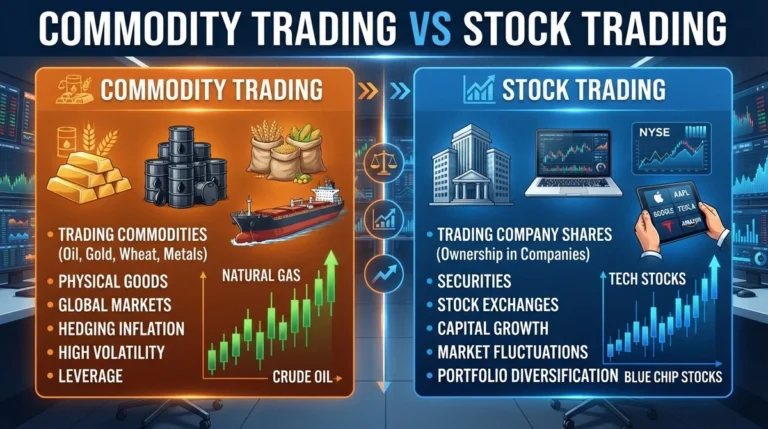
Investors often compare commodities and stocks as if they are competing versions of the same investment. They are not.
Stocks give investors an ownership interest in businesses. Commodities provide exposure to physical resources such as oil, gold, copper, wheat, and natural gas. Because the underlying assets are different, the forces driving their returns can also be very different.
That makes the more useful question less about which asset is universally better and more about what an investor wants the investment to do.
A stock portfolio may be built around long-term business growth, earnings, and dividends. Commodity exposure may be used to participate in changes in resource prices, diversify financial-asset exposure, or respond to specific economic conditions.
Understanding those differences can make the comparison much more useful.
The Return Comes from a Different Source
The biggest difference between stocks and commodities is what ultimately creates value for the investor.
When you own a stock, you own part of a business. Your return can come from an increase in the company’s value and, in some cases, dividends.
For readers who want a basic explanation of stock ownership before going deeper into this comparison, Economic Reader’s What Is Stock? provides that foundation.
Stock investors are therefore connected to factors such as:
- Revenue growth
- Profit margins
- Earnings
- Business expansion
- Dividends
- Valuation
- Interest rates
- Investor expectations
Commodities work differently.
A commodity does not generate corporate earnings or pay dividends simply because you own it. Its price is influenced heavily by supply, demand, inventories, production, transportation, weather, geopolitics, and economic activity.
For example, oil prices can respond to production disruptions or changes in global fuel demand. Agricultural commodities can be affected by weather and harvest conditions. Industrial metals can respond to manufacturing and construction activity.
This creates two very different investment experiences.
Stocks Have a Built In Growth Mechanism
One reason stocks can be powerful long-term investments is that businesses can grow.
A company can increase sales, expand into new markets, improve productivity, launch new products, reduce costs, or gain market share.
If those improvements increase earnings and the market values the business more highly, shareholders can benefit.
This creates a long-term connection between economic activity, business growth, and shareholder returns.
Stocks can also distribute part of their profits through dividends, giving investors another potential source of return. The SEC’s Investor.gov explains that investors can seek returns from stocks through both capital appreciation and dividend payments. (Investor)
Commodities do not have this same mechanism.
A barrel of oil does not become more productive because the global economy grows. An ounce of gold does not generate additional ounces through retained earnings.
Commodity returns therefore depend much more directly on changes in the price of the underlying resource and, depending on the investment vehicle, the structure used to obtain that exposure.
Commodity Prices Respond to the Physical Economy
Commodities are closely connected to the real economy.
When global fuel demand rises while production struggles to keep up, oil prices can increase. If supply expands faster than demand, prices can move in the opposite direction.
Agricultural commodities have another set of drivers. Weather conditions can affect harvests, while planting decisions, inventories, transportation, and global demand can influence prices.
Industrial metals such as copper can respond to construction, manufacturing, infrastructure investment, and broader industrial activity.
Gold has a different economic role. Its price can be influenced by interest rates, inflation expectations, currency movements, central-bank activity, and investor demand.
This means commodity investing is not one single economic exposure.
Gold, oil, copper, and agricultural commodities can behave very differently.
For investors interested specifically in commodity-market exposure through exchange-traded products, Economic Reader’s Best Commodity ETFs in the USA looks at the differences between physical commodity products, futures-based products, and broader commodity funds.
Stocks Respond to the Economy Through Businesses
The stock market also responds to the economy, but through companies.
Suppose consumer spending increases. A retailer may sell more products. A manufacturer may receive more orders. A logistics company may transport more goods. A technology company may sell more software.
If those companies convert stronger demand into higher profits, their valuations may benefit.
The opposite can happen during an economic slowdown.
Lower demand can reduce sales, while higher borrowing costs, wages, energy prices, or other expenses can squeeze profit margins.
This is why stock investing is closely connected to the health and expectations of businesses rather than simply the price of a physical resource.
Investors who want to go beyond share prices and understand the financial health of businesses can also use financial statements to examine revenue, profits, debt, and cash flow.
Inflation Creates Different Effects
Inflation is one of the most common reasons investors consider commodities.
There is some logic behind that approach. When energy, food, metals, and other raw materials become more expensive, commodity prices can rise alongside broader price pressures.
But commodities do not automatically outperform stocks whenever inflation increases.
The relationship depends on what is causing inflation and how companies respond.
Businesses with strong pricing power may be able to pass higher costs to customers. Others may experience margin pressure if input costs rise faster than their selling prices.
At the same time, a commodity can rise sharply because of a supply disruption even when economic growth is weak.
So inflation can affect both asset classes, but through different channels.
Income Is a Major Difference
Stocks can potentially provide two sources of return:
- Capital appreciation
- Dividend income
Some companies distribute part of their profits to shareholders.
Commodities generally do not provide an equivalent income stream.
If you own physical gold, for example, the gold itself does not pay a dividend.
This distinction matters for investors who want portfolio income. An investor focused on cash flow may evaluate a dividend-paying stock differently from an asset whose primary potential return comes from price appreciation.
Commodity Exposure Can Be More Complicated Than It Looks
Buying a stock is relatively straightforward: you purchase ownership in a company.
Commodity exposure can be obtained in several ways, including physical commodities, futures contracts, commodity-focused funds, exchange-traded products, or shares of commodity-producing companies.
These approaches are not interchangeable.
For example, owning an oil producer does not give you the same exposure as owning oil futures. The company has operating costs, debt, labor expenses, management decisions, capital spending, and other business risks.
Futures-based exposure introduces another issue: contracts expire.
An investment product using futures may need to replace an expiring contract with a later one. Depending on the shape of the futures market, that process can either reduce or potentially support returns.
The CFTC’s guidance on commodity ETPs and funds explains that futures-based commodity products can behave differently from traditional stock or bond funds and that rolling futures contracts can affect returns.
This means the price of the commodity itself and the return of a commodity investment product can sometimes differ.
Risk Looks Different in Each Market
Neither asset class is automatically safe.
Stocks face:
- Company-specific risk
- Market volatility
- Earnings risk
- Valuation risk
- Interest-rate sensitivity
- Economic slowdown risk
Commodities face:
- Supply shocks
- Demand changes
- Weather risk
- Geopolitical disruptions
- Storage and transportation issues
- Futures-market risk
- Significant price volatility
The risk also depends on how exposure is obtained.
A diversified stock fund is different from owning one highly volatile company. Likewise, broad commodity exposure is different from concentrating on a single commodity such as natural gas or crude oil.
The asset class alone does not tell the whole risk story.
For direct futures investors, the risks can be considerably higher. The CFTC describes commodity futures and options trading as volatile, complex, and risky and warns that losses can exceed the initial amount invested in some circumstances. (Commodity Futures Trading Commission)
Time Horizon Changes the Comparison
Time horizon is particularly important when comparing these investments.
A business can potentially grow for decades. It can reinvest profits, develop new products, acquire competitors, expand internationally, and increase earnings.
That creates a natural long-term growth mechanism for equities.
Commodities do not have the same compounding mechanism.
A commodity price can rise substantially, fall sharply, and recover later, but the physical commodity itself does not generate earnings that can be reinvested.
This does not make commodities unsuitable for long-term portfolios. It means the reason for holding them is usually different.
An investor may hold commodities for diversification, inflation-related exposure, or a specific view about supply and demand rather than expecting the underlying commodity to compound earnings.
Diversification Does Not Mean Opposite Performance
Stocks and commodities can sometimes behave differently because their primary economic drivers are different.
That can make commodity exposure useful as one component of a diversified portfolio.
But different exposure does not mean opposite performance.
Stocks and commodities can both rise during periods of strong economic demand. They can also both fall during periods of severe financial stress.
The useful question is therefore not whether commodities will always move against stocks.
It is whether adding a different source of economic exposure can reduce how dependent a portfolio is on one particular set of conditions.
Investor.gov notes that diversification involves spreading investments across different assets and within asset classes, while also emphasizing that diversification cannot guarantee protection from market losses. (Investor)
A Practical Way to Compare Them
Instead of asking which asset class is better in general, investors can start with the objective they are trying to achieve.
| If the main objective is… | Exposure that may be relevant |
| Long-term participation in business growth | Stocks |
| Potential dividend income | Dividend-paying stocks |
| Direct exposure to resource prices | Commodities |
| Exposure to selected inflation-sensitive assets | Certain commodities |
| Diversifying a portfolio dominated by financial assets | Potentially commodities alongside stocks |
| Expressing a specific view on supply and demand | Relevant commodity exposure |
| Long-term earnings compounding | Stocks |
This is not a ranking of the two asset classes. It is a way to match the investment to the job it is supposed to perform.
An investor should also ask what could make the investment thesis wrong.
For a stock, that might be falling earnings, excessive valuation, weak competitive positioning, or rising costs.
For a commodity, it might be stronger-than-expected supply, weaker demand, changing inventories, or a reversal in the economic conditions supporting the price.
The Portfolio Question Matters More Than the Asset Class Question
Investors do not necessarily have to choose between stocks and commodities.
A portfolio can contain both.
For example, stocks may serve as the primary long-term growth exposure while a smaller commodity allocation provides a different source of economic exposure.
The appropriate mix depends on factors such as investment objectives, time horizon, risk tolerance, liquidity needs, and the rest of the portfolio.
Investor.gov similarly notes that asset allocation depends on an investor’s time horizon and risk tolerance, while diversification can spread exposure across different types of assets. (Investor)
This also means investors should avoid judging either asset class in isolation.
A commodity that appears attractive on its own may not improve a portfolio if it creates too much concentration. Likewise, a stock portfolio may already be heavily exposed to the same economic risks an investor is trying to diversify.
The role of the investment matters as much as the investment itself.
So, Which Is Better for Investors?
There is no universal winner between commodity investing and stock investing because they are designed around different economic exposures.
Stocks connect investors to businesses, earnings, innovation, productivity, and long-term corporate growth.
Commodities connect investors more directly to resource prices shaped by supply, demand, inventories, production, weather, geopolitics, and global economic activity.
For an investor seeking long-term participation in business growth and potential dividend income, stocks may be the more natural fit.
For an investor seeking direct exposure to resource prices, a specific commodity cycle, or another source of portfolio diversification, commodities may have a different role.
And for some portfolios, the relevant answer may be a combination rather than an either-or decision.
The better approach is to start with the objective, identify the economic exposure required, understand how the investment generates returns, and then consider the risks and costs involved.
That turns the question from “Which asset is better?” into a more useful one:
“What role should this investment play in my portfolio?”
That is the question that can lead to a more informed investment decision.