iRobot Roomba Max 875 Combo Review: Is This $1,199 Robot Vacuum Worth It?
iRobot Roomba Max 875 Combo review
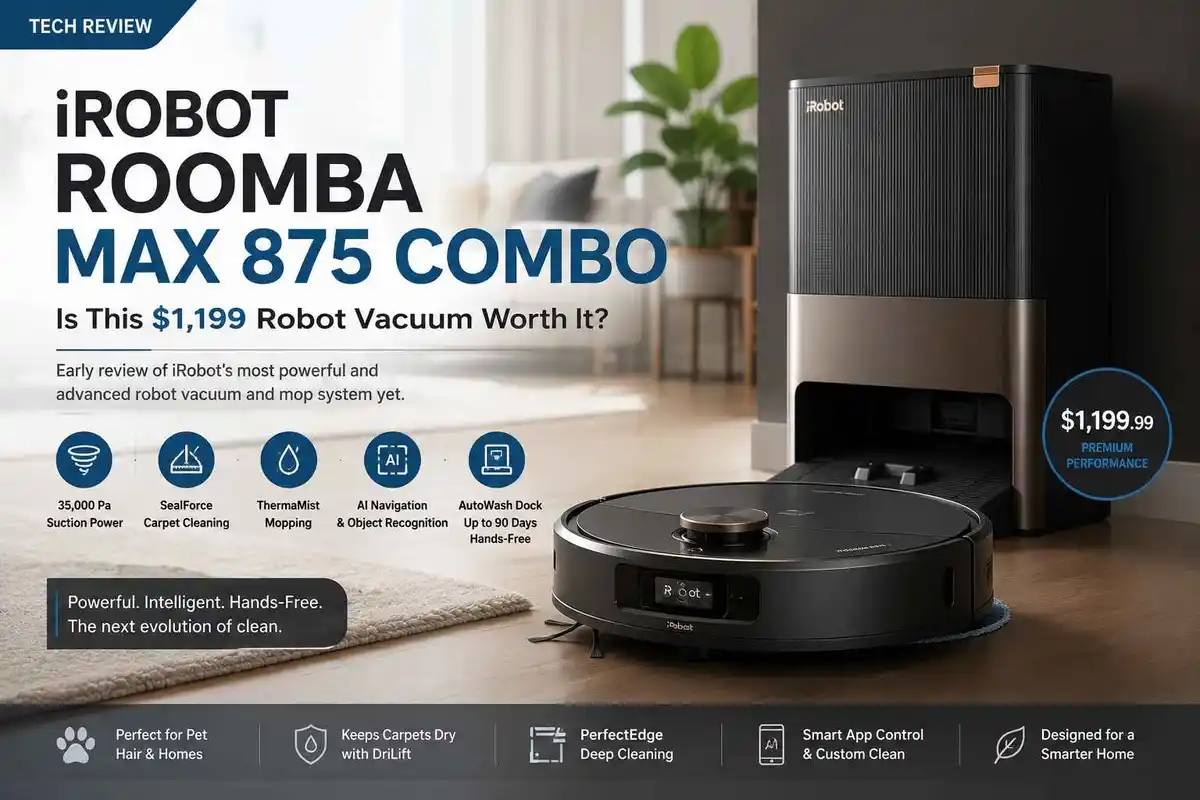
The iRobot Roomba Max 875 Combo is designed to do more than vacuum and mop your floors. At $1,199.99, it is positioned as a premium cleaning system built around deeper carpet cleaning, tougher stain removal, carpet protection and reduced day to day maintenance.
That price makes the usual robot-vacuum specification race less useful. The important question is not simply whether 35,000 Pa suction sounds impressive. It is whether the Max 875’s technology actually solves household cleaning problems well enough to justify paying hundreds of dollars more than a capable mid range robot.
The answer is more nuanced than a simple yes or no.
The Max 875 introduces iRobot’s SealForce vacuuming system, ThermaMist heated-mist mopping, a larger PowerSpin Max roller, DriLift carpet protection, AI powered navigation and an AutoWash dock. iRobot’s official launch material presents these as solutions to specific problems rather than just bigger numbers. (iRobot MediaKit)
Disclosure: This is an early, research based review rather than a hands on test. The Roomba Max 875 is a newly launched model, so extensive independent long-term testing is not yet available. The analysis below separates iRobot’s stated performance claims from what can currently be evaluated from the technology, pricing and independent coverage.
What You Are Actually Paying For
The Roomba Max 875 currently costs $1,199.99 on iRobot’s U.S. site. The company’s lineup includes less expensive options such as the Max 775 Combo at $799.99, making the Max 875 a substantial step up in price. (iRobot)
So what does the extra money buy?
Not simply more suction.
The Max 875 combines several technologies aimed at different problems:
- SealForce for deeper carpet pickup
- ThermaMist for dried-on stains
- PowerSpin Max for more aggressive roller scrubbing
- DriLift to protect carpets while mopping
- PrecisionVision AI and LiDAR for navigation and obstacle avoidance
- AutoWash automation for roller washing, drying, solution dispensing and debris emptying
The value of the machine therefore depends on how many of those problems exist in your home.
If you mainly need routine dust and debris removal from hard floors, paying $1,199.99 may be difficult to justify. If you have carpets, pets, frequent spills and want to minimize manual cleaning work, the calculation changes.
SealForce: Why the 35,000 Pa Number Is Not the Whole Story
The Max 875 has a headline suction rating of 35,000 Pa, alongside 20 L/s airflow.
Those numbers sound impressive, but suction power alone does not tell you how well a robot will clean a carpet. The way airflow reaches the surface matters too.
That is the idea behind SealForce.
Instead of simply increasing motor power, iRobot designed the robot’s chassis to create a tighter seal against carpet fibers. The goal is to reduce air escaping around the cleaning area and concentrate airflow where debris is embedded.
That is a more meaningful engineering change than simply adding another large suction number.
iRobot claims SealForce provides 3× deeper carpet cleaning compared with cleaning without the sealing system. That figure should be treated as a manufacturer comparison rather than an independently established performance benchmark. (iRobot MediaKit)
In practical terms, SealForce could matter most in homes where ordinary surface vacuuming is not enough. Think of fine debris, pet hair and particles pushed deeper into carpet fibers.
The important point for buyers is that 35,000 Pa does not automatically make the Max 875 better than every competing robot. The real test will be how effectively its airflow, brush design and surface contact translate into pickup on different carpets.
That is also why the Max 875 is more interesting than a conventional “high suction” robot: iRobot is trying to change how the available suction is applied.
ThermaMist Targets a Different Problem: Dried On Dirt
The mopping system addresses another common weakness of robot vacuums.
A robot can easily spread water across a floor. Removing dried food, drink residue or sticky marks is much harder.
The Max 875 uses ThermaMist, an ultrasonic heated-mist system that pre-treats the surface while the robot mops. The purpose is to soften dried residue before the roller scrubs it.
This is where the technology could have practical value.
Consider a kitchen floor where a small spill has dried overnight. A conventional robot mop may repeatedly pass over the area without applying enough targeted treatment to remove it completely. Pre treating the residue changes the cleaning process: loosen first, scrub second.
The PowerSpin Max roller then operates at up to 300 RPM, with 18 Newtons of downward pressure. iRobot claims 2× better stain removal with ThermaMist and 3.75× deeper scrubbing from the new roller. Those figures remain manufacturer claims until broader independent testing becomes available. (iRobot MediaKit)
Independent coverage has also identified ThermaMist as one of the Max 875’s most distinctive features, particularly because it approaches dried-on dirt through pre-treatment rather than relying entirely on mechanical scrubbing. (TechRadar)
That makes ThermaMist potentially more valuable than another incremental increase in mopping speed.
DriLift Solves the Carpet and Mop Problem
Mixed flooring creates a simple but important problem for robot mops: wet cleaning is useful on hard floors but undesirable on carpets.
The Max 875 uses DriLift to detect carpet, raise the mop and deploy a protective shield designed to keep the roller away from the carpet.
For a home with hardwood, tile, rugs and carpet, this matters more than it might initially appear.
A premium robot is supposed to reduce supervision. If you have to create complicated no-mop zones or constantly check whether the machine has dragged a wet mop onto a rug, some of that convenience disappears.
DriLift therefore contributes to the Max 875’s value not because it makes the robot clean harder, but because it makes mixed-floor automation more practical.
Navigation Is Part of Cleaning Performance
The Max 875 uses ClearView Pro Dual Line LiDAR and PrecisionVision AI. iRobot says the system can recognize and avoid more than 300 common household objects. (iRobot MediaKit)
That matters because cleaning performance is partly a navigation problem.
A robot with excellent suction can still deliver disappointing results if it gets stuck, repeatedly misses rooms or cannot safely navigate around everyday objects.
The Max 875’s combination of mapping, obstacle recognition and room-specific cleaning allows the robot to make more decisions without constant supervision.
For readers interested in the broader role of AI in consumer technology, the distinction between an AI feature and what that feature actually changes in a product is important. Economic Reader’s AI vs. Machine Learning vs. Deep Learning explains that distinction in more detail.
For the Max 875, the relevant question is not simply whether it has “AI.” It is whether its recognition system prevents enough interruptions and missed cleaning areas to save meaningful time.
The AutoWash Dock Is a Major Part of the Value
The robot itself is only half of the product.
The AutoWash dock washes the roller with hot water, dries it with heated air, dispenses cleaning solution and empties debris into a bag. iRobot says this can provide up to 90 days of hands-free maintenance. (iRobot MediaKit)
But that phrase needs context.
It does not mean the owner can ignore the entire machine for 90 days.
Water tanks, brushes, filters, charging contacts and other components still require periodic attention. Current independent research on the Max 875 makes the same distinction: the 90 day headline should not be interpreted as completely maintenance-free ownership. (Clean Floor Lab)
The real benefit is more practical:
The dock removes many repetitive cleaning tasks from the owner’s daily routine.
For a busy household, that can be worth real money.
If you already do not mind emptying bins, washing mop rollers and maintaining a robot yourself, however, the premium is harder to justify.
How the Max 875 Compares With Cheaper Robots
The strongest argument against the Max 875 is not that it lacks features. It is that the market already offers sophisticated robots for considerably less.
iRobot itself currently lists the Roomba Max 775 Combo at $799.99, while the Max 875 is $1,199.99. (iRobot)
That is a $400 difference.
A useful alternative outside iRobot is the Roborock Qrevo 2 Pro, which WIRED currently lists at about $800. It offers 20,000 Pa suction, 200 RPM mopping, LiDAR navigation, edge cleaning technology and a self-cleaning dock. WIRED found it particularly strong for pet hair and edge cleaning, although it noted weaknesses with sticky spills, some thresholds and certain small objects. (WIRED)
This comparison reveals where the Max 875’s premium has to come from.
The Max 875 is not necessarily the better choice simply because it has 35,000 Pa versus 20,000 Pa.
Instead:
- For routine vacuuming and general automation: a cheaper robot may offer better value.
- For homes with difficult dried on messes: ThermaMist gives the Max 875 a more specific advantage.
- For deeper carpet cleaning: SealForce is potentially more important than the raw Pa difference.
- For mixed floors: DriLift makes the Max 875 particularly relevant.
- For maximum hands off ownership: the AutoWash system becomes a bigger part of the value proposition.
This is why comparing robot vacuums purely by specifications can produce the wrong buying decision.
Is $1,199.99 Worth It?
The Max 875 makes the strongest financial case when its premium replaces tasks you would otherwise have to perform yourself.
Imagine a household with carpeted bedrooms, hard floors in the kitchen, several rugs, pets and frequent food spills. In that environment, the robot needs to solve several problems at once:
vacuum embedded debris → handle pet hair → mop hard floors → deal with dried spills → avoid wetting rugs → clean its own roller → reduce manual maintenance.
The Max 875 is designed around exactly that combination.
But if your home has mostly hard floors, little pet hair and relatively clean surfaces, much of the $400 premium over the Max 775 or the difference between the Max 875 and other premium competitors may buy capabilities you rarely use.
That is the key economic question.
The Max 875 is worth $1,199.99 only when its additional automation and specialized cleaning features solve enough real problems to justify the premium.
The Verdict: A Premium Robot With a Specific Value Proposition
The iRobot Roomba Max 875 Combo is one of the more interesting new premium robot vacuums of 2026, not because it has the largest number attached to its suction rating, but because several of its technologies are designed around specific household problems.
SealForce addresses the challenge of extracting debris from carpet more effectively. ThermaMist approaches dried-on stains through pre-treatment. DriLift makes automated cleaning more practical across mixed flooring. And the AutoWash dock reduces the repetitive maintenance that can undermine the convenience of robot mopping.
The limitation is that the product is still new. Some of iRobot’s headline performance claims require broader independent testing before they should be treated as established advantages. That uncertainty matters more at $1,199.99 than it would at a much lower price.
For a household that genuinely needs deep carpet cleaning, better handling of dried-on messes, rug protection and minimal daily intervention, the premium can make sense.
For a buyer who simply wants an automated vacuum and mop for routine cleaning, cheaper alternatives are likely to provide more value per dollar.
The smartest way to view the Roomba Max 875 is therefore not as the robot with the biggest specifications, but as a specialized convenience purchase. You are paying for a system designed to remove more of the cleaning work from your routine.
And at $1,199.99, that convenience is valuable only if you will actually use it.