How to Invest in Commodities: A Practical Guide to Commodity Investing
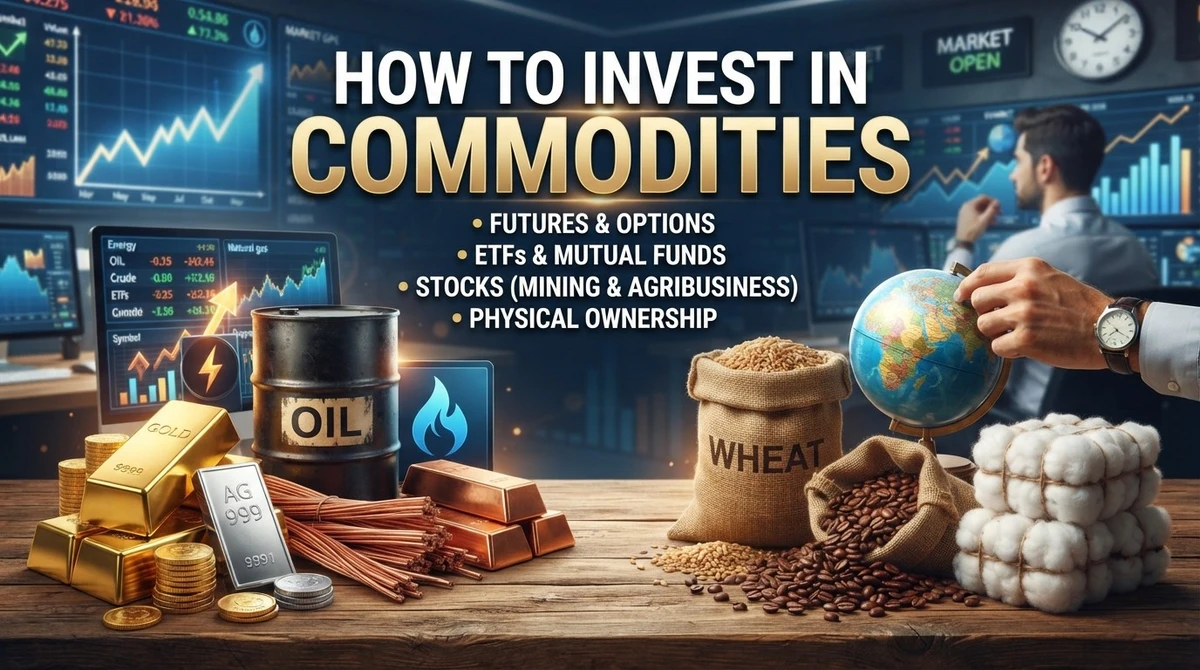
How to Invest in Commodities
Commodities are different from most traditional investments because they are tied to the physical resources that keep the economy running.
Oil powers transportation and industry. Natural gas supports electricity generation and heating. Copper is important to construction, manufacturing, and electrification. Agricultural commodities such as wheat, corn, coffee, and soybeans move through global food and trade networks. Gold and silver also occupy an important place in financial markets.
That makes commodities interesting to investors looking for exposure beyond traditional stocks and bonds.
But investing in commodities does not usually mean buying barrels of oil, tons of copper, or truckloads of wheat. For most individual investors, commodity exposure comes through financial products such as exchange-traded products, futures, options, or shares of commodity-producing companies.
Each route creates a different relationship with the underlying commodity.
A futures-based fund, for example, can behave differently from the spot price of the commodity because futures contracts expire and must generally be replaced or closed. A mining stock can move differently from the metal it produces because the company also has operating costs, debt, and other business risks. (CFTC)
So, the starting point is not simply choosing a commodity.
It is understanding how you want to gain exposure to it.
What Does It Mean to Invest in Commodities?
Commodity investing generally means gaining financial exposure to the price or economic performance of a commodity.
There are two broad approaches.
Direct exposure attempts to track the commodity itself. Physical gold and certain physically backed exchange-traded products are examples.
Indirect exposure comes through financial instruments or companies connected to commodities. Futures contracts, commodity funds, and shares of mining or energy companies fall into this category.
That difference can have a major effect on returns.
Suppose oil rises 15%. An investor might expect an oil-related investment to gain roughly the same amount. But if that investment uses futures contracts, the result can be affected by the futures curve, contract rolls, fees, and other factors.
The CFTC notes that commodity ETPs may use futures, options, swaps, or other commodity interests and may not track the underlying commodity in the same way a traditional stock or bond fund tracks its holdings. (CFTC)
Why Do Investors Buy Commodities?
There is no single reason to invest in commodities. Different investors may want different types of exposure.
Portfolio Diversification
Commodity prices are influenced by supply, demand, inventories, weather, production decisions, geopolitics, and economic activity.
Those drivers are not identical to the factors that determine the value of a company’s stock or a government bond.
That can make commodities useful as one component of a diversified portfolio. It does not mean they will always move independently from stocks and bonds, particularly during periods of broad market stress.
Exposure to Inflationary Pressures
Commodities can also be connected to inflation because energy, food, metals, and other raw materials are inputs into the production and transportation of goods.
When commodity prices rise sharply, businesses can face higher costs, which can eventually feed into consumer prices.
That does not make commodities a guaranteed inflation hedge. Their prices can fall even while overall inflation remains elevated.
Exposure to Specific Economic Trends
Some investors want exposure to particular changes in the global economy.
Examples include:
- Rising energy demand
- Infrastructure investment
- Manufacturing growth
- Electrification
- Food consumption
- Precious-metals demand
The important part is identifying the specific economic trend rather than treating all commodities as one market.
Oil, copper, gold, and wheat can respond to completely different forces.
1. Commodity ETFs and Exchange Traded Products
Exchange-traded products can provide one of the simpler ways for individual investors to gain commodity exposure through a brokerage account.
But “commodity ETF” is not a single structure.
Some products hold physical commodities. Others use futures contracts, commodity indexes, or other instruments.
A physically backed gold product, for example, has a different risk and return profile from an oil product that gains exposure through futures.
The CFTC advises investors to examine what financial instruments a commodity ETP uses, how those instruments behave, what fees apply, and how the strategy can change under different market conditions. (CFTC)
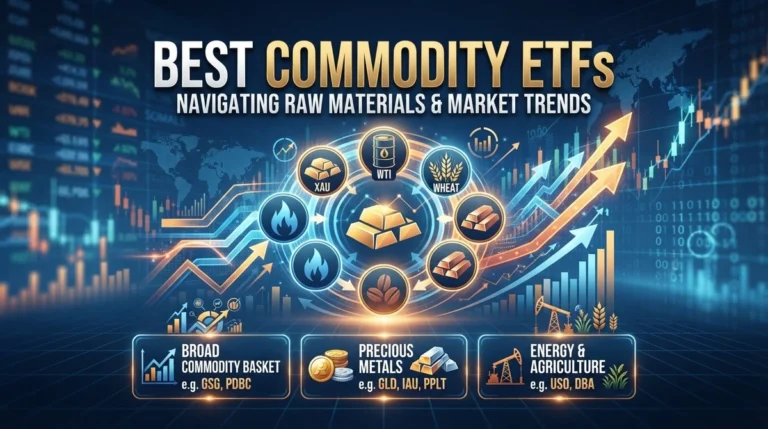
For a more detailed look at commodity ETFs and different fund structures, see Economic Reader’s Best Commodity ETFs in the USA.
What to Check Before Buying a Commodity ETF
Start with the structure rather than the ticker symbol.
Ask:
- What commodity or commodities does it track?
- Does it hold physical assets or futures?
- What index does it follow?
- How are futures contracts rolled?
- What are the fund’s expenses?
- How liquid is the product?
- How closely has it historically tracked its intended exposure?
- What tax considerations apply?
The fund’s name alone may not answer these questions. Reading its prospectus and other disclosure documents can reveal how the exposure is actually created.
2. Physical Commodities
Some commodities can be owned directly.
Gold and silver are the clearest examples for individual investors because they can be stored more easily than commodities such as crude oil, natural gas, or wheat.
Physical ownership provides a direct connection to the underlying asset, but it also introduces practical costs.
These can include:
- Storage
- Insurance
- Security
- Transportation
- Dealer premiums
- Buying and selling spreads
- Authenticity concerns
For many commodities, physical ownership is simply impractical.
An investor interested in crude oil, for example, does not need to purchase and store barrels of oil to gain financial exposure to the energy market.
3. Commodity Futures
Futures provide a more direct connection to commodity prices.
A futures contract is an agreement to buy or sell a specified quantity of a commodity at a specified price on a future date. Futures contracts are standardized and traded through organized markets, with centralized clearing in exchange-traded markets. (Investor.gov)
Futures are widely used by producers and commercial users to manage price risk. They are also used by traders and investors seeking exposure to price movements.
However, futures are more complex than simply buying shares of a company or a conventional fund.
They involve:
- Contract specifications
- Expiration dates
- Margin requirements
- Daily gains and losses
- Potential leverage
- Settlement procedures
- Position management
The CFTC describes commodity futures and options as volatile, complex, and risky and warns that losses can sometimes exceed the amount initially deposited. (CFTC)
That makes futures a fundamentally different route to commodity exposure from buying a conventional investment fund.
4. Commodity Options
Options provide another way to gain exposure to commodity markets.
A commodity option gives the buyer the right, but not the obligation, to buy or sell a futures contract at a specified price under defined conditions.
Options can provide more flexibility than simply taking a long or short futures position. Their value can be affected by:
- The underlying futures price
- Strike price
- Time remaining
- Volatility
- Interest rates
- Market expectations
That flexibility also makes them harder to evaluate.
An investor unfamiliar with futures markets may find commodity options difficult to understand because the option itself is linked to a futures contract rather than directly to the physical commodity.
5. Commodity Producer Stocks
Another way to gain commodity-related exposure is by investing in companies that produce or process commodities.
Examples include:
- Oil and gas producers
- Mining companies
- Gold miners
- Agricultural businesses
- Fertilizer producers
- Steel companies
But buying a commodity producer is not the same as buying the commodity.
Suppose gold rises sharply.
A gold-mining company may benefit from the higher selling price, but its stock is also affected by:
- Production costs
- Energy prices
- Debt
- Labor costs
- Mine output
- Management decisions
- Political conditions
- Operational problems
The company’s shares can therefore move differently from gold itself.
Producer stocks provide commodity exposure plus business exposure.
6. Broad Commodity Funds
Some funds provide exposure to several commodity sectors rather than concentrating on one market.
A broad commodity strategy might include combinations of:
- Energy
- Precious metals
- Industrial metals
- Agriculture
- Livestock
This can reduce dependence on the price of a single commodity.
However, diversification within commodities does not eliminate commodity-market risk. A broad fund can still fall when several commodity sectors decline together.
Investors should also examine how the fund creates its exposure. A broad futures-based fund can behave differently from a portfolio that directly holds physical commodities.
Commodity Price and Investment Return Are Not the Same Thing
This is one of the most important concepts in commodity investing.
A change in the commodity’s price does not automatically equal the same change in an investment’s value.
Consider a futures-based oil fund.
If the spot price of oil rises 15%, an investor might expect the fund to gain roughly 15%.
But futures contracts expire. A fund that wants to maintain exposure generally has to replace expiring contracts with later-dated contracts.
The price difference between those contracts can affect returns.
Contango
Contango occurs when later-dated futures contracts are priced above nearer-dated contracts.
When a fund repeatedly replaces a cheaper expiring contract with a more expensive later contract, the roll process can create a drag on returns, all else equal.
Backwardation
Backwardation occurs when later-dated contracts are priced below nearer-dated contracts.
In that environment, rolling contracts can have a different effect on returns.
The CFTC specifically notes that rolling futures positions can create either a drag or a positive roll yield depending on the relationship between near- and later-dated contracts. (CFTC)
This is why investors should look beyond the headline spot price when evaluating a futures-based commodity investment.
What Actually Moves Commodity Prices?
Commodity investing becomes easier to evaluate when the major price drivers are clear.
Different commodities respond to different economic conditions.
Energy
Oil and natural gas can be influenced by:
- Global demand
- Production levels
- Inventories
- Weather
- Geopolitical events
- Transportation constraints
- Economic growth
Metals
Copper, aluminum, and other industrial metals can respond to:
- Manufacturing activity
- Construction
- Infrastructure spending
- Industrial production
- Mine supply
- Global economic growth
Gold has a different set of drivers, including:
- Interest rates
- Real yields
- The U.S. dollar
- Central-bank demand
- Investor demand
- Geopolitical uncertainty
Agriculture
Agricultural commodities can be particularly sensitive to:
- Weather
- Crop yields
- Planting decisions
- Inventories
- Trade conditions
- Transportation
- Global food demand
This variety is one reason a bullish view on “commodities” is often too broad to be useful. An investor needs to know which commodity is being considered and what could change its supply-demand balance.
The Main Risks of Commodity Investing
Commodity exposure can add diversification, but it also introduces risks that deserve attention.
Price Volatility
Commodity prices can move sharply after unexpected changes in supply or demand.
A production outage, poor harvest, geopolitical event, or sudden economic slowdown can quickly change market expectations.
Leverage
Futures and some commodity strategies use leverage.
Leverage can magnify gains, but it can magnify losses just as quickly.
The CFTC recommends that people trading futures use only “risk capital” money they can afford to lose without affecting essential financial needs. (CFTC)
Futures and Roll Risk
Futures-based products can produce returns that differ from the spot commodity because contracts expire and positions may need to be rolled.
This becomes particularly important for investors holding futures-based exposure for longer periods.
Concentration Risk
A portfolio heavily concentrated in one commodity can become dependent on a narrow set of economic factors.
An oil position, for example, is highly exposed to changes in the global energy market.
Company Risk
Commodity producer stocks add risks that are not present in the same way when investing directly in commodity prices.
A company’s management, balance sheet, operating costs, and production performance can all affect the investment.
Liquidity Risk
Some commodity products and markets can become less liquid during periods of market stress.
Investors should consider both the liquidity of the investment product and the underlying market.
How Should You Choose a Commodity Investment?
Rather than asking which commodity investment is “best,” start with the exposure you actually want.
If You Want Gold Exposure
You could compare physical gold, physically backed gold products, gold futures, and gold-mining stocks.
Each provides a different combination of price exposure, costs, liquidity, and business risk.
If You Want Energy Exposure
You could research oil or natural gas funds, futures, or energy-company stocks.
These can behave very differently even when they are all connected to the same broad energy market.
If You Want Broad Commodity Exposure
A diversified commodity fund may provide exposure across energy, metals, and agriculture.
That can reduce dependence on one commodity, although it does not eliminate commodity-market risk.
If You Want More Direct Price Exposure
Futures provide a closer connection to commodity prices but bring greater complexity, leverage, margin requirements, and expiration considerations.
The investment vehicle should therefore follow the objective.
A Simple Commodity Investing Framework
Before investing, work through these questions.
1. What commodity exposure do I want?
Gold, oil, natural gas, copper, agriculture, or a broad basket?
2. How direct should the exposure be?
Physical commodity, exchange-traded product, futures, option, or producer stock?
3. What actually creates the return?
Is the investment linked to the spot commodity, futures prices, an index, or a company’s earnings?
4. What costs could reduce the return?
Consider management fees, trading costs, storage costs, bid-ask spreads, and futures-related costs.
5. What could cause the investment to fall?
Identify the supply, demand, economic, and market factors that matter for that particular exposure.
6. Am I comfortable with the complexity?
A futures contract requires a different level of understanding from buying a diversified commodity fund.
7. How does this fit into my portfolio?
Consider concentration, diversification, time horizon, and risk tolerance.
This framework shifts the decision away from recent performance and toward the actual mechanics of the investment.
Should Commodities Be a Long Term Investment?
The answer depends largely on the investment vehicle and the role the exposure is meant to play.
A physically backed precious-metals product may have very different long-term characteristics from a futures-based energy fund.
A mining stock can also behave differently from the underlying metal because the company has operating costs, debt, capital requirements, and other business risks.
For long-term investors, the key issue is therefore not simply whether a commodity is likely to rise over time.
It is whether the chosen investment vehicle can provide the intended exposure efficiently over the holding period.
Futures-based products deserve particular attention because contract expiration, rolling, fees, and the shape of the futures curve can affect long-term results.
Commodity Investing vs. Stock Investing
Stocks represent ownership in businesses.
Commodities are physical goods, while commodity investments may represent contracts or financial products linked to those goods.
That creates several important differences.
| Factor | Stocks | Commodity Investments |
| What you own | Ownership in a company | Commodity or commodity-linked exposure |
| Main return drivers | Earnings, growth, valuation | Supply, demand, inventories, weather, geopolitics, and market conditions |
| Income | Some stocks pay dividends | Many commodity investments do not provide regular income |
| Expiration | Shares do not expire | Futures contracts have expiration dates |
| Leverage | Not inherent in ordinary stock ownership | Can be significant with futures |
| Business risk | Central | Direct commodity exposure can avoid company-specific operating risk |
| Physical asset | No | Some products hold physical commodities |
The comparison matters because an investor may be taking very different risks depending on how commodity exposure is obtained.
What Investors Should Understand Before Investing
A commodity investment becomes much easier to evaluate once four layers are separated.
First: the commodity.
What market are you actually exposed to?
Second: the investment vehicle.
Are you buying physical assets, an exchange-traded product, futures, options, or a company?
Third: the return mechanism.
What has to happen for the investment to gain value?
Fourth: the risk structure.
What could cause the investment to lose money, and are there costs or leverage that could magnify the result?
For example, an investor seeking gold exposure could choose physical gold, a physically backed gold product, a gold futures contract, or a gold-mining company.
All four are connected to gold.
They are not the same investment.
Investor.gov notes that commodity futures have fixed contract sizes and expiration dates, while the CFTC emphasizes that commodity ETPs can have structures and risks that differ materially from traditional stock and bond funds. (Investor.gov)
Frequently Asked Questions
What is the easiest way to invest in commodities?
For many investors, exchange-traded commodity products can provide a simpler route than directly trading futures or storing physical commodities. However, the product’s structure matters because some use physical holdings while others use futures or other instruments.
Can you invest in commodities without buying futures?
Yes. Investors can gain commodity exposure through physical commodities, exchange-traded products, mutual funds, and shares of commodity-producing companies. Futures are only one route.
Are commodities a good way to diversify a portfolio?
Commodities can provide exposure to markets driven by different economic factors from traditional stocks and bonds. They can contribute to diversification, but they can also be volatile and should not be treated as guaranteed portfolio protection.
What is the difference between investing in commodities and commodity stocks?
Commodity investing generally seeks exposure to the commodity itself or a commodity-linked financial instrument. Commodity stocks represent ownership in companies whose businesses may depend on commodity prices. Company-specific factors can therefore have a major effect on stock performance.
Can commodity investments lose money?
Yes. Commodity prices can fall significantly, and futures-based investments can involve leverage and other risks. The CFTC warns that futures traders can lose all of their money and, in some circumstances, may be required to pay more than they initially invested. (CFTC)
Commodity Investing Starts With the Exposure You Actually Want
Investing in commodities is not one strategy.
An investor can own physical gold, buy a commodity exchange-traded product, purchase shares of a mining company, trade futures, use options, or invest through a diversified commodity fund.
Each route creates a different relationship with the underlying commodity.
That is why the first question should not be:
“Which commodity should I buy?”
A better starting point is:
“What type of commodity exposure do I want, and do I understand how that investment is designed to produce returns?”
From there, compare the investment structure, costs, liquidity, price drivers, and risks. Then consider how the position fits within the broader portfolio.
Commodity markets provide exposure to some of the most important forces in the global economy. But understanding the investment vehicle is just as important as understanding the commodity itself.