
What Are Commodities? Understanding the Essential Goods Behind the Global Economy
When people hear the word commodities, they may think of oil prices, gold, or traders watching markets on financial news. But commodities are much more fundamental than financial markets.
They are the physical goods that help economies produce, transport, build, eat, and operate.
Crude oil becomes fuel and petrochemicals. Wheat becomes bread and other food products. Copper becomes part of electrical equipment and infrastructure. Natural gas can generate electricity and provide industrial heat. Gold is used in jewelry and investment, but it also has industrial applications.
This makes commodities an important link between the natural world and the modern economy.
A change in the price of a commodity can affect businesses far beyond the industry that produces it. Higher oil prices can raise transportation costs. A poor wheat harvest can increase food costs. Strong demand for copper can affect manufacturers, construction companies, and infrastructure projects.
Understanding commodities, therefore, is not simply about understanding what gets traded on financial markets. It is about understanding some of the basic physical inputs behind economic activity.
What Are Commodities?
A commodity is a basic good that can generally be bought and sold in standardized form and used as an input in producing other goods or services.
Common examples include:
- Crude oil
- Natural gas
- Gold
- Silver
- Copper
- Wheat
- Corn
- Soybeans
- Coffee
- Sugar
- Cotton
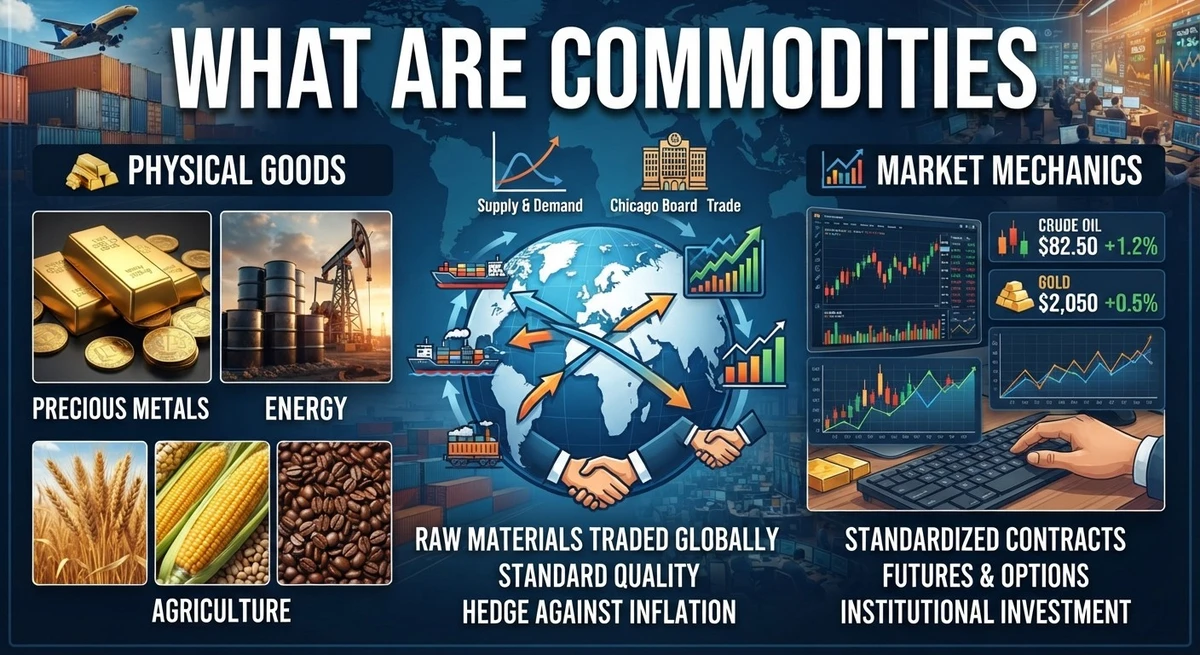
Commodities are commonly grouped into energy, metals, and agricultural products.
The important characteristic is not simply that a commodity is a physical product. Standardization matters too.
A barrel of a specified grade of crude oil can be compared with another barrel that meets the same specifications. A defined grade of wheat can be traded according to established quality standards.
That makes large-scale trade possible without every individual unit having to be uniquely identified.
Why Commodities Sit Near the Start of the Economy
Commodities often enter the economy before consumers ever see the finished product.
Take something as ordinary as a loaf of bread.
Farmers need seeds, fertilizer, fuel, machinery, and water to produce wheat. The crop is harvested and transported to a mill, where it becomes flour. Bakeries then use flour, energy, labor, packaging, and transportation to produce bread for consumers.
A change in wheat prices can therefore affect businesses several steps away from agriculture.
The same pattern exists in manufacturing.
Copper can become wiring. Oil can become fuel or petrochemical inputs. Natural gas can be used for electricity generation or industrial heat. Metals can become machinery, vehicles, buildings, and electronics.
The commodity is often only the beginning of a much longer production chain.
The Three Main Commodity Groups
Commodities do not all behave in the same way. Their economic characteristics depend heavily on how they are produced, stored, transported, and consumed.
Energy Commodities
Energy commodities include crude oil, natural gas, and other energy products.
Energy is a foundational input for modern economies. It powers transportation, electricity generation, manufacturing, heating, and many industrial processes.
Oil is particularly important because its uses extend beyond transportation. Petroleum is also an input for plastics, chemicals, synthetic materials, and other industrial products.
Natural gas has major roles in electricity generation, heating, and industrial production. It can also be used as a feedstock for chemicals and fertilizers.
Because energy is embedded in so many activities, a major energy shock can spread well beyond the energy sector.
Metals
Metals include both precious metals and industrial metals.
Gold and silver are widely associated with jewelry and investment, while also having industrial applications.
Copper, aluminum, nickel, zinc, and other industrial metals are closely connected to construction, manufacturing, infrastructure, and technology.
Copper is particularly useful for understanding the connection between commodities and economic development. It is used extensively in electrical wiring, power infrastructure, construction, and equipment.
As economies expand electricity grids, data centers, electric vehicles, and renewable-energy infrastructure, demand for some industrial metals can increase.
Agricultural Commodities
Agricultural commodities include crops and livestock products.
Examples include wheat, corn, soybeans, coffee, sugar, cotton, and cattle.
Agriculture has a major difference from many industrial commodity sectors: production is strongly affected by biological cycles and weather.
A factory can sometimes increase output by adding shifts or expanding capacity. A farmer cannot immediately replace a damaged harvest after a drought or flood.
That makes agricultural supply particularly sensitive to weather, disease, planting decisions, and growing conditions.
Supply and Demand Still Drive the Physical Economy
Commodity prices ultimately reflect changing conditions in supply and demand.
Supply can be influenced by:
- Production capacity
- Weather
- Natural resources
- Energy costs
- Labor
- Transportation
- Government policy
- Geopolitical disruptions
- Inventory levels
Demand can change with:
- Economic growth
- Industrial production
- Consumer activity
- Population
- Technology
- Weather
- Government policy
- Changes in consumption patterns
The balance can shift quickly.
If an unexpected disruption reduces oil production while demand remains strong, available supplies can tighten and prices may rise.
If economic activity slows while production remains high, inventories can build and prices may weaken.
The same basic principle applies across commodity groups, although the underlying drivers differ significantly from one product to another.
Why Commodity Supply Often Takes Time to Respond
One reason commodity prices can move sharply is that supply is often slow to adjust.
Suppose copper prices rise rapidly. A mining company cannot necessarily bring a major new mine into production within months. Large mining projects can require years of exploration, financing, permitting, construction, and infrastructure development.
Agriculture faces a different timing problem. A farmer cannot immediately produce more wheat simply because the market price has increased. The next planting and harvest cycles may be months away.
Energy production can also involve long investment cycles, depending on the resource and infrastructure involved.
This means a temporary disruption can have a larger effect when producers have little ability to increase supply quickly.
Storage Can Change the Impact of a Supply Shock
Inventories provide another important part of the commodity story.
Oil can be stored in large tanks. Metals can be stockpiled. Grain can be stored under suitable conditions.
Those inventories can act as a buffer.
If production temporarily falls while inventories are high, existing stocks can help meet demand.
If inventories are already low, the same disruption can create much greater pressure.
That is why commodity conditions cannot always be understood by looking at the headline price alone. Available inventories, spare production capacity, transportation constraints, and expected future supply can all influence how the physical market responds.
From a Commodity to a Global Supply Chain
Most commodities do not remain in the country where they are produced.
Oil may be extracted in one country, transported by pipeline or tanker, refined somewhere else, and eventually consumed thousands of miles away.
Copper can be mined in one region, processed in another, turned into components elsewhere, and eventually incorporated into products sold around the world.
Coffee offers another simple example. Beans can be grown in one country, processed and exported, roasted in another, packaged by a different company, and sold to consumers across multiple markets.
This is where commodities connect directly with international trade.
Economic Reader’s How Does International Trade Work? explains the broader movement of goods and services across borders. Commodities are an important part of that system because many economies specialize in producing natural resources or agricultural products that other economies need.
The result is a global chain in which a disruption at one stage can affect businesses and consumers much further away.
How Commodity Prices Reach Consumers
A commodity does not have to appear directly in a consumer’s shopping basket to affect household spending.
Energy provides the clearest example.
When fuel costs rise, transportation companies may face higher operating expenses. Manufacturers and distributors can also face higher logistics costs. Some of those costs may eventually be reflected in the prices of goods and services.
Food commodities can work in a similar way.
Higher wheat, corn, or vegetable-oil prices can increase costs for food manufacturers, restaurants, and other businesses. Whether consumers ultimately pay the full increase depends on competition, margins, inventories, contracts, and how businesses respond.
This is why a commodity-price increase does not automatically translate into an equivalent increase in consumer prices.
The transmission depends on the structure of the supply chain.
Commodities and Inflation
Because commodities feed into so many parts of production, they can also influence inflation.
Energy and food prices are particularly important because they affect household budgets directly and can also feed into production and transportation costs.
The IMF has described higher commodity prices as a supply shock that can raise production costs, disrupt supply chains, increase inflation, and reduce purchasing power. Its 2026 analysis also shows how commodity shocks can create particularly difficult conditions for economies that depend heavily on imported energy and food. (IMF)
The effect is not always permanent.
If a commodity price rises because of a temporary supply disruption and later falls, some of the inflation pressure can fade. But if higher energy or food costs spread into wages, services, transportation, and business pricing, the economic effects can become broader.
This is one reason central banks pay attention to commodity developments even when they cannot directly control commodity prices.
Commodities and Economic Growth
Commodity demand often changes alongside economic activity.
When factories produce more goods, they generally require more energy and industrial materials.
When construction expands, demand for metals and other inputs can increase.
When populations and incomes grow, demand for food, energy, and manufactured products can also rise.
But commodity demand is not a perfect measure of economic growth.
Technology can reduce the quantity of a commodity needed to produce a particular product. Substitution can shift demand from one material to another. Government policies can alter energy consumption. Efficiency improvements can also reduce resource intensity.
The relationship between economic growth and commodity demand therefore changes over time and differs across countries. The World Bank notes that technological innovation and substitution have changed the relative importance of different commodities even as overall consumption of commodities has increased. (World Bank)
Why Commodity Exporting Countries Can Be Exposed
Commodities can shape national economies as well as individual industries.
Countries that depend heavily on exporting oil, metals, agricultural products, or other resources can experience significant changes in export earnings when global prices move.
When prices rise, producers may receive more revenue, government royalties and tax receipts can increase, and investment in resource industries may expand.
When prices fall, those benefits can reverse.
This creates exposure to external shocks.
Commodity production itself is not necessarily a weakness. Natural resources can provide employment, foreign-exchange earnings, infrastructure investment, and government revenue.
The challenge is concentration.
An economy that relies heavily on a small number of commodity exports can be more vulnerable to global price movements than one with a diversified production base.
For commodity importers, the exposure can run in the opposite direction. A sharp rise in oil or food prices can increase import bills and put pressure on domestic inflation.
The U.S. Dollar Adds Another Layer
Many internationally traded commodities are priced in U.S. dollars.
That creates an additional connection between commodity prices and the global financial system.
When the dollar changes in value, the effective cost of a dollar-priced commodity can change for buyers using other currencies.
For a country that imports large quantities of oil, for example, a weaker domestic currency can make an unchanged dollar-denominated oil price more expensive in local-currency terms.
The relationship is not automatic or one-directional. Commodity-specific supply and demand conditions can be much more important at times.
Still, exchange rates are one reason the same global commodity price can have different effects across countries.
Commodity Prices Can Move in Different Directions
It is tempting to think of “commodities” as one market moving together.
In reality, the group is highly diverse.
Gold can respond to investment demand, interest-rate expectations, currency movements, and perceptions of financial risk.
Oil is strongly influenced by transportation demand, production, inventories, and geopolitical developments.
Copper is closely linked to industrial activity, construction, electricity infrastructure, and technology investment.
Agricultural commodities can be heavily influenced by weather and harvest conditions.
As a result, an event that supports one commodity can have little direct effect on another.
The World Bank’s 2026 commodity outlook illustrates this divergence: its April outlook projected sharp increases in energy and metal prices while agricultural commodity prices were expected to move differently. (World Bank Blogs)
The lesson is simple: there is no single “commodity cycle” that explains every commodity equally well.
Technology Is Changing What the World Needs
The global economy is becoming more digital, but that does not mean it is becoming less dependent on physical resources.
Data centers require electricity. Electric vehicles require metals and battery materials. Renewable-energy infrastructure requires large amounts of physical equipment and raw materials. Expanding electricity grids requires conductors, transformers, cables, and other materials.
This can create new sources of commodity demand.
At the same time, technology can reduce demand for certain resources through efficiency improvements, substitution, recycling, or entirely different technologies.
Energy is a good example.
More efficient vehicles can reduce fuel consumption. Renewable electricity can reduce demand for some fossil-fuel generation. Yet the expansion of electricity networks and new technologies can increase demand for metals such as copper and aluminum.
Technology therefore changes the composition of commodity demand rather than simply eliminating it.
Commodities and the Energy Transition
The transition toward lower-carbon energy systems adds another layer to the commodity story.
Moving away from some fossil fuels does not remove the need for natural resources. Instead, it can shift demand toward different materials.
Electric vehicles require batteries and electrical components. Solar and wind projects require metals, manufacturing inputs, and extensive infrastructure. Electricity grids need additional transmission and distribution capacity.
This means the energy transition can produce both declining demand for some commodities and rising demand for others.
It also creates supply challenges.
Mining capacity cannot always expand as quickly as demand. New projects can require substantial investment, permitting, infrastructure, and time.
The result is that the transition is partly a technology story and partly a commodity-supply story.
The Financial Market Is Not the Commodity Itself
This distinction is important, particularly because the word “commodity” is often used in financial news.
A commodity is the underlying physical good.
A commodity market is the broader system through which that good can be bought and sold, including physical transactions and financial instruments connected to future prices.
Futures contracts, for example, allow businesses and financial participants to manage exposure to changing commodity prices without necessarily taking immediate physical delivery.
Economic Reader’s What Is a Commodity Market? explains that market structure in greater detail.
Keeping these concepts separate makes the subject much easier to understand:
The commodity belongs to the physical economy. The commodity market connects that physical good with buyers, sellers, producers, consumers, and financial participants.
Why Commodities Remain Important in a Digital Economy
The global economy may be increasingly digital, but digital activity still depends on physical infrastructure.
A cloud-computing facility needs electricity and construction materials. An electric vehicle needs metals and battery materials. A supermarket needs agricultural products, packaging, fuel, and transportation. A modern city needs steel, copper, cement, energy, and countless other inputs.
That is why commodities remain economically important even as services, software, and digital assets become larger parts of global economic activity.
The composition of commodity demand may change, but the physical economy does not disappear.
In fact, technological change can sometimes make certain resources more strategically important.
The World Bank’s recent commodity analysis highlights how technology, changing energy systems, climate pressures, and shifts in global production are reshaping commodity demand and supply. (World Bank)
Understanding Commodities Through the Physical Economy
Commodities are best understood not simply as assets traded on exchanges, but as the basic physical inputs connecting natural resources, production, transportation, manufacturing, and consumption.
Their importance becomes clearer when viewed through the economy around them.
Weather can affect food production. Geopolitical disruptions can restrict energy supplies. Industrial expansion can increase demand for metals. Currency movements can change the cost of imports. Technology can create demand for new materials while reducing the need for others.
These effects can move through supply chains and eventually reach businesses, governments, and households.
That is why commodity prices are often more than market statistics on a financial screen. They can provide information about conditions in the physical economy.
Oil, metals, agricultural products, and other basic goods may be far removed from the final products consumers purchase, yet they often sit near the beginning of the production process.
When those resources become scarce, abundant, expensive, or cheaper, the effects can travel through trade, inflation, industrial production, investment, and household spending.
Commodities are therefore not simply another category of financial assets. They are part of the physical foundation on which the modern global economy operates.