
What Is Solana? Understanding the High Performance Blockchain Network in 2026
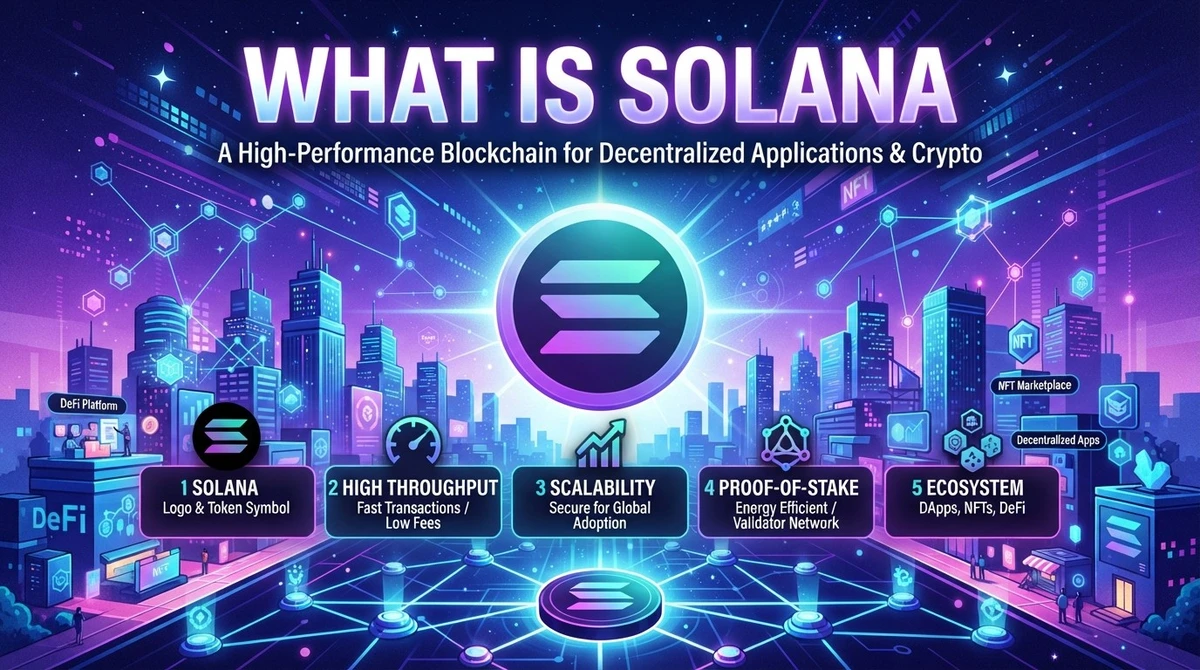
When people hear about blockchain networks, they often think of Bitcoin or Ethereum.
Bitcoin introduced a new way to create and transfer digital value without a central monetary authority. Ethereum expanded the concept by creating a programmable blockchain for smart contracts and decentralized applications.
Solana took a different route.
Its central challenge was how to make a public blockchain handle large amounts of activity quickly and at relatively low cost without relying on a single central operator.
That design goal shaped the network’s architecture.
Solana was built around fast transaction processing, parallel execution, specialized validator infrastructure, and a distinctive approach to establishing the order of events across a distributed network.
By 2026, Solana is being used for decentralized finance, stablecoins, payments, trading, tokenized assets, and other onchain applications.
But speed alone does not explain Solana.
The more useful question is why the network was designed this way, what its architecture makes possible, and what trade-offs come with that design.
What Is Solana?
Solana is a public blockchain network designed to process large amounts of onchain activity with relatively fast confirmation times and low transaction costs.
Its native cryptocurrency is SOL.
SOL is used to pay transaction fees, participate in staking, and support the economic incentives that help secure the network.
Unlike a cryptocurrency exchange such as Coinbase or Binance, Solana is not primarily a company that provides a marketplace for buying and selling digital assets.
It is a blockchain network.
That distinction matters.
A centralized exchange provides an interface through which users can access cryptocurrency markets. Solana provides an underlying network on which users, developers, applications, and validators can interact.
Economic Reader’s What Is Cryptocurrency? explains the broader digital-asset category, while What Is Ethereum? looks at another major programmable blockchain.
Solana belongs to the same broader ecosystem, but its architecture emphasizes a different set of priorities.
The Problem Solana Was Designed to Solve
Public blockchains face a basic coordination problem.
Thousands of independent computers need to agree on the state of one network.
At the same time, users expect transactions to be fast, inexpensive, secure, and reliable.
A centralized database can process transactions quickly because one organization controls the system.
A public blockchain cannot rely on that same structure.
Validators have to coordinate with one another while maintaining a common view of the network.
As activity increases, that coordination can become a bottleneck.
Solana’s architecture attempts to reduce some of that friction by giving the network a structured way to establish the order of events and by processing independent transactions in parallel.
That combination is central to understanding the network.
Proof of History Gives Solana a Verifiable Sense of Time
One of Solana’s most distinctive technologies is Proof of History (PoH).
PoH is not the network’s entire consensus mechanism.
Instead, it provides a cryptographically verifiable sequence that helps establish the order and passage of time between events.
In a distributed network, computers do not share one perfectly synchronized physical clock.
They still need a reliable way to determine when events occurred relative to one another.
Solana’s documentation describes Proof of History as a sequence of proofs showing that data existed before a proof was created and that a measurable amount of time passed between proofs.
The practical idea is straightforward:
Instead of repeatedly asking the network to agree on time, Solana creates verifiable timing information as part of the sequence itself.
That helps reduce some of the coordination work involved in ordering events.
PoH therefore became an important component of Solana’s high-throughput design.
Solana’s Performance Comes From More Than One Feature
Calling Solana a “fast blockchain” is easy, but it oversimplifies how the network works.
Its performance comes from several components working together, including:
- Proof of History
- Parallel transaction execution
- High-performance networking
- Specialized validator software
- Optimized transaction processing
- Increasingly specialized validator infrastructure
The important point is that throughput is not created by one technology.
A blockchain also has to verify transactions, maintain state, communicate between validators, and reach consensus.
Performance has to work alongside security and network participation.
That makes Solana’s architecture more interesting than a simple transaction-speed comparison.
How Solana Processes Transactions
Solana uses accounts and onchain programs to organize application activity.
A transaction specifies instructions and identifies the accounts those instructions need to access.
The network can then determine which transactions depend on the same state and which can be processed independently.
This creates an important opportunity for parallel execution.
Imagine two users making unrelated transactions involving completely different accounts.
There may be no reason for the network to process those transactions one after another.
Solana’s runtime is designed to take advantage of that independence.
Solana’s documentation describes Sealevel as its parallel runtime for onchain programs, while its transaction pipeline includes separate stages for receiving, verifying, loading, executing, and committing transactions.
This is one of the key differences between simply having a fast network and designing the execution system around parallel activity.
What Is the Solana Virtual Machine?
The Solana Virtual Machine (SVM) is the execution environment used to run programs on Solana.
Developers create programs that interact with accounts and process instructions through the network’s runtime.
That gives Solana a role beyond transferring SOL.
It provides infrastructure on which applications can operate.
Developers can build systems for:
- Decentralized finance
- Payments
- Stablecoins
- Trading
- Tokenized assets
- Consumer applications
- Gaming
- Other onchain services
This is where Solana starts to look less like a cryptocurrency and more like a general-purpose application and financial infrastructure layer.
What Is SOL?
SOL is the native cryptocurrency of the Solana network.
It performs several functions within the ecosystem.
Transaction Fees
Users pay network fees when they interact with Solana.
That creates a direct relationship between network activity and demand for the native token.
Staking
Solana uses proof-of-stake-based consensus.
SOL holders can stake their tokens directly or delegate them to validators.
Staking helps support network security while participants can receive rewards according to the protocol’s rules.
Network Incentives
Validators provide computing, storage, and networking resources to operate the network.
The protocol’s economic incentives are designed to encourage that participation.
SOL is therefore not simply an asset traded on cryptocurrency exchanges.
It is part of the economic mechanism that supports the blockchain itself.
Why Low Fees Can Change What Gets Built
Low transaction costs matter because they affect the economics of applications.
Suppose a blockchain application requires users to make hundreds of small transactions.
If each transaction is expensive, many potential business models become difficult to operate.
Lower costs can make more frequent onchain activity practical.
That can support use cases such as:
- Micropayments
- High-frequency trading
- Consumer applications
- Gaming transactions
- Automated financial activity
- Large-scale token transfers
This does not mean every low-cost blockchain application will succeed.
It means developers have a wider range of economic models they can consider.
For a blockchain, that can be an important competitive advantage.
Solana’s Competition Is Broader Than Ethereum
Ethereum is an obvious comparison because both networks support programmable applications.
But Solana is competing for more than developer attention.
It is competing for:
- Users
- Liquidity
- Applications
- Transactions
- Developers
- Stablecoin activity
- Institutional projects
Its broader competitive environment includes other high-throughput blockchains, Ethereum Layer 2 networks, centralized financial platforms, and even traditional payment infrastructure.
So the more useful question is not simply:
Which blockchain is faster?
It is:
Which network can turn technical capabilities into lasting economic activity?
A technically impressive blockchain without useful applications may struggle to generate durable demand.
Likewise, an ecosystem with strong applications can face problems if its infrastructure becomes too expensive or difficult to use.
Network effects therefore matter as much as raw performance.
What Is Solana Used For?
Solana’s ecosystem has expanded well beyond basic cryptocurrency transfers.
Decentralized Finance
DeFi applications allow users to trade, lend, borrow, provide liquidity, and interact with financial protocols without relying entirely on traditional intermediaries.
Low transaction costs can make frequent DeFi activity more practical.
Stablecoins
Stablecoins are another important part of Solana’s ecosystem.
They provide dollar-linked digital value that can move across blockchain networks without exposing users to the same price volatility associated with assets such as SOL or Bitcoin.
That makes stablecoins relevant to payments, trading, settlement, and financial applications.
Payments
Payments are becoming an increasingly important use case.
A blockchain that can process frequent transactions at relatively low cost can potentially support digital payment applications that would be less practical on a more expensive network.
Solana itself highlights payments and financial markets among its major areas of development.
Tokenized Assets
Blockchain networks can also be used to represent financial and real-world assets digitally.
Tokenized funds, securities, and other assets are being explored by financial institutions and asset managers.
Solana is positioning its infrastructure for this market as well.
That creates a potential bridge between blockchain technology and traditional financial markets.
Developers Are a Major Part of Solana’s Economic Model
A blockchain’s long-term value depends heavily on what developers build on it.
Developers create applications.
Applications attract users.
Users generate transactions.
Transactions create demand for block space and liquidity.
That can attract more developers.
The resulting cycle can be summarized as:
Developers → Applications → Users → Transactions → Liquidity → More Developers
This is a network effect.
It also explains why transaction speed alone is not enough.
Solana needs applications that provide enough utility for users to keep coming back.
If developers and users move to competing networks, technical performance by itself may not preserve the ecosystem.
Firedancer and the Push for Better Validator Infrastructure
Solana’s performance strategy also depends on its validator software.
One important development is Firedancer, an independent validator client developed by Jump Crypto.
Multiple validator clients can provide benefits beyond performance.
They can improve client diversity and reduce dependence on one implementation.
Firedancer has continued receiving mainnet and testnet releases during 2026, with ongoing work focused on performance, networking, and validator operations. Solana’s September changelog records continued Firedancer development alongside Agave and other validator releases.
That matters because a high-throughput blockchain needs its validator infrastructure to keep improving as network demand grows.
The goal is not simply to make one software client faster.
It is to make the overall network more capable and resilient.
Solana’s 2026 Upgrade Path Is About More Than Speed
Solana’s 2026 development has focused on several layers of the network at once.
In September, Transaction V1, a reduction in rent, and a feature reducing slot time to 250 milliseconds reached mainnet. The same release also included continued Agave and Firedancer development.
Transaction V1 expands the transaction format and can make some program deployments significantly cheaper. Solana’s documentation also notes that the V1 format raises the transaction size limit to 4,096 bytes from the previous 1,232-byte limit.
For users, these changes may not always be obvious.
For developers, they can change the economics of building and operating applications on the network.
That is an important distinction: blockchain upgrades can matter economically even when ordinary users barely notice the technical change.
Alpenglow Targets Much Faster Finality
Another major development is Alpenglow, Solana’s planned consensus upgrade.
Alpenglow is designed to replace the current TowerBFT consensus layer with a new approach to validator voting and finality.
The Solana Foundation currently describes a target of roughly 150 milliseconds of finality, compared with about 12.8 seconds under the current system.
But this needs an important clarification.
150 milliseconds is a target for finality, not a claim that Solana will produce a new block every 150 milliseconds.
Block production and transaction finality are different concepts.
Alpenglow is currently planned for the Agave 4.3 release, targeted for October 2026. The BLS and validator-admission prerequisites are already live on mainnet, but the full consensus switch itself is not yet activated.
If activated as planned, the upgrade could significantly reduce the time users and applications need to wait for strong finality.
What the 2026 Changes Mean Economically
The technical upgrades matter because blockchain infrastructure is ultimately an economic system.
Shorter slots can reduce waiting time.
Larger transactions can make more complex applications easier to operate.
Lower storage costs can reduce the cost of maintaining onchain state.
Cheaper program deployment can lower the cost of building applications.
Faster finality can make blockchain settlement more attractive for financial applications.
These improvements do not automatically create adoption.
But they can change the economics for developers, market makers, payment providers, and financial institutions considering whether to build on the network.
That is the more useful way to evaluate Solana’s 2026 upgrades.
The Trade Off Behind Solana’s Design
High performance also comes with trade-offs.
Running a high-throughput blockchain requires significant computing, storage, bandwidth, and networking resources.
That can make validator operations more demanding.
The economic question is therefore not simply how fast Solana can become.
It is also:
How much infrastructure does a participant need to operate competitively?
If validator requirements become too demanding, smaller operators may find participation more difficult.
That can raise questions about decentralization and the distribution of network control.
This does not mean Solana is automatically centralized.
It means performance, security, and decentralization have to be balanced continuously.
Client diversity is relevant here because having multiple validator implementations can improve resilience and reduce dependence on one software stack. Solana’s current validator ecosystem includes Agave, Firedancer, and Mithril.
Solana vs. Ethereum
Solana and Ethereum are both programmable blockchain networks, but their architectures emphasize different priorities.
Ethereum has developed a large ecosystem around smart contracts, decentralized applications, and a multi-layer scaling model.
Solana has focused heavily on high-throughput activity directly on its base network.
That creates different strengths and trade-offs.
Ethereum: a large application ecosystem, extensive Layer 2 infrastructure, and a strong emphasis on decentralized applications and composability.
Solana: high-throughput execution, low-cost transactions, parallel processing, and a strong focus on performance at the base layer.
The comparison is therefore less about declaring one network universally better.
It is about understanding what each architecture is designed to optimize.
Economic Reader’s What Is Ethereum? explores Ethereum’s smart-contract infrastructure and scaling model in more detail.
What Are Solana’s Main Risks?
Network Complexity
High-performance blockchain infrastructure is technically complex.
More sophisticated systems can introduce additional opportunities for software bugs, implementation errors, or unexpected network behavior.
Validator Economics
Higher hardware and bandwidth requirements can affect who can economically operate validators.
That creates an ongoing tension between performance and broad participation.
Competition
Other blockchains continue improving their transaction speed, fees, developer tools, liquidity, and user experience.
Technical leadership in one period does not guarantee long-term adoption.
Crypto Market Cycles
SOL and other crypto assets remain exposed to broader market cycles.
A strong network can still experience falling token prices when overall crypto risk appetite weakens.
Application Risk
Solana’s economic activity depends partly on the applications built on it.
If major applications lose users or liquidity, network activity can weaken.
Regulatory Uncertainty
Payments, stablecoins, tokenized assets, DeFi, and digital assets remain subject to evolving regulation.
The technology can therefore develop faster than the legal and financial frameworks surrounding it.
Investor.gov notes that crypto assets can involve significant volatility, illiquidity, technical risks, regulatory uncertainty, and other risks, and that protections can differ from those available for traditional financial products.
What Gives Solana Long Term Economic Value?
The long-term value of Solana should not be reduced to the market price of SOL.
A more useful question is whether the network becomes valuable enough for people and businesses to keep using it.
Several factors matter.
Transaction demand: More activity creates demand for block space.
Developer adoption: More developers can create more applications.
Liquidity: Deep liquidity makes financial applications more useful.
Stablecoins: Stablecoin activity can connect Solana with payments and digital-dollar infrastructure.
Institutional adoption: Tokenized assets and financial products could bring new types of users onto the network.
Infrastructure improvements: Better validator software, shorter slots, larger transactions, and faster finality can improve the network’s capabilities.
Network effects: Successful applications can attract users, who can then attract more developers.
This is a broader way to think about blockchain value.
The question is not only whether the token appreciates.
It is whether the network becomes useful enough to support sustained economic activity.
What Could Determine Solana’s Future?
Solana’s next phase will depend on whether its technical advantages translate into lasting demand.
The network is continuing to improve its infrastructure in 2026, with Transaction V1 and 250ms slot-time changes reaching mainnet while Firedancer continues to develop and Alpenglow remains on the roadmap for the next major validator release.
But technology alone does not guarantee adoption.
Solana needs useful applications.
It needs developers who continue building.
It needs liquidity and reliable infrastructure.
And it needs to balance performance with security and decentralization.
That makes the future of Solana less about achieving one impressive transaction-speed number and more about whether high-performance blockchain infrastructure can support a durable digital economy.
What Is Solana? A Simple Answer
Solana is a high-performance public blockchain designed to process large amounts of onchain activity quickly and at relatively low cost.
Its native token is SOL.
Its architecture combines Proof of History, proof-of-stake consensus, parallel execution, specialized validator infrastructure, and an execution environment designed for high-throughput applications.
But Solana’s significance goes beyond speed.
The network is being used for decentralized finance, stablecoins, payments, trading, tokenized assets, and other blockchain applications.
In 2026, its infrastructure is continuing to evolve through larger transactions, shorter slot times, lower storage costs, Transaction V1, continued Firedancer development, and the planned Alpenglow consensus upgrade.
The important question is whether those improvements can translate into sustained adoption.
If they do, Solana could become more than a high-performance blockchain.
It could become an important infrastructure layer for digital payments, financial markets, and onchain applications.
Solana’s real test is not simply how fast it can process transactions. It is whether that performance can support a durable ecosystem of users, developers, and economic activity.