

Bitcoin vs Ethereum: What Is the Difference? Understanding Two Different Crypto Networks in 2026
Bitcoin vs Ethereum: What Is the Difference?
Bitcoin and Ethereum are often mentioned together because they are the two most prominent names in cryptocurrency. Both operate on public blockchain networks, both have native digital assets, and both allow users to transfer value without relying on a traditional financial intermediary.
But the similarities can be misleading.
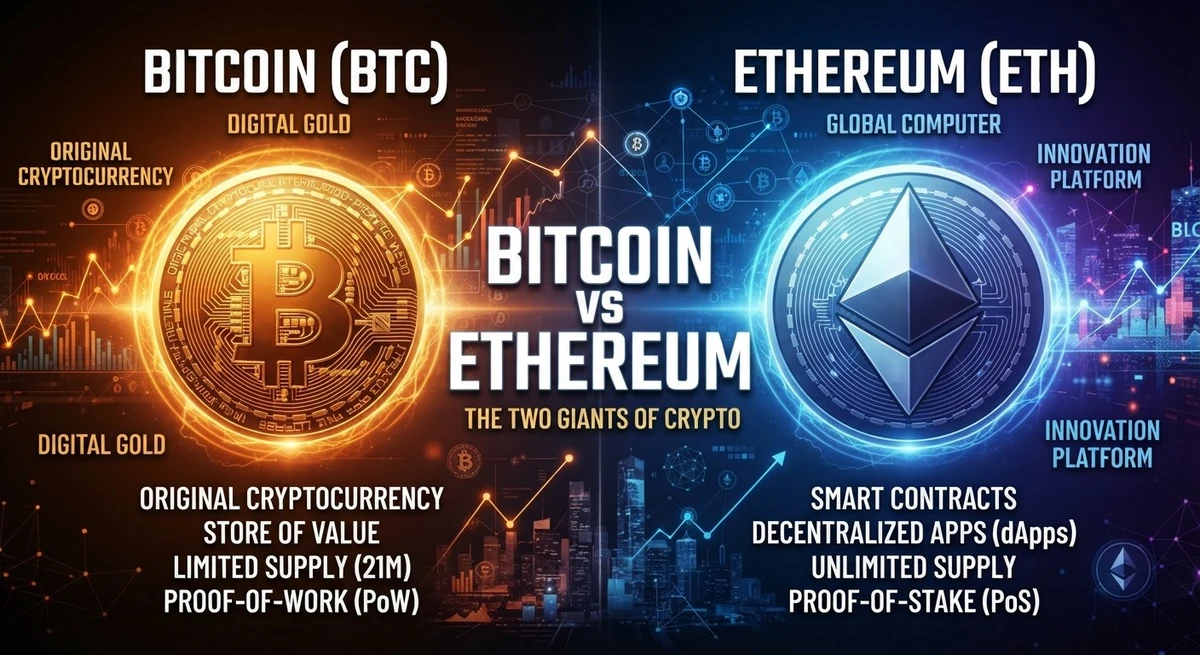
Bitcoin and Ethereum were built around different ideas about what a decentralized network should accomplish. Bitcoin is centered on creating a predictable digital monetary system. Ethereum takes a broader approach, using blockchain infrastructure as a programmable environment where applications, financial services, and digital assets can operate.
That difference affects almost everything else: how each network is secured, how users generate demand for it, how its native asset functions, how the networks scale, and how easily their underlying rules can evolve.
For readers already familiar with the basics of Bitcoin and Ethereum, the more useful question is not simply “What is Bitcoin?” or “What is Ethereum?” It is:
Why were these networks designed differently, and what do those design choices mean economically?
Bitcoin and Ethereum Are Built Around Different Priorities
The easiest way to understand the difference is to look at the problem each network is primarily trying to solve.
Bitcoin was created as a decentralized peer-to-peer payment network and digital monetary system. Its design emphasizes predictable rules, limited issuance, decentralized verification, and a security model based on proof of work. Bitcoin’s official documentation describes it as a decentralized payment network without a central authority. (Bitcoin)
Ethereum took a different path.
Instead of limiting blockchain activity primarily to transferring its native asset, Ethereum was designed as a programmable network. Developers can deploy smart contracts that execute according to predefined rules, allowing applications and financial systems to operate on shared infrastructure. Ethereum describes itself as both a blockchain network and a software development platform. (Ethereum)
That produces a useful distinction:
Bitcoin is primarily organized around decentralized money and settlement. Ethereum is organized around programmable economic activity.
The distinction is not absolute. Bitcoin can support more than simple payments, and Ethereum can obviously be used to transfer value. But their core design priorities remain different.
The Real Difference Is What Creates Network Demand
One of the most useful ways to compare Bitcoin and Ethereum is to ask a simple economic question:
Why does someone need to use the network?
For Bitcoin, demand is closely connected to the ability to hold and transfer a scarce digital asset through a decentralized monetary system. People can use the network to send BTC, hold it, settle transactions, or interact with additional systems built around Bitcoin.
For Ethereum, demand can come from a much wider range of activity.
Users may transfer ETH, but they can also interact with smart contracts, trade tokens, use decentralized financial applications, transfer stablecoins, tokenize assets, or access other applications built on Ethereum.
That means the networks can generate economic activity in different ways.
Bitcoin’s value proposition is closely connected to the monetary properties of its network.
Ethereum’s value proposition is more closely connected to the activity that takes place on its infrastructure.
This difference becomes important when thinking about the two assets themselves.
BTC and ETH Do Different Jobs Inside Their Networks
Bitcoin and Ethereum each have a native cryptocurrency, but the economic role of that asset is not identical.
BTC is the native asset of the Bitcoin network. It is used for transactions and forms the monetary base of the system. New BTC is issued through mining according to predetermined rules, with total issuance ultimately capped at 21 million bitcoin. (Bitcoin)
ETH has a broader operational role.
It is used to pay transaction fees on Ethereum and is also used as the asset that validators stake to help secure the network. Ethereum’s technical documentation describes ETH as a resource that provides an economic market for computation as well as a component of the network’s crypto-economic security. (Ethereum)
This creates an important difference.
BTC is closely tied to Bitcoin’s monetary function.
ETH is tied to both Ethereum’s monetary function and its computational infrastructure.
That does not mean ETH is simply “fuel” or BTC is simply “digital gold.” Those simplified descriptions can hide the wider economic roles of both assets.
Security Comes From Different Economic Costs
The two networks also ask participants to pay for decentralized security in different ways.
Bitcoin uses proof of work. Miners compete using computing power and electricity to add blocks to the blockchain. The cost of participating in the system is therefore closely connected to physical infrastructure and energy expenditure. (Bitcoin)
Ethereum uses proof of stake.
Validators commit ETH as collateral and participate in the process of proposing and confirming blocks. Misbehavior can result in penalties against their stake.
The important comparison is not simply:
Proof of work vs. proof of stake.
It is:
What economic resource makes dishonest behavior expensive?
For Bitcoin, that resource is largely external physical expenditure hardware and electricity.
For Ethereum, it is capital committed to the network through ETH staking.
Both systems therefore turn economic costs into part of their security model, but they do it differently.
The Bank for International Settlements has also highlighted that different consensus designs create different trade-offs involving decentralization, security, scalability, and participation. (Bank for International Settlements)
Their Monetary Systems Reflect Their Different Purposes
Bitcoin’s monetary architecture is deliberately predictable.
The protocol is designed so that new bitcoin is created at a declining rate, eventually reaching a maximum supply of 21 million BTC. (Bitcoin)
That makes supply predictability one of the defining characteristics of Bitcoin.
Ethereum does not use the same fixed maximum-supply model.
ETH is issued to support the proof-of-stake system, while part of transaction fees can be burned under Ethereum’s fee mechanism. As a result, ETH’s overall supply can change depending on network activity, issuance, and the amount of ETH removed through burning.
This creates two different monetary approaches.
Bitcoin emphasizes predictable scarcity.
Ethereum combines network security, issuance, and fee burning within a more dynamic monetary system.
The difference matters because these are not simply two tokens competing for the same monetary role.
One Network Is Mainly a Ledger. The Other Is Also an Execution Environment.
Another major distinction is what happens when a transaction reaches the network.
A Bitcoin transaction generally changes the ownership or spending conditions associated with BTC.
Ethereum can change ownership too, but an Ethereum transaction can also instruct the network to execute code.
That is possible because smart contracts are programs deployed on Ethereum. Users can interact with those programs, while the network processes the resulting state changes according to its rules.
This creates what is often called composability.
One application can interact with another application.
A financial protocol can use a stablecoin. Another application can use that protocol. A wallet can interact with multiple contracts. Tokenized assets can operate within the same broader environment.
The result is an ecosystem where applications can become building blocks for other applications.
Bitcoin’s base layer is much more narrowly focused.
That relative simplicity is not necessarily a weakness. It is connected to Bitcoin’s emphasis on maintaining a monetary network with a comparatively limited base-layer function.
Readers who want the underlying technology explained separately can refer to Economic Reader’s What Is Blockchain? and How Does Blockchain Work?. The important point here is what the different designs mean for Bitcoin and Ethereum rather than repeating blockchain fundamentals.
Scaling Reveals Another Difference in Philosophy
Both networks have had to confront the same basic problem:
How can a decentralized network handle more activity without sacrificing its core properties?
Their approaches have developed differently.
Bitcoin has generally maintained a conservative base-layer design while allowing additional systems, such as the Lightning Network, to handle certain types of activity outside the main blockchain. Bitcoin’s own documentation describes Layer 2-style payment systems as part of the network’s broader scalability approach.
Ethereum has built a much broader scaling ecosystem around Layer 2 networks and rollups.
Rather than requiring every transaction to be processed directly on Ethereum’s main execution layer, rollups can handle activity separately while using Ethereum for important settlement and data-availability functions.
This means Ethereum’s scaling strategy increasingly looks like a network of connected layers rather than a single chain handling every operation itself.
That strategy is still evolving.
Ethereum’s Fusaka upgrade went live in December 2025 and introduced PeerDAS, designed to improve how data for Layer 2 systems is handled. (Ethereum)
In 2026, Ethereum is continuing that development. Glamsterdam is currently being tested on devnets and is targeted for Q4 2026, although its mainnet date has not yet been confirmed. Proposed changes include improvements to processing capacity, data handling, and parallelization. (Ethereum)
This is more than a technical roadmap.
It shows a difference in development philosophy.
Ethereum is actively changing its architecture to accommodate a growing programmable ecosystem. Bitcoin’s development tends to be more conservative because changes to the base layer can affect a network whose predictability is central to its economic proposition.
Decentralization Is Not One Single Thing
It is easy to describe both networks as decentralized and stop there.
The more useful question is: decentralized in what way?
Bitcoin’s network allows users to independently verify the blockchain’s rules, while miners provide the computing work needed to add blocks. Bitcoin’s development and protocol changes also require broad voluntary adoption rather than instructions from a central authority. (Bitcoin)
Ethereum distributes network operation among nodes and validators and uses proof of stake to coordinate consensus.
But decentralization has several dimensions:
- Who can validate transactions?
- Who can run a node?
- How expensive is it to attack the network?
- Who controls the infrastructure?
- How are software changes adopted?
- How easily can different participants coordinate around upgrades?
Bitcoin and Ethereum make different trade-offs across these questions.
That is why simply saying one is “more decentralized” without defining the measurement can be misleading.
Ethereum Changes Faster Because Its Economic Role Keeps Expanding
The difference is also visible in how the two networks evolve.
Bitcoin’s conservative development approach is partly connected to its monetary role. Changing fundamental rules can have significant consequences when users value predictability.
Ethereum has gone through a series of major protocol upgrades, including The Merge, which moved the network from proof of work to proof of stake, followed by later upgrades such as Dencun, Pectra, and Fusaka. (Ethereum)
That process continues.
The Ethereum Foundation’s 2026 protocol priorities focus on scaling, improving user experience, and hardening the Layer 1 network. (Ethereum Foundation Blog)
This does not make Ethereum’s approach automatically better or Bitcoin’s approach automatically worse.
It reflects different requirements.
A programmable platform has strong incentives to evolve as developers, applications, and users demand new capabilities.
A monetary network has stronger reasons to preserve predictable behavior.
Bitcoin and Ethereum Are Not Direct Substitutes
This is probably the most important point in the entire comparison.
BTC and ETH are both traded digital assets. Both can be held in wallets. Both can be transferred on public blockchains. Both are widely integrated into the broader crypto market.
But their underlying networks are not trying to perform exactly the same job.
Bitcoin is primarily a decentralized monetary and settlement network.
Ethereum is a programmable economic platform.
That means the two can grow without one necessarily making the other obsolete.
A user could hold BTC as exposure to Bitcoin’s monetary system while also using Ethereum-based applications.
A business could accept or hold BTC while using Ethereum infrastructure for stablecoins or tokenized assets.
An investor can therefore interact with both ecosystems without treating them as interchangeable.
Where Bitcoin and Ethereum Meet
The wider digital-asset economy increasingly connects the two ecosystems.
Bitcoin can be used as collateral in financial applications. Ethereum hosts stablecoins and tokenized assets. Exchanges provide access to both assets. Cross-chain infrastructure can connect different networks.
This creates a more interconnected crypto economy.
But that interconnection also creates new challenges.
The BIS has noted that the expansion of multiple Layer 1 and Layer 2 networks can fragment liquidity, assets, and infrastructure. Bridges and other interoperability tools can reduce those frictions, but they can also introduce new dependencies involving trust, governance, and operational resilience. (Bank for International Settlements)
So the future of crypto is not necessarily a competition where one blockchain replaces all others.
It may instead be a system of specialized networks that increasingly need to communicate.
What Does Each Network Protect?
A useful way to summarize the difference is to ask what each system is fundamentally trying to protect.
Bitcoin places substantial emphasis on protecting the integrity of a monetary system: who owns BTC, how new BTC is issued, and whether the network’s rules remain predictable.
Ethereum places substantial emphasis on protecting a shared programmable state: who owns assets, what smart contracts do, and whether applications can execute according to agreed network rules.
That leads to two different economic priorities.
Bitcoin emphasizes monetary predictability.
Ethereum emphasizes programmable coordination.
Neither description captures every use case, but it explains why the networks have developed in such different directions.
What Bitcoin vs. Ethereum Means in 2026
By 2026, the distinction between Bitcoin and Ethereum is less about two competing cryptocurrencies and more about two different models of decentralized infrastructure.
Bitcoin continues to focus on a comparatively narrow monetary architecture built around proof of work, predictable issuance, and decentralized verification.
Ethereum continues to develop a broader programmable network, with proof of stake, smart contracts, Layer 2 systems, and ongoing protocol upgrades designed to increase capacity and improve usability.
The economic difference is therefore straightforward:
Bitcoin primarily creates a decentralized monetary network. Ethereum creates a decentralized platform for programmable economic activity.
That distinction explains why their consensus systems differ, why their native assets have different roles, why their scaling strategies are not identical, and why their development processes move at different speeds.
It also explains why comparing BTC and ETH purely by price, market capitalization, or short-term performance misses much of what makes the two networks important.
The more useful comparison is the infrastructure underneath the assets.
Bitcoin and Ethereum are two different answers to the same broad question: how can people coordinate ownership and value without relying entirely on a central authority?
Bitcoin answers that question with a tightly focused monetary network.
Ethereum answers it with a programmable network where financial and digital agreements can be executed through shared infrastructure.
As blockchain technology continues to develop, those two approaches may remain competitors in some areas, but they can also serve complementary roles within the wider digital economy.