
What Is Li-Fi Technology? How Light Can Transmit Data
What if the light above your desk could do more than illuminate the room?
It could also help connect your laptop, phone, or other device to a network.
That is the basic idea behind Li-Fi, short for Light Fidelity. Instead of using radio-frequency signals like conventional Wi-Fi, Li-Fi uses modulated light to transmit data wirelessly.
The concept sounds simple, but it represents a different approach to wireless networking. Rather than trying to make radio-based connectivity do everything, Li-Fi adds another part of the electromagnetic spectrum to the communications mix.
That makes Li-Fi less of a replacement for Wi-Fi and more of a potential complement to it.
What Is Li-Fi Technology?
Li-Fi is a wireless communication technology that uses light to transmit and receive digital information.
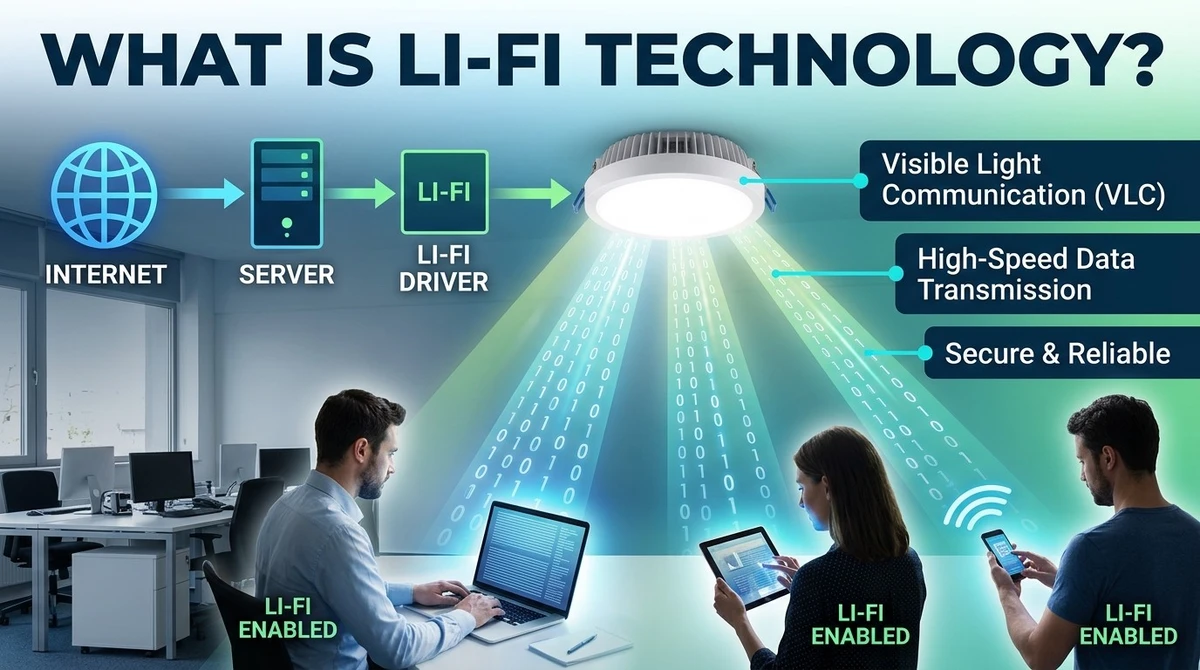
A Li-Fi system can use specially designed solid-state light sources and optical receivers. The transmitter changes the intensity of the light extremely rapidly according to the data being sent. A receiver detects those changes and converts them back into electronic information.
The changes are far too fast for the human eye to perceive as flickering.
The basic difference is therefore straightforward:
Wi-Fi uses radio-frequency signals. Li-Fi uses optical signals.
Li-Fi sits within the broader field of optical wireless communication. The technology can use visible or near-infrared light, depending on the system.
That distinction is important because Li-Fi is not simply “internet through a light bulb.” It is a complete wireless communication approach that can provide network connectivity through optical signals.
How Does Li-Fi Work?
A basic Li-Fi connection needs a transmitter, a receiver, and a network connection.
Data from a network is sent to a Li-Fi access point. The access point uses a light source to encode that information into rapid changes in light intensity.
A receiver on the connected device detects the optical signal and converts it back into data.
Communication can also work in the opposite direction, allowing the device to send information back to the Li-Fi access point.
Modern Li-Fi systems are therefore designed for bidirectional communication, rather than simply broadcasting information from a light to a device.
IEEE’s 802.11bb standard brings Li-Fi into the wider IEEE 802.11 wireless networking framework and specifies physical-layer technologies for light communications. (IEEE Standards Association)
Why Use Light for Wireless Data?
The obvious question is: if Wi-Fi already works, why use light?
One reason is capacity.
Light occupies a different part of the electromagnetic spectrum from the radio frequencies used by Wi-Fi and many other wireless technologies. That gives Li-Fi access to an additional communications medium rather than forcing every wireless connection to compete within the same radio environment.
There is also a physical difference.
Radio signals can travel through walls. Light generally cannot pass through opaque walls.
At first, that sounds like a major disadvantage.
But in some environments, it can be useful.
A Li-Fi connection can be confined more closely to a particular room or area. That can reduce the amount of signal extending beyond the intended space and allow nearby areas to reuse optical connections.
IEEE has described Li-Fi as a complementary technology for Wi-Fi, particularly for high-density environments where additional wireless capacity could be useful. (IEEE Spectrum)
Li-Fi vs Wi-Fi: The Important Difference
Li-Fi and Wi-Fi solve a similar problem connecting devices without cables but they do it in different ways.
Wi-Fi’s radio signals can cover larger areas and pass through many common building materials. That makes Wi-Fi practical for whole homes, offices, public spaces, and mobile connectivity.
Li-Fi is more localized.
A light source typically serves a smaller physical area, and an object blocking the optical path can affect the connection.
That means Li-Fi is not automatically better or worse than Wi-Fi. It is suited to different conditions.
Think of Wi-Fi as a broad wireless network and Li-Fi as a more precisely contained wireless connection.
In a large office, for example, Wi-Fi could provide general coverage throughout the building while Li-Fi adds capacity in conference rooms, workspaces, laboratories, or other areas with many connected devices.
That is one reason the technology is increasingly discussed as complementary to Wi-Fi rather than a replacement for it. (IEEE Spectrum)
What Is IEEE 802.11bb?
A major development for Li-Fi was the introduction of IEEE 802.11bb.
Published in 2023, the amendment extends the 802.11 wireless LAN framework to support light communications. IEEE specifies operation in the 800-1000 nanometer band and bidirectional throughput ranging from 10 Mb/s to 9.6 Gb/s, measured at the MAC data service access point. (IEEE Standards Association)
The importance of the standard is not simply the headline speed.
Standards create common technical rules that allow equipment from different manufacturers to work within the same framework. That can make it easier for Li-Fi products to develop beyond isolated demonstrations and specialized deployments.
The standard also helps position Li-Fi alongside existing Wi-Fi technology rather than treating it as an entirely separate networking world.
What Are the Potential Advantages of Li-Fi?
Li-Fi has several characteristics that could make it useful in specific environments.
Additional Wireless Capacity
Because Li-Fi uses optical signals rather than conventional radio frequencies, it can provide another medium for wireless communication.
This could be valuable in locations where many devices are competing for wireless capacity.
Less Radio-Frequency Interference
Li-Fi does not use the same radio spectrum as Wi-Fi, Bluetooth, and other RF-based systems.
That can make it attractive in environments where radio-frequency interference is a concern.
More Localized Connectivity
Light generally remains within the physical area illuminated by the source.
That can make Li-Fi useful when network operators want tighter control over where a wireless signal is available.
Potentially High Data Rates
The 802.11bb standard supports Li-Fi operation up to a specified 9.6 Gb/s maximum throughput at the MAC service access point. That is a technical capability of the standard, not a guarantee that every commercial Li-Fi installation will deliver that speed. (IEEE Standards Association)
Actual performance depends on the equipment, distance, optical conditions, receiver position, and network design.
What Are Li-Fi’s Limitations?
Li-Fi’s biggest advantage its localized nature is also one of its biggest challenges.
A wall can block the signal.
A person or object can interrupt the optical path.
A device may therefore experience changes in connectivity when the receiver is blocked or when the user moves between different light sources.
Modern systems can address some of these problems through multiple access points, reflections, and handover techniques. But Li-Fi still requires careful network design.
There is also the hardware question.
A regular smartphone cannot automatically connect to Li-Fi simply because it has a camera or an LED flash. Devices need appropriate optical communication components to transmit and receive the required signals.
That creates an adoption challenge.
For Li-Fi to become widespread, manufacturers need to integrate the technology into devices, businesses need reasons to deploy it, and the overall cost has to make sense compared with existing wireless infrastructure.
Where Could Li-Fi Actually Be Useful?
Li-Fi becomes more interesting when its specific characteristics solve a specific problem.
Hospitals are one potential application. Some areas can have strict requirements around wireless equipment, while high-density connectivity can be valuable for connected medical devices and other systems. Research has explored Li-Fi in operating-room environments. (IEEE Spectrum)
Offices and conference rooms could use Li-Fi to add wireless capacity where large numbers of people are connected at the same time.
Industrial facilities could potentially benefit in environments where radio-frequency interference is a concern.
Smart buildings could use lighting infrastructure as part of a broader communications network.
Secure or sensitive environments may also benefit from the physical confinement of optical signals, although Li-Fi should not be treated as a complete security solution by itself.
The common factor is that these are environments where Li-Fi’s characteristics may offer something useful beyond what a conventional Wi-Fi network provides.
Could Li-Fi Replace Wi-Fi?
For most users, the more realistic question is not whether Li-Fi will replace Wi-Fi.
It is where Li-Fi can add something Wi-Fi cannot provide as efficiently.
Wi-Fi remains highly practical for general wireless coverage, mobility, and connections across larger spaces.
Li-Fi can potentially provide high-capacity, localized connectivity in selected areas.
A future network could therefore use both.
A building might rely on Wi-Fi for general coverage while Li-Fi access points provide additional capacity in crowded indoor spaces. Devices could potentially switch between technologies depending on the network environment.
This hybrid approach fits the direction of IEEE 802.11bb, which brings light communications into the established 802.11 framework. (IEEE Spectrum)
Why Li-Fi Could Matter to Businesses
The business case for Li-Fi is ultimately less about the novelty of transmitting data through light and more about whether it can improve how organizations operate.
Suppose an office has hundreds of devices competing for wireless capacity in a limited area. Adding Li-Fi could potentially create another connectivity layer.
Or consider a factory where certain equipment creates radio-frequency interference. An optical connection could provide another option for connecting machines and sensors.
In a smart building, lighting and communications could become more closely integrated.
This is where the technology connects with the broader economic impact of innovation.
Economic Reader’s analysis of how technology changes the economy explains that the value of new technology comes from what businesses can actually do with it whether it raises productivity, lowers costs, improves operations, or opens new markets.
Li-Fi faces the same test.
A technically impressive wireless system has limited economic value if businesses cannot deploy it affordably or find useful applications for it.
What Is the Future of Li-Fi?
Li-Fi has moved beyond the idea of using a blinking LED to send information.
The IEEE 802.11bb standard gives the technology a formal framework for light-based wireless networking, including interoperability and defined performance requirements. (IEEE Standards Association)
But standardization does not automatically mean mass adoption.
Li-Fi still faces practical questions around device integration, deployment costs, coverage, mobility, and consumer demand.
That makes its future difficult to reduce to a simple prediction that Li-Fi will replace Wi-Fi.
A more realistic possibility is that the two technologies will increasingly serve different purposes.
Wi-Fi can continue providing broad wireless connectivity, while Li-Fi adds a high-capacity optical layer where its particular advantages make sense.
The larger lesson is that wireless connectivity does not have to depend on a single technology.
As demand for connected devices grows, networks may increasingly combine different communication methods to match different environments.
Li-Fi is one example of that shift: using light not just to illuminate a space, but to help connect everything inside it.