
How Technology Changes the Economy: The Impact of Innovation on Growth and Business
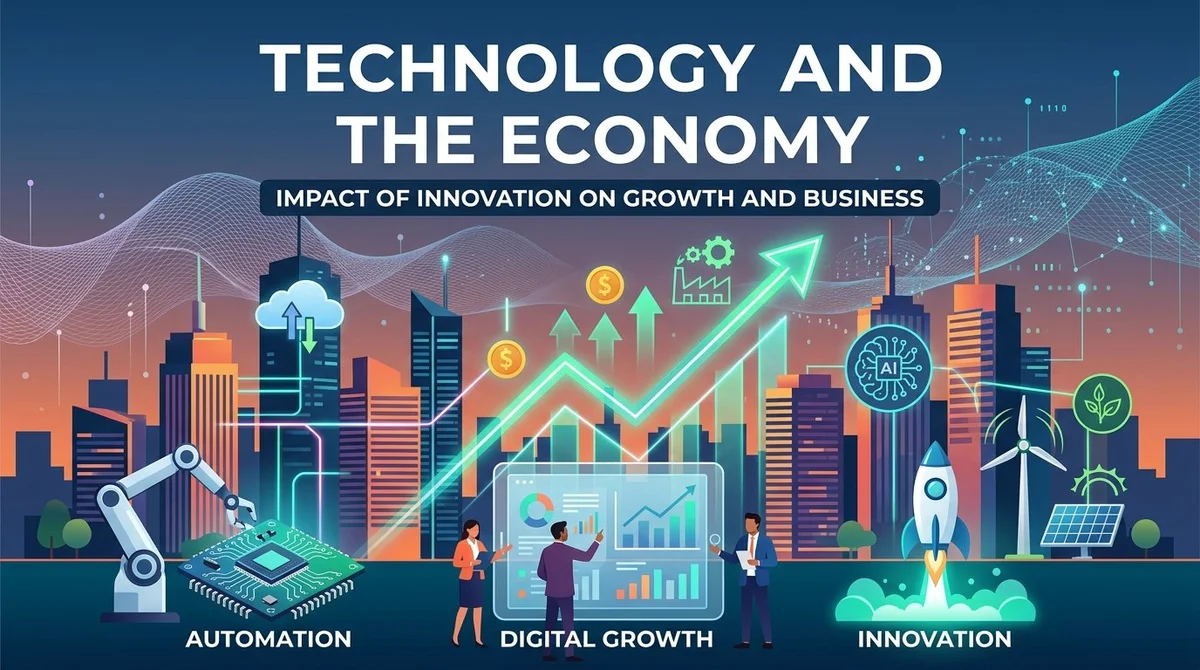
How Technology Changes the Economy
Technology changes the economy in ways that go far beyond new gadgets, faster software, or the latest AI application.
When a business adopts better technology, it can sometimes produce more with the same number of workers, reduce costs, reach customers in new markets, or develop products that were previously difficult to offer. When those changes spread across many businesses, they can affect productivity, investment, employment, wages, trade, and long-term economic growth.
That makes technology an economic issue, not simply a business or consumer trend.
The important question is not whether technology changes the economy. It clearly does. The more useful question is how innovation turns into measurable economic gains and why some technologies spread quickly while others take years to have a broad impact.
Technology Is a Production Tool, Not Just a Product
It is easy to think about technology through the products consumers use: smartphones, computers, electric vehicles, cloud services, or AI assistants.
Businesses experience technology differently.
For a manufacturer, technology may mean automated equipment that increases output. For a retailer, it could be inventory software that reduces stock shortages. A bank may use algorithms to detect fraud more efficiently, while a logistics company can use real-time data to improve delivery routes.
In each case, the economic value comes from what the technology allows the organization to do.
This is why technological innovation can influence the economy even when consumers do not see a dramatic change in their daily lives. A new production system, database, payment network, or industrial process may be invisible to the public while substantially changing how businesses operate.
The connection to broader economic growth becomes clearer through productivity.
The Link Between Technology and Productivity
Productivity measures how efficiently an economy, industry, or business turns inputs such as labor and capital into output.
Technology can raise productivity by allowing workers and businesses to accomplish more with the resources they already have.
Consider a warehouse where employees previously spent hours locating products manually. A combination of barcode scanning, inventory software, and automated sorting could allow the same workforce to process more orders during a shift.
The economy has not gained additional workers, but it has gained additional productive capacity.
At a national level, repeated productivity improvements can increase the amount of goods and services an economy can produce without requiring a proportional increase in labor or other inputs.
That relationship is one reason technology is closely connected to economic growth. The OECD describes technology diffusion as a critical driver of productivity growth, while its 2026 research shows that adoption varies significantly across sectors and firms. (OECD)
For more background on the broader concept, see What Is Economic Growth?.
Why New Technology Does Not Transform the Economy Overnight
A common mistake is to assume that once an important technology is invented, its economic benefits appear immediately.
History suggests otherwise.
Businesses need time to purchase equipment, redesign processes, train employees, change management practices, and integrate new systems with existing infrastructure. Customers also need time to change their behavior.
Electricity provides a useful historical example. Simply making electricity available did not automatically transform every factory. Businesses had to redesign production systems so that electric power could be used efficiently.
Digital technologies have faced a similar challenge.
A company can buy cloud software without becoming more productive if employees do not know how to use it effectively or if the company’s underlying processes remain inefficient.
The same issue is becoming increasingly important with artificial intelligence.
The economic impact of AI will depend not only on how capable the technology becomes, but also on how widely businesses adopt it and whether they reorganize work around it.
Technology Changes How Businesses Compete
Technology can change competition by lowering costs, improving quality, speeding up production, or making information easier to access.
A company that adopts better technology may be able to process orders faster than competitors. Another may use data more effectively to understand customer demand. A manufacturer may automate repetitive tasks and redirect employees toward quality control, product development, or customer service.
That can create a competitive advantage.
But technological advantages rarely remain permanent. Once a useful technology becomes widely available, competitors can often adopt similar systems.
The result is a continuous cycle:
innovation → adoption → competitive pressure → wider diffusion → new innovation
This is one reason technological change can reshape entire industries rather than simply benefiting the company that introduced an innovation first.
Technology Can Create Entirely New Markets
Some technologies do more than improve existing businesses. They create markets that previously barely existed.
The internet expanded digital commerce, online advertising, cloud computing, streaming, and many forms of digital services. Smartphones created new opportunities around mobile applications, digital payments, location-based services, and on-demand platforms.
AI is now opening another layer of potential applications across software, customer service, research, coding, healthcare, manufacturing, and professional services.
Not every new application will become a large industry. Many will disappear or remain niche products.
The broader economic significance comes from the innovations that survive, spread, and generate additional investment.
Technology Changes Jobs by Changing Tasks
One of the most misunderstood effects of technology is its relationship with employment.
Technology can replace certain tasks while increasing demand for other tasks.
A machine may reduce the amount of manual work required on a production line. Software may eliminate repetitive data entry. An AI system may automate parts of research, customer support, translation, or document processing.
At the same time, businesses may need more workers who can manage technology, interpret information, maintain complex systems, or perform tasks that remain difficult to automate.
That means the economic question is often not simply whether technology “destroys jobs.”
A more useful question is which tasks change, which new tasks appear, and how quickly workers can move toward the activities where their contribution remains valuable.
This is particularly important in the AI era, where technological adoption is likely to affect individual tasks and occupations differently.
For a deeper discussion, see AI vs Human Jobs.
Productivity Gains Can Affect Wages and Living Standards
Higher productivity can create room for higher wages, lower prices, higher profits, or some combination of the three.
Suppose a company introduces technology that allows employees to produce significantly more output per hour.
If demand remains strong, the business may expand production. Greater output can support higher revenue and potentially higher wages. Increased productivity can also allow a company to reduce prices while maintaining margins.
At the economy-wide level, sustained productivity growth is one of the foundations for improving living standards.
The distribution of those gains, however, is not automatic.
Workers with skills that complement new technology may benefit more quickly than workers whose tasks are easier to automate. Firms with access to capital and advanced infrastructure may also adopt new technologies faster than smaller businesses.
Technology can therefore raise overall productive capacity while producing very different effects across workers, firms, industries, and regions.
Technology Can Lower Business Costs
Cost reduction is one of the most direct economic effects of innovation.
Digital systems can reduce paperwork. Automation can lower the amount of repetitive labor required for certain processes. Better logistics can reduce fuel use and delivery time. Predictive maintenance can help companies identify equipment problems before they become expensive failures.
Lower costs can improve profitability, but businesses do not always keep the entire benefit.
Competition can push firms to pass some savings to customers through lower prices.
That can increase demand and allow businesses to sell more, creating another round of economic activity.
Technology Also Changes Investment
Technological change often creates new investment requirements.
A company adopting AI may need computing capacity, software, data infrastructure, cybersecurity, employee training, and changes to its internal systems.
A manufacturer introducing robotics may need new machinery, factory redesigns, maintenance systems, and specialized workers.
The technology itself is therefore only part of the economic investment.
The complementary investment around it can be just as important.
This helps explain why a technology with enormous theoretical potential can have a relatively small short-term economic impact. Businesses may still be building the infrastructure and organizational capabilities needed to use it effectively.
Technology Makes Global Business More Connected
Technology has also changed the geography of economic activity.
Digital communication allows companies to coordinate employees and suppliers across borders. Cloud systems make international collaboration easier. Digital payments can simplify transactions. Logistics technology helps businesses track products as they move through global supply chains.
A small company can now reach international customers without establishing a physical presence in every country.
For larger companies, technology can make complex international operations easier to coordinate.
This does not eliminate the importance of geography, regulation, trade costs, or infrastructure. Instead, technology changes which economic activities can be coordinated across distance.
Businesses expanding internationally can therefore use technology as part of a much broader growth strategy. See How Businesses Expand Globally for more on that process.
Technology Can Improve Economy Wide Efficiency
The largest economic effects appear when technological improvements spread beyond individual firms.
Imagine that thousands of businesses become better at forecasting demand, managing inventory, processing payments, producing goods, or coordinating transportation.
The combined effect can improve the efficiency of the wider economy.
This is what makes technology diffusion so important.
An innovation used by one company can create a competitive advantage. An innovation adopted across an industry can change industry productivity. When the technology spreads across many sectors, its influence can become macroeconomic.
OECD research published in 2026 emphasizes that advanced technologies often build on enabling technologies and that diffusion varies substantially by sector and firm size. Larger firms tend to have higher adoption rates, highlighting the importance of the conditions that allow technologies to spread beyond early adopters. (OECD)
Developing Economies Face a Different Technology Challenge
For developing economies, technology can create an opportunity to catch up with more advanced economies.
A country does not necessarily have to reproduce every stage of technological development experienced by richer economies.
Mobile communications are a good example. In some markets, consumers adopted mobile technology without first developing the same scale of fixed-line infrastructure seen in advanced economies.
Digital payments provide another example.
But technology adoption still depends on infrastructure, education, financing, reliable electricity, internet access, institutions, and business capabilities.
A country may have access to advanced technology but capture relatively little economic value if businesses lack the skills or infrastructure required to use it productively.
That is why technology policy is not simply about acquiring the newest tools.
Technology Can Also Increase Economic Inequality
Innovation can distribute economic gains unevenly.
Highly skilled workers may benefit from technologies that complement their abilities, while workers performing highly repetitive tasks may face stronger pressure to adapt.
Large companies may also have more resources to invest in new technology than small firms.
This creates an important distinction between access to technology and the ability to use technology productively.
If adoption is concentrated among large firms or highly skilled workers, productivity gains can coexist with wider differences in economic outcomes.
Education, training, competition, infrastructure, and access to capital therefore influence how broadly the gains from innovation are distributed.
Technology Brings New Economic Risks
Technological progress is not cost-free.
Businesses face cybersecurity risks, technology failures, data-management challenges, and increasingly complex regulatory requirements.
Rapid technological change can also make existing skills less valuable.
AI introduces additional questions around data quality, reliability, intellectual property, privacy, and the consequences of using automated systems in important decisions.
There is also a risk of overinvestment.
A technology can attract enormous amounts of capital before businesses have demonstrated how much economic value it can actually produce.
That does not mean investment is necessarily wasteful. It means the eventual economic impact depends on whether the technology moves from experimentation into productive, scalable use.
Why Innovation Matters More Than Simply Buying Technology
A business can spend heavily on technology and still see little improvement in productivity.
That may happen when the technology is poorly integrated into existing operations, employees are not trained, management processes remain unchanged, or the company is using advanced tools to solve problems that do not actually matter.
The distinction is simple:
technology ownership is not the same as productive technology use.
The real economic benefit appears when innovation changes what a business can produce, how efficiently it operates, or which markets it can serve.
This is particularly relevant for AI.
Buying access to an AI model does not automatically make a company more productive. Businesses need appropriate data, workflows, skills, governance, infrastructure, and organizational changes.
OECD research in 2026 similarly points to diffusion and complementary investments including skills as important conditions for AI-related productivity improvements. (OECD)
What AI Means for the Economy in 2026
Artificial intelligence has become one of the most important examples of technology’s potential economic impact.
AI is already being integrated into software development, customer service, research, marketing, data analysis, and other business processes. Investment in AI-related computing infrastructure and software has also become economically significant.
But the evidence should be interpreted carefully.
The OECD’s 2026 productivity research notes that recent productivity developments provide early and tentative signals that AI may be contributing to productivity in some sectors, while also emphasizing that the evidence remains preliminary. Productivity outcomes differ across countries and industries, and technology adoption is uneven. (OECD)
That makes the current AI story more complicated than simply predicting a large productivity boom.
The potential is substantial, but the economic payoff depends on diffusion, complementary investment, worker skills, infrastructure, and how businesses reorganize around the technology.
In other words, the next stage of the AI story is likely to be determined less by demonstrations of what AI can technically do and more by how effectively businesses turn those capabilities into repeatable economic output.
The Bigger Economic Picture
Technology changes the economy through a chain of connected effects.
Innovation creates new capabilities. Businesses invest in those capabilities. Adoption changes production and business processes. Productivity can rise. Higher productivity expands productive capacity and can support stronger economic growth.
The process is rarely immediate or evenly distributed.
Some technologies spread rapidly. Others take decades. Some create new industries, while others quietly improve existing ones. Some benefit workers and businesses broadly, while others create adjustment costs that require new skills and investment.
That is why technological progress should not be measured only by how impressive a new invention appears.
The more important economic question is whether innovation becomes widely and productively used.
When it does, technology can change much more than individual products or companies. It can alter how economies produce, compete, invest, employ workers, trade, and grow and over time, that can reshape the productive capacity of an entire economy.