
10 Ways Donald Trump Has Changed the US Economy
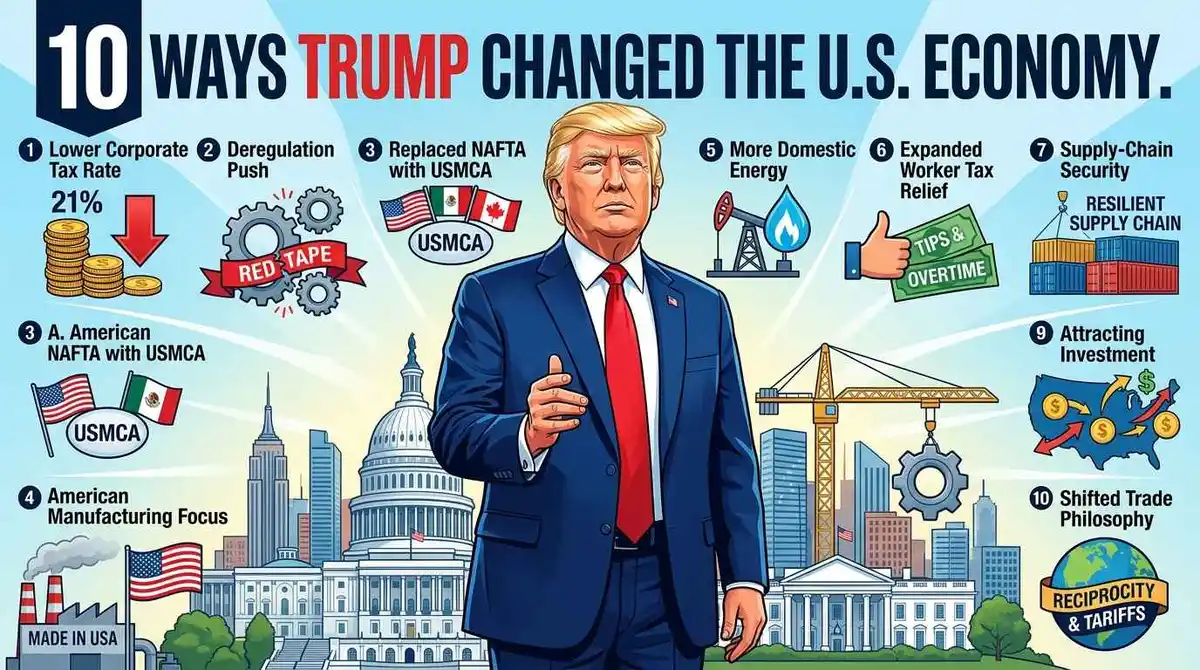
10 Ways Donald Trump Has Changed the US Economy
Donald Trump’s return to the White House has changed more than individual U.S. economic policies. It has changed the assumptions businesses, investors, workers, and trading partners use when making economic decisions.
The clearest shift is from an economy that largely treated globalization, low trade barriers, and international supply chains as sources of efficiency toward one that places greater weight on domestic production, economic security, energy production, trade leverage, and control over strategic industries.
That shift does not fit neatly into a “good for the economy” or “bad for the economy” label.
Some policies can encourage domestic investment or strengthen strategic supply chains while also increasing costs. Tax changes can support household demand and business investment while adding to federal deficits. Lower immigration can reduce labor-force growth even as tighter labor supply may raise wages in some industries.
The important question, therefore, is not simply what Trump changed. It is how those changes alter the way the U.S. economy allocates capital, labor, production, and risk.
As of 2026, the Congressional Budget Office projects real GDP growth of 2.2% in 2026, with unemployment at 4.6% and PCE inflation at 2.7%. But those numbers describe the economy as a whole; they do not mean every Trump policy has produced the same economic effect. (Congressional Budget Office)
1. Trump Turned Tariffs Into a Central Economic Policy Tool
The biggest change is the role of tariffs.
Trump’s administration has treated tariffs not simply as a source of government revenue, but as a tool for influencing trade relationships, protecting strategic industries, encouraging domestic production, and putting pressure on trading partners.
The administration’s January 2025 America First Trade Policy directed officials to investigate persistent U.S. goods trade deficits, unfair trade practices, and possible measures including tariffs. (The White House)
The administration subsequently expanded tariffs across a range of products and countries. Steel, aluminum, and copper have received particular attention because they are considered strategically important to manufacturing and national security. In June 2026, the White House further adjusted tariff regimes affecting those metals. (The White House)
But tariffs create an economic trade-off.
A tariff is collected from an importer when goods enter the United States. The importer can then absorb the cost, negotiate with suppliers, change suppliers, or pass some of the additional cost through the supply chain.
That means the economic question is not simply whether tariffs “hurt foreign countries.”
The more useful question is:
Who ultimately bears the cost, and what behavior does the higher cost change?
For consumers, tariffs can increase prices on imported goods or products containing imported components. For manufacturers, they can raise input costs. For domestic producers protected from foreign competition, however, tariffs can improve their competitive position.
The fiscal picture has also proved more complicated than simply “tariffs raise money.” CBO reported in August 2026 that changes in tariff policy through July 31 were projected to make federal deficits $0.9 trillion larger over 2027–2036 than in its February baseline, partly because tariffs imposed under IEEPA were terminated after a Supreme Court ruling and replacement tariffs were expected to raise less revenue. (Congressional Budget Office)
So Trump’s tariff policy has changed the U.S. economy not only through trade prices, but through business incentives, government revenue, supply-chain decisions, and investment planning.
For readers who want the broader mechanics, Economic Reader’s How Does International Trade Work? explains how imports, exports, customs, tariffs, and cross-border business activity connect.
2. The Economics of Supply Chains Have Changed
Tariffs have also changed how companies think about supply chains.
For decades, many businesses optimized supply chains primarily around cost. If producing a component in another country was cheaper, companies could source it internationally and concentrate production where suppliers, workers, infrastructure, and logistics were most efficient.
Trump’s policies have increased the value of another factor:
resilience.
A company may now accept a higher production cost in exchange for reducing exposure to tariffs, geopolitical tensions, shipping disruptions, or dependence on a single country.
But this does not mean reshoring automatically makes American production cheaper.
A striking 2026 example shows why.
Reuters reported in September that some companies that had shifted production away from China because of tariffs were reconsidering those decisions after encountering higher costs, weaker infrastructure, unreliable electricity, labor shortages, and less-developed supplier networks in alternative manufacturing locations. (Reuters)
This reveals an important economic distinction:
Reducing dependence on one country is not the same thing as producing everything domestically.
Businesses may instead choose a “China plus one” model, diversify suppliers across several countries, or keep production abroad while moving only strategically important activities to the United States.
Economic Reader’s What Is Supply Chain? explains why supplier networks, transportation, inventory, and production decisions are so closely connected.
Trump has therefore changed the economics of supply chains by making risk and national security more important variables in corporate decision-making.
3. Tax Policy Has Shifted Toward Demand and Investment
Trump’s economic agenda has also relied heavily on tax policy.
The 2025 reconciliation legislation signed into law by Trump extended or changed major tax provisions and included provisions affecting households, businesses, investment, and energy production. (The White House)
The economic logic behind tax cuts is straightforward.
If households keep more of their income, consumption can increase.
If businesses face lower effective tax costs, investment may become more attractive.
More consumption and investment can increase aggregate demand and support employment in the short run.
CBO expects the 2025 reconciliation act to boost aggregate demand and employment in 2026. It estimates that changes from the legislation increase potential labor supply over the following years as well. (Congressional Budget Office)
But tax cuts also create a second economic question:
How are they financed?
CBO’s 2026 outlook estimates that the 2025 reconciliation act increased projected deficits by about $4.7 trillion over 2026–2035, after accounting for broader economic effects and debt-service costs. (Congressional Budget Office)
That creates a trade-off.
Tax policy can support near-term demand and incentives to invest, but larger deficits can increase future borrowing requirements and interest costs.
The effect therefore depends not only on how much taxes fall, but on whether the additional economic activity generated by the policy is large enough to offset some of its fiscal cost.
4. Immigration Policy Has Become an Economic Policy
Immigration is often discussed politically, but it is also a major economic variable because immigrants affect the size and composition of the labor force.
Trump’s immigration policies have sought to reduce unauthorized immigration and increase enforcement.
From an economic perspective, the important mechanism is labor supply.
If fewer workers enter the country, the labor force grows more slowly.
CBO explicitly identifies lower net immigration as one of the factors reducing projected labor-force growth. It projects average annual labor-force growth of only 0.4% from 2026 to 2029, compared with much faster growth in the years immediately after the pandemic. (Congressional Budget Office)
The effect is not uniformly negative for every worker.
In industries facing labor shortages, a smaller supply of workers can increase wages.
But there is another side.
Businesses that cannot find enough workers may reduce production, invest in automation, raise prices, or delay expansion.
There is also a demographic effect.
An aging U.S. population already puts downward pressure on labor-force growth. Lower immigration can intensify that constraint because immigration is an important source of population and working-age growth.
This means Trump’s immigration policy has consequences that extend beyond the border.
It can influence wages, hiring, production capacity, housing demand, consumer spending, and long-term economic growth.
5. Manufacturing Has Moved Closer to the Center of Economic Policy
Trump has also changed the role of manufacturing in U.S. economic policy.
Traditional economic policy often emphasizes comparative advantage: countries specialize in activities they can perform relatively efficiently and trade with one another.
Trump’s approach places greater emphasis on maintaining domestic capacity in industries considered strategically important.
That includes areas such as:
- Steel and aluminum
- Critical minerals
- Semiconductors
- Energy
- Defense-related manufacturing
- Other strategically important supply chains
The administration argues that domestic production reduces dependence on foreign suppliers and strengthens national security. Its trade policy explicitly connects manufacturing capacity and supply-chain resilience with economic and national security. (The White House)
The economic trade-off is important.
Domestic production can create jobs, investment, and industrial capabilities that would otherwise disappear.
But producing everything domestically can also be more expensive.
The real economic benefit therefore comes when policy helps build industries that can eventually become productive and competitive, rather than permanently protecting inefficient production from competition.
That distinction will determine whether industrial policy becomes a source of long-term productivity or simply a more expensive way of producing goods.
6. Deregulation Has Become a Growth Strategy
Trump has also placed greater emphasis on reducing federal regulatory barriers.
The economic argument is that regulation can impose costs on businesses by increasing compliance expenses, delaying projects, restricting investment, or making it harder to build infrastructure.
Reducing unnecessary regulation can therefore lower the cost of starting projects and increase the potential return on investment.
But deregulation is not automatically equivalent to economic growth.
Regulations sometimes exist because markets do not fully account for environmental damage, financial risk, health costs, or other externalities.
The economic question is therefore not simply:
“More regulation or less regulation?”
It is:
“Which regulations create costs greater than their benefits, and which ones protect the economy from larger risks?”
That distinction matters particularly in financial markets, energy, environmental policy, and infrastructure.
Trump’s approach has shifted the policy balance toward reducing regulatory barriers, but the long-term economic outcome will depend on whether deregulation improves productivity and investment without creating larger costs elsewhere.
7. Energy Policy Has Shifted Toward Production and Abundance
Energy is another area where Trump’s economic philosophy is especially clear.
His January 2025 executive order on energy called for greater exploration and production of U.S. energy resources, expanded mineral development, and policies intended to increase reliable energy supplies. (The White House)
The economic logic is broader than oil and gas.
Energy is an input into almost every part of the economy.
Manufacturing plants need electricity.
Transportation needs fuel.
Data centers need enormous amounts of power.
Agriculture depends on fuel and energy-intensive inputs.
Chemical and industrial production can also depend heavily on natural gas and electricity.
If abundant energy reduces production costs, it can improve the competitiveness of U.S. businesses.
But energy policy also involves investment timing and technological competition.
Encouraging fossil-fuel production can support existing industries, while changes to electric-vehicle and clean-energy policies can alter where companies invest their capital.
The important economic effect is therefore not simply “more oil and gas.”
It is a change in the relative incentives facing different energy technologies and industries.
8. The Relationship Between the White House and the Federal Reserve Has Changed
One of Trump’s most consequential economic changes may be institutional rather than legislative.
Trump has repeatedly pushed for lower interest rates and criticized the Federal Reserve’s monetary policy.
That matters because the Fed is designed to make monetary policy based on economic conditions rather than presidential political preferences.
In September 2026, Reuters reported that economists had shifted strongly toward expecting a Federal Reserve rate increase as inflation remained elevated, even as Trump continued to demand lower rates. (Reuters)
Reuters also reported that Trump’s pressure on the Fed had become a growing concern for central-bank independence and financial-market credibility. (Reuters)
This creates a difficult economic tension.
Lower interest rates can encourage borrowing, housing activity, business investment, and consumer spending.
But if rates are lowered while inflation remains too high, demand may stay stronger than the economy can comfortably support.
That can make inflation harder to control.
For investors, the important issue is therefore not whether Trump wants lower rates.
It is whether political pressure changes expectations about the Fed’s independence.
Economic Reader’s Historical Fed Decisions provides useful context on how the Federal Reserve has responded to earlier economic crises.
9. Trump’s Policies Have Changed the Fiscal Trade Off
Trump’s economic agenda cannot be evaluated without looking at the federal budget.
Tax changes and spending increases can support economic activity, while tariffs can raise government revenue.
But these effects do not necessarily offset each other.
CBO projects a $1.9 trillion federal deficit in fiscal year 2026, equal to 5.8% of GDP. It projects cumulative deficits of $23.1 trillion from 2026 through 2035. (Congressional Budget Office)
CBO’s analysis also provides a useful illustration of the competing forces.
It estimates that the 2025 reconciliation act increased projected deficits by about $4.7 trillion over 2026–2035, while higher tariffs reduced projected deficits by about $3.0 trillion relative to the baseline used in that analysis. Lower immigration was estimated to increase deficits by another $0.5 trillion. (Congressional Budget Office)
This is why saying “tariffs pay for tax cuts” is too simplistic.
Tariff revenue is only one part of the fiscal equation.
The broader question is whether tax policy, spending, tariff revenue, economic growth, and interest costs produce a sustainable fiscal position.
As borrowing grows, interest payments themselves become an increasingly important claim on future federal resources.
10. Economic Policy Uncertainty Has Become a Business Variable
Perhaps the least visible but most important change is the role of policy uncertainty.
Companies make long-term decisions about factories, suppliers, hiring, technology, and capital spending.
Those decisions become harder when businesses do not know what tariffs, regulations, immigration rules, taxes, or trade relationships will look like several months later.
CBO has noted that uncertainty surrounding trade policy can cause firms to postpone expansion, which can restrain investment, hiring, and productivity. (Congressional Budget Office)
This does not mean every Trump policy reduces investment.
A credible long-term industrial policy could encourage companies to build factories in the United States because they expect domestic production to remain strategically valuable.
But frequent policy changes can have the opposite effect.
A company may delay a factory not because the project is unprofitable, but because it cannot confidently estimate its future costs.
That is an important distinction.
Policy can influence investment through both incentives and uncertainty.
The second effect is often harder to see because the economic activity that does not happen is difficult to measure.
What Has Actually Changed in the U.S. Economic Model?
Looking across these ten areas reveals a broader pattern.
Trump’s economic policies have increased the importance of economic security, domestic production, energy abundance, trade leverage, and strategic industries.
That represents a meaningful change in policy philosophy.
The older globalization model generally emphasized producing goods where they could be made most efficiently and using international trade to connect those production networks.
The Trump approach is more willing to sacrifice some efficiency for resilience and domestic capacity.
That can make sense when the product is strategically important.
A country may reasonably decide that it is worth paying somewhat more to maintain domestic capacity for critical minerals, defense equipment, energy infrastructure, or other essential goods.
But applying the same logic to every industry could reduce productivity and raise prices.
The central economic challenge is therefore selectivity.
The United States does not need to produce everything domestically to have a resilient economy.
It needs to identify where domestic capacity provides enough strategic value to justify the additional cost.
The Bigger Economic Question
The most important way Trump has changed the U.S. economy is not any single tariff, tax provision, immigration rule, or energy order.
It is the change in the trade off policymakers are willing to make.
For decades, economic policy placed substantial weight on efficiency, low-cost global supply chains, and relatively open international markets.
Trump has placed more weight on resilience, domestic production, bargaining power, and economic security.
That shift can create winners.
Domestic manufacturers may gain protection. Some workers may benefit from stronger demand for U.S. production. Energy-intensive industries may benefit from greater energy availability. Strategic industries may attract new investment.
It can also create costs.
Consumers may face higher prices. Businesses may pay more for inputs. Some industries may lose access to efficient international suppliers. Lower immigration can constrain labor-force growth. Larger deficits can increase future financing pressures. And policy uncertainty can cause businesses to delay investment.
The 2026 evidence suggests that the U.S. economy is not moving toward a simple “Trump boom” or “Trump decline.” It is undergoing a reallocation of incentives.
That is the more useful way to understand Trump’s economic legacy.
The ultimate test will be whether the new emphasis on domestic capacity produces enough productivity, investment, and economic security to justify the higher costs that can come with it.
For investors and businesses, that is the question worth watching not whether a single policy is good or bad, but which parts of the American economy become more competitive, which become more expensive, and where capital flows as those incentives change.