What Is Maslow’s Hierarchy of Needs? Understanding Human Needs, Work, and Consumer Behavior
What Is Maslow’s Hierarchy of Needs?
People do not make economic decisions based on money alone.
A household may spend more on food when its budget is tight, prioritize savings when it becomes concerned about financial security, pay for products that create social connection, or spend on education and personal development when basic needs are relatively secure.
Businesses face a similar challenge. They need to understand why customers buy, why employees respond to different incentives, and why priorities change when economic conditions change.
One of the most famous attempts to explain these motivations came from American psychologist Abraham Harold Maslow.
Maslow developed his theory of human motivation in the 1940s and became one of the major figures associated with humanistic psychology. His 1943 paper, A Theory of Human Motivation, proposed that human needs could be arranged according to their relative importance, or “prepotency.” (Psych Classics)
The theory later became widely known as Maslow’s hierarchy of needs.
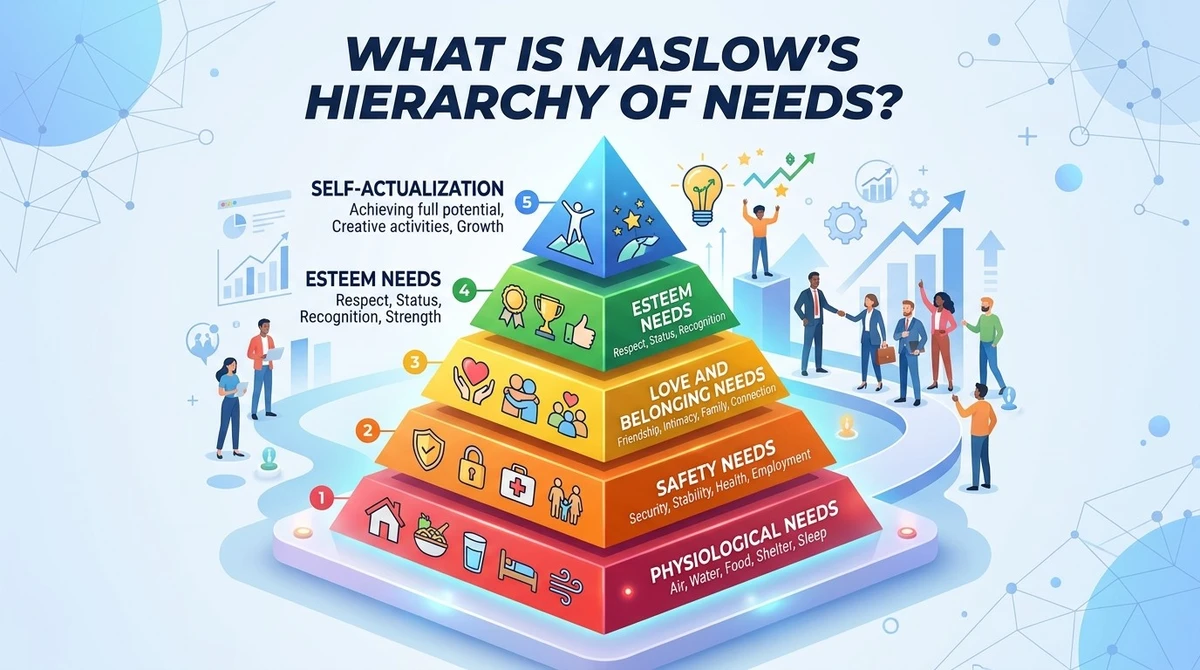
It is often shown as a five-level pyramid, beginning with physiological needs and ending with self-actualization. But that familiar pyramid can give a misleading impression. Maslow’s original work was more flexible than the popular diagram suggests, and later research has found limited support for treating the needs as a universal sequence that everyone follows in exactly the same order.
Understanding that distinction matters when applying Maslow’s ideas to consumer behavior, employment, business, and economics.
Who Was Abraham Maslow?
Abraham Harold Maslow was an American psychologist born in Brooklyn, New York, in 1908. He became a major figure in humanistic psychology, an approach that placed greater emphasis on human potential, personal development, motivation, and psychological well-being.
Maslow’s work differed from approaches that focused primarily on psychological disorders or observable behavior. He was interested in what healthy people could become and why individuals pursue growth, achievement, creativity, and meaning.
He later taught at institutions including Brooklyn College and Brandeis University. Brandeis describes Maslow as an important figure in the development of humanistic psychology and notes his emphasis on human potential and lifelong development. (Brandeis University)
His most famous contribution was the theory of human needs presented in his 1943 paper, A Theory of Human Motivation, published in Psychological Review. (Psych Classics)
Although the theory originated in psychology, its influence eventually spread into management, marketing, education, organizational behavior, and other fields concerned with human decision-making.
What Is Maslow’s Hierarchy of Needs?
Maslow proposed that people have several fundamental categories of needs and that some become more pressing than others depending on how adequately they are being met.
The five levels most commonly associated with the theory are:
- Physiological needs
- Safety needs
- Love and belonging
- Esteem
- Self-actualization
The basic idea is that an unmet lower-level need can become a stronger source of motivation.
Someone struggling to obtain food or shelter, for example, is likely to have different immediate priorities from someone whose basic living conditions are already secure.
But the theory should not be understood as a rigid staircase in which a person completely satisfies one level before moving to the next.
Maslow’s original paper explicitly acknowledged that needs can overlap. He wrote that human behavior can have multiple motivations and later explained that people are generally partially satisfied and partially unsatisfied across different needs at the same time.
That detail is particularly important when applying the theory to economics.
The Five Levels of Human Needs
1. Physiological Needs
At the foundation are basic physiological requirements such as food, water, sleep, and other necessities required for physical survival.
These needs have an obvious economic dimension.
People need resources to obtain food, housing, clothing, energy, and other essentials. When income is limited, a larger share of household spending can be directed toward necessities, leaving less room for discretionary purchases.
Changes in food, rent, energy, and other essential costs can therefore have a particularly strong effect on households with limited financial resources.
A household facing higher essential expenses may postpone spending on entertainment, travel, luxury goods, or other discretionary categories.
This does not mean consumers mechanically move from one level to another. It means economic constraints can change which needs receive the most attention.
Economic Reader’s guide to What Is Demand? explains the broader economic relationship between consumer preferences, income, purchasing ability, and demand.
2. Safety Needs
The next category concerns security, stability, and protection.
In economic life, security can involve much more than physical safety. Stable employment, savings, insurance, reliable housing, manageable debt, and protection against unexpected expenses can all be connected to the broader idea of security.
Consider two households with similar incomes.
One has several months of emergency savings, stable employment, manageable debt, and adequate insurance. The other has little savings, high debt payments, and uncertain income.
Their current incomes may look similar, but their financial priorities can be very different.
The second household may place greater importance on building savings, reducing debt, securing stable employment, or avoiding large discretionary purchases.
This illustrates how economic security can influence behavior independently of current income.
3. Love and Belonging
Maslow’s third category involves relationships, affection, friendship, family, and belonging.
This may appear less connected to economics than food or housing, but social needs influence many markets.
Restaurants, travel, entertainment, sporting events, social platforms, community activities, and other services can have a strong social dimension.
A person may pay for an experience not simply because of its physical usefulness, but because it provides an opportunity to spend time with family, maintain friendships, meet other people, or participate in a community.
The same idea appears inside organizations.
Employees do not experience their workplaces only as sources of income. Relationships with colleagues, team identity, communication, and a sense of belonging can also shape how people experience work.
That does not make Maslow a complete theory of employee behavior. It simply highlights that financial compensation is not the only possible motivation in an economic relationship.
4. Esteem Needs
Esteem relates to self-respect, competence, achievement, recognition, and respect from others.
Economic behavior can reflect these motivations.
Consumers sometimes purchase products that communicate status, identity, achievement, or membership in a particular group. A luxury vehicle, premium watch, designer clothing, or expensive experience may provide functional benefits, but its social meaning can also influence demand.
The same principle can appear in employment.
An employee may value compensation while also caring about recognition, responsibility, professional status, and opportunities to demonstrate competence.
That helps explain why businesses sometimes use promotions, recognition, greater responsibility, professional development, and other non-cash incentives alongside salaries and bonuses.
The broader economic lesson is that price and income do not capture every motivation behind a transaction.
5. Self-Actualization
At the highest level in the commonly presented version of the hierarchy is self-actualization.
Maslow associated self-actualization with realizing one’s potential, personal growth, creativity, and becoming what a person is capable of becoming.
Economic choices can sometimes support these goals.
Someone may spend money on education because learning is personally meaningful. Another person may leave a highly paid position to pursue work that better fits their interests or values.
Entrepreneurship can involve motivations beyond income as well. Some founders pursue independence, creativity, problem-solving, or the opportunity to build something of their own.
These examples do not prove that people reach self-actualization only after satisfying every lower-level need.
People routinely pursue several goals at once.
Why the Famous Pyramid Can Be Misleading
One of the most important facts about Maslow’s hierarchy is that Maslow did not create the famous pyramid diagram that is now almost synonymous with his name.
His 1943 paper described the hierarchy in written form. It did not contain the familiar triangular pyramid. The pyramid became a later visual interpretation that made the theory easier to communicate but also encouraged a more rigid understanding of it. (Psych Classics)
The popular image suggests a simple progression:
basic needs → safety → belonging → esteem → self-actualization
Human behavior is rarely that neat.
A person can care deeply about family while struggling financially. An artist may pursue creative work despite economic insecurity. Someone may save money while spending on education. An employee may seek recognition while worrying about job security.
These motivations can coexist.
Maslow himself acknowledged that the hierarchy was not completely fixed. He discussed exceptions to the usual order and explained that people could be partially satisfied and partially unsatisfied across several categories simultaneously.
The pyramid is therefore best treated as a simplified visual representation, not a universal five-step rule.
Maslow and Consumer Behavior
Maslow’s theory became attractive to marketers because it provides a simple way to think about why different products can appeal to different human motivations.
Consider housing.
A home provides shelter, connecting it to physiological needs. It can also provide security and stability. A larger home may create space for family relationships. A prestigious property can communicate status. For some buyers, building or designing a home can represent personal achievement.
The same product can therefore connect with multiple needs at the same time.
This matters when businesses study consumer behavior.
People do not always purchase products because they are objectively necessary. They may buy based on convenience, identity, social connection, status, security, comfort, or personal aspirations.
Economic conditions can also change the balance between these motivations.
When household budgets become tighter, consumers may become more sensitive to prices and concentrate spending on essential goods. When financial conditions improve, some households may have more room for experiences, premium products, education, travel, or other discretionary purchases.
Maslow’s framework does not provide a precise formula for predicting these changes. It offers a way of asking what need or combination of needs may be influencing a purchasing decision.
That question becomes more useful when combined with conventional economic concepts such as income, prices, preferences, and purchasing power.
Maslow and the Workplace
The workplace provides another useful application.
A business may think employee motivation begins and ends with salary. Maslow’s framework suggests a broader view.
An employee may care about:
- adequate pay and working conditions
- job security
- relationships with colleagues
- belonging to a team
- recognition
- responsibility
- career development
- opportunities to use their abilities
These factors can overlap.
A promotion, for example, may provide higher income, greater recognition, and more responsibility at the same time.
Professional training can increase skills while also creating a path toward career development.
A supportive team can contribute to belonging while improving day-to-day working conditions.
Research has not provided strong evidence for treating Maslow’s hierarchy as a precise model of workplace motivation. A 1968 study of managers, for example, found no strong evidence for the hierarchy itself, although some needs changed in importance as managers progressed through their careers. (ScienceDirect)
That is a useful warning for businesses: Maslow can provide a framework for thinking about motivation, but it should not replace evidence about what employees actually value.
Why Maslow Matters to Economics
Maslow’s hierarchy is not an economic theory.
It is a psychological framework for thinking about human motivation.
Its relevance to economics comes from the fact that economic activity is ultimately connected to human choices.
Households allocate limited income across food, housing, transportation, healthcare, savings, education, entertainment, and other uses.
Businesses decide which products to develop, which customers to target, how to price products, how to organize work, and which employee incentives to offer.
Governments and institutions make decisions about policies that affect access to necessities, economic security, opportunity, and living standards.
In all of these cases, people are responding to a mixture of constraints and motivations.
Economic Reader’s What Is the U.S. Economic System? explains how consumers, workers, businesses, markets, and institutions interact within a market-based economy.
Maslow adds another layer to that picture: what people need can influence how they use the resources available to them.
That does not mean income is unimportant. Income strongly affects purchasing power and the ability to obtain goods and services.
But income alone does not explain every economic choice.
Two people with similar incomes can have very different priorities because of their family circumstances, financial security, social relationships, career goals, or personal values.
Needs, Income, and Consumer Demand
The relationship between needs and income becomes especially interesting when looking at consumer demand.
Suppose a household experiences a significant fall in disposable income.
The household may respond by reducing restaurant visits, delaying a vacation, buying cheaper brands, postponing a vehicle purchase, or cutting other discretionary spending.
The underlying needs have not necessarily disappeared.
The household may simply have less purchasing power available to satisfy them.
The opposite can happen when income rises.
Additional income can allow a household to spend more on experiences, education, higher-quality products, financial protection, or other goals that were previously difficult to afford.
This is one reason economists distinguish between wanting something and having the ability to purchase it.
A consumer can strongly desire a product without generating effective market demand if the consumer cannot afford it.
Economic Reader’s What Is Demand? explores this distinction and explains how income, preferences, prices, and other factors influence demand.
Maslow can complement that analysis by asking what underlying human motivation may be associated with the purchase.
The two approaches answer different questions.
Economics asks how constraints and incentives affect choices. Maslow’s framework asks what kinds of needs may motivate those choices.
Economic Insecurity Can Change Priorities
One of the clearest applications of Maslow’s framework is economic insecurity.
When people become concerned about employment, housing costs, debt, or unexpected expenses, financial security can become more prominent in decision-making.
That can affect businesses as well.
A company selling discretionary products may find customers becoming more price-sensitive during periods of financial pressure. A business selling essential goods may experience a different demand pattern.
Economic Reader’s How to Face a Lack of Customer Demand examines how businesses can distinguish between weak demand caused by pricing, customer fit, economic conditions, visibility, and other factors.
Maslow does not tell a business exactly which factor is responsible.
It provides one possible lens for understanding why customers’ priorities can shift when their circumstances change.
What Does Research Say About Maslow’s Theory?
Maslow’s hierarchy is extremely influential, but its popularity should not be confused with strong empirical confirmation.
A major 1976 review by Wahba and Bridwell examined research on the need hierarchy and found only partial support for Maslow’s propositions. Later organizational research also failed to find strong evidence for a strict hierarchical structure. (ScienceDirect)
More recent research has continued to question the idea that people satisfy needs in a fixed sequence.
A 2023 study examining Maslow’s theory in a Mexican population found that several assumptions associated with the traditional hierarchy were not supported, including the idea that needs must be satisfied sequentially. (ScienceDirect)
Recent academic discussion has also highlighted concerns about the model’s cultural assumptions, conceptual limitations, and limited empirical support for a rigid hierarchy.
This does not make Maslow’s work useless.
It changes how the framework should be interpreted.
Maslow’s hierarchy is more defensible as a historically influential framework for thinking about human motivation than as a scientifically established universal law that predicts everyone’s behavior.
That distinction is particularly important when applying it to economics and business.
What Maslow Can and Cannot Explain
Maslow can help organize questions about why people value security, belonging, recognition, achievement, or personal growth.
But it cannot independently explain:
- how much a consumer will buy
- how prices affect demand
- how income affects consumption
- why one product beats another
- why one employee performs better than another
- how culture changes preferences
- how economic policy changes behavior
Those questions require additional evidence and economic or behavioral models.
For example, a consumer may value a premium product because of status, but the purchase still depends on income, price, alternatives, expectations, and preferences.
An employee may value recognition, but compensation, working conditions, career opportunities, management quality, and job availability can also affect the decision to stay.
Maslow is therefore better viewed as one lens among several, rather than a complete explanation of human behavior.
Maslow’s Lasting Influence
Maslow’s influence extends far beyond the original psychological theory.
His ideas have been used in discussions of management, organizational behavior, marketing, education, and human development. His work at Brandeis also helped shape the university’s psychology department and its broader humanistic tradition. (Brandeis University)
Part of the theory’s staying power comes from its simplicity.
It encourages a straightforward question:
What need is influencing this decision?
That question can be useful even when the full hierarchy does not accurately describe a person’s behavior.
A customer may be buying security.
An employee may be seeking recognition.
A household may be protecting itself against financial uncertainty.
A student may be investing in future opportunities.
An entrepreneur may value independence as much as income.
These motivations can exist at the same time.
Understanding Maslow Without Treating the Pyramid as a Rule
Maslow’s hierarchy of needs remains one of the most recognizable frameworks for thinking about human motivation.
But its modern usefulness depends on understanding both its contribution and its limitations.
Maslow’s original work proposed that human motivation involves different categories of needs with different levels of urgency. It also acknowledged that motivations can overlap and that the hierarchy is not completely rigid. (Psych Classics)
The later pyramid made the theory visually memorable, but it also encouraged a more rigid interpretation than the original work supports.
For economics and business, the most useful lesson is not that consumers always move from food to safety to belonging and eventually to self-actualization.
It is that economic decisions are connected to human needs that go beyond price and income.
People spend money to survive, protect themselves, connect with others, gain recognition, and pursue personal goals. Which motivation becomes more important can change with income, economic security, culture, relationships, circumstances, and personal objectives.
That makes Maslow’s framework worth understanding not as a perfect map of human behavior, but as a starting point for asking a more useful question about economic activity:
What human need is behind the choice, and how do economic constraints shape the way that need is pursued?
That question connects psychology with consumer behavior, work, business, and economics without pretending that one pyramid can explain all of them.