
Growth Stocks vs Value Stocks: Which Is Better for Investors?
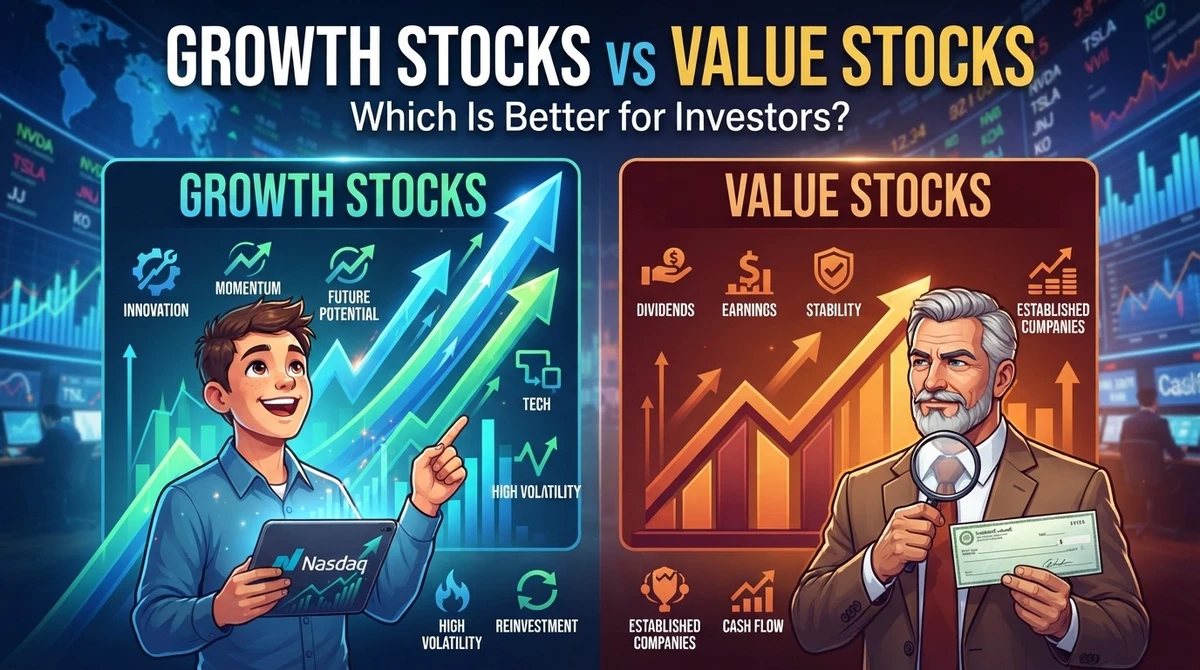
Growth Stocks vs Value Stocks
Growth stocks and value stocks are often presented as two competing ways to invest in the stock market.
Growth investors look for companies that can expand revenue and earnings rapidly. Value investors look for stocks whose market prices appear low relative to the underlying business.
That sounds simple. The harder question is what investors are actually paying for.
A growth stock can be expensive and still produce strong returns if the company grows faster than the market expects. A value stock can look cheap and still perform poorly if its earnings continue to deteriorate.
So, the real comparison is not simply growth versus value.
It is future expectations versus current valuation.
Understanding that difference gives investors a more useful way to evaluate both approaches.
Growth and Value Are Different Investment Styles
Growth and value are classifications based on how investors view a company’s prospects and current market valuation.
According to Investor.gov overview of stocks, growth stocks generally represent companies whose earnings are growing faster than the market average. Value stocks tend to trade at relatively low valuations compared with measures such as earnings, although a low valuation can also reflect problems that investors have identified.
Growth companies often reinvest earnings to expand the business rather than distributing a large share of profits to investors. Value companies are more likely to be mature businesses with established earnings and, in some cases, regular dividends. But neither characteristic is an absolute rule.
The important point is that these labels describe different investment characteristics, not two permanent categories of companies.
A stock can move from growth toward value characteristics, or display elements of both, as its business and valuation change.
What Makes a Growth Stock?
Growth stocks are generally associated with companies expected to increase revenue, earnings, cash flow, or another important business measure faster than the broader market.
They can appear in many industries. Technology is often associated with growth investing, but a company does not need to be a technology business to qualify.
The important question is the quality and durability of the expected growth.
Imagine two companies.
Company A increases earnings by 20% a year, but investors already expect that performance and the stock trades at a very high valuation.
Company B increases earnings by 12% a year, but investors had expected only 5%.
Company B could potentially produce the stronger stock-market return even though its business is growing more slowly.
Why?
Because stock returns depend not only on what a business does, but also on what the market had already priced in.
That is one of the central ideas behind growth investing.
What Makes a Value Stock?
Value investing focuses more heavily on the relationship between a company’s market price and its underlying fundamentals.
Investors may examine measures such as:
- Price-to-earnings ratio
- Price-to-book ratio
- Price-to-cash-flow ratio
- Dividend yield
- Earnings and cash-flow trends
- Balance-sheet strength
A low valuation can attract investors because the stock may appear inexpensive relative to comparable businesses or its own historical valuation. Fidelity’s explanation of value investing highlights the importance of evaluating valuation alongside the company’s underlying fundamentals.
But a low valuation does not automatically mean a stock is undervalued.
A company may trade at a low P/E ratio because investors expect its earnings to decline.
A retailer may look cheap because customers are moving elsewhere.
An industrial company may trade below its historical valuation because demand has weakened.
A bank may appear inexpensive because investors are concerned about future credit losses.
Value investing therefore requires a second question:
Why is the stock cheap?
That answer can reveal either an opportunity or a value trap.
The Biggest Difference Is What the Stock Price Already Assumes
This is where growth and value become more interesting.
Suppose a growth company trades at a high valuation.
That price may already reflect expectations for:
- Rapid revenue growth
- Expanding profit margins
- Strong future cash flow
- A large addressable market
- A durable competitive advantage
The company does not necessarily need to perform badly for the stock to fall.
It may simply grow more slowly than investors expected.
If investors expect earnings to increase 30% but actual growth comes in at 15%, the business may still be expanding rapidly. Yet the stock could decline because expectations were even higher.
Value investing can work through the opposite mechanism.
A company may trade at a low valuation because investors expect weak results. If earnings stabilize, the business improves, or the market becomes less pessimistic, the stock can rise without becoming a high-growth company.
The investment thesis can therefore work because expectations change.
Growth Stocks Can Be Sensitive to Expectations
The more heavily a company’s valuation depends on future growth, the more important expectations become.
Growth stocks can therefore be sensitive to:
- Earnings forecasts
- Revenue growth
- Profit margins
- Interest rates
- Competitive pressure
- Changes in investor sentiment
- Valuation multiples
A company may continue growing while its stock falls if the market decides that future growth will be weaker than previously expected.
Interest rates can add another layer.
Higher rates can affect the valuation investors place on future cash flows. This can matter particularly for highly valued companies whose investment case depends heavily on earnings expected further into the future.
That does not mean growth stocks automatically fall whenever rates rise.
It means valuation and the cost of capital can become more important when a large portion of the investment case depends on future growth.
Value Stocks Can Become Value Traps
Value investing has its own major risk: the stock may be cheap because the business is genuinely deteriorating.
This is known as a value trap.
Imagine a company whose shares trade at only eight times earnings.
That may look attractive compared with another company trading at 25 times earnings.
But what if the first company’s earnings are falling 15% a year?
The low P/E ratio may not mean the stock is undervalued. The market may simply be anticipating weaker future earnings.
The important distinction is between:
A temporary problem and a permanent decline in the business.
A temporary setback can create an opportunity if the underlying business remains strong.
A structural decline can make a low valuation misleading.
This is why value investing is not simply about finding the lowest P/E ratios. The reason behind the valuation matters. Fidelity’s guide to value stocks makes a similar distinction between low valuation and genuine undervaluation.
Valuation Matters to Both Strategies
Growth investors may focus heavily on growth rates.
Value investors may focus heavily on valuation ratios.
But the two cannot really be separated.
Consider two companies:
| Company A | Company B | |
| Earnings growth | 25% | 8% |
| P/E ratio | 45 | 12 |
| Business outlook | Strong | Stable |
| Investor expectations | Very high | Moderate |
Company A has stronger growth.
Company B has a much lower valuation.
Which one produces the better investment return?
There is no answer based on those numbers alone.
Company A might justify its valuation if growth remains exceptionally strong.
Company B might be undervalued if its earnings stabilize and investors reassess the business.
But Company A could disappoint if growth slows, while Company B could remain cheap if its problems continue.
The outcome depends on the relationship between business performance and the expectations already embedded in the stock price.
Growth Does Not Mean Better, and Value Does Not Mean Safer
These labels can create misleading assumptions.
Growth does not mean “good.”
Value does not mean “safe.”
A growth company can have an excellent business but an excessive valuation.
A value company can have a low valuation but a declining business.
Investor.gov’s stock investing guidance notes that stock prices can fall and that there is no guarantee that a company will grow and perform well.
The classification is therefore only a starting point.
Investors still need to understand the business, its financial position, its competitive environment, and the assumptions reflected in its market price.
Economic Conditions Can Change the Environment
Growth and value stocks can respond differently to changes in the broader economy, but these relationships are not fixed rules.
During periods of strong economic expansion, investors may become more willing to pay for businesses expected to grow rapidly.
In other environments, investors may place greater emphasis on current earnings, cash flow, dividends, or lower valuations.
Interest rates can also affect the comparison.
Higher rates can put pressure on highly valued growth companies because future cash flows become less valuable in present-value terms.
But a value stock in a troubled industry can continue falling even when conditions appear favorable for value investing.
Likewise, a high-quality growth company can continue performing strongly when the broader environment is challenging for growth stocks.
The individual business still matters more than the label.
When Growth Characteristics May Fit an Investor
Growth-oriented stocks can be relevant to investors who want greater exposure to companies with strong expected expansion.
That may include businesses benefiting from:
- New technologies
- Expanding markets
- Rising consumer adoption
- Productivity improvements
- New products and services
- Long-term structural changes
The potential benefit is participation in business expansion.
The trade-off is valuation risk.
If investors are already paying a high price for expected growth, the company may need to deliver exceptional results simply to justify that valuation.
That makes the investor’s time horizon important. A company can have a strong long-term business story while its stock still experiences substantial short-term volatility.
When Value Characteristics May Fit an Investor
Value-oriented investing may appeal to investors who focus more heavily on the relationship between price and fundamentals.
Potential candidates may include companies with:
- Lower valuation multiples
- Established businesses
- Strong or recoverable cash flows
- Attractive assets
- Temporary business problems
- More modest growth expectations
The opportunity exists when the market price appears to underestimate the company’s long-term value.
But the investor needs a reason to believe that the gap can eventually close.
A stock being cheap is not the complete investment thesis.
The thesis is that the market’s current assessment is too pessimistic relative to the business’s underlying prospects.
That can take time to play out, and it may never happen if the original analysis is wrong.
Growth and Value Can Overlap
The categories are not completely separate.
A company can grow quickly while still having a reasonable valuation.
That idea is often associated with growth at a reasonable price, or GARP.
The approach combines elements of both styles: look for meaningful growth while paying attention to valuation rather than assuming that rapid growth justifies any price.
Charles Schwab’s GARP investing guide explains the basic idea of looking for growth opportunities without ignoring valuation.
This middle ground highlights an important point.
Investors do not have to choose between “buy expensive growth” and “buy cheap companies.”
There is a wider range of possibilities between the two.
Can a Portfolio Hold Both?
Yes.
An investor does not necessarily need to select one style and exclude the other.
A diversified portfolio can contain both growth and value stocks, giving the investor exposure to businesses with different growth expectations and valuation profiles.
This can also reduce dependence on one investment style.
But diversification does not guarantee profits or prevent losses.
The more useful question is whether the combination matches the investor’s objectives, time horizon, and tolerance for market volatility.
Economic Reader’s What Is Risk Management in Investing? explores diversification, concentration risk, and how investment risk relates to financial goals.
A Better Way to Compare Growth and Value
Instead of choosing a style first, investors can examine the company and then ask which characteristics matter most.
For a potential growth stock:
How sustainable is the growth?
Rapid growth caused by a temporary event is different from growth supported by a durable competitive advantage.
How much growth is already priced in?
A strong business can still be an expensive investment.
For a potential value stock:
Why is the stock cheap?
The answer may reveal an opportunity or a structural problem.
What could change the market’s view?
Without improving fundamentals, a stock can remain inexpensive for a long time.
For either style, investors can also examine:
What does the balance sheet look like?
Are earnings and cash flow improving or deteriorating?
How does the valuation compare with relevant peers?
What assumptions about the future are already reflected in the share price?
Fidelity’s overview of fundamental analysis provides further context on evaluating financial statements, earnings, cash flow, and other business fundamentals rather than relying on a single metric.
So, Which Is Better: Growth or Value?
There is no universal answer.
Growth stocks can provide exposure to companies with strong expected expansion, but investors may pay a high price for that potential.
Value stocks can provide exposure to companies whose market prices appear low relative to their fundamentals, but some may be cheap because their underlying businesses are deteriorating.
The more useful question is not:
“Which style is better?”
It is:
“Is the stock priced appropriately for the business and the expectations surrounding it?”
A growth investor needs to consider whether future expansion can justify the current valuation.
A value investor needs to consider whether the market has become too pessimistic.
And an investor who owns both needs to understand what each position contributes to the portfolio.
Growth and value are therefore not simply opposing camps.
They are two different ways of thinking about business prospects, valuation, and market expectations.
That makes the most important decision less about choosing a label and more about understanding what you are paying for.
Click here to read Best Growth Stocks and Best Value Stocks in USA 2026.