
What Is Silicon Valley? How Silicon Valley Contributes to the US Economy – In Depth Analysis
Few places have influenced the modern US economy as deeply as Silicon Valley.
The name is usually associated with technology giants, startups, venture capital, Stanford University, and wealthy entrepreneurs. But Silicon Valley is more than a collection of technology companies in Northern California.
It is an economic ecosystem in which universities, researchers, entrepreneurs, investors, skilled workers, large companies, and financial markets interact.
That ecosystem has repeatedly turned scientific and technical ideas into commercial products. Its influence can be seen in semiconductors, personal computers, software, internet services, smartphones, cloud computing, financial technology, biotechnology, and artificial intelligence.
The economic effect also extends well beyond the region itself.
A startup founded in Silicon Valley can employ workers locally, raise capital from investors, buy services from other businesses, and eventually sell its products to customers around the world. The technology it develops can then be adopted by companies across the United States.
That makes Silicon Valley important not simply because it produces technology, but because it has developed a system for turning knowledge, capital, and talent into businesses and productivity gains.
At the same time, the region’s success has created major challenges, including extremely high housing costs, inequality, infrastructure pressure, and financial concentration.
Understanding Silicon Valley therefore requires looking at both sides of the equation: how the region generates economic value and what limits that model creates.
What Is Silicon Valley?
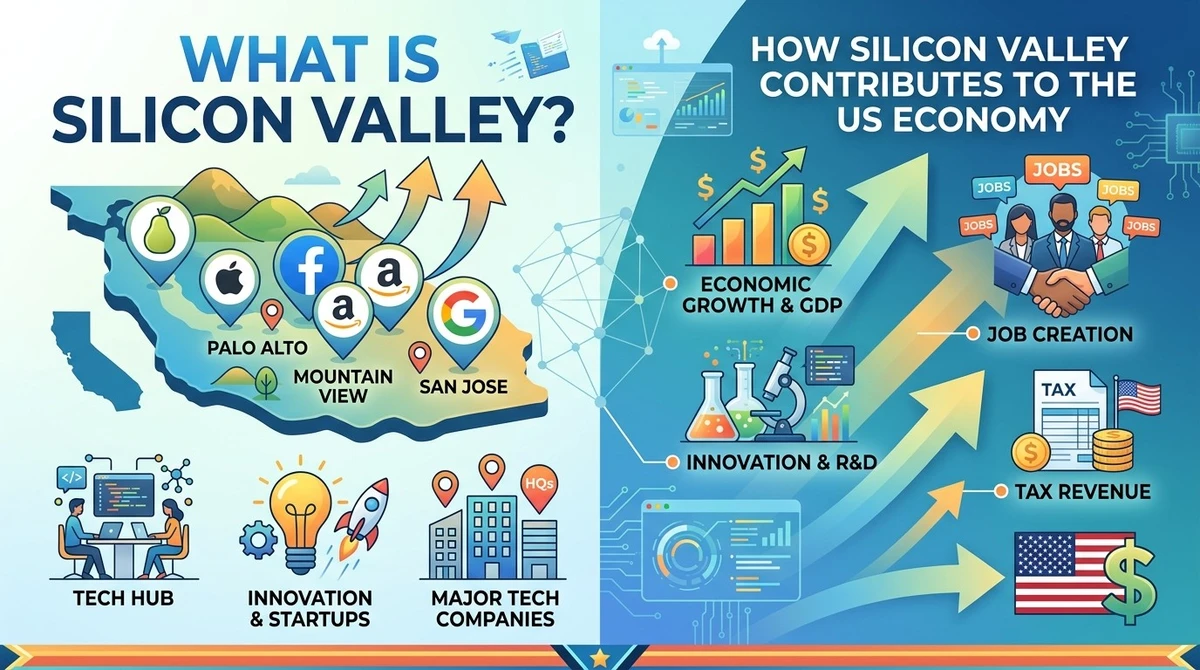
Silicon Valley is a major technology and innovation ecosystem in the southern part of California’s San Francisco Bay Area.
It is not a formally incorporated city or a single government-defined economic region. Its boundaries can vary depending on the organization or dataset being used.
Joint Venture Silicon Valley’s regional research generally covers Santa Clara and San Mateo counties, along with parts of neighboring counties. Other economic statistics may use the San Jose metropolitan area or broader Bay Area definitions.
That distinction matters when comparing statistics.
For example, the U.S. Bureau of Economic Analysis publishes GDP at the county level, while the U.S. Bureau of Labor Statistics publishes employment data for metropolitan areas. These are not interchangeable measures of “Silicon Valley GDP.” (Bureau of Economic Analysis)
The name Silicon Valley comes from the region’s historical connection to the semiconductor industry. Silicon is a key material used in semiconductor manufacturing, while the “Valley” refers to the Santa Clara Valley.
The economy eventually expanded far beyond semiconductors.
Today, Silicon Valley is closely associated with:
- Software
- Semiconductors
- Internet services
- Artificial intelligence
- Cloud computing
- Venture capital
- Biotechnology
- Fintech
- Cybersecurity
- Robotics
- Consumer technology
- Enterprise software
Joint Venture’s 2026 Silicon Valley Index illustrates the scale of the ecosystem, reporting about $92 billion in venture capital and more than 23,000 new patents, while also highlighting severe housing affordability pressures. (Joint Venture Silicon Valley)
Those numbers do not by themselves measure the region’s contribution to U.S. GDP. They do, however, show the unusual concentration of capital and innovation activity around the region.
How Silicon Valley Developed
Silicon Valley was not created by one company or one invention.
Its development came from several forces working together over decades: university research, government spending, defense-related technology, semiconductor companies, entrepreneurs, and private investment.
Stanford University was particularly important.
During the 1930s, Stanford engineering professor Frederick Terman encouraged students and researchers to commercialize their technical work. Stanford’s history notes that Terman encouraged students to develop and commercialize ideas, while William Hewlett and David Packard developed an audio oscillator that became the foundation of Hewlett-Packard. (Stanford University)
That approach helped create a stronger connection between academic research and private enterprise.
Instead of treating the university as an institution completely separate from industry, the region increasingly connected:
Research → entrepreneurship → investment → commercial products
Government spending also played a role.
Defense and Cold War research created demand for electronics, communications systems, and advanced engineering. That demand helped build technical capabilities that private companies could later commercialize.
The semiconductor industry then became central to the region’s identity.
Fairchild Semiconductor became particularly influential because engineers who worked there later helped create other important technology companies.
Intel, founded in 1968 by Robert Noyce and Gordon Moore, became one of the most important examples.
The result was not simply a collection of successful firms.
It was a growing network of engineers, entrepreneurs, managers, investors, researchers, and specialized service providers who could move between organizations and create new businesses.
That network effect became one of Silicon Valley’s defining economic advantages.
Silicon Valley’s Real Advantage Is the Ecosystem
It is easy to say that Silicon Valley succeeded because it has talented people.
Talent is important, but talent alone does not explain the region’s long-term performance.
The more important feature is the interaction between different economic resources.
A simplified version looks like this:
Universities → Research → Talent → Startups → Venture Capital → Products → Successful Companies → New Capital and Talent
Each part strengthens the others.
A university produces research and graduates.
A researcher becomes an entrepreneur.
A venture capitalist provides funding.
The startup hires engineers and other specialists.
Law firms, accountants, recruiters, consultants, and other businesses support the company.
If the company succeeds, employees may receive equity and later use their wealth or experience to create another company.
Investors receive returns and can deploy capital into new startups.
The process begins again.
Stanford’s historical research on Silicon Valley emphasizes this combination of universities, skilled workers, government-supported research, venture capital, and entrepreneurship as part of the region’s innovation environment. (Stanford University)
This helps explain why building a technology park does not automatically create another Silicon Valley.
The physical infrastructure is only one part.
The deeper advantage comes from relationships and accumulated knowledge.
Venture Capital Became a Financial Engine
Venture capital is one of the most important pieces of Silicon Valley’s economic model.
A traditional bank loan generally works better for an established business with predictable revenue, assets, and a clear ability to repay debt.
A young technology company may have almost none of those things.
It may have:
- A promising idea
- A small team
- High research costs
- Little revenue
- An uncertain business model
- Large potential markets
Venture capital provides another form of financing.
Investors provide equity capital in exchange for an ownership stake, accepting a high risk of failure in exchange for the possibility of very large returns from successful companies.
Economic Reader’s guide to What Is Venture Capital? explains the basic role of VC in financing high-growth companies.
Silicon Valley became a major center for this type of investment because technology businesses can sometimes scale much faster than traditional businesses.
A software company, for example, may spend heavily developing a product but later serve millions of customers without increasing costs at the same rate.
That possibility makes investors willing to finance companies with uncertain near-term profitability.
The model also creates a feedback loop:
Investment → Startup Growth → Successful Exit → Investor Returns → New Investment
The cycle can produce repeated waves of company formation.
The 2026 National Venture Capital Association Yearbook, using PitchBook data, reported approximately $320 billion in U.S. venture capital deal value across 15,352 deals in 2025. California attracted about $191.2 billion, roughly 60% of U.S. venture capital, with AI accounting for a large share of recent investment activity.
That concentration shows why California remains central to the U.S. innovation economy, even as other technology centers continue to grow.
Silicon Valley Creates More Than Technology Jobs
The region’s employment contribution is also significant.
The San Jose-Sunnyvale-Santa Clara metropolitan area has an unusually high concentration of technology-related occupations.
According to the U.S. Bureau of Labor Statistics, 149,970 workers were employed in computer and mathematical occupations in the San Jose metropolitan area in May 2025, representing 13.2% of local employment compared with 3.4% nationally.
The average hourly wage for that occupational group was $97.15, compared with $57.73 nationally. Software developers alone accounted for about 87,350 jobs. (Bureau of Labor Statistics)
These numbers show more than high technology employment.
High-paying technology jobs generate demand throughout the local economy.
Workers spend income on:
- Housing
- Food
- Transportation
- Healthcare
- Education
- Entertainment
- Professional services
Technology companies also purchase office space, legal services, accounting, security, construction, cloud infrastructure, equipment, and other services.
That creates indirect economic activity outside the technology sector.
However, it is important not to assume that every dollar of technology-company revenue becomes additional U.S. GDP.
GDP measures production of final goods and services, while company revenue, market value, venture capital, and wages measure different parts of the economy.
This distinction becomes especially important when assessing Silicon Valley.
Silicon Valley’s Contribution to Productivity
The most important economic contribution of Silicon Valley may not be the number of people employed inside the region.
It may be the productivity effects of the technologies developed there.
Productivity broadly describes how efficiently an economy turns labor and capital into goods and services.
Technology can raise productivity when it allows businesses to:
- Automate repetitive tasks
- Process information faster
- Reduce transaction costs
- Coordinate supply chains
- Improve communication
- Reduce waste
- Analyze large amounts of data
- Produce more with existing resources
Silicon Valley has repeatedly produced technologies that changed how other industries operate.
Personal computers changed office work.
Internet services transformed commerce and advertising.
Smartphones changed communication and consumer behavior.
Cloud computing changed how businesses obtain computing capacity.
Digital platforms changed payments, logistics, media, and retail.
Artificial intelligence is now creating another potential productivity cycle.
This creates an important distinction:
Silicon Valley’s economic contribution is not limited to what is produced inside Silicon Valley.
A technology developed there may eventually be used by a manufacturer in Ohio, a hospital in Texas, a bank in New York, or a logistics company in Illinois.
The original economic activity is regional.
The productivity effect can become national.
From Semiconductors to Artificial Intelligence
Silicon Valley has repeatedly moved from one technological generation to another.
A simplified sequence is:
Electronics → Semiconductors → Personal Computing → Software → Internet → Mobile → Cloud → AI
Each stage built on infrastructure, talent, and knowledge accumulated during earlier stages.
Semiconductor expertise supported computing.
Computing created software markets.
Software and telecommunications supported internet services.
Internet businesses created new digital business models.
Cloud computing reduced the cost and complexity of launching internet-scale businesses.
AI is now building on all of these layers.
That ability to move into emerging technologies is one of Silicon Valley’s most important economic characteristics.
It means the region is not dependent on a single product or technology.
Instead, it has repeatedly adapted its existing talent, capital, infrastructure, and networks to new technological opportunities.
Silicon Valley and the AI Investment Boom
Artificial intelligence is the clearest example of this process today.
AI has attracted enormous amounts of capital in the United States.
Stanford’s 2026 AI Index reports that U.S. private AI investment reached $285.9 billion in 2025, more than 23 times China’s reported private AI investment of $12.4 billion. The United States also recorded 1,953 newly funded AI companies during the year. (Stanford HAI)
Private investment figures should not be treated as a complete measure of national AI spending, particularly because countries use different public and government-directed funding mechanisms. But the scale of U.S. private investment shows how strongly capital markets are responding to AI opportunities.
Silicon Valley is deeply connected to this investment cycle.
AI companies need more than software engineers.
They require:
- Advanced semiconductors
- Data centers
- Cloud computing
- Networking equipment
- Electricity
- Cooling systems
- Construction
- Specialized software
- Research talent
That means AI investment can spread across traditional economic sectors.
An AI data center, for example, creates demand for construction, electrical equipment, power infrastructure, networking hardware, and specialized services.
The technology ecosystem therefore becomes connected to the physical economy.
This could make the next Silicon Valley growth cycle different from earlier software-driven periods.
Why Company Valuations Are Not the Same as Economic Output
Silicon Valley has produced companies worth hundreds of billions or even trillions of dollars.
That can create a misleading impression that company valuations can simply be added together to measure the region’s contribution to the U.S. economy.
They cannot.
Market capitalization is not GDP.
Market capitalization represents the value investors place on a company’s equity.
GDP measures the value of final goods and services produced during a specific period.
If investors suddenly value a company at $500 billion instead of $400 billion, the additional $100 billion in market capitalization is not automatically $100 billion of new economic production.
This distinction matters when discussing Silicon Valley because its economic influence is visible through several different channels.
A more useful framework is to examine:
- Business production
- Employment and wages
- Venture investment
- Research and development
- Patents
- Business formation
- Productivity
- International sales
- Tax revenue
- Technology diffusion
Together, these provide a more complete picture of the region’s economic role.
Startups Turn Ideas Into Economic Activity
Entrepreneurship is another central part of Silicon Valley’s model.
A startup is not simply a new company. Many startups are designed to discover a scalable business model and grow rapidly.
Economic Reader’s What Is a Startup? explains how startups differ from traditional businesses and why scalability matters.
Silicon Valley’s advantage is that founders can access many of the resources needed to move from idea to company:
- Venture capital
- Engineers
- Designers
- Experienced executives
- Lawyers
- Accountants
- Recruiters
- Advisors
- Early customers
- Other entrepreneurs
This reduces some of the transaction costs involved in starting a company.
A founder does not have to construct an entire business ecosystem from scratch.
The ecosystem already exists.
That makes company formation more repeatable.
Employee Mobility Creates Knowledge Spillovers
Another less visible advantage is employee mobility.
People move between startups, large technology companies, venture capital firms, universities, and research organizations.
That movement transfers knowledge.
An engineer may learn how to solve a difficult technical problem at one company and later use that experience somewhere else.
A product manager may learn how to scale a digital service and eventually become a founder.
An executive may leave a large technology company and become an investor or advisor.
A researcher may commercialize university research.
This creates what economists often describe as knowledge spillovers.
The original employer may benefit from the worker’s contribution, but the knowledge acquired can later create value elsewhere.
Over time, experience accumulates across the ecosystem.
That is difficult to reproduce quickly in a newly created technology cluster.
Universities Are Part of the Economic Infrastructure
Silicon Valley’s relationship with universities is another major source of its strength.
Stanford University played an especially important historical role, while institutions such as UC Berkeley and UCSF contribute to the broader Bay Area research ecosystem.
Universities support the economy through several channels.
Research
They generate scientific and technical knowledge.
Talent
They train engineers, scientists, managers, and entrepreneurs.
Commercialization
Research can become patents, licenses, startups, and commercial products.
Networks
Students, professors, researchers, and businesses create relationships that can later become partnerships.
Universities can provide laboratories, incubators, entrepreneurship programs, and connections to investors.
Stanford’s own historical account describes Frederick Terman’s role in encouraging students to commercialize their technical ideas, helping establish the relationship between academic research and industry that became characteristic of Silicon Valley. (Stanford University)
This suggests an important economic lesson.
Universities can contribute to growth not only by educating workers, but also by becoming part of the process through which new industries are created.
Patents Provide Another Measure of Innovation
Innovation is difficult to capture with a single statistic.
One useful indicator is patent activity.
Joint Venture’s 2026 Silicon Valley Index reports more than 23,000 new patents associated with the region. (Joint Venture Silicon Valley)
Patents do not automatically create economic value.
Some never become commercial products.
Others may have limited financial importance.
Their significance comes when research and intellectual property are successfully commercialized.
The broader process can be represented as:
Research → Intellectual Property → Commercialization → Investment → Production → Productivity
Silicon Valley’s strength has historically been its ability to connect these stages.
Silicon Valley and the US Tax Base
High-income technology activity also affects government revenue.
Technology companies, employees, investors, and supporting businesses generate different forms of tax revenue, including:
- Individual income taxes
- Corporate taxes
- Payroll taxes
- Property taxes
- Sales taxes
- Capital gains taxes
- Local business taxes
California’s economy is particularly exposed to high-income households, financial markets, and capital gains.
That can generate substantial revenue during periods of strong technology and asset-market performance.
But it can also create volatility.
Technology wealth is closely connected to stock prices, private-company valuations, IPOs, acquisitions, and investment cycles.
A strong technology market can therefore boost government revenue.
A major downturn can weaken it.
This is another example of the trade-off created by economic specialization.
Silicon Valley and Financial Markets
Silicon Valley is closely connected to the U.S. financial system.
A typical technology company may begin with founder capital or angel investment, raise venture capital, secure larger private funding rounds, and eventually reach an exit through an acquisition or IPO.
The cycle can then return capital to investors.
Startup → Funding → Growth → Exit → Investor Returns → New Startup Investment
A healthy exit market is important because it allows investors to recycle capital into younger companies.
The 2026 NVCA Yearbook reported that U.S. venture-backed exits reached approximately $217.1 billion in 2025, while also highlighting a large backlog of private companies waiting for exits.
This matters for Silicon Valley because the region has a large concentration of venture-backed technology companies.
If exits remain active, capital can continue flowing into new businesses.
If exits slow significantly, venture investors may become more cautious, reducing funding available to early-stage companies.
Silicon Valley’s Global Economic Reach
Silicon Valley’s influence also extends through international trade.
Technology companies can sell digital products and services to customers around the world.
Software subscriptions, cloud services, digital advertising, online platforms, and intellectual property can generate international revenue without requiring a traditional physical export for every transaction.
That gives the U.S. economy another source of global earnings.
The structure differs from manufacturing exports.
A factory may produce a physical product in the United States and ship it overseas.
A software company may develop a product in the United States and deliver it digitally to customers around the world.
Both activities generate economic value, but their production and distribution systems are different.
Silicon Valley helped develop many of the business models that made this form of global digital commerce possible.
Silicon Valley’s Technology Spreads into Traditional Industries
The growth of Silicon Valley does not mean the U.S. economy has become a technology-only economy.
Manufacturing, healthcare, agriculture, energy, transportation, construction, finance, and retail remain essential.
Technology increasingly works as an input into these sectors.
A manufacturer can use software to manage inventory.
A hospital can use AI to analyze medical images.
A bank can use machine learning to detect fraud.
A logistics company can use algorithms to optimize delivery routes.
A farm can use sensors and satellite data to improve production.
This is where the economic spillover becomes particularly important.
The technology does not need to remain inside the technology sector to create value.
Its economic effect becomes larger when other industries adopt it.
The Costs of Silicon Valley’s Success
Silicon Valley’s economic success has created serious local pressures.
Housing is the clearest example.
The 2026 Silicon Valley Index reported median home prices approaching $2 million and found that about one-quarter of households were unable to meet basic needs without assistance. (Joint Venture Silicon Valley)
That creates a difficult economic contradiction.
The region generates exceptionally high incomes and productivity, but many workers who support the local economy struggle to afford housing.
High housing costs can lead to:
- Longer commutes
- Difficulty attracting workers
- Higher business costs
- Lower household disposable income
- Pressure on infrastructure
- Workers moving away from the region
Housing therefore becomes more than a quality-of-life issue.
It can become a constraint on economic growth.
If workers cannot afford to live near productive economic centers, businesses may eventually face greater difficulty hiring and retaining them.
Inequality Within a High Income Region
Silicon Valley also illustrates how average economic statistics can hide differences between households.
Highly paid engineers, executives, founders, and investors can accumulate substantial income and financial assets.
At the same time, workers in food services, childcare, cleaning, transportation, retail, and other essential occupations face much lower wages while living in one of the country’s most expensive regions.
The BLS data illustrates this gap.
In May 2025, the average hourly wage across all occupations in the San Jose metropolitan area was $57.32, compared with $33.54 nationally. But wages varied dramatically across occupations, from $110.19 for management to $22.41 for healthcare support. (Bureau of Labor Statistics)
This matters because a region can have very high average earnings while still experiencing affordability problems.
Economic output and household financial security are related, but they are not identical.
Silicon Valley Bank Showed the Risks of Concentration
Silicon Valley’s concentration also creates financial risks.
The 2023 failure of Silicon Valley Bank demonstrated how closely a financial institution can become connected to the technology and venture-capital ecosystem.
SVB had a highly concentrated customer base among technology and life-sciences companies and venture-backed businesses.
The Federal Reserve’s review found that the bank’s vulnerabilities included weaknesses in risk management, a concentrated business model, and heavy reliance on uninsured deposits. Those vulnerabilities became especially dangerous as interest rates rose and technology-sector activity slowed. (Federal Reserve)
The speed of the deposit run was extraordinary.
The Federal Reserve reported that SVB experienced more than $40 billion in deposit outflows on March 9, 2023, with management expecting another $100 billion of withdrawals the following day. (Federal Reserve)
The episode demonstrated an important economic principle:
Specialization can create efficiency, but concentration can also create vulnerability.
A strong network can spread knowledge and capital quickly.
The same network can also transmit financial stress quickly.
Capital Concentration Is Another Risk
The same issue can be seen in venture capital.
When investment becomes heavily concentrated in a small number of companies or technologies, the ecosystem becomes more exposed to changes in investor expectations.
The 2026 NVCA Yearbook reported that AI accounted for 65.4% of U.S. venture deal value in 2025. It also found that a relatively small number of very large deals accounted for a substantial share of total investment.
This does not mean the AI investment cycle will fail.
It does mean that a large amount of capital is being directed toward a relatively narrow group of opportunities.
If those investments generate strong commercial returns, they could finance another major productivity cycle.
If returns disappoint, the adjustment could affect startups, employees, investors, suppliers, and supporting businesses.
The issue is therefore not simply how much capital Silicon Valley attracts.
It is how productively that capital is allocated.
Can Other Regions Create Another Silicon Valley?
Many regions have tried.
Within the United States, Austin, Boston, Seattle, New York, Los Angeles, and other cities have developed strong technology ecosystems.
Internationally, governments and businesses have invested heavily in technology clusters across Europe, Asia, and the Middle East.
Some have achieved significant success.
But reproducing Silicon Valley’s full ecosystem is difficult.
A region needs more than:
- Office space
- Tax incentives
- Research facilities
- Technology companies
It also needs experienced entrepreneurs, investors, skilled workers, specialized services, research institutions, and networks that have developed over time.
The process is cumulative.
Early success attracts capital.
Capital attracts entrepreneurs.
Entrepreneurs attract workers.
Workers attract companies.
Companies attract more investors.
That cycle can reinforce itself.
This is one reason Silicon Valley’s advantage has persisted despite the emergence of competing technology centers.
Why Silicon Valley Still Matters to the US Economy
Silicon Valley’s contribution to the U.S. economy comes through several connected channels rather than one single number.
Capital
The region attracts substantial venture and private investment.
Innovation
Universities and companies produce new technologies and intellectual property.
Employment
Technology firms create large numbers of high-skilled, relatively high-paying jobs.
Entrepreneurship
The ecosystem makes it easier to create and finance new companies.
Productivity
Technologies developed in the region can improve efficiency across other industries.
Financial Markets
Successful technology companies generate IPOs, acquisitions, investment returns, and new capital.
International Revenue
Digital products and services can reach customers around the world.
Tax Revenue
High incomes, company activity, and capital gains contribute to government revenue.
Knowledge Spillovers
Workers, entrepreneurs, and researchers carry experience from one organization to another.
Technology Diffusion
Perhaps most importantly, technology developed in the region can spread across the entire U.S. economy.
The final point is the one that most clearly separates Silicon Valley’s regional footprint from its national economic influence.
The Next Silicon Valley Cycle May Be Built Around AI Infrastructure
Silicon Valley’s next phase could be significantly different from its software-heavy past.
Earlier technology startups could sometimes scale with relatively limited physical infrastructure.
Frontier AI is different.
It requires enormous amounts of computing power, advanced chips, data centers, electricity, networking infrastructure, and specialized talent.
Stanford’s 2026 AI Index notes that U.S. AI investment has surged while compute costs and infrastructure spending are also reaching very high levels. (Stanford HAI)
That means the next technology cycle may connect Silicon Valley even more closely to the physical economy.
AI investment can create demand for:
AI companies → chips → data centers → electricity → construction → networking → cloud infrastructure → skilled workers
This could broaden the economic impact of technology investment.
But it also creates new constraints.
The United States needs enough electricity generation and transmission capacity.
It needs advanced semiconductor supply chains.
It needs data-center infrastructure.
It needs engineers and researchers.
And it needs capital to fund these investments.
Silicon Valley can help create the companies and technologies, but the broader U.S. economy must provide the physical infrastructure required to scale them.
What Silicon Valley Teaches About Economic Growth
Silicon Valley offers a useful case study in how modern economic growth can emerge from the interaction of knowledge, capital, and entrepreneurship.
Its development can be viewed as a chain:
Research creates knowledge.
Universities develop talent.
Entrepreneurs turn ideas into businesses.
Venture capital provides risk capital.
Companies commercialize technology.
Capital markets finance expansion.
Customers adopt new products.
Other industries use the technology.
Productivity can increase.
The final step is particularly important.
A technology company’s economic value does not end when it sells a product.
If the product allows thousands of other businesses to operate more efficiently, the original innovation can produce a much wider economic effect.
That is the mechanism through which a regional technology cluster can influence a national economy.
Silicon Valley’s Economic Legacy Is Larger Than Its Geography
Silicon Valley is often described as the center of America’s technology industry.
That description is accurate, but it does not fully explain its economic importance.
Its deeper significance comes from the system built around technology.
Universities supply research and talent.
Venture capital supplies risk capital.
Entrepreneurs create businesses.
Large technology companies provide experience, markets, and employees.
Financial markets provide exit opportunities.
Specialized service providers support company formation and expansion.
The resulting ecosystem has repeatedly turned technical knowledge into commercial activity.
Its effects appear in employment, wages, investment, patents, business formation, tax revenue, international sales, and productivity.
But Silicon Valley’s most important contribution may happen outside the region.
A technology developed in Palo Alto or Santa Clara can eventually change how a manufacturer in Michigan operates, how a bank in New York detects fraud, how a hospital in Texas uses data, or how a logistics company in Illinois manages deliveries.
That is the difference between regional production and economic spillover.
Silicon Valley has become powerful because it does both.
The region produces technology and creates an environment in which that technology can spread.
Its future economic importance will depend on whether it can maintain that innovation cycle while dealing with the costs created by its success.
Housing affordability, inequality, infrastructure constraints, capital concentration, financial risks, and the enormous resource requirements of AI are no longer side issues. They can influence whether the ecosystem remains capable of attracting the workers, capital, and businesses it needs.
For the U.S. economy, the broader lesson is therefore not simply that technology creates wealth.
It is that innovation becomes economically powerful when research, talent, capital, entrepreneurship, and markets reinforce one another and when the resulting technology spreads beyond the place where it was created.
That is the economic role Silicon Valley has played for decades, and it is the model the U.S. will be testing again as the economy moves deeper into the artificial intelligence era.