
US Stock Market Weekly Update: What Happened This Week? (August 3–7, 2026)
US Stock Market Weekly Update: Market Overview
The US Stock Market Weekly Update for August 3–7, 2026, shows a powerful rebound across major U.S. equity indexes, with technology stocks leading the market higher and the S&P 500 reaching a new record closing high.
The week began with strong investor optimism surrounding potential progress in U.S.-Iran negotiations. Falling crude oil prices helped reduce concerns about inflation, while strong corporate earnings continued to support equity valuations.
The rally accelerated throughout the week as investors increasingly focused on the possibility of a more supportive Federal Reserve policy environment.
The biggest catalyst arrived on Friday, when the U.S. Labor Department reported that the economy lost 23,000 nonfarm jobs in July, a sharp surprise compared with expectations for employment growth. The unemployment rate edged down to 4.1%, partly because labor-force participation declined.
The weak employment report reduced expectations for a September Federal Reserve rate hike. Market pricing placed the probability of a September hike at approximately 44%, down from about 67% one week earlier.
The result was a broad-based stock market rally.
The S&P 500 gained 3.58% for the week, the Nasdaq Composite advanced 5.19%, and the Dow Jones Industrial Average increased 2.96%. All three major indexes posted their strongest weekly gains in months.
US Stock Market Snapshot (August 3–7, 2026)
| Market Indicator | Weekly Data |
| S&P 500 – August 7 Close | ≈ 7,757.64 |
| S&P 500 Weekly Change | +3.58% |
| Nasdaq Composite – August 7 Close | ≈ 26,690.62 |
| Nasdaq Weekly Change | +5.19% |
| Dow Jones – August 7 Close | ≈ 54,036.52 |
| Dow Weekly Change | +2.96% |
| S&P 500 Trend | Strongly Bullish |
| Nasdaq Trend | Strongly Bullish |
| Dow Trend | Bullish |
| Overall Market Sentiment | Bullish |
| Main Catalyst | Weak U.S. jobs data + lower rate-hike expectations |
| Other Major Drivers | Earnings, AI, lower oil prices, falling yields |
The US Stock Market Weekly Update data shows that technology stocks were the clear leaders.
The Nasdaq’s 5.19% weekly gain significantly outpaced the Dow’s 2.96% increase. This indicates that investors were particularly willing to add exposure to growth-oriented and technology companies.
The S&P 500 also reached a record closing high on Friday, confirming that the broader market had moved into a stronger bullish phase.
Weekly Price Action Summary
Monday: Stocks Start August Strong
U.S. stocks began August with a strong rally.
The Dow Jones Industrial Average gained approximately 1.32%, while the S&P 500 advanced 1.48% and the Nasdaq climbed 2.13%. The Dow closed at a record high as optimism surrounding potential U.S.-Iran diplomatic progress reduced geopolitical concerns.
Lower oil prices were particularly important.
As crude prices declined on hopes of improved geopolitical conditions, investors became less concerned about an immediate inflationary shock.
Technology stocks also performed strongly, helping the Nasdaq outperform the broader market.
Tuesday: S&P 500 and Dow Reach Records
The rally continued on Tuesday.
The S&P 500 gained 1.79% to 7,736.52, while the Dow advanced 1.71% to 54,085.88. The Nasdaq rose 2.59% to 26,584.99.
Both the S&P 500 and Dow reached record closing levels.
The move demonstrated that investor confidence was extending beyond a single sector.
Technology, AI-related companies and strong corporate earnings remained important drivers.
Wednesday-Thursday: Investors Prepare for Jobs Data
The middle of the week was dominated by expectations surrounding Friday’s employment report.
Investors were increasingly focused on whether the labor market was weakening enough to change Federal Reserve policy expectations.
Bond yields also became an important part of the market story.
Lower yields can support growth stocks because the present value of future corporate earnings becomes relatively more attractive when discount rates fall.
The Nasdaq therefore remained particularly sensitive to changes in Treasury yields and rate expectations.
Friday: Jobs Report Triggers Major Rally
Friday delivered the week’s most important catalyst.
The U.S. economy unexpectedly lost 23,000 nonfarm jobs in July.
Instead of interpreting the report purely as negative economic news, equity investors focused on its implications for monetary policy.
The weaker labor market reduced expectations for a September rate hike, helping push Treasury yields lower and supporting risk assets.
The S&P 500 finished at a record high, while the Nasdaq and Dow also posted strong gains.
The weekly result was:
- S&P 500: +3.58%
- Nasdaq Composite: +5.19%
- Dow Jones: +2.96%
The Nasdaq’s performance was particularly impressive, highlighting renewed demand for technology and growth stocks.
Market Sentiment Analysis
The US Stock Market Weekly Update points to a clear improvement in investor sentiment.
At the start of the week, investors were concerned about geopolitical risk, inflation and Federal Reserve policy.
By Friday, the dominant market narrative had shifted toward:
Weak jobs data → lower rate-hike expectations → lower yields → stronger equity valuations.
Bullish Factors
- S&P 500 record close
- Strong technology-sector performance
- Weak jobs data reducing rate-hike expectations
- Lower Treasury yields
- Strong corporate earnings
- Falling crude oil prices
- Improving geopolitical sentiment
- Continued AI investment expectations
Risks
- Weak employment could signal a broader economic slowdown
- Equity valuations remain elevated
- Inflation could remain sticky
- Fed policy could change again if inflation rises
- AI capital spending expectations are extremely high
Overall sentiment ended the week Bullish, but investors still need to distinguish between a supportive rate environment and genuine economic strength.
Technical Market Analysis
S&P 500
The S&P 500’s move to a new record closing high significantly strengthened its technical structure.
The index finished around 7,757.64 on Friday.
Key Resistance
Because the index moved into record territory, there is no established historical resistance immediately above the current level.
Psychological levels such as:
7,800
and
8,000
could therefore become important future reference points.
Key Support
7,700
A sustained move below this area could indicate short-term profit-taking.
7,500–7,550
This broader zone could become more important if the market experiences a deeper correction.
Nasdaq Composite
The Nasdaq was the week’s strongest major benchmark.
The index finished near 26,690.62, gaining approximately 5.19% for the week.
Key Resistance
27,000
A sustained move above this psychological level could reinforce bullish momentum.
Key Support
26,000
This could become an important short-term support zone.
Dow Jones Industrial Average
The Dow finished near 54,036.52, gaining approximately 2.96% during the week.
The Dow also reached record territory earlier in the week.
Key Resistance
54,500–55,000
Key Support
53,000–53,500
The Dow’s structure remains bullish as long as it holds above its recent breakout area.
Why Did the Stock Market Move This Week?
1. Weak U.S. Jobs Report
The most important catalyst was Friday’s employment report.
The U.S. economy unexpectedly lost 23,000 jobs in July.
This changed the market’s expectations for Federal Reserve policy.
The probability of a September rate hike fell to approximately 44%, compared with around 67% one week earlier.
This was particularly supportive for growth stocks.
2. Federal Reserve Expectations
Interest-rate expectations are one of the most important drivers of equity valuations.
When investors expect lower interest rates, future corporate earnings can become more valuable relative to fixed-income investments.
Technology companies are particularly sensitive to this relationship because much of their valuation depends on expectations for future growth.
That helps explain why the Nasdaq gained more than 5% during the week.
3. Strong Corporate Earnings
Corporate earnings remained another major source of support.
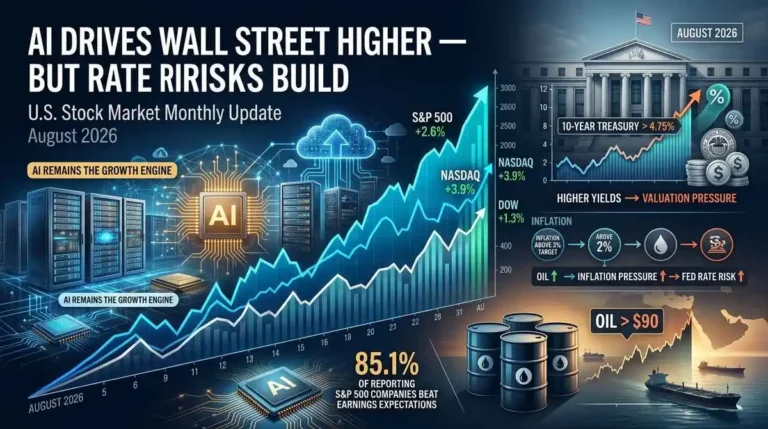
Approximately 85.1% of S&P 500 companies reporting results had exceeded analyst earnings expectations, according to Friday’s Reuters market report.
Strong earnings are important because they provide fundamental support for elevated stock valuations.
The market therefore had two supportive forces at the same time:
Better-than-expected corporate results + more favorable rate expectations.
4. Artificial Intelligence Investment
AI remained a major theme in the technology sector.
Investors continued to evaluate whether enormous AI infrastructure investments would eventually produce sufficient revenue and earnings growth.
The week’s technology rally suggested that investors were becoming more comfortable with the long-term AI growth story.
However, concerns about the size of capital expenditures have not disappeared.
5. Falling Oil Prices
Lower crude prices also supported equities.
Falling oil prices can reduce inflationary pressure, particularly for transportation and energy-intensive businesses.
The decline in crude prices was partly connected to hopes for progress in U.S.-Iran negotiations.
This helped reinforce the idea that inflation pressures might remain manageable.
Institutional Flow Analysis
The US Stock Market Weekly Update suggests that institutional investors were responding to several major macro signals simultaneously.
The combination of:
- Record equity indexes
- Strong earnings
- Lower Treasury yields
- Reduced Fed rate-hike expectations
- Strong technology performance
created a favorable environment for risk assets.
However, institutional investors are also likely to remain sensitive to valuation.
When indexes reach record highs, future gains require continued earnings growth rather than simply expanding investor optimism.
That makes upcoming inflation data especially important.
How Does This Affect Investors?
The week’s market action has several important implications.
Growth Stocks Could Benefit from Lower Rate Expectations
Technology and growth stocks often respond strongly when interest-rate expectations decline.
The Nasdaq’s 5.19% weekly gain illustrates this sensitivity.
Strong Earnings Remain Essential
Record stock prices need fundamental support.
If earnings continue exceeding expectations, valuations can remain supported.
If earnings growth slows, high valuations could become more vulnerable.
Diversification Still Matters
The Dow, S&P 500 and Nasdaq all gained, but they did not move equally.
Technology stocks substantially outperformed the Dow.
Investors therefore need to understand sector concentration when evaluating index performance.
Biggest Market Stories This Week
S&P 500 Hits a Record High
The S&P 500 closed Friday at approximately 7,757.64, reaching a new record closing high.
Nasdaq Leads the Rally
The Nasdaq gained approximately 5.19% during the week, making it the strongest major U.S. index.
Dow Gains Nearly 3%
The Dow increased approximately 2.96% and also reached record territory during the week.
Weak Jobs Data Changes Fed Expectations
The U.S. economy lost 23,000 jobs in July, sharply reducing expectations for a September rate hike.
Technology Stocks Remain Strong
AI-related companies and technology stocks continued to lead the broader market.
Key Risks Ahead
1. Inflation Data
The next major test will be whether inflation remains under control.
Higher-than-expected inflation could quickly push rate expectations higher again.
2. Federal Reserve Policy
The market’s rally increasingly depends on expectations for easier monetary policy.
A change in those expectations could produce significant volatility.
3. High Valuations
Record stock prices mean that investors are paying elevated prices for future earnings.
If earnings disappoint, valuations could come under pressure.
4. Economic Slowdown
The weak jobs report was positive for rate expectations but negative from a fundamental economic perspective.
If employment weakness continues, investors could begin worrying about recession risk.
5. AI Spending
Technology companies continue investing heavily in AI infrastructure.
Investors will increasingly demand evidence that those investments are producing strong revenue and profit growth.
US Stock Market Outlook
Short-Term Outlook
The US Stock Market Weekly Update points to a bullish short-term environment.
The S&P 500 has reached a new record, the Nasdaq has shown strong momentum, and the Dow remains near record territory.
However, the market’s next move will depend heavily on inflation data and Federal Reserve expectations.
If inflation remains manageable, the current rally could continue.
If inflation surprises to the upside, Treasury yields could rise and place pressure on growth stocks.
Bullish Scenario
The bullish scenario would involve:
- Continued earnings growth
- Moderate inflation
- Lower Treasury yields
- Reduced probability of Fed rate hikes
- Continued AI investment
- Stable geopolitical conditions
Under this scenario, the major indexes could continue exploring new highs.
Bearish Scenario
The bearish scenario would involve:
- Accelerating inflation
- Higher Treasury yields
- Renewed Fed tightening expectations
- Weak corporate earnings
- A sharper labor-market slowdown
- Geopolitical escalation
This combination could trigger a correction, particularly in highly valued technology stocks.
Frequently Asked Questions (FAQ)
1. How did the U.S. stock market perform during August 3–7, 2026?
The major indexes had a strong week. The S&P 500 gained approximately 3.58%, the Nasdaq rose 5.19%, and the Dow increased 2.96%.
2. What was the S&P 500’s closing level on August 7, 2026?
The S&P 500 closed at approximately 7,757.64, reaching a new record closing high.
3. Why did stocks rise after the weak jobs report?
Investors interpreted the weak employment data as increasing the possibility that the Federal Reserve would avoid raising interest rates in September. Lower expected rates can support equity valuations, particularly growth stocks.
4. Which major U.S. index performed best this week?
The Nasdaq Composite was the strongest of the three major indexes, gaining approximately 5.19% during the week.
5. What should investors watch next week?
Investors should focus on upcoming inflation data, Treasury yields, Federal Reserve expectations, corporate earnings, AI spending and geopolitical developments.
Final Thoughts
The US Stock Market Weekly Update for August 3–7, 2026, was characterized by strong gains across all three major U.S. indexes.
The S&P 500 reached a record closing high, the Nasdaq delivered a powerful 5.19% weekly gain, and the Dow advanced nearly 3%.
The biggest catalyst was the unexpectedly weak July employment report.
Although weaker employment can be a warning sign for the economy, investors focused on its implications for Federal Reserve policy. The reduced probability of a September rate hike helped push Treasury yields lower and supported risk assets.
Strong corporate earnings and continued enthusiasm surrounding artificial intelligence added another layer of support.
However, investors should not assume that record highs mean risk has disappeared.
The market now faces an important test: Can earnings growth and moderate inflation justify current valuations?
If the answer remains positive, the current rally could continue.
If inflation rises again or economic weakness becomes more severe, the same market that rallied sharply this week could experience increased volatility.
For now, the overall U.S. stock market trend remains bullish, but investors should continue watching monetary policy, inflation, earnings and valuations closely.
Read last week’s Stock Market Weekly Update
Author Note: This article is crafted by “The Economic Reader editorial team”, dedicated to analyzing the latest market trends, financial updates, and global economic shifts to keep you informed with accurate and comprehensive insights.
Disclaimer: The information provided on this website is for educational and informational purposes only and should not be construed as professional financial, investment, or legal advice. Always consult with a certified financial advisor or professional before making any financial decisions based on this content.