US Stock Market Weekly Update: Oil, Inflation and the Fed Shake Wall Street | September 7-11, 2026
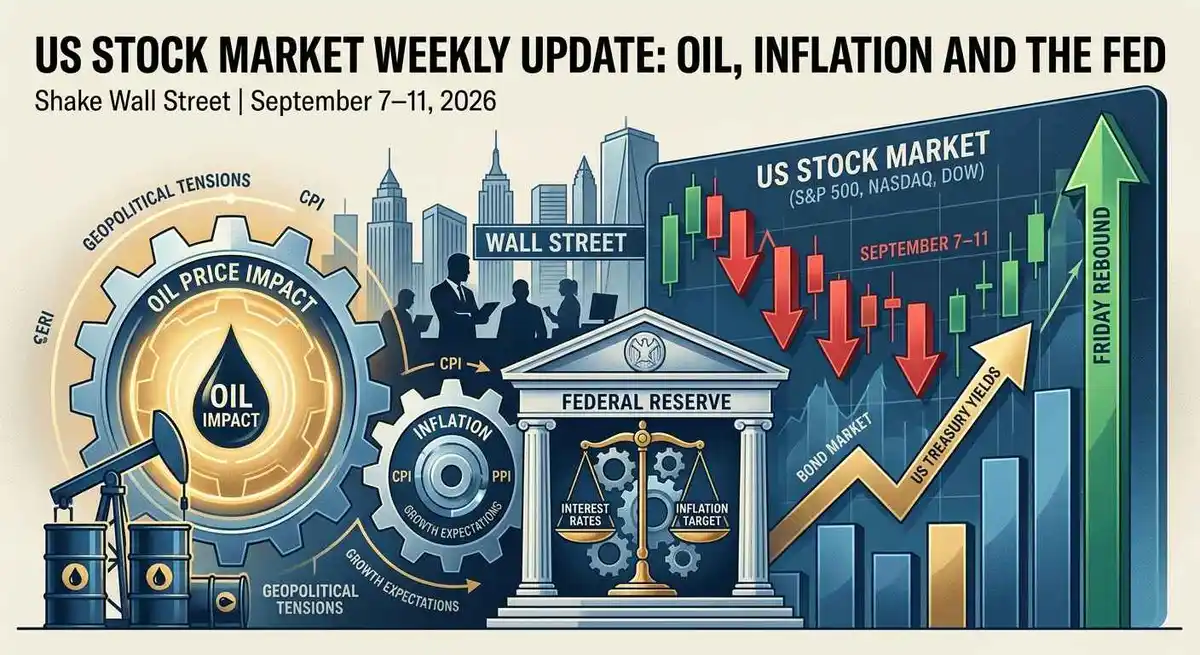
US Stock Market Weekly Update: September 7-11, 2026
Wall Street’s biggest problem last week was not a collapse in corporate earnings. It was the sudden return of an old market threat: higher oil prices forcing investors to rethink inflation and interest rates.
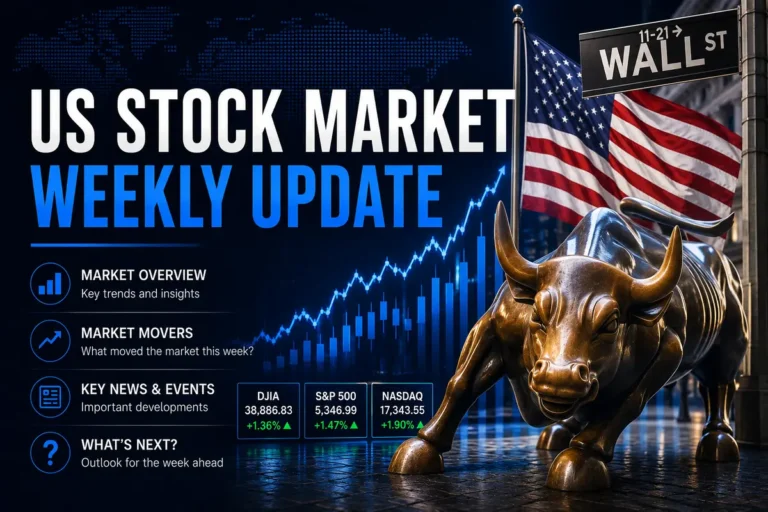
From September 7–11, 2026, U.S. stocks moved through four consecutive sessions of losses before rebounding sharply on Friday. The S&P 500 finished the week down about 0.8%, the Nasdaq Composite fell 0.7%, and the Dow Jones Industrial Average declined 1.6%. The Russell 2000, which tracks smaller U.S. companies, performed worse, losing about 2.4%. (AP News)
The decline itself was not dramatic enough to suggest a market crisis. What mattered was the reason behind it.
A renewed escalation in the Middle East pushed oil prices toward and eventually above $100 a barrel. That revived inflation concerns just as investors were preparing for the Federal Reserve’s September policy meeting. Treasury yields moved sharply higher, while expectations for another Fed rate increase strengthened.
By Friday, falling oil prices and the latest U.S. inflation data helped stocks recover. But the week left investors with a more complicated question: if energy prices remain elevated, can the Federal Reserve ease monetary policy without allowing inflation to become more persistent?
That question is now more important for U.S. stocks than the size of last week’s decline.
Oil Turned Into a Stock Market Problem
The week began with investors already watching developments around the Strait of Hormuz.
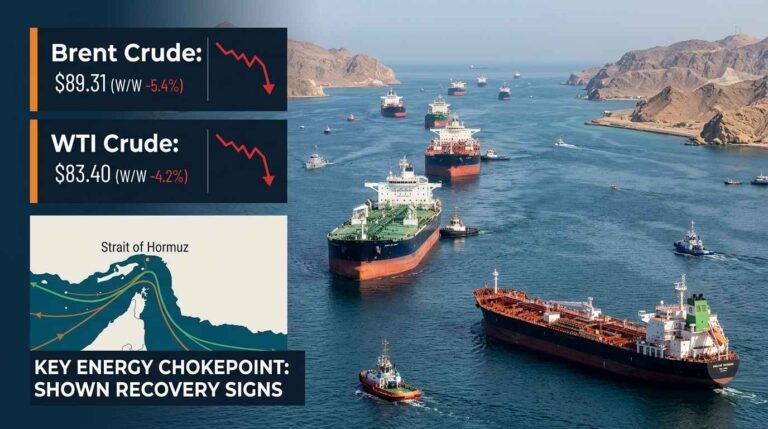
On Monday, Brent crude was approaching $100 a barrel as tensions between the United States and Iran intensified and attacks affected vessels in and around the strategic shipping route. Brent reached about $97.17 during Monday trading, while U.S. West Texas Intermediate crude traded around $92.27. (KSL News)
The significance for stocks was straightforward.
Oil is not simply another commodity. A sustained increase in crude prices can work its way through transportation, manufacturing, logistics, aviation and consumer spending. More importantly, it can make the Federal Reserve’s inflation problem harder to solve.
By later in the week, Brent had moved above $100, while U.S. crude also climbed above that level. Oil eventually pulled back on Friday, but Brent still posted a substantial weekly gain. (The Wall Street Journal)
That created a difficult combination for investors.
If higher oil prices are temporary, the impact on inflation may fade. But if supply disruptions persist, businesses may face higher costs for longer, consumers may spend more on energy, and inflation expectations can become more difficult to contain.
For the stock market, the distinction matters because investors are not only valuing companies based on today’s earnings. They are also estimating what those earnings will be worth under future economic and interest-rate conditions.
Inflation Gave the Fed Another Reason to Be Careful
The market received two important inflation signals during the week.
On Thursday, the Producer Price Index showed that prices received by U.S. producers rose 0.4% in August. Producer prices were up 5.4% from a year earlier. Energy was a major contributor: final-demand energy prices increased 4.2%, while diesel fuel prices jumped 24.1%. (Bureau of Labor Statistics)
That data mattered because producer prices can provide an early indication of cost pressures moving through the economy.
Then came Friday’s Consumer Price Index.
U.S. consumer prices increased 0.4% in August and were 3.4% higher than a year earlier. Core CPI, which excludes food and energy, rose 0.3% for the month. Reuters noted that the core increase was the strongest since April and reinforced expectations that the Federal Reserve could raise interest rates at its next meeting. (Reuters)
The headline number was not dramatically worse than expected. The problem was the combination of energy costs and underlying price pressure.
That made the inflation picture more uncomfortable for policymakers.
Economic Reader’s Historical Fed Decisions provides useful context on how changes in Federal Reserve policy have affected financial markets over different economic cycles.
Treasury Yields Became the Market’s Second Warning Signal
Oil created the inflation concern. The bond market translated that concern into higher borrowing costs.
The U.S. 10-year Treasury yield approached 5% during the week and reached its highest level since 2023. The 30-year Treasury yield also climbed above 5.3%, while the two-year yield moved toward levels not seen in more than a year. (Reuters)
This matters because Treasury yields influence almost every major financial asset.
When government bond yields rise, investors can earn more from relatively lower-risk assets. That can reduce the amount they are willing to pay for stocks, particularly companies whose valuations depend heavily on earnings expected many years into the future.
That is one reason higher yields can be especially uncomfortable for growth and technology stocks.
The relationship does not mean technology stocks automatically fall whenever Treasury yields rise. Strong earnings can offset higher discount rates.
But it does mean valuation becomes more important.
After years of enormous enthusiasm around artificial intelligence, cloud computing and mega-cap technology companies, investors are increasingly asking whether future growth expectations justify current stock prices.
That question becomes more important when the risk-free rate approaches 5%.
Why the Stock Market Did Not Collapse
Despite all those pressures, the U.S. stock market remained remarkably resilient.
The S&P 500 declined less than 1% for the week. The Nasdaq’s loss was even smaller. And the major indexes remained strongly positive for the year. By Friday, the S&P 500 was still up roughly 11.9% for 2026, while the Nasdaq was up about 13.3%. (AP News)
That context is important.
A weekly decline after a strong year is not necessarily evidence that the underlying bull market has ended.
Instead, last week looked more like a repricing of risk.
Investors were forced to consider a less comfortable possibility: interest rates may remain higher for longer if energy prices prevent inflation from moving steadily toward the Federal Reserve’s target.
That is very different from an economy suddenly entering recession.
Corporate earnings remain important, employment conditions matter, and consumer spending has not disappeared. The market is simply facing a more difficult monetary-policy backdrop.
Small Cap Stocks Revealed a Different Side of the Market
The Russell 2000’s 2.4% weekly decline deserves particular attention.
Large technology companies often have stronger balance sheets, substantial cash reserves and greater access to capital markets. Smaller companies can be more exposed to financing costs and domestic economic conditions.
That makes small-cap performance useful when assessing how higher interest rates are affecting the broader economy.
The divergence last week was significant:
- S&P 500: about -0.8%
- Nasdaq Composite: about -0.7%
- Dow Jones Industrial Average: about -1.6%
- Russell 2000: about -2.4%
The pattern suggests that the pressure was not distributed evenly.
The largest and most profitable companies were able to absorb some of the uncertainty better than smaller businesses. That does not necessarily mean small caps will continue underperforming, but it shows how quickly financing conditions can influence different parts of the equity market.
Friday’s Rally Was More Important Than It Looked
The most interesting session of the week was Friday.
After four consecutive losing sessions, the S&P 500 gained 0.9%, the Dow rose 1%, and the Nasdaq advanced 1%. (AP News)
The immediate catalyst was a retreat in oil prices.
Brent crude fell sharply from its recent highs, reducing some of the immediate fear that the energy shock would continue accelerating. Stocks responded even though the latest inflation data still pointed to significant price pressure.
That reaction tells investors something useful.
The market was not simply looking for good economic news. It was looking for evidence that the worst-case combination of high oil prices, accelerating inflation and higher interest rates might not become permanent.
In other words, Friday’s rally was less about declaring inflation defeated and more about reducing the fear of an uncontrolled inflationary shock.
That distinction is important.
A market can rally even when economic conditions are not perfect if investors believe the negative scenario has become less likely.
The Fed Is Now the Biggest Market Event
The next major test arrives with the Federal Reserve’s September 15–16 meeting. The official Fed calendar confirms that the meeting includes updated economic projections, making it particularly important for markets. (Federal Reserve)
Investors are increasingly expecting a rate increase, but the decision itself is only part of the story.
Markets will be watching what Fed officials say about inflation, energy prices, economic growth and the possibility of additional rate increases.
If policymakers signal that higher oil prices are temporary and that inflation remains manageable, stocks could find room to recover.
If the Fed instead signals that inflation risks require a prolonged tightening cycle, Treasury yields could remain elevated and equity valuations could face another round of pressure.
For investors, the difference between “one rate hike” and “a new hiking cycle” is enormous.
What This Means for U.S. Stock Investors
The September 7–11 week did not produce a major stock-market crash. It produced something more useful for investors: a reminder of how quickly different markets can become connected.
The chain reaction was clear.
Geopolitical tensions pushed oil higher.
Higher oil prices increased inflation concerns.
Inflation concerns pushed Treasury yields higher.
Higher yields increased expectations for tighter Federal Reserve policy.
And tighter monetary-policy expectations pressured stock valuations.
The important question now is whether that chain reaction continues.
If oil prices retreat and Treasury yields stabilize, last week’s stock-market weakness could prove temporary. A calmer bond market would give investors more room to focus on corporate earnings, productivity growth and the continuing investment cycle around artificial intelligence.
But if crude remains above $100 for an extended period, the situation becomes more complicated.
Companies could face higher operating costs. Consumers could have less money available for discretionary spending. Inflation could remain elevated. And the Federal Reserve could be forced to keep interest rates higher for longer.
That would create a very different environment for the U.S. stock market.
Economic Reader’s How Investors Should Prepare for a Recession also explores how investors can think about portfolio risk when the economic outlook becomes less predictable.
The Market’s Next Move Depends on Three Numbers
For the week ahead, investors do not need to watch every headline equally.
Three indicators deserve particular attention: oil prices, the 10-year Treasury yield and Federal Reserve expectations.
Oil will show whether the geopolitical risk premium is fading or becoming embedded in energy markets.
The 10-year Treasury yield will show how bond investors are interpreting inflation and government borrowing conditions.
And the Fed’s September decision will determine whether the market needs to adjust to a more restrictive monetary-policy environment.
Those three markets together may tell investors more than any single daily move in the S&P 500.
That is the real lesson from September 7-11, 2026.
Wall Street did not suddenly lose confidence in U.S. companies. Instead, investors were reminded that stock valuations ultimately depend on the economic environment surrounding those companies.
As long as oil prices stabilize and inflation does not accelerate further, the recent pullback could remain a relatively normal correction inside a broader bull market.
But if energy prices stay elevated and the Federal Reserve has to respond with a prolonged period of tighter policy, investors may need to rethink how much they are willing to pay for future growth.
For now, the market is not facing one problem. It is watching to see whether oil, inflation and interest rates become the same problem.