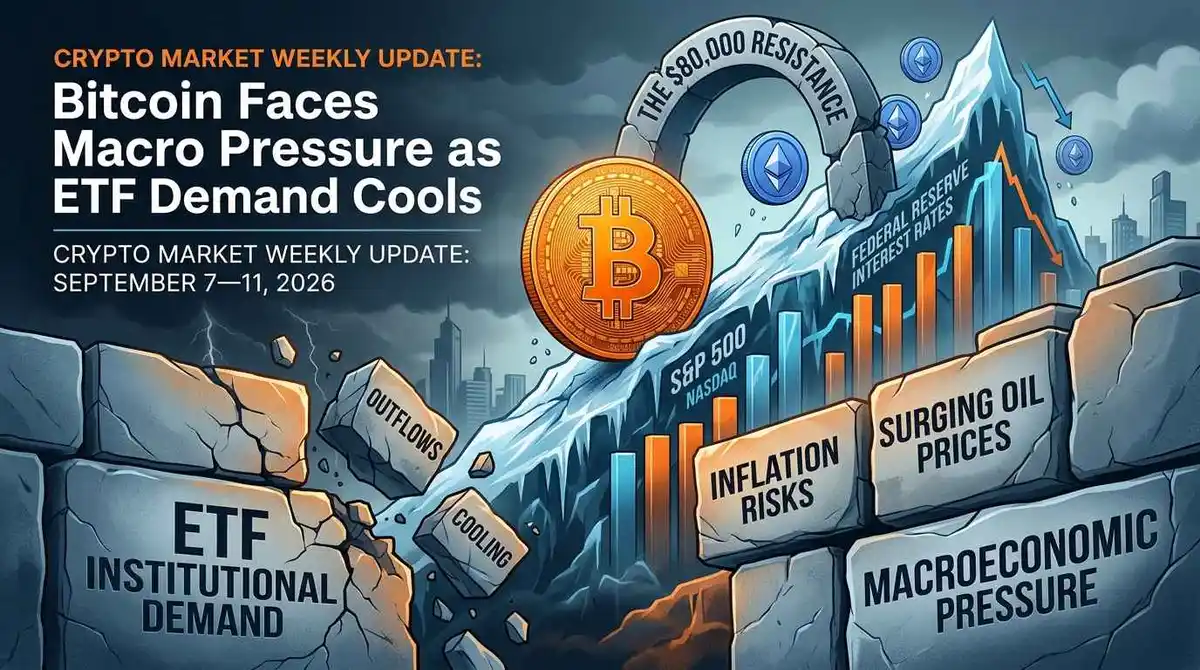
Crypto Market Weekly Update: Bitcoin Faces Macro Pressure as ETF Demand Cools | September 7-11, 2026
Crypto Market Weekly Update: September 7-11 2026
The crypto market entered September 7-11, 2026, with a bullish story already in place: Bitcoin had recently recovered toward $80,000, institutional demand had returned through U.S. spot ETFs, and Ethereum had enjoyed an even stronger recent run.
Yet the week did not turn that optimism into a fresh breakout.
Instead, Bitcoin slipped below $80,000 as oil prices surged, inflation remained uncomfortable and investors became increasingly cautious ahead of the Federal Reserve’s September meeting. At the same time, ETF flows became more mixed, showing that institutional demand was still important but no longer moving in a straight line.
That combination makes this week more interesting than a simple Bitcoin price recap.
The market is now testing whether the institutional buying that supported the August recovery is strong enough to overcome a more difficult macroeconomic environment.
Bitcoin Ran Into a Different Kind of Resistance
Bitcoin started the week close to $80,000. On September 7, it was trading around $79,486, while Ethereum was near $2,500. The relatively stable start suggested that investors were willing to wait for more information rather than immediately reduce crypto exposure. (The Economic Times)
That patience did not last.
By September 8, Bitcoin had fallen below $80,000 as oil prices rose and investors became more cautious about inflation and interest rates. Reuters reported that broader markets were also under pressure, with traders increasingly focused on the Federal Reserve’s upcoming policy decision. (Reuters)
Bitcoin’s move was significant because $80,000 had become more than a round number. It represented an area where the market needed to prove that the recent recovery could develop into another sustained leg higher.
Instead, the cryptocurrency spent the week showing how difficult that becomes when the macroeconomic backdrop turns less supportive.
The problem was not a collapse in crypto-specific demand.
It was that the market suddenly had more reasons to be cautious.
ETF Demand Was Strong, But the Signal Was Changing
U.S. spot Bitcoin ETFs had entered September with substantial momentum.
For the week ending September 5, Bitcoin ETFs attracted approximately $986.9 million, according to SoSoValue data, extending a three-week inflow streak to roughly $3.8 billion. That was one of the strongest stretches of institutional demand seen during 2026. (CoinMarketCap)
But that momentum became less consistent during September 7-11.
Farside’s Bitcoin ETF data shows that flows turned negative during the week, including an approximately $19.5 million outflow on September 9. Separate reporting showed that U.S. spot Bitcoin ETFs recorded a $120.2 million net outflow that day, while Ethereum ETFs attracted about $34.75 million. (Farside Investors)
That distinction matters.
The right conclusion is not that institutional investors suddenly abandoned Bitcoin. The stronger conclusion is that the exceptional buying momentum seen in late August and early September began to lose some of its force just as macroeconomic pressure increased.
That helps explain why Bitcoin struggled to push decisively above $80,000.
ETF flows remain an important source of demand, but they are not a permanent floor under the market.
When the macro environment changes, even institutional investors can slow their purchases, take profits or wait for better entry points.
The Bigger Problem Was Liquidity
The week’s crypto story becomes clearer when Bitcoin is viewed alongside oil, inflation and interest rates.
Brent crude rose above $100 per barrel during the week and eventually settled at $104.61 on Friday, while WTI settled at $100.05. Brent remained more than 8% higher for the week. (Reuters)
That matters to crypto because higher energy prices can make inflation harder to control.
The August U.S. consumer price report added to that concern. Consumer prices increased 0.4% in August from the previous month and 3.4% from a year earlier. Core CPI increased 0.3% month over month and remained 2.4% higher than a year earlier.
The inflation picture did not give investors the clean disinflationary signal they wanted before the Federal Reserve meeting.
As a result, expectations for monetary policy became more important again. Reuters reported that the latest inflation data strengthened expectations for a rate increase at the September meeting. (Reuters)
For Bitcoin, the connection is indirect but increasingly important.
Higher rates and higher bond yields can reduce the attractiveness of assets whose valuations depend heavily on liquidity and risk appetite. Investors do not necessarily need to become bearish on Bitcoin itself. They simply need to become less willing to take additional risk.
That is enough to slow a rally.
Ethereum Revealed a Different Side of the Market
Ethereum deserves more attention this week because its behavior showed why the crypto market should not be treated as one single trade.
Ethereum had entered September following a powerful rally. Reuters reported that Ether had gained about 37% over a 10-day period before consolidating around the $2,500 area. (The Economic Times)
Its ETF flows also provided an interesting contrast with Bitcoin.
On September 9, when Bitcoin ETFs experienced a $120.2 million outflow, Ethereum ETFs recorded approximately $34.75 million of inflows. (Crypto Briefing)
That does not mean Ethereum had suddenly become stronger than Bitcoin across every measure.
But it does show that institutional crypto demand can rotate between assets.
Ethereum’s recent price performance has also been notable. From August 11 through September 10, Ethereum gained roughly 33%, compared with about 23% for Bitcoin over the same period. (24/7 Wall St.)
The important takeaway is that ETF flows and price performance do not always move together.
Bitcoin can attract larger absolute institutional flows while Ethereum produces stronger percentage gains over a particular period. Different investor groups can also be responding to different narratives, valuations and expectations.
That makes Ethereum an important confirmation signal for the broader market.
If both Bitcoin and Ethereum weaken together as macro conditions tighten, the problem is probably broader risk appetite.
If Bitcoin struggles while Ethereum and other major assets continue to attract capital, the market may instead be undergoing a rotation within crypto.
That distinction will matter in the weeks ahead.
Institutionalization Has Changed Bitcoin’s Behavior
There is a larger structural point behind all of this.
The arrival of spot Bitcoin ETFs has made Bitcoin much easier for traditional investors to own. Investors can now obtain exposure through familiar brokerage accounts and regulated investment products rather than relying entirely on crypto exchanges or self-custody.
That has expanded the pool of potential buyers.
But it has also connected Bitcoin more closely to traditional financial markets.
This is one of the less obvious consequences of institutionalization.
Bitcoin has not become a stock or a bond. Its underlying characteristics remain very different. But a larger portion of the capital entering the asset is now influenced by portfolio allocation decisions, interest rates, bond yields and overall risk appetite.
That means institutional adoption can provide long-term structural support while simultaneously making short-term price movements more sensitive to macroeconomic conditions.
September 7-11 provided a good example of that tension.
The market did not need a major crypto-specific negative event to weaken. A less supportive monetary environment was enough.
The Market Is Becoming More Selective
Another change worth watching is the growing separation between major cryptocurrencies and the rest of the market.
When liquidity is abundant, investors are often willing to move further down the risk curve. That can lift smaller tokens and speculative projects alongside Bitcoin and Ethereum.
When liquidity becomes less comfortable, investors tend to become more selective.
Bitcoin benefits from its position as the largest and most established digital asset. Ethereum has a different investment case and increasingly significant institutional infrastructure. Smaller tokens do not necessarily have the same depth of institutional demand.
That means a healthy Bitcoin market does not automatically guarantee a broad altcoin rally.
The opposite is also true: weakness in Bitcoin does not necessarily mean the entire crypto ecosystem is entering a new collapse.
The market is becoming more segmented.
For investors, that is an important development because headline crypto performance can hide significant differences underneath the surface.
What the Week Really Changed
The biggest change during September 7-11 was not a dramatic shift in the long-term crypto story.
It was a shift in the balance between two forces.
On one side, institutional adoption remains a powerful structural development. The nearly $1 billion Bitcoin ETF inflow during the week ending September 5 demonstrated that large-scale demand can return quickly when investors become constructive on Bitcoin. (CoinMarketCap)
On the other side, macroeconomic conditions can still interrupt that demand.
The combination of higher oil prices, persistent inflation and rising expectations for Federal Reserve tightening created a less favorable environment for risk assets. Global equity funds also experienced major outflows as investors responded to inflation concerns, illustrating how broadly the change in risk appetite was being felt. (Reuters)
This is why ETF flows should not be interpreted in isolation.
A large inflow tells us that investors are buying.
It does not tell us that prices must rise immediately.
Price is ultimately determined by the balance between buyers and sellers, and that balance is influenced by everything from institutional allocations to leverage, liquidity and expectations for monetary policy.
That is a much more useful way to interpret the current crypto market than simply watching whether Bitcoin is above or below $80,000.
The Fed Meeting Could Decide the Next Move
The Federal Reserve’s September 15-16 meeting is now the next major macro event for crypto investors.
The question is not only whether policymakers raise rates. Investors will also be watching the language surrounding the decision and what it suggests about future policy.
A clearly hawkish message could keep pressure on Bitcoin by maintaining higher yields and limiting risk appetite.
A less aggressive message could give cryptocurrencies room to recover, particularly if ETF demand starts strengthening again.
That creates an important setup for the market.
Bitcoin does not necessarily need another huge wave of institutional buying to move higher. It may simply need the macroeconomic pressure to stop getting worse.
If ETF flows stabilize while interest-rate expectations become less restrictive, the recent weakness could prove to be consolidation rather than the beginning of a deeper decline.
If ETF outflows continue while yields and inflation expectations remain elevated, the market may need more time to rebuild momentum.
What Investors Should Watch Now
The September 7-11 week showed that Bitcoin’s institutional story is real, but it is not operating in isolation.
ETF demand remains one of the most important developments in the modern crypto market. However, the latest week also demonstrated that strong prior inflows cannot guarantee a short-term rally when investors are becoming more cautious about inflation and monetary policy.
Ethereum added another layer to the picture. Its stronger recent price performance and occasional ETF-flow divergence from Bitcoin show that capital is becoming more selective rather than simply moving into or out of “crypto” as one asset class. (Crypto Briefing)
For readers following the broader evolution of digital assets, Economic Reader’s Crypto Market Monthly Update: August 2026 provides useful context on the earlier recovery and institutional demand.
The more important question now is whether September’s macro pressure fades.
If it does, the institutional infrastructure built around Bitcoin and Ethereum gives the market a stronger foundation than it had in previous cycles. If it does not, investors may continue to see the same pattern that defined this week: strong long-term interest competing with short-term pressure from rates, inflation and liquidity.
That is the real signal from September 7-11.
Bitcoin is no longer being driven by crypto sentiment alone. Institutional money has changed the market, but institutional investors are still operating inside the same global financial system as everyone else.