Gold Market Weekly Update: Inflation Helped Gold and Hurt It at the Same Time | September 7-11, 2026
Gold Market Weekly Update: September 7-11 2026
Gold had a difficult week from September 7-11, 2026, but the reason was more complicated than simple profit-taking.
The precious metal was caught between two opposing forces.
Rising oil prices and geopolitical uncertainty increased the traditional demand for gold as a defensive asset. At the same time, those higher energy prices raised concerns about inflation and made investors more confident that the Federal Reserve could keep interest rates higher.
That created an unusual situation for gold.
The same inflation pressure that can encourage investors to seek protection in bullion also increased the opportunity cost of holding a non-yielding asset.
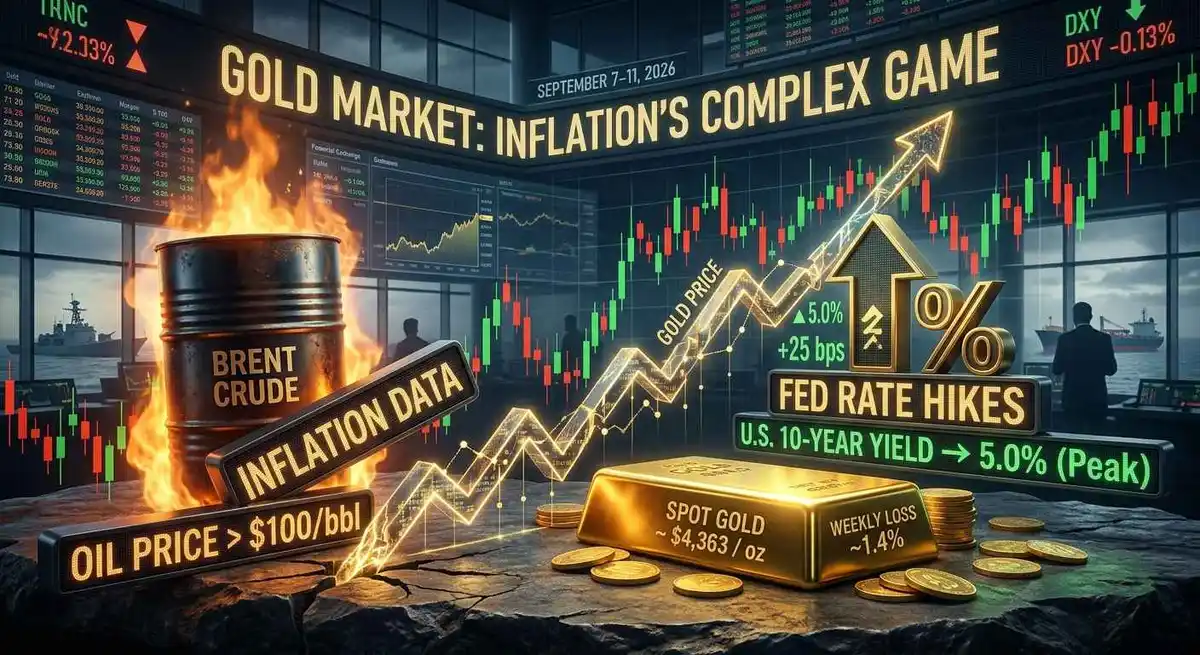
By Friday, spot gold had recovered from its sharp midweek decline, rising more than 1% as oil prices pulled back and some inflation concerns eased. But the recovery was not enough to prevent a weekly loss of roughly 1.4%. (Reuters)
The week therefore offered an important lesson for gold investors: inflation is not automatically bullish for gold. What matters is how inflation changes expectations for interest rates, bond yields and the U.S. dollar.
Gold Entered the Week Already Facing a Rate Problem
Gold began the week under pressure from the previous Friday’s strong U.S. employment report.
On September 7, spot gold fell about 0.4% to $4,410.55 per ounce after the latest labor-market data increased expectations for a Federal Reserve rate hike at its September meeting. U.S. gold futures declined about 0.5% to $4,456.40. (Reuters)
The unemployment rate remained at 4.1%, while stronger job growth gave investors less reason to assume that the Federal Reserve needed to move toward easier monetary policy immediately.
That mattered because gold does not generate interest income.
When expectations for interest rates rise, investors can earn more from interest-bearing assets such as Treasury securities. The relative attractiveness of holding gold can therefore decline, particularly when bond yields are also moving higher.
This was the first headwind facing bullion as the week began.
But the market soon developed another problem.
Oil prices were climbing rapidly.
Oil Created an Unusual Problem for Gold
Normally, higher oil prices can support gold because they raise concerns about inflation and economic uncertainty.
This week, however, the relationship worked differently.
Brent crude moved above $100 per barrel and eventually reached a four-month high near $109.97 before retreating on Friday. It still finished the week more than 8% higher. (Reuters)
For gold investors, that created a difficult chain of events.
Higher oil prices can increase inflation.
Higher inflation can make investors want protection against rising prices.
But persistent inflation can also make the Federal Reserve more reluctant to ease monetary policy.
That can push Treasury yields higher.
And higher yields can make gold less attractive because investors have more opportunities to earn income elsewhere.
In other words:
Higher inflation can be bullish for gold.
But higher inflation combined with higher interest-rate expectations can be bearish for gold.
That tension became the defining feature of the week.
Tuesday: Gold Struggles as Oil and Fed Expectations Rise
By September 8, gold remained under pressure as oil prices continued to climb and investors reassessed the Federal Reserve’s next move.
Reuters reported that spot gold was down about 0.4% at $4,385.09 per ounce, while U.S. gold futures settled about 1% lower at $4,430.10. (Reuters)
The important detail was not simply the daily decline.
Gold was struggling despite several factors that would normally provide support.
Geopolitical uncertainty remained elevated.
Oil prices were rising.
The dollar was not particularly strong.
Yet gold could not build upward momentum.
That suggested interest-rate expectations were becoming the dominant force.
Investors were increasingly focused on what higher energy prices could mean for the Federal Reserve rather than simply treating gold as a safe haven.
The Inflation Data Arrived at Exactly the Wrong Time
The U.S. inflation data later in the week gave the market another reason to reconsider the rate outlook.
Consumer prices increased 0.4% in August from the previous month and 3.4% from a year earlier. Core CPI increased 0.3% month over month and remained 2.4% higher than a year earlier.
The figures did not represent an uncontrolled inflation surge, but they reinforced the idea that price pressures remained above the Federal Reserve’s 2% target.
More importantly for financial markets, investors were already dealing with higher energy costs.
That meant the inflation outlook could not be viewed only through the latest CPI number.
If oil remained above $100 for an extended period, the concern was that energy costs could feed into transportation, production and consumer prices.
That made the Federal Reserve’s policy decision more complicated.
By the end of the week, market pricing was assigning roughly an 87% probability to a quarter-point rate increase at the September meeting, according to CME-related market expectations cited by Reuters and the Wall Street Journal. (Reuters)
For gold, that was a significant obstacle.
Thursday Showed How Sensitive Gold Had Become
The pressure became particularly visible on Thursday.
Gold fell after the U.S. Producer Price Index showed a 0.4% monthly increase in August. Energy prices were an important part of the move, reinforcing the broader inflation concern. (Kitco)
This was another example of the unusual position gold was in.
An inflationary environment should, in theory, strengthen the argument for owning gold.
But markets were not asking only whether inflation was high.
They were asking what the Federal Reserve would do about it.
That distinction explains much of the week’s price action.
If inflation rises while interest rates are expected to remain low, gold can benefit strongly.
If inflation rises and investors respond by expecting tighter monetary policy, the effect can reverse.
Gold was caught in the second situation.
Friday Finally Gave Gold Some Relief
Friday brought the week’s most important change in direction.
Oil prices retreated from their highs, reducing some of the immediate inflation pressure. Gold responded by recovering more than 1%.
Reuters reported that spot gold rose about 1.1% to $4,363.01 per ounce. Other market data put the metal around $4,366.20 at the New York close. (Reuters)
The recovery was important because it demonstrated that buyers had not disappeared.
Investors were still willing to step into the market after gold’s decline.
But Friday’s rebound also showed something else.
Gold did not need inflation to disappear completely to recover.
It needed the market’s interpretation of the inflation problem to become slightly less threatening.
The decline in oil prices helped.
So did the sense that the latest inflation data was not dramatically worse than expected.
U.S. 10-year Treasury yields also pulled back toward 4.93% after briefly approaching 5%, providing some relief to rate-sensitive assets. (Reuters)
That combination helped gold recover before the weekend.
The Dollar Was Not the Main Story This Time
The U.S. dollar normally deserves a prominent place in any discussion of gold.
Because gold is priced in dollars, a stronger dollar can make bullion more expensive for international buyers, while a weaker dollar can provide support.
The dollar was relatively soft during parts of the week, yet gold still struggled.
That is significant.
It suggests that currency movements were not strong enough to overcome the pressure coming from interest-rate expectations.
The WSJ reported that the dollar index fell about 0.13% over the week and was down for the second consecutive week. (The Wall Street Journal)
Normally, a softer dollar would be a favorable condition for gold.
But the market was more concerned about yields and monetary policy.
This is useful context for investors because it demonstrates why gold should not be analyzed through a single indicator.
A weaker dollar does not guarantee a gold rally.
Neither does higher inflation.
The interaction between the dollar, real yields, inflation expectations and monetary policy is what matters.
Gold’s Safe Haven Role Is Still Intact
Despite the weekly decline, it would be a mistake to conclude that investors have stopped treating gold as a defensive asset.
The opposite may be true.
The metal’s Friday recovery showed that buyers were still prepared to use weakness as an entry point.
Geopolitical tensions remained significant throughout the week, particularly around the Middle East and energy shipping routes.
Those risks provide a structural reason for investors to maintain exposure to gold even when short-term monetary-policy conditions are unfavorable.
That is one reason the current gold market cannot be described as simply bullish or bearish.
There are two separate investment cases operating at the same time.
The first is the defensive case:
Geopolitical uncertainty, inflation risk and concerns about the global economy can support demand for gold.
The second is the monetary-policy case:
Higher interest rates, rising Treasury yields and a potentially stronger dollar can pressure gold.
The September 7-11 week showed the second force temporarily winning the battle.
It does not mean the first one has disappeared.
What the Week Revealed About Gold’s Current Position
The most useful way to understand this week’s gold market is to stop thinking about inflation as automatically bullish.
The market has become more sensitive to the policy response to inflation.
Consider two hypothetical situations.
If inflation rises because economic growth is weakening and investors expect the Fed to cut rates, gold could benefit from both safe-haven demand and lower yields.
But if inflation rises because energy prices are climbing while the economy remains resilient, investors may instead expect the Fed to keep policy tight.
That can create pressure on gold.
The second situation is much closer to what markets faced this week.
The U.S. economy was not showing signs of an immediate collapse.
The labor market remained relatively resilient.
Oil prices were rising.
Inflation remained above target.
And rate-hike expectations increased.
Gold therefore had to compete against a stronger yield environment.
That is a much more important insight than simply saying gold fell 1.4% for the week.
The Next Fed Decision Is Now the Central Test
The Federal Reserve’s September 15-16 meeting is now the most important near-term event for gold.
The market is already leaning heavily toward a quarter-point rate increase.
That means the actual rate decision may not be the only thing that matters.
Gold investors will be watching the Fed’s language about what comes next.
If policymakers signal that the September move is a one-off adjustment and that further tightening is unlikely, gold could receive some relief.
If officials signal that persistent inflation or energy prices could require additional tightening, Treasury yields could remain elevated and gold could face another round of selling.
That makes the post-meeting communication potentially more important than the headline rate decision itself.
What Gold Investors Should Watch Next
The coming week should be viewed through several connected indicators rather than a single gold-price target.
First is the Federal Reserve.
The market needs to determine whether September’s expected rate increase represents a temporary response to inflation or the beginning of a more restrictive policy phase.
Second is Treasury yields.
The 10-year yield approaching 5% during the week showed how powerful the bond market can be for gold. A sustained move above that area could create additional pressure, while a meaningful decline would improve gold’s relative appeal. (Reuters)
Third is crude oil.
If Brent remains above $100, inflation concerns are unlikely to disappear quickly. If oil falls substantially as geopolitical tensions ease, some of the pressure on gold could fade.
Fourth is the U.S. dollar.
A sustained dollar decline could provide an important source of support if rate expectations become less aggressive.
Finally, investors should watch whether gold buyers continue to defend the lower price levels reached during this week’s decline.
That will help determine whether the recent weakness is simply consolidation or the beginning of a deeper correction.
What September 7-11 Means for the Gold Market
The gold market did not lose its long-term appeal this week.
Instead, it encountered one of the most difficult combinations for bullion: inflation that was high enough to concern investors but also high enough to increase expectations for tighter monetary policy.
That distinction is likely to remain important beyond this week.
Gold can still benefit from geopolitical uncertainty, central-bank demand and concerns about inflation. But investors are increasingly asking what those forces mean for real yields and the Federal Reserve.
The result is a market where gold may remain structurally supported while still experiencing significant short-term corrections.
That is not necessarily a contradiction.
It is simply what happens when long-term demand meets short-term monetary-policy pressure.
For readers looking at the broader trend, Economic Reader’s Gold Market Monthly Update for August 2026 provides context on the strong rally that preceded September’s pullback. Economic Reader’s earlier Gold Market Monthly Update for July 2026 also provides a longer view of how the metal moved through the summer.
The bigger question now is whether the Federal Reserve meeting confirms the market’s current expectations or changes them.
If rate expectations ease, gold could regain momentum quickly.
If yields remain elevated and policymakers sound more hawkish, the metal may need more time to rebuild its upward trend.
Either way, the September 7-11 week demonstrated something investors should keep in mind: gold is not simply an inflation trade. It is a trade on how inflation changes the financial environment.