Gold Market Monthly Update: August 2026 Gold Surges Nearly 10% Before Fed Rate Hike Fears Return
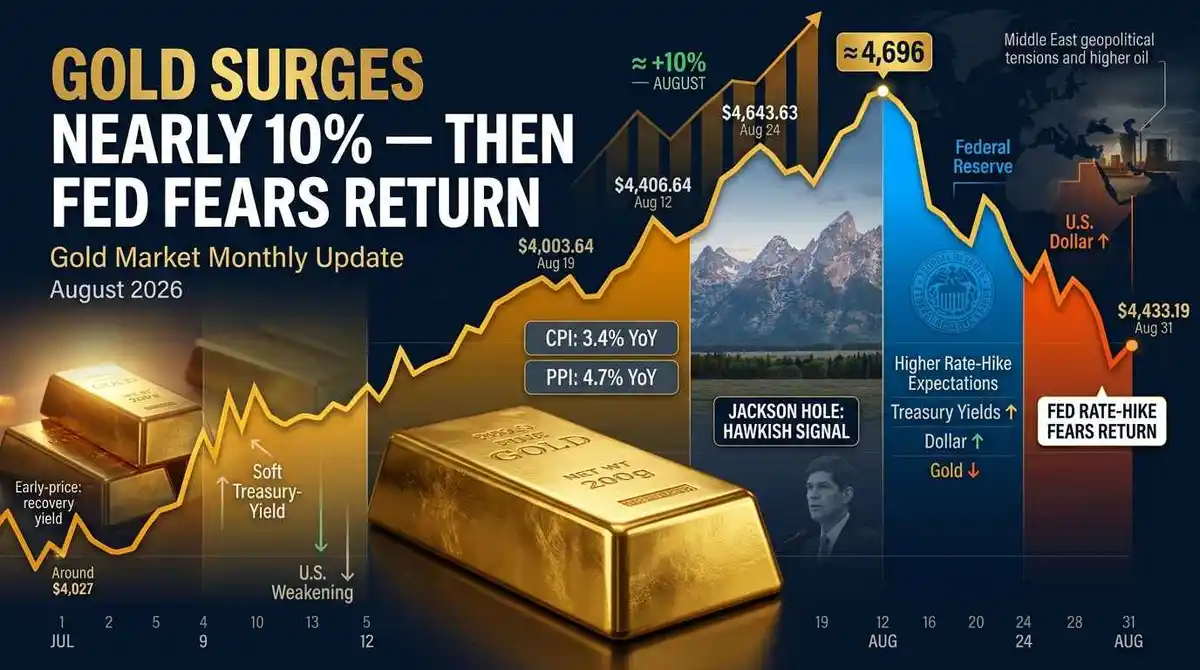
Gold Market Monthly Update: August 2026
Gold had a strong August, but the month ended very differently from how it began.
The precious metal recovered sharply from its July levels, climbed above $4,600 an ounce during the month and reached a more than three-month high before a late-August selloff brought the rally back under pressure.
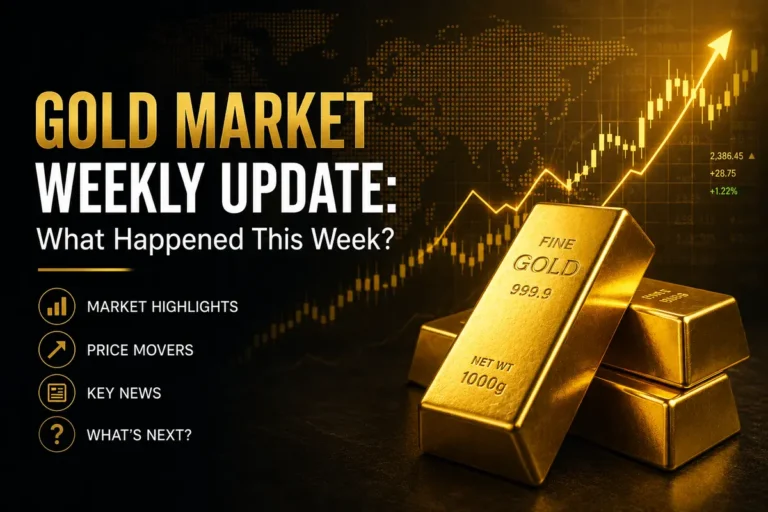
By the end of August, spot gold was still roughly 10% higher for the month, making August its strongest monthly performance since January. Reuters reported on August 31 that gold was up 9.7% at that point despite a late-month decline. Another market-data series puts the August 31 close at around $4,452 an ounce and the monthly gain at about 10.1%. The small difference reflects different pricing and closing conventions. (Reuters)
The bigger story, however, was not simply the size of the gain.
August showed how quickly gold can move when expectations for U.S. interest rates change. Early in the month, softer economic data encouraged investors to expect a less restrictive Federal Reserve. Later, Federal Reserve Chairman Kevin Warsh’s Jackson Hole comments reversed part of that optimism and triggered a sharp correction.
That made August a strong month for gold, but also a warning that the path forward could remain volatile.
August Started With a Recovery From July’s Weakness
Gold entered August after finishing July near $4,000 an ounce.
The July decline had left the metal in a corrective phase after its earlier record-setting rally. According to the World Gold Council, gold finished July at approximately $4,027 an ounce after repeatedly testing the $4,000 level. (World Gold Council)
August brought a different environment.
Investors began reassessing the U.S. interest-rate outlook after weaker labor-market data and softer economic signals reduced expectations for an immediate Federal Reserve rate increase.
That change in expectations was important because gold does not generate interest income. When investors expect interest rates and real yields to rise, holding gold becomes relatively less attractive. When expectations for tighter monetary policy decline, the opportunity cost of holding gold can fall.
Gold therefore began August with a more supportive macroeconomic backdrop.
Inflation Data Helped Gold Push Higher
The middle of August produced one of the month’s most important catalysts.
U.S. consumer inflation for July came in broadly in line with expectations, with the Consumer Price Index rising 3.4% year over year. Gold initially reacted positively as traders interpreted the data as reducing some of the pressure for an immediate rate increase. (Reuters)
Gold subsequently climbed above $4,400 an ounce.
The following day’s producer-price report provided another piece of the puzzle. U.S. producer prices were unchanged in July, while the annual PPI increase slowed to 4.7% from 5.5% in June. (Reuters)
That combination temporarily encouraged the idea that inflation might be cooling sufficiently for the Fed to remain patient.
Gold was already responding strongly to the change in expectations.
By August 12, spot gold had reached about $4,406.64 an ounce, its highest level since June 5 at the time. (Reuters)
The rally was not completely uninterrupted. Investors took profits after the sharp advance, producing a pullback on August 13. But the broader direction remained positive.
For investors trying to understand the relationship between inflation and asset prices, Economic Reader’s How Inflation Affects Your Money provides useful background.
The Dollar and Bond Market Became Important Gold Drivers
Gold’s August rally was also supported by movements in the U.S. dollar and Treasury market.
When the dollar weakens, gold can become more affordable for investors holding other currencies. At the same time, lower Treasury yields can reduce the relative attractiveness of interest-bearing assets compared with gold.
These relationships were visible throughout August.
Gold rose to a more than three-month high during the week ending August 21, helped by a weaker dollar and improving technical momentum. Reuters reported that gold was heading toward a third consecutive weekly gain at the time. (Reuters)
The rally accelerated again on August 24.
Spot gold reached around $4,643.63 an ounce, its highest level since mid-May, as investors focused on U.S. inflation data and the upcoming Jackson Hole speech from Fed Chair Kevin Warsh. (The Star)
The market was increasingly positioning around a key question:
Would the Fed become more supportive of lower rates, or would the new Fed leadership place greater emphasis on controlling inflation?
That question ultimately determined how August ended.
Gold Reached Nearly $4,700
The strongest part of the August rally came during the final full week of the month.
On August 25, spot gold traded around $4,647.03 and touched its highest level since May 14. (Reuters)
Gold subsequently moved even higher, with market data showing a peak around $4,696 on August 25.
At that stage, the metal had gained substantially from its early-August levels.
The rally was being supported by several factors at the same time:
- reduced expectations for an immediate rate increase a softer dollar.
- lower or more stable Treasury yields.
- renewed investor interest after July’s correction.
- expectations surrounding Federal Reserve policy.
- longer-term demand for gold as a store of value.
But the rally also created a difficult setup.
The higher gold climbed, the more vulnerable the market became to profit-taking if the Federal Reserve delivered a less accommodative message than investors expected.
That is exactly what happened.
Jackson Hole Changed the Market’s Tone
Federal Reserve Chairman Kevin Warsh’s speech at the Jackson Hole economic symposium became the defining event of the month.
Warsh emphasized that the Federal Reserve needed sufficient confidence that underlying inflation was moving toward its 2% target. If that confidence was not there, he said the central bank would have “work to do” language that markets interpreted as leaving the door open to further rate increases. (Investing.com)
The reaction in gold was immediate.
On August 28, spot gold fell by more than 3% at one point, reaching about $4,567.23, as traders increased their expectations for a September rate hike. Reuters reported that the probability of a September hike rose to 58%, compared with 36% before Warsh’s remarks. (Reuters)
This was one of the clearest examples during August of the relationship between Fed expectations and gold prices.
A more hawkish Fed outlook can increase Treasury yields and strengthen the dollar. Both factors can create pressure on gold.
The decline therefore was not necessarily a breakdown in the long-term gold story. It was, at least initially, a repricing of short-term monetary-policy expectations.
The Month Ended With a Significant Pullback
The selling continued into the final trading session of August.
On August 31, spot gold fell to around $4,433.19 an ounce, while December U.S. gold futures settled at approximately $4,481.50. Gold was near a two-week low after the late-August correction. (Reuters)
The dollar and Treasury yields were both stronger, while rising crude oil prices added another layer of inflation concern.
Yet even after the correction, gold remained up about 9.7% for August according to Reuters its strongest monthly performance since January. (Reuters)
This is an important distinction.
August was not a straight-line rally.
It was a month in which gold moved sharply higher, reached a multi-month high, and then gave back part of the gain as the market reassessed Federal Reserve policy.
Why the Fed Matters So Much for Gold
The Federal Reserve remained the most important macroeconomic influence on gold throughout August.
The basic relationship is relatively simple.
Gold does not pay interest. Treasury securities and other interest-bearing assets do.
When investors expect interest rates to remain high or rise further, the opportunity cost of holding gold increases. When expectations shift toward lower rates, gold can become more attractive.
That does not mean gold always moves in the opposite direction to interest rates. Geopolitical risks, central-bank purchases, currency movements, investment demand and concerns about fiscal stability can all influence prices.
But in August, monetary policy clearly became one of the dominant short-term drivers.
The market moved from expecting a more patient Fed in the first half of the month to pricing a considerably higher probability of a September rate increase after Warsh’s Jackson Hole remarks.
That reversal explains much of the dramatic change in gold’s momentum near month-end.
Economic Reader’s What Is the Federal Reserve? explains the central bank’s role in the U.S. economy and financial markets.
Geopolitical Tensions Complicated the Picture
Geopolitical risk remained another important influence on gold.
Renewed fighting involving the United States and Iran intensified toward the end of August, while oil prices also moved higher.
Gold is traditionally viewed as a safe-haven asset during periods of geopolitical uncertainty. However, August demonstrated that this relationship is not automatic.
When geopolitical tensions push oil prices higher, they can also increase inflation expectations.
That creates a potential problem for gold.
The safe-haven demand may support gold, but higher energy prices can strengthen the case for tighter monetary policy. If investors focus more heavily on the interest-rate effect, gold can fall even while geopolitical risks remain elevated.
That tension was visible during the final days of August, when gold declined despite renewed Middle East concerns. Reuters noted that the rise in crude oil prices was adding to inflation worries and reinforcing expectations for higher U.S. rates. (Reuters)
This is one reason gold’s August performance should not be interpreted simply as a geopolitical safe-haven rally.
What August Tells Us About Gold’s Next Move
Gold enters September from a much stronger position than it had at the beginning of August, but the short-term outlook has become less straightforward.
Three forces are likely to matter most.
1. Federal Reserve policy
The September Federal Reserve meeting will be closely watched. Any further indication that the Fed is prepared to raise rates could keep pressure on gold.
On the other hand, softer inflation data or weaker economic conditions could reduce rate-hike expectations and potentially support another recovery.
2. U.S. inflation and Treasury yields
Inflation remains central to the gold outlook.
If inflation proves persistent, Treasury yields could remain elevated. That would create a headwind for non-yielding gold.
If inflation cools more convincingly, the market could once again begin pricing a less restrictive monetary-policy path.
3. Geopolitical and fiscal risks
Gold’s longer-term appeal is broader than the next Fed meeting.
Geopolitical tensions, concerns over government debt, currency risks and central-bank demand can continue to support investment interest.
That means a short-term correction does not automatically invalidate the broader bullish case.
Instead, investors need to distinguish between short-term monetary-policy pressure and longer-term structural demand.
Gold’s August Performance in Perspective
The month can be divided into three distinct phases:
Early August: Gold recovered as expectations for near-term Fed tightening eased.
Mid-August: Inflation data and a weaker dollar helped push gold above $4,400 and eventually toward $4,700.
Late August: Warsh’s hawkish message increased rate-hike expectations, triggering a sharp correction.
That sequence makes August particularly useful for understanding how financial markets work.
Gold did not rise simply because investors were worried about the economy. It rose because several forces aligned and then corrected when one of the most important of those forces changed.
By month-end, the precious metal had still delivered an exceptional monthly gain.
But the final week served as a reminder that strong momentum can reverse quickly when interest-rate expectations change.
FAQ
1. How much did gold rise in August 2026?
Gold gained roughly 10% during August 2026, making it one of its strongest monthly performances of the year and its best monthly performance since January, according to Reuters’ August 31 report. Different market-data providers show slightly different final percentages because of pricing and closing conventions. (Reuters)
2. What was the highest gold price reached in August 2026?
Gold climbed to around $4,696 an ounce during the final week of August, reaching its highest level since May before retreating after Federal Reserve Chairman Kevin Warsh’s Jackson Hole remarks. (Kitco)
3. Why did gold fall sharply at the end of August?
The late-month decline was mainly linked to rising expectations for a Federal Reserve rate increase after Chairman Kevin Warsh indicated that the Fed still had work to do if inflation was not moving sufficiently toward its 2% target. Higher rate expectations supported the dollar and Treasury yields, putting pressure on gold. (Reuters)
4. Does higher inflation always make gold rise?
Not necessarily. Gold can benefit from inflation concerns because investors may seek assets perceived as stores of value. However, if inflation causes the Federal Reserve to raise interest rates aggressively, higher yields and a stronger dollar can create pressure on gold.
5. What should gold investors watch in September 2026?
The most important factors will be U.S. inflation data, Treasury yields, Federal Reserve policy expectations, the U.S. dollar and developments in the Middle East. The September Federal Reserve meeting will be particularly important because August ended with a significant increase in rate-hike expectations.
Final Thoughts
August 2026 was a powerful month for gold, but it was not a simple one.
The metal began the month recovering from its July correction, gained momentum as inflation and economic data reduced immediate rate-hike concerns, and eventually climbed close to $4,700 an ounce.
Then the Federal Reserve changed the tone.
Kevin Warsh’s Jackson Hole message reminded investors that inflation remains a central concern for U.S. monetary policy. Rate-hike expectations increased, Treasury yields and the dollar strengthened, and gold gave back part of its late-month advance.
Even so, gold finished August roughly 10% higher.
The most important takeaway is therefore not just the monthly gain. It is the degree to which gold remains sensitive to the interaction between inflation, interest rates, Treasury yields, the dollar and geopolitical risk.
After such a strong August, September may be less about whether gold can continue rising in a straight line and more about whether the economic and monetary conditions that supported the rally can survive another round of U.S. inflation and Federal Reserve data.
Read July Month’s Market Reports:
- Oil Market Monthly Update: click here.
- Gold Market Monthly Update: click here.
- Stock Market Monthly Update: click here.
- Crypto Market Monthly Update: click here.
Author Note: This article is crafted by “The Economic Reader editorial team”, dedicated to analyzing the latest market trends, financial updates, and global economic shifts to keep you informed with accurate and comprehensive insights.
Disclaimer: The information provided on this website is for educational and informational purposes only and should not be construed as professional financial, investment, or legal advice. Always consult with a certified financial advisor or professional before making any financial decisions based on this content.