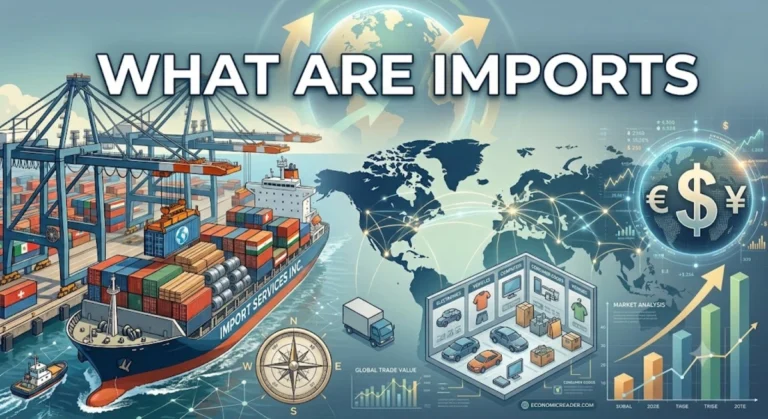

How Foreign Trade Affects the Economy: Understanding International Trade and Economic Growth

How Foreign Trade Affects the Economy
A country’s economy does not operate in isolation.
Businesses buy raw materials from other countries, manufacturers sell products abroad, consumers purchase imported goods, banks finance international transactions, and companies build supply chains that can stretch across several continents. Even services such as software development, financial services, consulting, tourism, and digital entertainment can cross borders without a physical product ever being shipped.
This is why foreign trade matters far beyond the import and export figures reported each month. International trade can expand markets, increase productivity, create jobs, lower the cost of some goods, attract investment, and give businesses access to technologies and inputs that may not be available domestically.
But trade does not automatically make every part of an economy better off.
Import competition can put pressure on domestic producers. Workers in industries facing foreign competition may lose jobs even while other industries expand. Countries that depend heavily on a narrow range of exports can become vulnerable to commodity-price swings or changes in global demand. Trade can also spread economic shocks from one country to another.
The economic impact of foreign trade therefore depends on what a country trades, how productive its businesses are, how integrated it is into global supply chains, and whether workers and firms can adapt when trade patterns change.
What Is Foreign Trade?
Foreign trade is the exchange of goods and services between countries.
It generally has two sides:
- Exports: Goods and services produced domestically and sold to foreign buyers.
- Imports: Goods and services produced abroad and purchased by domestic consumers, businesses, or governments.
For a broader explanation of how these transactions work including tariffs, exchange rates, trade agreements, and global supply chains see Economic Reader’s guide to How Does International Trade Work?.
For example, a U.S. company selling software to a customer in Germany creates an export of services. A U.S. retailer importing smartphones manufactured in Asia creates an import of goods.
Trade can also involve several countries in the production of a single product.
A vehicle might use components manufactured in Mexico, electronic systems produced in South Korea, software developed in the United States, and raw materials sourced from several other economies. The finished vehicle may then be sold in multiple markets.
This system is commonly described through global value chains, where different stages of production take place in different economies.
The result is that imports and exports are not always competing categories. A country may import components precisely because those inputs allow its domestic companies to produce and export more sophisticated products.
That distinction is important when considering how trade affects economic growth.
Why Do Countries Trade With Each Other?
The basic economic reason is specialization.
Countries have different natural resources, labor forces, technologies, capital, infrastructure, geography, and production capabilities. Producing everything domestically would often be more expensive or simply impossible.
A country with abundant agricultural land may specialize in food exports. Another with advanced manufacturing capabilities may export machinery. A country with a highly educated workforce and strong digital infrastructure may specialize in software or professional services.
This idea is closely related to comparative advantage.
A country does not necessarily need to be the world’s most efficient producer of a product to benefit from trade. What matters is the opportunity cost of producing different goods and services.
Suppose Country A can produce both computers and agricultural products efficiently, while Country B is relatively better at agriculture. Country A may specialize more heavily in computers and buy agricultural products from Country B, while Country B specializes in agriculture and imports computers.
Both economies can potentially obtain more goods and services than if each attempted to produce everything itself.
This is one of the foundations of modern international trade, but the effects extend beyond specialization. Trade can also influence productivity, investment, technology adoption, and the size of markets available to businesses.
Trade Can Expand an Economy’s Market
One of the biggest limitations facing businesses is the size of their domestic market.
A company selling only inside a small country may eventually reach a point where most potential local customers already have access to its product. International trade changes that equation.
Exporting allows businesses to sell to customers in many different countries.
Consider a manufacturer that spends heavily on machinery, software, research, or specialized workers. Those costs can be difficult to justify if the company can sell to only a small domestic market.
Access to foreign customers can allow the company to produce at a larger scale.
This is one reason export-oriented industries can become more productive. Companies have a stronger incentive to invest in technology, improve production processes, develop internationally competitive products, and build specialized expertise when the potential market is much larger.
The World Bank’s research covering 1995-2019 found that a 10% increase in exports was associated with higher employment of about 3.1%, labor earnings of 3.9%, and productivity of 0.95% in its cross-country sample. The relationship varies across countries and sectors, so these figures should not be treated as a universal cause-and-effect rule. (World Bank)
The broader lesson is that export markets can give productive firms room to scale, invest, and specialize.
Imports Can Help Businesses Grow Too
It is easy to think of imports as money leaving an economy and exports as money coming in.
That is incomplete.
Imports can provide businesses with machinery, energy, raw materials, components, software, and other inputs needed for domestic production.
Imagine a furniture manufacturer that imports specialized cutting equipment. The import itself is recorded as an expenditure on foreign goods, but the equipment may allow the domestic company to produce more furniture, reduce waste, improve quality, and eventually export more.
The same principle applies to intermediate goods.
A country may import semiconductor components, industrial machinery, chemicals, or specialized parts that are then incorporated into products sold domestically or overseas.
Research from the IMF found that lower tariffs on imported inputs can have a significant effect on productivity. One study estimated that a one-percentage-point decline in input tariffs was associated with roughly a 2% increase in total factor productivity in the affected sector. (IMF)
This is why the economic effect of an import cannot always be judged by looking only at the value of the imported product. The more important question can be what the economy does with that imported product afterward.
Trade Can Increase Productivity
Economic growth is not simply about producing more things. Over the long run, sustained improvements in living standards depend heavily on productivity how much output workers and businesses can produce with the resources available to them.
International trade can influence productivity through several channels.
Competition
Foreign competition can pressure domestic businesses to reduce costs, improve quality, and innovate.
A company that previously dominated its domestic market may have little incentive to change. Exposure to international competitors can alter that incentive.
Technology and knowledge
Imported machinery, software, production techniques, and specialized inputs can help domestic companies adopt technologies that would otherwise take longer to develop.
Larger-scale production
Export markets can allow firms to spread fixed costs across a larger volume of production.
Specialization
Businesses can concentrate resources on products and services where they have stronger capabilities instead of attempting to produce everything themselves.
Together, these mechanisms can raise productivity.
Trade is therefore not just an exchange of finished products. It can also function as a channel through which technology, knowledge, competition, and capital-intensive inputs move between economies.
Trade Can Create Jobs but Not Every Worker Benefits
Exports can support employment in factories, farms, logistics companies, shipping, financial services, technology businesses, tourism, and other industries.
There are also indirect jobs.
A company that expands exports may need more transportation, packaging, accounting, marketing, insurance, warehousing, and professional services.
But the employment story has another side.
When consumers can buy cheaper imported products, domestic businesses competing with those imports may lose market share. Some companies may shrink or close, and workers in those industries can lose their jobs.
This means trade can create and destroy jobs at the same time.
The World Bank’s research shows why the distribution of these effects matters. Trade exposure has been associated with stronger employment, earnings, and productivity outcomes overall, but the gains are not uniform across countries, industries, or workers. The same research also finds that the positive effects have varied over time and are weaker in some low-income economies. (World Bank)
A worker who loses a job in an import-competing factory cannot necessarily move immediately into an expanding export industry. The new job may be in another city, require different skills, or pay differently.
That is one reason the economic debate around trade cannot be reduced to a simple question of whether trade is “good” or “bad.”
The more useful question is how the gains from trade are distributed and whether the economy can help people adjust when production shifts across borders.
Trade Can Affect Prices and Consumer Choice
International trade also changes what consumers can buy and how much they pay.
Imports can increase competition and give households access to products that domestic producers may not supply efficiently.
A country may import coffee, electronics, medicines, vehicles, clothing, or machinery because producing those goods domestically would be more expensive or because certain resources are unavailable locally.
Lower trade costs can therefore contribute to lower prices and greater consumer choice.
The effect is not always straightforward, however. Shipping costs, tariffs, exchange rates, supply disruptions, and other trade barriers can raise the final price of imported products.
For a deeper explanation of how tariffs can influence prices, businesses, consumers, and inflation, see Economic Reader’s What Are Tariffs?.
For consumers, the result is often a trade-off: international competition can reduce prices in some markets, while disruptions or restrictions can increase them.
Foreign Trade Can Attract Investment
Trade and foreign investment often reinforce each other.
A multinational company may establish a factory in a country because it wants access to that country’s workers, infrastructure, suppliers, and export markets.
That investment can bring capital, technology, management expertise, and connections to international supply chains.
Economic Reader’s guide to Foreign Direct Investment (FDI) explains how foreign investment can connect economies through capital, production, employment, and technology.
A country that becomes an important production location for an international industry may therefore gain more than export revenue alone.
It can develop supplier networks, specialized skills, logistics infrastructure, and supporting industries around that activity.
This is one reason global value chains can be important for developing economies.
The WTO’s 2026 World Trade Report notes that the share of low- and middle-income economies in global trade rose from 23% in 1995 to 45% in 2024, although the benefits of deeper integration have not been distributed evenly. (World Trade Organization)
Why Some Countries Benefit More From Trade Than Others
Simply opening an economy to international trade does not guarantee rapid development.
Countries need the capacity to participate effectively in global markets.
That includes:
- Reliable ports, roads, airports, and logistics
- Stable electricity and communications infrastructure
- Skilled workers
- Access to finance
- Efficient customs procedures
- Predictable regulations
- Competitive businesses
- Education and technical training
- Institutions capable of supporting investment and contracts
A country may technically have access to international markets but still struggle to export because getting a product from a factory to a foreign customer is too expensive or unreliable.
This is where trade connects with the broader idea of economic development.
The WTO’s latest report also emphasizes that the gains from international trade have not been shared evenly and that many lower-income economies continue to face higher trade costs and barriers to deeper integration. (World Trade Organization)
This shows why trade policy cannot be separated entirely from domestic economic policy.
Trade Can Also Make Economies More Vulnerable
Greater international integration creates opportunities, but it also creates connections through which shocks can spread.
A country that depends heavily on imported energy may be affected by a global energy-price shock.
A manufacturer that relies on one foreign supplier can face production problems if that supplier shuts down.
An agricultural exporter can suffer when global commodity prices fall.
Geopolitical disputes, shipping disruptions, natural disasters, financial crises, and sudden changes in foreign demand can therefore affect domestic businesses even when those businesses operate thousands of miles from the original event.
This became increasingly visible as global supply chains expanded.
The economic lesson is not necessarily that countries should eliminate international dependence. Complete self-sufficiency would itself be extremely costly in many industries.
Instead, businesses and governments increasingly have to think about diversification and resilience alongside efficiency.
What Happens When Countries Raise Trade Barriers?
Governments can restrict trade through tariffs, quotas, licensing requirements, subsidies, export restrictions, and other measures.
A tariff, for example, raises the cost of an imported product.
This may protect domestic producers from foreign competition, at least in the short term. But the cost does not disappear. It can be passed through to consumers, businesses using imported inputs, or foreign exporters depending on market conditions.
If a country imposes restrictions and trading partners respond with their own restrictions, the effects can spread across multiple industries.
The latest WTO World Trade Report emphasizes that increasingly fragmented trade policies can raise uncertainty and affect firms and supply chains beyond the countries directly involved. (World Trade Organization)
This is one reason predictable international trade rules matter.
The issue is not simply whether every tariff should be zero. Governments may have legitimate reasons to use trade measures in particular circumstances. The broader economic question is whether trade policy creates a predictable environment in which businesses can invest, produce, and trade over the long term.
The Trade Balance Does Not Tell the Whole Story
One of the most common misunderstandings about international trade is treating a trade deficit as automatically bad and a trade surplus as automatically good.
The trade balance is simply the difference between the value of exports and imports.
A country can run a trade deficit while experiencing strong economic growth. It can also run a trade surplus while households have weak purchasing power or domestic demand.
Imports may include productive capital goods and inputs that help businesses expand. Exports may also depend heavily on imported components.
The broader economic picture therefore requires looking at productivity, investment, income, employment, consumption, capital flows, and the structure of trade rather than focusing on one number.
Trade statistics are useful, but they need economic context.
How International Trade Influences Long Term Economic Growth
The strongest connection between trade and long-term growth is not simply that exports increase GDP.
It is that international trade can help an economy expand its productive capacity.
A successful export industry can encourage investment in factories, technology, worker training, infrastructure, and research.
Imported machinery can raise productivity.
Foreign competition can push inefficient firms to improve.
Access to larger markets can allow successful businesses to scale.
Foreign investment can connect domestic firms to international supply chains.
Knowledge and technology can spread across borders.
Over time, these effects can raise the economy’s ability to produce goods and services.
That is why trade can contribute to economic growth even when the immediate effect of an individual import or export is difficult to interpret.
The World Bank describes trade as an engine of growth and finds that export growth has been associated with stronger employment, earnings, and productivity outcomes across its 1995–2019 cross-country research. (World Bank)
But trade is not a substitute for productive domestic institutions. Countries need education, infrastructure, investment, sound economic management, and policies that allow workers and businesses to adapt.
Why International Trade Matters Even More in 2026
The structure of global trade is changing.
Physical goods remain central, but services, digital products, data, intellectual property, and technology are becoming increasingly important. Artificial intelligence is also changing how some services are produced and delivered across borders.
The WTO’s World Trade Report 2026, published September 15, highlights global value chains, digitalization, artificial intelligence, environmental policies, and geopolitical tensions as forces reshaping international trade. The report says AI could increase global trade by 40% by 2040 in its simulations, with particularly large gains in digitally deliverable services. (World Trade Organization)
That does not mean a 40% increase is guaranteed. It is a WTO simulation based on assumptions about how AI affects trade costs and productivity. But it illustrates the potential scale of the change.
AI may allow more services to cross borders without traditional physical infrastructure. A software company, financial analyst, design firm, or consulting business can increasingly serve customers in other countries from a digital platform.
At the same time, countries are reconsidering how much dependence they want on foreign suppliers in strategically important industries.
That creates a difficult economic balance.
Businesses want the efficiency that comes from specialization and global supply chains. Governments also want resilience against supply shocks and greater security in strategically important sectors.
The future of international trade is therefore unlikely to be simply about “more trade” or “less trade.” It will increasingly be about which trade, with whom, under what rules, and with how much resilience built into the system.
The Bigger Economic Picture
Foreign trade affects almost every major part of an economy.
It can expand markets for businesses, increase competition, improve access to technology and inputs, create export-related employment, attract investment, broaden consumer choice, and raise productivity. These channels can support higher output and living standards over time.
But the benefits are not automatic or evenly distributed.
Some workers and regions can lose from import competition. Economies dependent on a narrow group of exports can become vulnerable to external shocks. Trade restrictions can protect selected industries while raising costs elsewhere. And countries without the infrastructure, skills, institutions, or investment needed to participate effectively in global markets may capture far fewer benefits than more competitive economies.
That is the central economic lesson of foreign trade: international commerce creates opportunities, but the quality of the domestic economy determines how effectively those opportunities become growth, productivity, jobs, and higher living standards.
As global trade enters a more complicated period, that distinction matters more than ever. The countries best positioned to benefit will not necessarily be those that trade the most. They will be those capable of combining international market access with productive businesses, adaptable workers, reliable infrastructure, and economic policies that allow the gains from global commerce to spread through the wider economy.