Economic Freedom vs Financial Freedom: What Is the Difference?
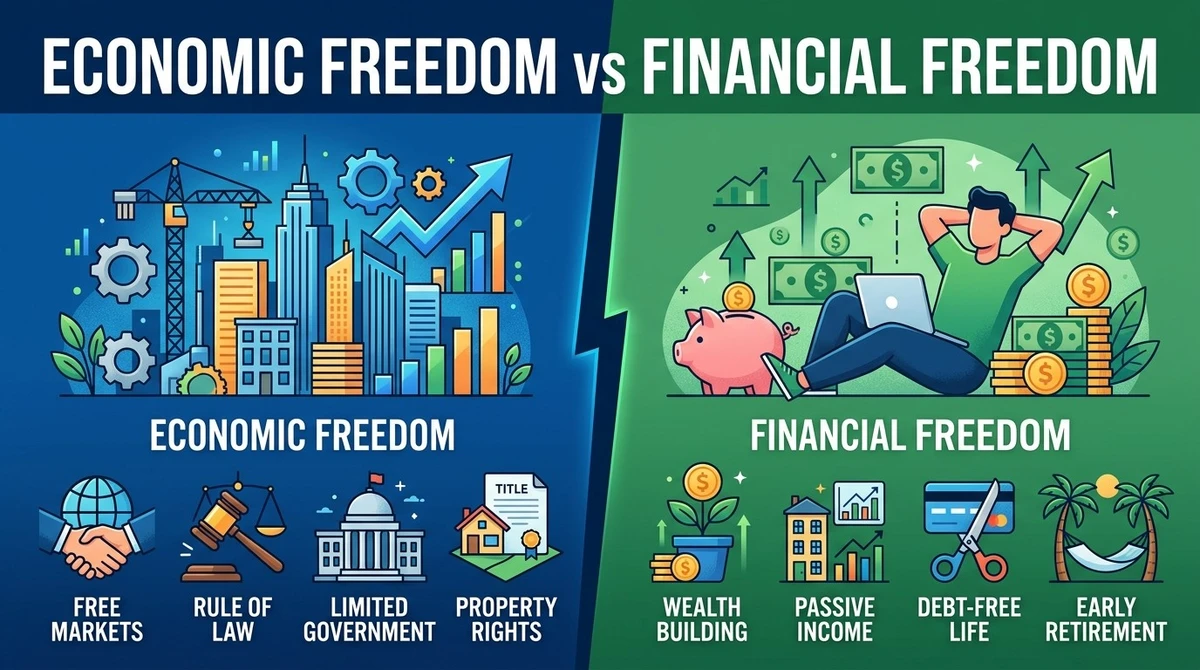
Economic Freedom vs Financial Freedom
Economic freedom and financial freedom sound similar, but they describe two different ideas.
Economic freedom is mainly about the ability of people and businesses to make economic choices within a country’s legal, institutional, and market environment.
Financial freedom is mainly about an individual’s or household’s financial position and ability to make personal choices without being heavily constrained by financial pressure.
The two concepts can influence each other, but they operate at different levels.
A person may have considerable financial freedom while living in an economy with significant restrictions on certain types of economic activity. At the same time, a country can provide broad economic freedom without every household having enough income, savings, or assets to achieve financial freedom.
The simplest distinction is:
Economic freedom concerns the environment in which economic choices are made. Financial freedom concerns the financial position that gives an individual greater freedom to make personal choices.
Economic Freedom Is About Participation in the Economy
Economic freedom is a broad concept that applies to individuals, businesses, and economies.
It concerns the ability to participate in economic activity, including owning property, starting businesses, working, investing, exchanging goods and services, competing in markets, and trading.
The concept is influenced by the rules and institutions surrounding those activities.
These can include:
- Property rights
- Contract enforcement
- Business regulations
- Competition
- Taxation
- Trade rules
- Labor-market rules
- Financial regulations
- Monetary conditions
Economic freedom therefore asks questions such as:
Can people start businesses? Can companies compete? Can individuals own property? Can workers choose where to work? Can businesses trade and invest with reasonable predictability?
The key idea is that economic freedom is largely about the choices available within the economic system and the rules governing those choices.
Financial Freedom Is More Personal
Financial freedom is narrower in scope.
It generally refers to having enough financial security and control to make important life choices without being dominated by financial pressure.
The exact meaning can differ from one person to another.
For someone, financial freedom might mean having enough savings and assets to reduce dependence on a paycheck. For someone else, it might mean being able to handle an unexpected expense, change careers, or reduce working hours without creating a serious financial problem.
The Consumer Financial Protection Bureau describes financial well-being in terms of financial security and freedom of choice. Its framework includes having control over day-to-day finances, the ability to absorb a financial shock, progress toward financial goals, and the freedom to make choices that allow a person to enjoy life. (Consumer Financial Protection Bureau)
This article has a different purpose: to explain why financial freedom and economic freedom are not the same thing.
The Biggest Difference Is Scope
The easiest way to understand the distinction is to compare what each concept is actually measuring.
| Economic Freedom | Financial Freedom |
| Broad economic concept | Mainly a personal or household concept |
| Concerns economic choices and institutions | Concerns personal financial security and control |
| Includes property rights, markets, competition, regulation, and trade | Often involves income, expenses, savings, debt, and assets |
| Can apply to individuals, businesses, and economies | Usually discussed at the individual or household level |
| Strongly influenced by laws and institutions | Strongly influenced by personal circumstances and financial decisions |
| Describes the surrounding economic environment | Describes an individual’s financial capacity and flexibility |
This difference matters because economic freedom does not automatically produce financial freedom for every person.
Likewise, one person’s financial independence does not tell us how economically free the wider economy is.
Economic Freedom Shapes the Environment Around You
Imagine someone wants to start a small business.
The person’s personal finances matter, but so does the environment in which the business will operate.
They may need to register the company, obtain permits, rent or purchase property, hire employees, access financing, sign contracts, and sell products.
If property rights are secure, contracts are enforceable, regulations are predictable, and markets are open to competition, the entrepreneur has greater room to make economic decisions.
Those conditions exist outside the person’s personal bank account.
That is the key difference.
Economic freedom asks what economic choices the system allows and how reliably those choices are protected.
Financial Freedom Depends on Personal Circumstances
Two people can live under exactly the same economic rules and have very different levels of financial freedom.
Consider two workers earning similar incomes.
One may have substantial savings, manageable expenses, and assets that provide additional financial support.
The other may have large financial obligations, little savings, and limited ability to absorb an unexpected expense.
They live in the same economic environment, but their personal financial choices are different.
This is consistent with the CFPB’s approach to financial well-being: income alone does not fully determine financial security or freedom of choice. The organization notes that people with similar incomes can have different levels of financial well-being because their circumstances and financial situations differ. (Consumer Financial Protection Bureau)
The Federal Reserve’s 2025 Survey of Household Economics and Decision making also shows substantial differences in financial well-being across U.S. households. In its 2025 survey, 73% of adults reported that they were either doing okay financially or living comfortably, while financial concerns varied across demographic and income groups. (Federal Reserve)
So financial freedom is much more closely tied to individual circumstances than economic freedom is.
Economic Freedom Can Influence Financial Opportunities
Although the two concepts are different, they can interact.
Suppose a country has secure property rights, competitive markets, predictable business rules, and functioning financial institutions.
An entrepreneur may find it easier to start and expand a company.
A worker may have more opportunities to change employers or enter a growing industry.
An investor may have more ways to allocate capital.
If those opportunities result in higher income or greater asset ownership, they can eventually contribute to an individual’s financial freedom.
But the relationship is not automatic.
Economic freedom creates an environment for economic activity; it does not guarantee that every person will benefit equally from that environment.
Education, skills, access to capital, family circumstances, health, economic conditions, and individual decisions can all affect financial outcomes.
Can Someone Have Financial Freedom Without High Economic Freedom?
Yes.
Financial freedom is not a direct measurement of how economically free a country is.
Imagine someone who owns a successful business, has substantial savings, and has enough assets or income to cover their needs without depending entirely on a paycheck.
That person could have significant financial freedom.
But the surrounding economy could still have restrictions affecting trade, business formation, investment, or other forms of economic activity.
The individual’s financial position and the country’s economic institutions are separate things.
However, they are not completely disconnected.
Changes in taxation, regulation, inflation, property rights, financial rules, or economic conditions can affect the value of assets and the income that supports personal financial freedom.
Can a Country Have Economic Freedom Without Everyone Having Financial Freedom?
Yes and this is the other side of the distinction.
Economic freedom does not mean that everyone will have the same income, wealth, or financial security.
People start with different resources and circumstances.
They have different levels of education, skills, assets, family support, financial obligations, and risk exposure.
As a result, even when people operate under broadly the same economic rules, their financial outcomes can differ substantially.
A country can therefore have relatively broad economic freedom while households experience very different levels of financial security.
This is why the two concepts should not be treated as interchangeable.
One concerns economic choice within a system.
The other concerns financial capacity at the individual or household level.
Business Owners Show the Difference Clearly
Business owners provide a useful example because they experience both concepts at the same time.
Imagine an entrepreneur who wants to expand a company.
Economic freedom affects the environment around the business:
- Can the company enter new markets?
- Can it hire workers?
- Can it purchase or lease property?
- Can it access financing?
- Can it compete with established firms?
- Are contracts enforceable?
- Are regulations reasonably predictable?
Financial freedom affects the owner’s personal situation:
- Can the owner handle a temporary fall in business income?
- Does the owner have personal savings or assets?
- Can the owner make a career change without immediate financial pressure?
The business may operate in an economically open environment while the owner still has limited personal financial security.
The opposite can also happen: a financially wealthy owner may have considerable personal financial freedom while operating in a heavily regulated business environment.
Why the Two Concepts Are Often Confused
The confusion largely comes from the word freedom.
Both concepts involve having choices, but the source of those choices is different.
Consider these two statements:
“I am free to start a business.”
That is primarily an economic-freedom question.
“I can afford to leave my job and start a business.”
That is primarily a financial-freedom question.
The first concerns the surrounding rules and opportunities.
The second concerns whether the individual has enough financial capacity to act on an opportunity.
That distinction is simple, but it explains much of the confusion between the two terms.
A Simple Example
Consider Alex and Jordan.
Both live in the same country. They face the same tax system, business regulations, property laws, labor-market rules, and financial institutions.
The country provides people with broad opportunities to work, own property, start businesses, and participate in markets.
From an economic-freedom perspective, Alex and Jordan operate under essentially the same framework.
But their personal finances are different.
Alex has substantial savings, manageable expenses, and investments that provide additional income.
Jordan has little savings and significant monthly financial obligations.
Alex may be able to take time away from work, start a business, or change careers without creating immediate financial stress.
Jordan may have fewer practical choices because financial obligations make income disruption much harder to absorb.
Their economic environment is similar.
Their financial freedom is not.
How Economic Freedom and Financial Freedom Interact
The relationship can be viewed as a sequence:
Economic environment → economic opportunities → income and wealth-building opportunities → personal financial position → financial freedom
But there is no guarantee that every step will produce the same result for everyone.
A competitive labor market may create more job opportunities, but workers have different skills.
An open business environment may allow new companies to enter, but entrepreneurs have different access to capital.
Financial markets may be available, but households have different amounts of money to invest.
This is why economic freedom should not be treated as a guarantee of personal financial success.
It can influence the opportunities people have, while financial freedom depends much more directly on what happens to an individual’s financial position.
Economic Freedom vs Financial Freedom: Key Differences
| Question | Economic Freedom | Financial Freedom |
| What does it describe? | Freedom to participate in economic activity | Financial security and freedom of personal choice |
| Main focus | Markets, institutions, rights, and rules | Personal finances and financial capacity |
| Who does it apply to? | Individuals, businesses, and economies | Mainly individuals and households |
| Property rights? | A major component | Relevant mainly through personal ownership and wealth |
| Business regulation? | Directly relevant | Usually affects it indirectly |
| Savings and debt? | Not the central focus | Often important |
| Income and assets? | Can be influenced by the economic environment | Major factors in personal financial freedom |
| Government institutions? | Central to the concept | Shape the environment around personal finances |
| Main question | How much economic choice exists? | How much financial flexibility does the individual have? |
The table highlights why the terms should not be used as synonyms.
Neither Concept Guarantees the Other
It is tempting to assume that greater economic freedom automatically leads to financial freedom.
The relationship is more complicated.
Economic freedom can create opportunities for entrepreneurship, employment, investment, and trade. But people have different abilities to use those opportunities.
Similarly, financial freedom does not tell us how open or restrictive the wider economic system is.
A wealthy individual may have considerable personal financial independence while operating in an economy with substantial restrictions.
Personal financial outcomes are shaped by many factors beyond economic freedom, including income, education, skills, asset ownership, family circumstances, economic conditions, and individual decisions.
The two concepts therefore interact without becoming interchangeable.
Why the Distinction Matters
Understanding the difference prevents two common mistakes.
The first is assuming that economic freedom means personal financial independence.
It does not.
A country can provide broad economic rights and opportunities while households experience very different levels of financial security.
The second is assuming that personal financial freedom tells us how economically free a country is.
It does not either.
One person’s wealth or financial independence cannot describe the economic rules facing everyone else.
The clearest way to remember the distinction is:
Economic freedom is about the freedom to participate in the economy. Financial freedom is about having enough financial security and control to make personal choices with less financial pressure.
Economic freedom describes the rules, institutions, and opportunities surrounding economic activity.
Financial freedom describes the financial position that gives an individual greater flexibility over personal choice.
Understanding that difference makes it easier to see how the two concepts can influence each other without being the same thing.