
How Trump’s Immigration Policy Affects the US Economy – Economic Impact Analysis
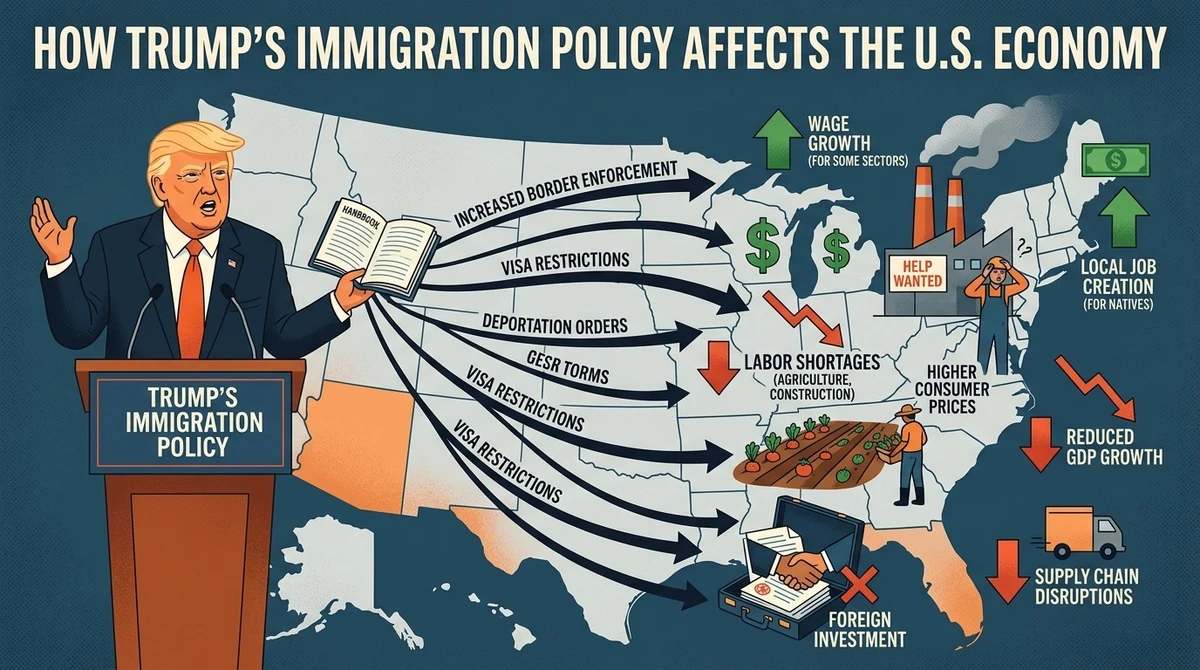
How Trump Immigration Policy Affects the US Economy
Immigration policy is usually discussed in terms of borders, visas, deportations, asylum, and national security.
But immigration is also an economic variable.
People who enter the United States can become workers, consumers, renters, homeowners, entrepreneurs, students, investors, and taxpayers. When immigration changes, the effects can therefore move through labor markets, consumer demand, housing, business investment, government finances, and long-term economic growth.
That makes the economic impact of President Donald Trump’s immigration policy more complicated than asking whether fewer immigrants are simply good or bad for the U.S. economy.
The central economic question is how changes in immigration alter the supply and composition of labor relative to demand for workers.
A tighter immigration system can reduce the number of workers entering the country. In occupations where immigrant labor is significant, that can make labor scarcer and put upward pressure on wages. But businesses may also respond by raising prices, investing in automation, reducing output, delaying expansion, or changing where production takes place.
There is another side to the equation.
Immigrants do not only supply labor. They also create demand. They buy food, rent homes, use transportation, receive healthcare, purchase services, and start businesses. A sustained reduction in immigration can therefore affect both the future supply of workers and the growth of consumer demand.
The demographic effect may become even more important over time.
The United States has an aging population and relatively slow natural population growth. If immigration remains substantially lower for years, the working-age population could expand more slowly just as large numbers of Americans approach retirement.
The latest Census estimates already show a major change in migration. Net international migration fell from 2.7 million between July 2023 and June 2024 to 1.3 million between July 2024 and June 2025, a 53.8% decline. The Census Bureau projected that net international migration could fall to roughly 321,000 by July 2026 if the trend continued. (Census.gov)
That makes immigration policy relevant to a much larger question:
How much labor, consumption, and productive capacity will the U.S. economy have available to grow?
What Has Changed Under Trump?
Trump’s second administration has pursued a broad tightening of U.S. immigration policy.
The approach includes stronger border enforcement, restrictions on entry, changes to parole programs, expanded interior enforcement, changes affecting temporary protected status, and tighter rules affecting some employment-based immigration.
At the southern border, the change in migration flows has been substantial. U.S. Customs and Border Protection reported 8,725 Border Patrol encounters between ports of entry at the southwest border in May 2025, down 93% from 117,905 in May 2024. Those are enforcement encounters, not a direct measure of total immigration, but they illustrate how sharply border activity changed after the administration’s policy shift. (CBP)
The administration has also expanded immigration enforcement and removals. Its stated rationale is that stronger enforcement is intended to reduce unauthorized immigration, restore enforcement of immigration laws, and address public-safety and labor-market concerns. These are the administration’s stated positions and should be distinguished from independent estimates of economic effects. (IMF eLibrary)
The policy also reaches legal immigration.
One of the clearest examples is the H-1B program. On September 18, 2026, the White House extended a restriction requiring certain H-1B petitions for workers outside the United States to be accompanied by a $100,000 payment, subject to specified exceptions. The extension runs through September 21, 2027. The administration says the measure is intended to address what it considers abuse of the H-1B system and protect U.S. workers. (The White House)
Economically, that distinction matters.
Reducing unauthorized migration affects the labor supply in one way. Making skilled-worker visas more expensive or restrictive affects another.
The occupations, employers, wages, and productivity channels are not identical.
Immigration Is a Labor Supply Variable
The first economic connection is the labor market.
The labor force consists of people who are working or actively looking for work. When additional workers enter the country, the potential supply of labor increases. When fewer workers enter, labor-force growth slows.
But the U.S. labor market is not one market.
A farm worker, construction worker, nurse, software engineer, truck driver, and financial analyst do not compete for exactly the same jobs.
That means the economic effect of immigration depends heavily on which workers are entering or leaving the economy.
The scale is significant. The Bureau of Labor Statistics reported that foreign-born workers represented 19.1% of the U.S. civilian labor force in 2025. Their labor-force participation rate was 66.3%, compared with 61.6% for native-born workers. (Bureau of Labor Statistics)
Foreign-born workers are also distributed differently across occupations. In 2025, they were more heavily represented than native-born workers in service occupations, natural resources, construction and maintenance, and production, transportation, and material-moving occupations. They also represented a meaningful share of professional and technical employment. (Bureau of Labor Statistics)
This matters because a reduction in immigration does not remove an abstract number of workers from the economy.
It changes the supply of labor in particular industries.
The First Labor Market Effect: Scarcity
Suppose a business normally needs 20 workers but can find only 15.
It has several options.
It can raise wages.
It can improve benefits.
It can reduce operating hours.
It can increase prices.
It can invest in labor-saving technology.
Or it can produce less.
A tighter labor market can therefore improve bargaining power for some workers without automatically increasing total economic output.
The International Monetary Fund’s 2026 U.S. assessment expects stricter immigration enforcement to reduce the size of the foreign-born labor force, raise wages for lower-skilled workers, add modest inflation pressure, and slow economic activity. (IMF eLibrary)
That is an important distinction.
Higher wages for some workers and slower aggregate output can occur at the same time.
The question is what businesses and consumers do in response.
Who Competes With Immigrant Workers?
The wage effect is unlikely to be uniform.
Workers who perform similar tasks can compete more directly with immigrant workers. If the supply of competing labor declines, wages may rise.
But immigrant workers can also complement domestic workers.
Consider a construction project.
A shortage of construction labor does not affect only construction workers. It can also affect supervisors, engineers, equipment operators, architects, suppliers, and other workers involved in the project.
If fewer workers are available for one part of the process, the entire project can become slower or more expensive.
The same principle applies to agriculture, healthcare, hospitality, logistics, and manufacturing.
Economists therefore distinguish between substitute labor and complementary labor.
If two groups perform similar tasks, they can compete.
If one group helps increase the productivity of another, they can complement one another.
This is one reason immigration can produce different wage effects across occupations.
Why Higher Wages Do Not Automatically Mean Faster Growth
Consider a construction company that loses access to a portion of its workforce.
It may raise wages for the workers who remain.
That can benefit those workers.
But if the company cannot recruit enough additional employees, it may complete fewer projects.
The same thing can happen in restaurants.
A labor shortage can lead to higher pay for existing employees, but the restaurant may also raise prices, reduce hours, or serve fewer customers.
The economy therefore has to be viewed as a production system.
Labor supply → business capacity → output → prices → household spending
A change at the beginning of that chain can produce several effects at once.
Why Immigration Can Affect Inflation
Immigration can influence prices through both supply and demand.
On the supply side, fewer workers can increase labor costs.
On the demand side, fewer immigrants also means fewer consumers.
These forces can partly offset one another.
The IMF examined this relationship using data from 306 metropolitan areas. Its research found that reductions in inward migration tend to be mildly inflationary, with the effect particularly connected to changes in the supply of less-educated workers. The IMF estimated that the reduction in immigration expected between 2024 and 2025 could add roughly 0.3% to consumer prices by the end of 2026. (IMF)
That is a model-based estimate, not a measurement of every price change caused by Trump’s policies.
But it identifies a useful economic mechanism:
fewer workers → tighter labor market → higher labor costs → higher prices in some sectors
The size of the effect depends on how easily businesses can substitute capital, technology, or domestic workers for the labor that becomes unavailable.
For broader background on how labor and production costs can feed into inflation, see Economic Reader’s What Is Inflation?.
Agriculture Could Feel the Effect Quickly
Agriculture is particularly sensitive to labor availability.
Planting, harvesting, processing, and packaging still require substantial amounts of human labor in many parts of the industry.
If labor becomes harder to obtain, farms have several choices:
- Raise wages
- Increase mechanization
- Reduce production
- Change crops
- Increase prices
- Find workers through other legal channels
The effect on consumers depends on how much of the additional labor cost is passed through into food prices.
The impact also varies by crop and region.
Highly mechanized agricultural production has more ability to substitute machinery for workers than activities that require intensive manual labor.
This makes agricultural immigration policy partly a question of production technology.
Construction Faces a Different Version of the Same Problem
Construction is important because it connects immigration policy with housing supply.
Immigration affects housing demand because immigrants need somewhere to live.
But immigrants also work in construction.
That produces two opposing forces.
Lower immigration → slower housing demand growth
but also:
Lower immigration → potentially smaller construction labor supply
If demand falls faster than construction capacity, housing pressure may ease.
If labor shortages constrain new construction, the supply of housing may also weaken.
The result will differ across markets.
A city with severe housing shortages and strong construction demand may respond differently from a region where housing supply is already abundant.
The IMF’s research also finds that immigration’s effects on housing are not straightforward because supply and demand effects can offset one another. (IMF)
That is a good example of why national immigration policy can produce different local economic outcomes.
Healthcare Shows Why Worker Composition Matters
Healthcare is another sector where the composition of immigration matters.
Foreign-born workers are employed across healthcare occupations, including physicians, nurses, healthcare technicians, aides, and other support roles.
BLS data show that foreign-born workers accounted for 5.4% of employment in healthcare practitioner and technical occupations and 4.5% of healthcare support employment in 2025. (Bureau of Labor Statistics)
If immigration restrictions reduce the supply of healthcare workers, providers may face higher labor costs or greater difficulty filling positions.
They may respond through higher wages, increased use of technology, reduced services, or recruitment from other regions.
The economic consequences are therefore not limited to employment statistics.
They can reach healthcare costs and access.
The H-1B Question Is Economically Different
H-1B restrictions raise a different issue because the program is designed for specialty occupations.
The Trump administration argues that some employers and outsourcing firms have used the program to undercut U.S. workers’ wages and displace domestic labor. That is the administration’s stated rationale for the September 2026 measures. (The White House)
The economic question is broader.
If an employer cannot hire a foreign specialist, what happens next?
The company could:
- Hire a U.S. worker
- Raise wages
- Train an employee
- Recruit from another company
- Automate the work
- Move some activity abroad
- Delay expansion
The outcome depends on how easily domestic workers can replace the missing skills.
That is why the H-1B debate cannot be reduced to a simple question of how many visas are issued.
It is also a question of skill scarcity, substitution, business investment, and productivity.
Skilled Immigration Can Affect Innovation
Highly skilled immigration can influence the economy through channels that are not immediately visible in employment data.
Researchers and engineers can contribute to:
- New products
- Scientific research
- Patents
- Business formation
- Technology development
- Productivity growth
The Congressional Budget Office’s analysis of the recent immigration surge provides evidence of this broader mechanism. CBO’s modeling includes labor-force growth, employment composition, investment, and innovation-related productivity among the channels through which immigration affects economic output. (Congressional Budget Office)
That does not mean every immigrant increases productivity.
Nor does it mean every restriction reduces innovation.
The relevant question is whether the skills that become harder to obtain through immigration can be replaced domestically and how quickly that replacement can occur.
Training takes time.
Business expansion decisions often happen immediately.
That timing difference can matter.
Immigrants Are Also Consumers
One of the simplest economic effects of immigration is also one of the easiest to overlook.
Workers are consumers.
If fewer people enter the United States, there are also fewer additional consumers entering the economy.
They would otherwise spend money on:
- Food
- Housing
- Transportation
- Healthcare
- Entertainment
- Clothing
- Financial services
- Education
That creates a demand effect.
A lower immigration rate can therefore reduce the growth of consumer demand.
But it can also reduce pressure on housing and infrastructure.
Again, the direction is not one-sided.
The economy is simultaneously losing some labor supply and some consumer demand.
The balance depends on how many people would have entered, their age, income, household structure, location, and employment status.
GDP: Total Output Is Not the Same as Output Per Person
This is one of the most important distinctions in the immigration debate.
Immigration can increase the size of the population and labor force.
That tends to increase total economic output.
But total GDP is not the same thing as GDP per capita.
Economic Reader’s What Is GDP? explains that GDP measures the value of final goods and services produced within a country, while GDP per capita divides output by population.
This creates two separate questions:
Does immigration make the U.S. economy larger?
and
Does immigration increase economic output per person?
Those questions should not be treated as identical.
CBO’s analysis of the recent immigration surge illustrates the distinction. It projected that the surge would increase nominal GDP by $8.9 trillion over 2024-2034, with population growth accounting for the largest share of that increase. (Congressional Budget Office)
That is evidence that immigration can increase total economic output.
It does not by itself establish what happens to every resident’s income or living standard.
The same distinction works in reverse.
A reduction in immigration can slow the growth of total GDP without necessarily reducing wages for every worker.
Fiscal Effects Depend on Who Enters
Immigration also changes government finances.
Immigrants pay taxes.
They can pay:
- Income taxes
- Payroll taxes
- Sales taxes
- Property taxes
- Business taxes
They can also use public services.
The net fiscal effect depends heavily on age, income, employment, family structure, legal status, and the level of government being considered.
A young worker entering the labor force has a different fiscal profile from an older person arriving near retirement.
A high-income professional pays different taxes from a low-income worker.
A household with children creates different public-service costs from a single worker.
That makes broad statements about whether “immigrants pay for themselves” economically incomplete.
What CBO Shows About the Federal Budget
CBO’s 2024 analysis provides a useful example of these fiscal channels, although it should not be treated as a forecast of the fiscal effect of Trump’s current immigration policy.
CBO estimated that the immigration surge it studied would increase federal revenues by about $1.2 trillion between 2024 and 2034, while increasing mandatory spending and net interest costs by about $0.3 trillion. The resulting projected reduction in cumulative federal deficits was about $0.9 trillion. (Congressional Budget Office)
The largest revenue effects came from individual income and payroll taxes.
CBO also found that immigration affects the budget indirectly by changing economic activity, productivity, interest rates, and the size of the tax base. (Congressional Budget Office)
But this does not mean lower immigration would automatically produce the exact reverse numbers.
The CBO analysis examines a particular immigration surge and a counterfactual scenario. Trump’s current policies involve a different population and a different set of restrictions.
The value of the CBO research is that it shows how the fiscal mechanism works.
State and Local Budgets Are Different
Federal and local governments do not experience immigration in the same way.
States and cities may face spending pressures related to:
- Education
- Healthcare
- Shelters
- Transportation
- Housing services
- Public administration
CBO’s research on the 2023 effects of the immigration surge found that state and local tax revenues increased, but service costs also rose, particularly for education, shelter-related services, and border security. The effects varied substantially by jurisdiction. (Congressional Budget Office)
This is important because national fiscal statistics can hide local pressures.
A city receiving a large number of migrants may experience costs quickly.
Federal tax revenues may rise over a longer period.
The geographic distribution of costs and benefits therefore matters.
Enforcement Has an Economic Cost
Tighter immigration enforcement requires resources.
Border enforcement requires:
- Personnel
- Technology
- Transportation
- Processing
- Detention capacity
- Administrative systems
Interior enforcement and removals require additional resources as well.
Those costs do not disappear simply because the number of people entering the country falls.
At the same time, tighter immigration can reduce certain public-service pressures in communities experiencing rapid population growth.
The relevant economic question is therefore not whether enforcement costs money.
It does.
The question is how that enforcement costs compare with the economic and fiscal effects produced by lower immigration.
That comparison is difficult because many of the benefits and costs occur at different levels of government and over different time periods.
Business Investment Can Move in Two Directions
Labor scarcity can influence investment.
When workers become harder to find, businesses have stronger incentives to invest in machines and software that perform some of the same tasks.
A warehouse may automate sorting.
A farm may invest in machinery.
A manufacturer may increase robotics.
A restaurant may adopt self-service technology.
This is the capital-substitution effect.
But labor shortages can also discourage investment.
If a company cannot recruit enough workers to operate a new factory, opening the factory may no longer make sense.
A restaurant chain may plan 20 new locations but open only 10.
A construction company may postpone projects because it cannot staff them.
So tighter immigration can either encourage capital deepening or reduce business expansion.
The difference depends on the industry’s technology, financing, expected demand, and ability to substitute capital for labor.
Small Businesses Have Fewer Adjustment Options
Large corporations often have more ways to respond to labor shortages.
They can automate.
They can move production.
They can outsource.
They can recruit across multiple markets.
Small businesses often have fewer alternatives.
A restaurant, landscaping company, farm, cleaning business, or small construction contractor may not have the capital required for rapid automation.
If labor becomes more expensive, the business may have to raise prices or accept lower margins.
If it cannot hire enough workers at any reasonable wage, it may reduce operations.
This means the economic impact of immigration restrictions can vary with business size as well as industry.
The Geographic Effects Will Be Uneven
Immigration is not distributed evenly across the United States.
Some states and metropolitan areas have much larger foreign-born populations than others.
BLS data show that foreign-born workers represented 24.5% of the labor force in the West and 22.7% in the Northeast in 2025, compared with 18.7% in the South and 10.8% in the Midwest. (Bureau of Labor Statistics)
That means a national policy can produce very different local outcomes.
A technology center may be particularly exposed to skilled-worker restrictions.
An agricultural region may be more exposed to changes in seasonal labor.
A high-growth city may feel stronger effects through housing demand.
Another region may experience little immediate change.
National averages can therefore obscure important regional differences.
Demographics May Be the Long Term Constraint
The most consequential economic effect may not appear in the first year.
It may appear through demographics.
The U.S. population is aging.
Natural population growth has slowed.
As older workers retire, the economy needs enough working-age people to replace them.
The Census Bureau’s latest estimates show how quickly migration has become important to population growth. U.S. population growth slowed to 0.5% between July 2024 and July 2025, while net international migration fell sharply. (Census.gov)
If lower immigration persists for many years, the working-age population could grow more slowly.
That could affect:
- Labor-force growth
- Consumer demand
- Business formation
- Housing demand
- Tax revenue
- Social Security financing
- Medicare financing
Immigration is not the only way to address demographic aging.
Higher labor-force participation, longer working lives, productivity growth, automation, education, and family policy can also influence the outcome.
But immigration is one of the few factors capable of changing population and labor-force growth relatively quickly.
Social Security Adds Another Layer
An aging population creates pressure on retirement programs because the ratio of workers to retirees changes.
Immigration can partly offset that pressure by adding working-age taxpayers.
But the size of the effect depends on immigrants’ age, employment, earnings, and eventual eligibility for benefits.
A young worker who pays payroll taxes for decades has a different fiscal profile from someone who enters the country near retirement.
This is another reason why the economic analysis needs to focus on the composition of immigration, not simply the number of people entering.
Could Lower Immigration Increase Productivity?
Possibly but not automatically.
If workers become more expensive or harder to find, businesses have greater incentives to invest in productivity-enhancing technology.
That could accelerate:
- Robotics
- Artificial intelligence
- Automated warehouses
- Agricultural machinery
- Software systems
- Self-service technology
But automation requires capital.
A small business may not be able to replace workers with expensive equipment.
A large corporation may be able to.
Some jobs can be automated relatively easily.
Others require physical presence, human judgment, interpersonal skills, or specialized expertise.
The realistic economic outcome is therefore not simply “workers versus robots.”
It is a changing mix of labor and capital.
The question is whether the productivity gains from that substitution are large enough to compensate for slower labor-force growth.
The Innovation Question Is Harder
Innovation is one of the least visible but potentially most important channels.
Immigrants can contribute to research, engineering, entrepreneurship, patents, and company formation.
But restricting immigration could also encourage more domestic workers to enter those fields.
The economic outcome depends on how quickly domestic talent can replace the skills that become harder to obtain internationally.
If a company needs a specialized engineer today, a training program that produces a replacement worker five years later does not solve the immediate problem.
That timing difference matters.
Short-term labor shortages can affect current production.
Long-term training can change the labor supply.
The same policy can therefore have different effects at different points in time.
Short Term and Long Term Effects Are Different
Consider a simplified sequence.
Year 1:
Immigration falls → labor supply tightens → wages rise in some occupations.
Years 2-4:
Businesses adjust → automation and training increase → production methods change.
Years 5-10:
Lower population growth becomes more visible → labor-force growth slows → demographic pressure increases.
The actual path will not be this smooth.
But the example illustrates why the first-year effect should not simply be projected indefinitely.
Workers respond.
Businesses respond.
Consumers respond.
Government policies change.
Technology changes.
Economic models therefore need to be interpreted as scenarios rather than fixed predictions.
What the IMF Estimates
The IMF’s 2026 Article IV analysis provides one of the clearest current estimates of the macroeconomic effect.
Its model suggests that immigration changes under the new policy environment could reduce the level of U.S. GDP by around 0.4% by 2027, with the drag becoming larger over the medium term. The IMF also expects slower employment growth, higher wages for lower-skilled workers, and modest additional inflation pressure. (IMF eLibrary)
The IMF’s estimate is a model-based assessment.
It is not an observed measurement of the complete effect of Trump’s policies because many of the long-term effects have not yet occurred.
That distinction matters.
Observed data tell us that migration has fallen sharply.
Economic models attempt to estimate what that change means for output, wages, and prices.
Both are useful, but they answer different questions.
What CBO Research Adds
CBO’s research helps explain the opposite side of the labor and population mechanism.
Its analysis of the recent immigration surge projected that the surge would increase nominal GDP by $8.9 trillion over 2024-2034 relative to a counterfactual scenario.
CBO found that population growth was the largest contributor, while changes in labor-force participation, employment composition, and innovation-related productivity also contributed. (Congressional Budget Office)
Again, this is not a forecast of what Trump’s current policy will cost the U.S. economy.
The policy scenarios are different.
The value of the CBO analysis is that it shows the channels through which changes in immigration can affect the economy:
population → labor force → production → investment → productivity → tax revenue
Reducing immigration affects many of those channels in the opposite direction.
What Current Data Can and Cannot Tell Us
The fall in migration is already measurable.
Its full economic consequences are not.
The Census Bureau can estimate changes in population and net international migration.
BLS can measure the share and characteristics of foreign-born workers.
CBP can measure border encounters.
Government agencies can report enforcement activity.
But none of these statistics alone tells us how much immigration policy changed:
- Real GDP
- Productivity
- Average wages
- Inflation
- Housing prices
- Business investment
- Government finances
Those outcomes are influenced by many other variables.
Interest rates matter.
Energy prices matter.
Trade policy matters.
AI investment matters.
Consumer demand matters.
Business confidence matters.
This creates a major attribution problem.
If inflation rises in 2026, it would be incorrect to automatically attribute the increase to immigration policy.
Likewise, if wages rise, that does not prove immigration restrictions caused the increase.
A research analysis needs to separate observed outcomes from modeled policy effects.
Why the Effects Will Not Be Equal Across Americans
Economic policy rarely affects everyone in the same way.
Under tighter immigration, some workers may gain bargaining power.
Some businesses may benefit from lower competition for labor.
Some housing markets may experience slower demand growth.
Some communities may face less pressure on public services.
At the same time:
- Employers may face labor shortages.
- Consumers may face higher prices in labor-intensive industries.
- Some companies may delay expansion.
- Specialized industries may have greater difficulty recruiting.
- Population growth may slow.
- Tax-base growth may weaken.
- Long-term GDP growth may be lower.
These effects can occur simultaneously.
That is why a national statement such as “immigration helps workers” or “immigration hurts workers” is too broad to be economically useful.
The more useful question is:
Which workers, businesses, consumers, and governments are affected and through which mechanism?
The Central Trade Off
The economic trade off can be summarized in two directions.
A tighter immigration system can contribute to:
- A smaller labor supply
- Higher wages for some workers
- Less competition in some occupations
- Slower population growth
- Lower housing demand in some markets
- Greater incentives for automation
- Lower pressure on some public services
It can also contribute to:
- Slower labor-force growth
- Labor shortages
- Higher business costs
- Higher prices in some labor-intensive industries
- Lower consumer-demand growth
- Less access to specialized workers
- Slower population growth
- Potentially slower total GDP growth
The size of each effect depends on the category of immigration being restricted.
Unauthorized migration, family-based immigration, refugee admissions, temporary workers, and highly skilled employment visas do not have identical economic effects.
That is why the details of the policy matter more than the general label “immigration restriction.”
The Role of Automation
Automation could become one of the most important adjustment mechanisms.
If labor becomes more expensive, businesses have stronger incentives to invest in technology.
This could accelerate adoption of:
- Robotics
- AI
- Automated logistics
- Agricultural machinery
- Digital business systems
- Self-service technology
If those investments raise output per worker enough, they can partly compensate for slower labor-force growth.
But there is a time lag.
A business cannot always replace workers immediately.
It needs financing, equipment, software, management capacity, and skilled employees capable of operating the new systems.
That means automation may reduce the long-term economic effect of labor shortages without eliminating the short-term disruption.
What Happens If Lower Immigration Persists?
A temporary decline in immigration can be absorbed.
A permanent decline changes the demographic path.
The working-age population grows more slowly.
Consumer demand expands more slowly.
The potential labor force becomes smaller.
Businesses have fewer workers available.
Government programs face a different ratio of workers to retirees.
At that point, productivity becomes more important.
The United States could compensate through:
- Higher productivity
- More automation
- Greater labor-force participation
- More capital investment
- Better education and training
- Stronger domestic business formation
- Technological innovation
But those adjustments are not automatic.
They require investment and time.
That is why immigration policy should be viewed alongside productivity and labor-force policy rather than as an isolated issue.
The U.S. Economy Under Lower Immigration
Trump’s immigration policy is changing more than the number of people entering the United States.
It is changing the demographic and labor-supply assumptions under which the economy operates.
The early data already show a sharp reduction in net international migration, while foreign-born workers remain a substantial part of the U.S. labor force. (Census.gov)
From there, the economic effects spread through several channels.
A smaller labor supply can raise wages for some workers.
Higher wages can improve income for those workers.
But higher labor costs can also increase business expenses.
Businesses may respond through higher prices, automation, lower hiring, reduced production, or delayed expansion.
Lower immigration also means fewer consumers entering the economy.
Housing markets can experience weaker demand, while construction firms can face tighter labor supply.
Government finances can see lower service pressures in some communities while also experiencing slower growth in the future tax base.
Highly skilled immigration adds another layer because restrictions can affect the availability of specialized labor and the pace at which some businesses expand.
The IMF’s current modeling points toward slower economic activity, modestly higher inflation, and higher wages for some lower-skilled workers as labor supply becomes tighter. (IMF eLibrary)
CBO’s earlier research on the immigration surge shows the reverse channels: a larger immigrant population can expand GDP, labor supply, investment, and federal revenues, while the wage effects differ across groups. (Congressional Budget Office)
Neither source provides a complete forecast of Trump’s long-term policy outcome.
The final result will depend on how households, workers, businesses, and governments adjust.
That leaves the United States with a broader economic question.
If immigration remains lower, can stronger productivity, automation, domestic labor-force participation, capital investment, and innovation compensate for slower growth in the working-age population?
The answer will shape not only the size of the U.S. labor force, but also the country’s capacity to produce, consume, invest, and finance an aging population.
That is the central economic issue behind Trump’s immigration policy.
The policy changes who enter the country and under what conditions. The economy then determines what happens next through wages, prices, production, investment, government finances, and productivity.
The long-term economic effect will therefore depend less on immigration numbers alone than on whether the United States can turn a smaller and differently composed labor force into enough productivity growth to sustain rising output and living standards.