
What Is WTI? Understanding West Texas Intermediate and Why Oil Prices Matter
When you see headlines saying that “oil prices rose” or “WTI crude fell,” the number being discussed is often the price of a specific crude oil benchmark rather than the price of every barrel of oil in the world.
That benchmark is West Texas Intermediate, or WTI.
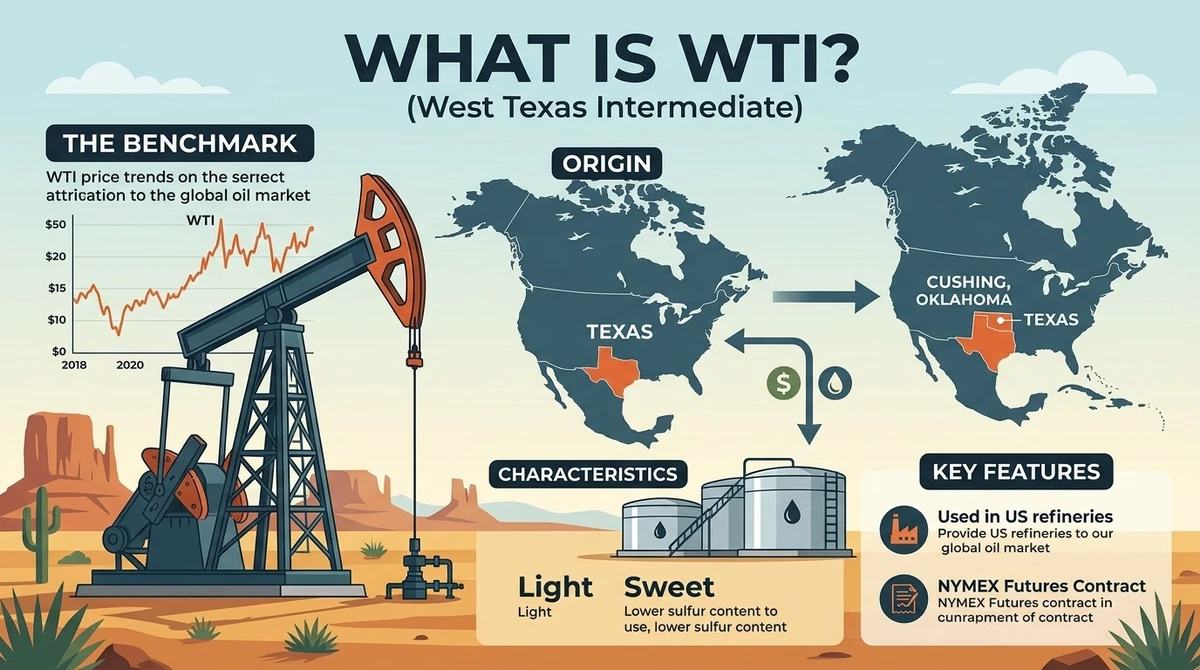
WTI is a U.S. crude oil blend and one of the most closely watched reference prices in the global oil market. It is particularly important because its pricing system is tied to a physical oil market in Cushing, Oklahoma, while its futures contract provides a highly liquid marketplace for producers, refiners, traders, and financial participants. (CME Group)
Understanding WTI therefore requires more than knowing what the acronym stands for. Its importance comes from the connection between the physical characteristics of crude oil, pipelines and storage, futures trading, and the broader economics of supply and demand.
What Is WTI?
WTI stands for West Texas Intermediate.
It refers to a blend of U.S. domestic light, sweet crude oils. “Light” describes relatively low density, while “sweet” means the crude has relatively low sulfur content.
The term can refer to the physical crude itself, but in financial news, “WTI” often refers to the benchmark price associated with crude delivered at Cushing, Oklahoma.
The U.S. Energy Information Administration describes WTI-Cushing as a crude stream produced in Texas and southern Oklahoma that serves as a reference price for other crude streams and is traded in the domestic spot market at Cushing. (U.S. Energy Information Administration)
That distinction is important.
WTI is not simply “the price of oil.”
It is a particular crude grade and pricing benchmark that has become a reference point for a much wider market.
Why Does Cushing Matter So Much?
The answer to WTI’s importance is partly geographic.
Cushing is a major oil storage and pipeline hub in Oklahoma. Crude from different production regions can move into the area through pipelines, while other pipelines connect the hub with refineries and export markets.
That makes Cushing useful as a meeting point between physical oil supply, storage, transportation, and trading.
It also serves as the delivery point for the standard NYMEX WTI crude oil futures contract. (CME Group)
This physical connection gives WTI something extremely important for a commodity benchmark: a direct relationship between a financial price and barrels of crude that can actually be delivered.
The benchmark is therefore not just an abstract number generated by financial markets.
WTI Is a Price Reference, Not a Single Global Oil Price
Different crude oils have different characteristics and are produced in different locations.
A barrel from Texas is not necessarily identical to a barrel from the North Sea, Canada, Saudi Arabia, or Mexico.
Differences in quality, transportation costs, location, refinery requirements, and local supply and demand can all affect the price.
WTI provides one important reference point for these transactions.
For example, another crude grade may trade at a premium or discount to WTI. If transportation becomes more expensive or a particular region experiences excess supply, the difference between the two prices can change.
CME Group describes crude transactions in North America as being negotiated in relation to benchmark prices such as WTI, with differences reflecting quality, transportation, and regional market conditions. (CME Group)
This is one of the main economic functions of a benchmark: it gives buyers and sellers a common reference price.
Why Is WTI Traded Through Futures Contracts?
The WTI price seen in financial markets is closely associated with the NYMEX WTI crude oil futures contract.
A futures contract is an agreement tied to the purchase or sale of a commodity at a specified future time and price.
The standard WTI contract represents 1,000 barrels of crude oil and is physically delivered at Cushing when contracts reach delivery. (CME Group)
That physical delivery feature matters because it helps connect futures prices with the underlying physical oil market.
If the futures price moved permanently far away from the physical market, traders could potentially exploit the difference through arbitrage. The ability to make or take delivery helps pull the futures and physical markets toward one another as contracts approach expiration.
This is one reason WTI futures are useful for price discovery and risk management.
Who Actually Cares About the WTI Price?
WTI is not just a number watched by oil traders.
Different participants use the benchmark for different reasons.
Oil producers can use WTI futures and related instruments to hedge against falling crude prices.
Refiners can use derivatives to manage the risk that the price of crude rises before they process it into gasoline, diesel, jet fuel, and other products.
Oil companies and trading firms can use WTI-linked prices to evaluate buying, selling, transportation, and storage decisions.
Investors and financial institutions may use WTI futures and other instruments to gain exposure to oil-price movements.
This means WTI acts as both a market information signal and a risk-management tool.
What Makes WTI Different From Brent?
WTI and Brent are the two crude benchmarks that appear most frequently in financial news, but they represent different underlying markets.
WTI is associated with U.S. light, sweet crude and has its physical delivery point at Cushing, Oklahoma.
Brent is the major benchmark associated with crude from the North Sea and is widely used in international oil pricing.
Their prices often move in the same general direction because both respond to global oil-market conditions.
But they do not have to trade at the same price.
Transportation constraints, regional inventories, production changes, refinery demand, and differences in crude quality can cause the spread between WTI and Brent to widen or narrow.
That spread can itself provide information about regional market conditions.
Why Can WTI Be Cheaper or More Expensive Than Brent?
Suppose U.S. crude production increases rapidly while pipeline capacity in a particular region becomes constrained.
More crude may arrive at a storage hub than local buyers can immediately absorb.
That can put downward pressure on the local benchmark.
Alternatively, if inventories become unusually tight while demand remains strong, the local price can rise relative to other benchmarks.
The difference between WTI and Brent therefore isn’t necessarily an error or an inefficiency.
It can reflect real economic differences between two connected but distinct oil markets.
CME notes that crude prices around North America can trade at differentials to WTI based on transportation costs, crude quality, and regional supply-demand conditions. (CME Group)
Why Oil Storage Can Move the WTI Market
Storage is one of the most important concepts for understanding WTI.
Oil cannot simply disappear when production exceeds immediate consumption. It has to be stored, transported, refined, exported, or otherwise moved into another part of the supply chain.
That makes storage capacity economically valuable.
Cushing has extensive storage and pipeline infrastructure, which is one reason it became an important delivery location for WTI futures. (CME Group)
When storage levels rise substantially, it can signal that supply is exceeding immediate demand.
When inventories fall, it can indicate tighter market conditions.
But inventory data needs context. A falling stockpile does not automatically mean oil prices must rise, just as rising inventories do not guarantee falling prices. Traders also consider production, refinery activity, imports, exports, seasonal demand, and expectations about future conditions.
The 2020 WTI Price Collapse Shows Why Location Matters
One of the clearest examples of WTI’s physical-market connection occurred in April 2020.
As the COVID-19 pandemic sharply reduced transportation and fuel demand, oil producers and traders faced an extraordinary storage problem.
The May 2020 WTI futures contract settled at negative $37.63 per barrel on April 20, 2020.
That did not mean every barrel of oil everywhere suddenly had a negative economic value.
The collapse reflected the specific conditions surrounding the expiring WTI contract, including extremely weak demand and limited available storage at Cushing.
The EIA explained that WTI’s physical delivery structure made it particularly sensitive to storage conditions at the Cushing hub. (U.S. Energy Information Administration)
This episode is an important lesson in commodity markets.
A benchmark price is shaped not only by broad global supply and demand but also by where the commodity is delivered, how much can be stored, and how quickly it can be moved.
Why U.S. Oil Production Changed WTI’s Importance
WTI became even more significant as U.S. crude production expanded.
The growth of shale production increased the amount of crude moving through the U.S. pipeline system and helped strengthen the connection between domestic production, Cushing, Gulf Coast infrastructure, and international markets.
The removal of the U.S. crude export ban at the end of 2015 also changed the role of U.S. crude in global trade.
U.S. producers could increasingly sell crude into international markets rather than relying primarily on domestic buyers. CME notes that expanding U.S. production and export infrastructure helped WTI become more integrated with global oil pricing. (CME Group)
This is why WTI is no longer simply a regional U.S. oil reference.
Its price increasingly interacts with international crude markets.
What Does WTI Tell Us About the U.S. Economy?
WTI is useful for understanding more than the oil industry.
Higher crude prices can increase revenue for oil producers and support investment in exploration, drilling, pipelines, and energy services.
At the same time, higher oil prices can raise costs for transportation companies, manufacturers, airlines, logistics firms, and households.
Lower oil prices can have the opposite effects.
For consumers, the connection is usually most visible at the gasoline pump. But the economic effects can spread much further because petroleum products are used throughout supply chains.
The effect can also differ across businesses.
An oil producer may benefit from higher crude prices, while an airline may face higher fuel expenses. A refinery can experience different effects depending on the relationship between crude costs and refined-product prices.
This is why a change in WTI cannot be interpreted as simply “good” or “bad” for the economy.
WTI and Inflation: The Connection Is Indirect
WTI can contribute to inflation through energy costs, but it is not an inflation measure itself.
When crude prices rise, gasoline and other petroleum products can become more expensive. Higher transportation and production costs can then spread into other parts of the economy.
But the final effect depends on many variables, including refining margins, taxes, transportation costs, exchange rates, inventories, and consumer demand.
This means a 10% rise in WTI does not automatically produce a 10% rise in gasoline prices or consumer inflation.
The benchmark is one input into a much larger pricing chain.
Why WTI Matters to Investors
Investors often encounter WTI through futures, exchange-traded products, energy-company valuations, and financial news.
But exposure to WTI does not always mean owning physical oil.
A futures contract is a derivative tied to the underlying commodity. Other investment products may track oil prices through futures contracts or other structures.
That distinction matters because the return on an oil-linked investment can differ from the simple percentage change in the spot price of crude.
Futures markets can move between contango, when later-dated contracts are priced above near-term contracts, and backwardation, when later contracts are priced below near-term contracts.
Those structures can affect the economics of storing, hedging, and maintaining financial exposure to oil.
For investors, therefore, understanding WTI requires looking beyond the headline price.
What Should You Watch When WTI Moves?
A large WTI price move becomes more meaningful when you look at the forces behind it.
Ask:
- Did U.S. crude production change?
- Are Cushing inventories rising or falling?
- Has refinery demand changed?
- Are imports or exports shifting?
- Is OPEC+ changing global supply?
- Are geopolitical disruptions affecting supply expectations?
- Is global economic growth strengthening or weakening?
- Is the WTI-Brent spread widening or narrowing?
These questions help distinguish a temporary market movement from a broader change in oil-market fundamentals.
For example, a sharp WTI decline caused by a temporary regional storage problem tells a different economic story from a decline caused by a major deterioration in global oil demand.
WTI Is More Than an Oil Price on a Screen
WTI is important because it connects several parts of the oil economy.
It links physical crude production with storage and pipelines at Cushing. It connects those physical markets to a highly traded futures contract. And that futures market provides a transparent reference that businesses can use to price transactions and manage risk. (CME Group)
That is why WTI appears so frequently in discussions about energy markets, inflation, corporate costs, and the U.S. economy.
The next time you see a headline saying that WTI crude has moved sharply, the useful question is not simply “Did oil go up or down?”
It is “What changed in the physical or financial market that caused the benchmark to move?”
That question gets much closer to understanding what is actually happening in the global oil economy.
Click here to read What Is OPEC? Understanding the Organization That Influences Oil Markets.