Home Insurance vs. Renters Insurance: Understanding the Key Differences
Home Insurance vs. Renters Insurance
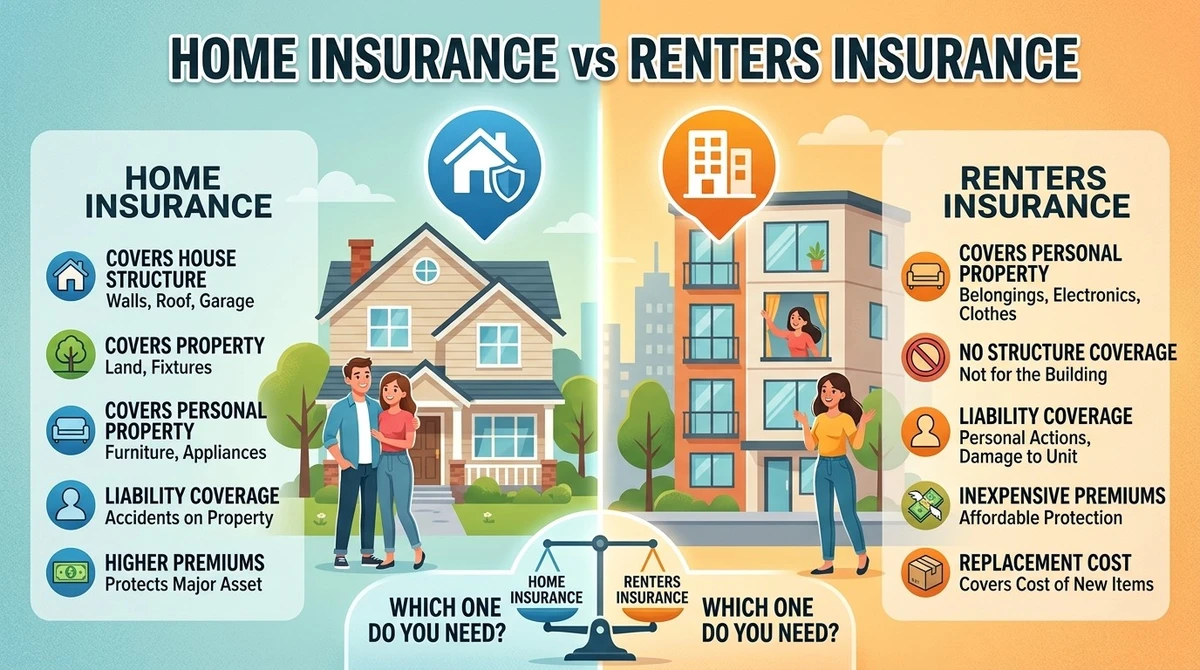
Home insurance and renters insurance protect against some of the same financial risks, but they are built around very different responsibilities.
The key difference is not simply that one policy is for homeowners and the other is for renters. It is who is financially responsible for the property itself.
A homeowner has an interest in the building, while a renter generally does not own the structure they live in. That changes what needs to be insured, who carries the risk, and what happens after a covered loss.
Both types of policies can protect personal belongings and provide liability coverage. Both may also help with additional living expenses after certain covered losses. But the building itself creates the biggest dividing line.
The Building Is Where the Two Policies Separate
Imagine two people living in similar houses.
One owns the house. The other rents it.
If a covered fire causes major structural damage, the homeowner has a direct financial problem: the roof, walls, floors, and other parts of the building may need to be repaired or rebuilt.
The renter has a different problem. The landlord generally deals with the building, while the renter may need to replace furniture, electronics, clothing, and other personal belongings.
That is why renters insurance generally does not insure the structure. The National Association of Insurance Commissioners (NAIC) explains that renters insurance focuses on insured contents and personal liability, while the renter does not insure the building itself. (NAIC Content)
The difference can be summarized simply:
| Coverage | Homeowners Insurance | Renters Insurance |
| Building structure | Generally covered | Generally, not covered |
| Personal belongings | Generally covered | Generally covered |
| Personal liability | Generally included | Generally included |
| Additional living expenses | May be included | May be included |
| Other structures | May be covered | Generally, not applicable |
| Mortgage-related requirement | Often required by lenders | Not usually applicable |
The exact protection depends on the policy, limits, deductible, exclusions, and endorsements.
What the Homeowner Is Actually Insuring
For a homeowner, the property itself is usually the largest financial exposure.
Homeowners insurance can provide coverage for the dwelling, other qualifying structures, personal belongings, liability, and certain additional living expenses.
Consider a house with a market value of $400,000.
If a covered event causes severe structural damage, the homeowner cannot simply replace the furniture and move on. The physical property may require extensive repairs or rebuilding.
That is why dwelling coverage is central to homeowners insurance. The NAIC notes that coverage should generally be sufficient to address the cost of rebuilding the home rather than simply matching its market value. (NAIC Content)
Homeowners also need to consider risks beyond the building itself. A liability claim, for example, can create financial exposure even when the house has suffered no damage.
For a detailed explanation of the different components of homeowners coverage, see Economic Reader’s What Is Homeowners Insurance?.
What the Renter Still Has at Risk
Not owning the building does not mean a renter has little to protect.
A renter might have:
- $2,000 in electronics
- $5,000 in furniture
- $3,000 in clothing
- $1,500 in kitchen and household items
- Several thousand dollars in other personal possessions
The total can become substantial without the renter realizing it.
If a covered event destroys those belongings, the landlord’s insurance generally does not replace them. Triple-I explains that a landlord’s policy typically protects the building, while renters insurance provides protection for personal possessions, liability, and additional living expenses. (Triple-I)
This is one of the most important differences between owning a property and living in a property.
The homeowner has to protect the structure and what is inside it.
The renter generally needs to protect what they own inside someone else’s structure.
The Two Policies Still Overlap
The differences can make the policies seem completely separate, but there is meaningful overlap.
Personal Property
Both homeowners and renters policies can provide coverage for eligible personal belongings after covered losses.
Furniture, clothing, electronics, and other possessions can fall into this category, subject to policy limits and exclusions.
The important question is not simply whether personal property is covered. It is whether the coverage limit is enough.
A renter with $30,000 worth of possessions who buys only $15,000 of coverage could still face a significant financial gap after a major loss.
The same issue applies to a homeowner.
Liability
Homeowners are not the only people who face liability risks.
A renter could also face a claim if someone is injured in the rental property or if the renter is legally responsible for certain property damage.
Renters insurance can provide personal liability protection subject to the policy’s terms and limits. (NAIC Content)
That means liability coverage can matter even for someone whose personal belongings are relatively inexpensive.
Additional Living Expenses
A covered loss can sometimes make a home temporarily unlivable.
For a homeowner, that could mean staying somewhere else while repairs are completed.
For a renter, it could mean finding temporary accommodation after a covered event damages the rental unit.
Both types of policies may provide additional living expense coverage, but the amount and conditions depend on the policy.
Your Landlord’s Insurance Is Not Your Renters Insurance
This distinction deserves special attention because it is easy to misunderstand.
Suppose a fire damages an apartment building.
The landlord’s insurance may help cover damage to the building.
That does not normally mean the renter’s laptop, furniture, clothing, and other possessions are automatically covered.
The tenant and landlord have different financial interests in the same property.
The landlord owns the building.
The tenant owns the belongings inside it.
That is why the two insurance policies can operate alongside each other rather than replacing one another. Triple-I specifically notes that landlord insurance does not replace a renter’s personal possessions or cover the renter’s additional living expenses. (Triple-I)
For a deeper look at the tenant side, Economic Reader’s What Is Renters Insurance? covers the purpose and main features of renters coverage.
The Price of a Policy Is Only One Part of the Comparison
It can be tempting to compare insurance primarily by monthly premium.
That can be misleading.
Two policies can have different premiums because they provide different limits, deductibles, valuation methods, and exclusions.
For example, imagine two renters policies:
- Policy A costs less but has a lower personal property limit and a higher deductible.
- Policy B costs more but provides higher limits and replacement-cost coverage.
The cheaper policy may look attractive before a loss occurs. After a major claim, however, the difference in coverage could matter far more than the difference in monthly premiums.
Homeowners face the same issue, but with a much larger potential exposure because the policy may also need to protect the structure.
Deductibles Can Change the Real Cost of a Loss
The deductible is another point that matters for both homeowners and renters.
If a covered loss totals $5,000 and the policy has a $1,000 deductible, the insured generally has to absorb the first $1,000, subject to the policy’s terms.
A higher deductible can sometimes reduce the premium, but it also means more out-of-pocket cost after a covered claim.
This creates an important practical question:
How much could you realistically pay after an unexpected loss?
The cheapest premium is not necessarily the most useful policy if the deductible or coverage gap would be difficult to manage.
Replacement Cost Can Matter More Than the Premium
Another difference that is easy to overlook is how personal property is valued.
Policies may use actual cash value or replacement cost approaches, depending on the policy.
Actual cash value generally accounts for depreciation.
Replacement cost coverage is designed around the cost of replacing eligible property with comparable new property, subject to the policy’s terms and limits.
Consider a five-year-old laptop that originally cost $1,500.
If it is stolen in a covered loss, the amount paid can differ significantly depending on how the policy values the item.
This issue matters to both homeowners and renters, because both can have substantial personal property to replace.
A Homeowner’s Biggest Risk Is Usually Larger
The difference becomes clearer when looking at the size of the potential loss.
A renter might have $25,000 worth of personal property at risk.
A homeowner could have that same $25,000 of belongings plus a building worth hundreds of thousands of dollars.
That does not mean homeowners automatically need every possible type of coverage. It means their insurance decision involves a larger physical asset and potentially much larger repair or rebuilding costs.
The homeowner therefore has to think about the rebuilding cost of the property, while the renter generally focuses on belongings, liability, and temporary living costs.
That is the financial distinction behind the two policies.
What Happens When You Move from Renting to Owning?
Insurance needs can change significantly when your housing situation changes.
Someone who moves from an apartment into a house they purchase is no longer responsible only for personal belongings. The building becomes part of their financial responsibility.
The reverse is also true.
Someone who sells a home and begins renting generally no longer needs to insure the building they previously owned. But they still have belongings and liability risks.
A move is therefore a good time to reassess insurance rather than simply carrying over assumptions from the previous living arrangement.
What Neither Policy Automatically Covers
Neither homeowners nor renters insurance should be treated as unlimited protection.
Policies contain exclusions and special limits.
Flood and earthquake damage, for example, are commonly excluded from standard homeowners and renters policies and may require separate insurance or additional coverage depending on the location and policy. (Triple-I)
High-value possessions can also have special limits.
Someone with expensive jewelry, artwork, collectibles, or specialized equipment may need additional coverage if the standard policy limit is insufficient.
The lesson is straightforward: the policy’s exclusions can be just as important as its coverage list.
How to Compare the Two Without Looking Only at Price
Whether you own or rent, a useful insurance comparison starts with your actual financial exposure.
Ask:
- What property am I responsible for?
- How much would it cost to replace my belongings?
- How much liability coverage do I need?
- What is my deductible?
- Is personal property valued at actual cash value or replacement cost?
- What major risks are excluded?
- Do valuable possessions have special limits?
- Would additional living expense coverage be enough if I had to leave the property temporarily?
For homeowners, add another question:
Would the dwelling coverage be enough to rebuild the property after a covered loss?
For renters, the more relevant question is:
Could I replace my belongings and manage the financial consequences of a liability claim without putting major pressure on my savings?
These questions make the comparison much more practical than simply asking which policy is cheaper.
Home Insurance vs. Renters Insurance: The Key Takeaway
Homeowners insurance and renters’ insurance overlap in several areas, but they protect different financial interests.
The homeowner generally needs protection for the building, personal property, liability, and certain additional expenses.
The renter generally needs protection for personal property, liability, and certain additional expenses, while the building remains the landlord’s responsibility.
The real dividing line is ownership.
Once that is understood, the rest of the comparison becomes much easier: identify what you own, determine what financial risks you carry, check the policy limits and exclusions, and then compare the cost of that protection.
For anyone deciding between the two, the right starting point is not the insurance premium.
It is the question of what could financially fall on you if something goes wrong.