What Is a Business Cycle? Understanding How Economic Activity Expands and Contracts
What Is a Business Cycle?
Economic activity does not move in a straight line.
Businesses can experience periods of stronger sales, rising production, expanding investment, and increased hiring. Later, growth can slow, companies may reduce investment, and demand may weaken. Eventually, economic activity can stabilize and begin expanding again.
This recurring movement in overall economic activity is known as the business cycle.
The term is often used interchangeably with “economic cycle,” but there is a useful reason to study the business cycle separately. Rather than simply describing periods of expansion and contraction, business-cycle analysis looks at how economists identify changes in economic activity and determine whether a slowdown represents a genuine turning point.
That involves more than asking whether GDP increased or fell.
Economists look at the breadth, depth, duration, and timing of changes across the economy. They examine employment, income, spending, production, and sales to determine whether the economy is experiencing a broad shift or simply a temporary slowdown.
That distinction matters for businesses, investors, and policymakers trying to understand where the economy stands.
What Does “Business Cycle” Actually Mean?
A business cycle describes fluctuations in aggregate economic activity around an economy’s longer-term growth path.
The economy can expand for years while still experiencing periods of slower growth. A contraction can eventually occur, followed by another expansion.
The cycle therefore does not follow a fixed timetable.
The National Bureau of Economic Research (NBER), which maintains the widely used U.S. business-cycle chronology, identifies peaks and troughs in overall economic activity. A peak marks a turning point before a broad contraction, while a trough marks the end of a contraction and the beginning of a new expansion. NBER: Business Cycle Dating Procedure
This approach is broader than simply tracking quarterly GDP.
Different parts of an economy rarely move together perfectly. Manufacturing can weaken while services remain strong. Consumer spending can continue rising while business investment declines. Employment can remain resilient while industrial production falls.
The business cycle is therefore a measure of broad economic movement, rather than a description of every company or industry at the same time.
Business Cycle vs. Economic Cycle
In everyday economic writing, business cycle and economic cycle generally describe the same broad concept.
Economic Reader’s What Is an Economic Cycle? already explains the traditional cycle in detail, including expansion, peak, contraction, and trough.
This article takes a different approach by focusing on how economists determine whether those turning points have actually occurred.
That distinction is useful because economic turning points are rarely obvious when they happen.
A company may know that its sales have weakened this quarter. That does not necessarily mean the entire economy has entered a contraction.
Likewise, one strong month of employment or retail sales does not prove that a new expansion has begun.
Business-cycle analysis is partly about separating temporary movements from broad changes in economic direction.
Why the Business Cycle Is Hard to Identify in Real Time
One of the most important features of a business cycle is that economists often identify turning points after they have occurred.
The NBER’s Business Cycle Dating Committee does not use a mechanical formula that automatically declares a recession when one indicator reaches a certain level. Instead, it evaluates a range of measures of aggregate economic activity.
These include real personal income less transfers, payroll employment, real personal consumption expenditures, manufacturing and trade sales adjusted for price changes, household-survey employment, and industrial production. For quarterly analysis, real GDP and real GDI are also important. NBER: Business Cycle Dating FAQ
There is a practical reason for this approach.
Economic data are released with delays and are often revised.
Suppose production falls in January. By February, economists may have only an early estimate of what happened. Several months later, revised data may tell a different story.
At the same time, some sectors may already be recovering while others continue weakening.
A turning point can therefore become clear only after several pieces of evidence begin pointing in the same direction.
This is why recession declarations are generally retrospective rather than real-time signals.
The Four Phases Still Matter – But They Are Only a Framework
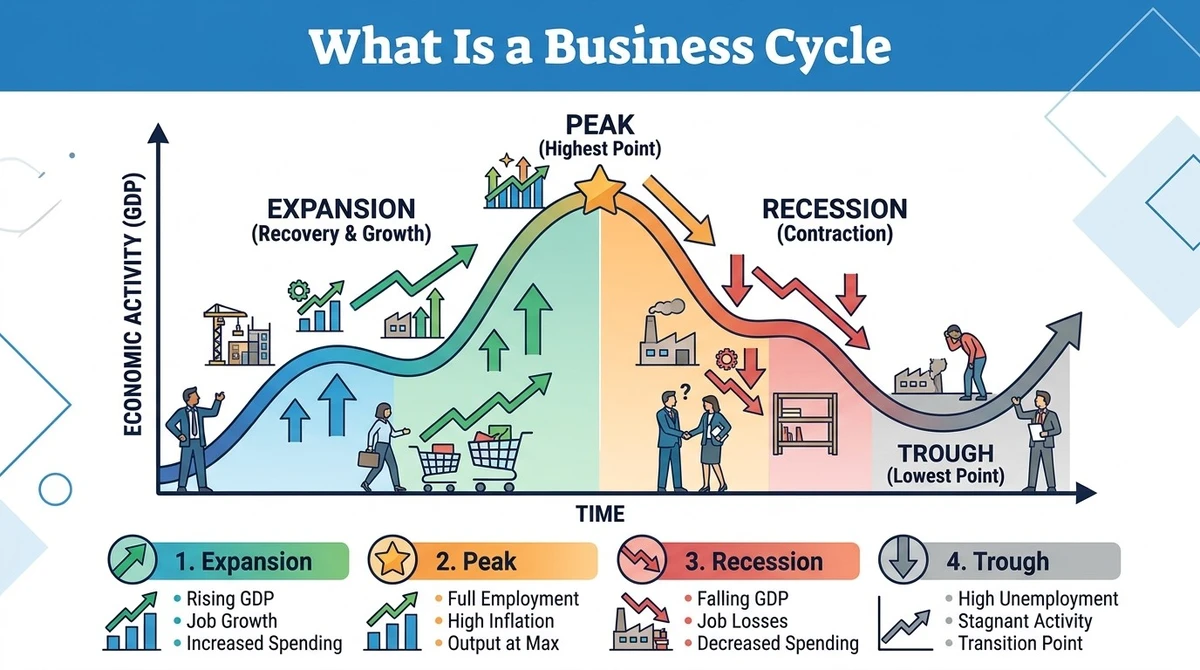
The traditional business-cycle framework consists of:
Expansion → Peak → Contraction → Trough → New Expansion
An expansion is a period when overall economic activity is increasing.
A peak is the turning point at which the expansion ends.
A contraction is the period in which broad economic activity declines.
A trough marks the low point before activity begins rising again.
These stages are useful, but they should not be treated like a calendar.
There is no rule saying an expansion must last five years, ten years, or any other fixed period. Historical U.S. business-cycle data show substantial variation in the length of expansions and contractions. NBER: U.S. Business Cycle Expansions and Contractions
The more useful question is not “How long has this expansion lasted?”
It is:
“What is happening to the underlying forces supporting economic activity?”
Duration, Depth, and Diffusion Tell Different Stories
A business-cycle downturn cannot be understood from its duration alone.
Economists also consider how deep and widespread the decline is.
The NBER uses the concepts of depth, diffusion, and duration when evaluating recessions. A downturn needs to represent a meaningful decline across the economy rather than being limited to one industry or a short-lived disturbance. NBER: Business Cycle Dating Procedure
Consider two hypothetical situations.
In the first, manufacturing production declines for three months because companies temporarily reduce inventories, while employment, consumer spending, and services continue expanding.
In the second, manufacturing declines, consumer spending weakens, employment falls, business investment contracts, and real income declines across several months.
Both situations contain weakness.
But the second represents a much broader change in economic activity.
This is why the word recession should not be applied automatically whenever one economic indicator turns negative.
Why GDP Alone Is Not Enough
GDP is one of the most important measures of economic activity, but the business cycle is broader than GDP.
GDP measures the value of goods and services produced in an economy. Business-cycle analysis asks a wider question:
Is overall economic activity rising or falling across multiple parts of the economy?
That requires looking at other measures.
Employment can show whether businesses are adding or reducing workers.
Real personal income can reveal whether households are experiencing changes in income after accounting for inflation.
Consumer spending provides information about demand.
Industrial production shows what is happening across factories, utilities, and mining.
Real sales can reveal whether businesses are actually selling more or less after accounting for price changes.
The NBER uses several of these measures because no single indicator captures every part of the economy. NBER: Business Cycle Dating Procedure
This broader approach can explain situations where GDP appears weak while other parts of economic activity remain relatively resilient.
A Business Cycle Can Look Very Different Across Industries
The word “business” can make the cycle sound uniform across companies.
It is not.
Different industries respond differently to changes in demand, interest rates, credit, inventories, and consumer confidence.
Construction companies can be highly sensitive to mortgage rates and financing conditions.
Technology companies may be more exposed to corporate investment and capital spending.
Consumer-discretionary businesses can be particularly sensitive to household income and confidence.
Utilities may experience more stable demand because households continue to require electricity and other essential services even during downturns.
This creates an important distinction:
A recession for the economy does not necessarily mean the same recession for every business.
Some companies may experience declining sales before the broader economy turns down. Others may continue growing throughout a national slowdown.
Business-cycle analysis can provide the macroeconomic context, but it cannot replace industry-level analysis.
The Cycle Can Move Through Different Channels
Changes in economic activity can spread through the economy in several ways.
Consider a company that notices weaker demand.
It may reduce orders from suppliers.
Suppliers then lower production.
Manufacturers may postpone new equipment purchases.
Businesses may slow hiring.
Household income can weaken if employment growth slows.
Lower income and confidence can then reduce spending further.
The process can work in the opposite direction during an expansion.
Stronger demand can increase sales. Businesses raise production, add workers, increase inventories, and invest in new capacity.
Those decisions generate additional income and spending elsewhere in the economy.
The business cycle is therefore not simply a sequence of four labels. It reflects a network of decisions made by households, businesses, financial institutions, and governments.
Financial Conditions Can Influence the Cycle Before the Economy Turns
Financial conditions are another important part of business-cycle analysis.
Interest rates, bond yields, mortgage costs, equity prices, credit availability, and the value of the dollar can all influence future economic activity.
The Federal Reserve has developed financial-condition measures designed to estimate how changes in financial variables can create future headwinds or support for economic growth. Its Financial Conditions Impulse on Growth incorporates variables including the federal funds rate, Treasury yields, mortgage rates, corporate borrowing costs, equity prices, house prices, and the dollar. Federal Reserve: A New Index to Measure U.S. Financial Conditions
The timing matters.
A company may face higher borrowing costs today but postpone a major investment project six months later.
A household may adjust spending only after higher borrowing costs remain in place for some time.
This creates a gap between a change in financial conditions and its eventual effect on economic activity.
Financial conditions can therefore provide information about potential future economic pressure before conventional economic data fully reflect the change.
For readers who want to understand the interest-rate transmission mechanism in more detail, Economic Reader’s How Interest Rates Affect the Economy covers how borrowing costs influence spending, investment, employment, and growth.
Why Employment Can Send a Different Signal
Employment is particularly interesting because it can lag changes in economic activity.
Businesses may hesitate to lay off workers immediately when sales weaken because hiring and training employees again can be expensive.
The opposite can happen during a recovery.
A company may see sales improve but remain cautious about expanding its workforce until it becomes confident that stronger demand will last.
The NBER notes that employment can continue changing after an economy has already reached a business-cycle turning point. Following the June 2009 trough, for example, nonfarm payroll employment continued to decline for several months. NBER: Business Cycle Dating Procedure
This creates an important distinction between economic recovery and labor-market recovery.
The economy can begin expanding before households feel that conditions have fully improved.
Turning Points Are Not the Same as Strong or Weak Economies
A business-cycle turning point describes a change in direction.
It does not necessarily describe whether economic conditions are good or bad in absolute terms.
Suppose economic output reaches a peak and then begins declining.
The first month after the peak might still have relatively high employment, strong consumer spending, and substantial business activity.
The economy has nevertheless entered a contraction according to the cycle’s turning point.
Similarly, when the economy reaches a trough, conditions may still be weak.
Production may remain below its previous peak. Unemployment may still be elevated. Businesses may have unused capacity.
The important change is that the direction has shifted from decline toward expansion.
The NBER explicitly distinguishes the direction of economic activity from its absolute level. An expansion can begin while overall activity remains below the previous peak. NBER: Business Cycle Dating Procedure
This is one of the most useful concepts for understanding business-cycle data.
What Businesses Can Learn from the Cycle
Companies do not need to wait for an official recession announcement to respond to changing conditions.
Management teams often monitor:
- New orders
- Sales growth
- Customer demand
- Inventory levels
- Credit conditions
- Hiring trends
- Capital spending
- Input costs
- Consumer confidence
- Industry-specific activity
The purpose is not necessarily to predict the exact month of the next recession.
It is to identify whether conditions are becoming more supportive or less supportive of future revenue and investment.
A manufacturer may notice falling new orders before overall industrial production declines.
A retailer may see consumers trading down to cheaper products before headline consumer spending weakens.
A construction company may detect weaker project demand as financing costs rise.
In this sense, businesses often experience the business cycle through individual operating decisions before the cycle becomes obvious in national statistics.
What Investors Should Watch
Investors also need to distinguish between current economic conditions and expectations about future conditions.
Financial markets are forward-looking.
Stock prices can fall before a recession is officially dated because investors expect weaker earnings. They can also recover before employment and other lagging indicators improve significantly.
The business cycle and financial markets therefore do not move in perfect synchronization.
A useful approach is to monitor several areas together:
Demand: Are consumers and businesses continuing to spend?
Employment: Is hiring strengthening or weakening?
Investment: Are companies expanding capacity or postponing projects?
Credit: Are lending conditions becoming easier or tighter?
Production: Is industrial activity increasing or declining?
Financial conditions: Are borrowing costs and market conditions creating support or pressure for future growth?
Looking at several signals together is generally more informative than reacting to one headline number.
Why Every Business Cycle Is Different
Business cycles repeat in the sense that economies experience recurring expansions and contractions.
But the underlying causes can be very different.
A financial crisis can produce one type of downturn.
An energy shock can create another.
A collapse in housing investment can affect the economy through construction, finance, household wealth, and employment.
A sudden change in consumer behavior can create a different pattern.
A productivity boom can extend an expansion by increasing the economy’s productive capacity.
Government policy and central-bank responses can also influence how quickly a downturn develops or how strong a recovery becomes.
This is why historical comparisons need to be used carefully.
Knowing that an economy is in an expansion does not tell you how that expansion will end.
Likewise, knowing that a recession has begun does not tell you how deep or long it will become.
The Business Cycle Is a Measurement Framework, Not a Forecast
The most useful way to understand the business cycle is not as a predictable four-stage clock.
It is a framework for organizing changes in economic activity.
Economists use turning points to identify when broad activity changes direction. They examine multiple indicators because GDP alone cannot capture every part of the economy. They consider the breadth and persistence of changes because weakness in one industry is not necessarily a national recession.
For businesses, the cycle can appear through changes in orders, sales, inventories, hiring, financing, and investment.
For investors, it can appear through changing expectations for earnings, interest rates, credit conditions, and economic growth.
For households, it can eventually show up through employment, income, borrowing costs, and spending opportunities.
That is what makes the business cycle more useful than a simple expansion-recession chart.
The important question is not only where the economy is in the cycle, but what is driving the current direction and whether those forces are broad enough to persist.
Once that distinction becomes clear, business-cycle data become easier to interpret. A weak quarter is not automatically a recession, a strong month is not necessarily a new expansion, and an official turning point does not mean every household or company experiences the change at the same time.
The business cycle is best understood as the changing rhythm of economic activity measured through many signals, shaped by many decisions, and rarely moving in exactly the same way twice.