What Is Natural Gas? Understanding LNG, Global Trade, and Its Economic Role
Natural gas is one of the world’s most important energy sources.
It heats buildings, generates electricity, supplies industrial facilities, and provides a feedstock for products such as fertilizers and chemicals. But natural gas has another role that has become increasingly important: it can be converted into a liquid and transported across oceans.
That form is known as liquefied natural gas, or LNG.
Natural gas and LNG are not two different fuels. LNG is natural gas that has been cooled to an extremely low temperature until it becomes a liquid. The change in physical form makes it possible to move natural gas between countries that are not connected by pipelines.
That ability has helped turn natural gas from a largely regional energy market into a much more internationally connected commodity.
Understanding natural gas therefore means looking beyond the fuel itself. It means understanding how gas is produced, processed, transported, priced, traded, and ultimately connected to electricity, industry, inflation, and economic activity.
What Is Natural Gas?
Natural gas is a gaseous mixture of hydrocarbons, primarily methane. It is found underground in geological formations and can occur alongside crude oil or in deposits that primarily contain natural gas. (EIA)
After extraction, raw natural gas usually requires processing before it becomes suitable for consumers or pipeline transportation.
Water, impurities, and other hydrocarbons can be removed during processing. The resulting product is generally referred to as dry or pipeline-quality natural gas.
Natural gas can then move through pipelines to:
- Power plants
- Factories
- Commercial buildings
- Homes
- LNG export facilities
- Storage facilities
The fuel’s importance comes partly from its flexibility. It can be burned to produce electricity and heat, while methane and other components of natural gas can also serve as industrial feedstocks.
Energy prices can also feed into wider inflationary pressures. Economic Reader’s What Is Inflation? explains how changes in production and energy costs can eventually affect broader prices.
Where Does Natural Gas Come From?
Natural gas forms over geological timescales as organic material is transformed by heat and pressure beneath the Earth’s surface.
Commercial production involves drilling wells into gas-bearing formations and bringing the gas to the surface.
Natural gas production has expanded significantly in several regions because of advances in drilling and hydraulic fracturing, particularly in the United States.
Gas can also be produced together with crude oil. In that situation, it is known as associated gas.
Once extracted, the gas must be processed and transported to where it will be consumed.
The transportation method becomes particularly important when the producing country is far away from the consuming market.
That is where LNG enters the picture.
What Is LNG?
LNG stands for liquefied natural gas.
It is natural gas that has been cooled to approximately -162°C (-260°F), turning it into a liquid. In this state, its volume is roughly 600 times smaller than the same amount of natural gas in gaseous form.
That dramatic reduction in volume is the key to LNG’s economic importance.
Natural gas is relatively difficult to transport long distances by ship in its normal gaseous state. Pipelines are highly effective where infrastructure exists, but they cannot simply cross oceans.
Liquefaction changes the equation.
The simplified process is:
Natural gas → Processing → Liquefaction → LNG tanker → Regasification → Natural gas
At the destination, LNG is warmed and converted back into gas. This process is called regasification.
The gas can then enter pipelines and reach power plants, factories, businesses, and households.
The U.S. Energy Information Administration explains that LNG allows natural gas to reach markets that are not connected to producing regions by pipeline. (EIA)
How Natural Gas Becomes LNG
Turning natural gas into LNG requires specialized infrastructure.
First, gas is transported to an LNG export facility.
The gas is processed to remove water and unwanted compounds. It is then cooled through a refrigeration process until it becomes a liquid.
The LNG is stored in insulated cryogenic tanks before being loaded onto specially designed LNG carriers.
The basic chain looks like this:
Gas production → Processing → Pipeline → Liquefaction plant → LNG storage → LNG carrier → Import terminal → Regasification → Pipeline → End user
Each stage adds costs.
That is why LNG delivered to an overseas market is not priced in exactly the same way as natural gas produced next to that market.
The buyer is effectively paying for the gas itself plus the infrastructure and energy required to process, liquefy, transport, and regasify it.
Why Liquefy Natural Gas?
The main reason is transportability.
A country with abundant natural gas may have more gas than its domestic market can absorb.
If it is connected to neighboring countries by pipeline, it can export gas directly.
But if potential customers are across an ocean, LNG provides another route.
This expands the potential market for natural gas.
It also changes the bargaining position of both producers and consumers.
A producer is no longer limited to nearby pipeline customers.
An importing country is no longer limited entirely to pipeline suppliers.
That flexibility has helped create a global LNG market.
How LNG Is Transported Around the World
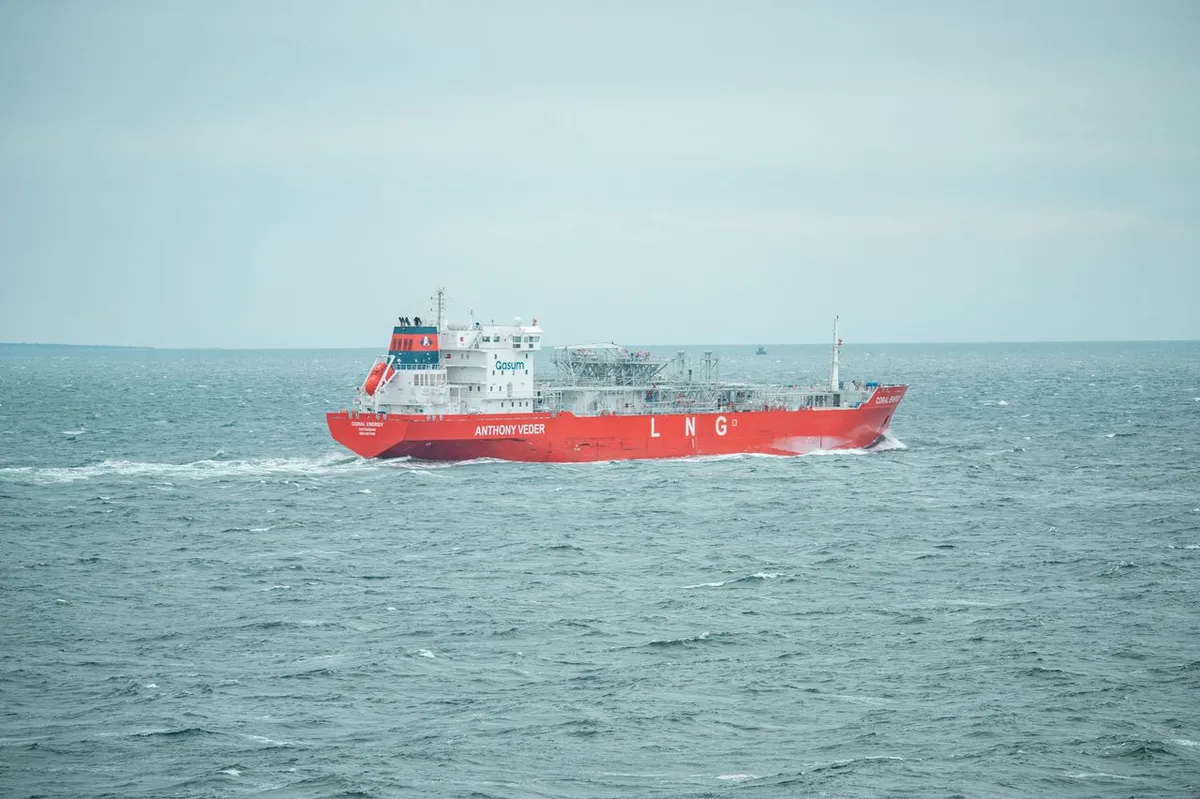
LNG is transported mainly on specialized ships called LNG carriers.
These vessels use heavily insulated tanks designed to keep the cargo at cryogenic temperatures.
At the destination, LNG is unloaded and stored before being converted back into gas at a regasification terminal.
The gas can then enter the local pipeline network.
The scale of this infrastructure is substantial. Global LNG trade reached a record 56.3 billion cubic feet per day in 2025, according to EIA data based on GIIGNL figures. The increase was driven in large part by expanding U.S. LNG export capacity. (EIA)
That growth illustrates an important shift: LNG is no longer a niche transportation method for natural gas. It has become a major component of international energy trade.
Natural Gas vs. LNG
Natural gas and LNG are often discussed together, but they are not identical terms.
| Natural Gas | LNG |
| Normally exists as a gas | Natural gas converted into liquid form |
| Primarily methane | Primarily methane |
| Commonly transported by pipeline | Commonly transported by LNG carrier |
| Suitable for direct pipeline distribution | Suitable for long-distance ocean transport |
| Does not require cryogenic storage | Must be kept at extremely low temperatures |
| Used directly by consumers and industry | Usually regasified before conventional use |
The simplest way to remember the relationship is:
LNG is natural gas in a transport-friendly liquid form.
What Determines Natural Gas and LNG Prices?
Natural gas prices are fundamentally influenced by supply and demand.
But the market is more complicated than that simple description suggests.
Major influences include:
- Natural gas production
- Pipeline capacity
- Storage inventories
- Weather
- Electricity demand
- Industrial activity
- LNG exports
- Imports
- Economic conditions
- Competition from other fuels
Cold weather can increase demand for heating.
Hot weather can also increase demand because air-conditioning raises electricity consumption, which can increase demand for gas-fired power generation.
That gives natural gas an unusual seasonal pattern: extreme cold and extreme heat can both increase demand, although through different channels.
LNG prices have additional influences because international shipping and competition between importing markets become part of the equation.
A supply disruption in one major exporting region can therefore affect prices thousands of miles away.
The 2026 gas market has provided a clear example. The IEA reported that disruption to LNG flows through the Strait of Hormuz contributed to strong price volatility after the conflict in the Middle East disrupted a route that had carried almost 20% of global LNG supply. (IEA)
Why LNG Matters to Global Energy Markets
The growth of LNG has made regional natural gas markets more connected.
Historically, pipeline infrastructure meant that natural gas markets could be heavily regional.
LNG reduces some of that geographic limitation.
A cargo can move by sea from one producing region to another consuming region when market conditions make the trade economically attractive.
This does not make all gas prices identical.
Transportation costs, infrastructure constraints, contracts, storage levels, weather, and regional demand still create price differences.
But greater LNG trade allows supply and demand conditions in one market to have a stronger influence on another.
The IEA’s gas-market analysis now tracks both pipeline and LNG flows as part of an increasingly interconnected international gas system. (IEA)
Natural Gas and Electricity Prices
Natural gas has a particularly important relationship with electricity.
Gas-fired power plants can respond relatively quickly to changes in electricity demand compared with some other generation technologies.
That makes natural gas valuable in power systems that need flexible generation.
When electricity demand rises sharply, gas demand can also increase.
This creates a link between:
Electricity demand → Natural gas demand → Gas prices → Power-generation costs
The relationship varies by country because electricity systems have different mixes of gas, coal, nuclear, hydro, wind, solar, and other sources.
The economic effect can extend beyond utilities. Higher gas costs can raise electricity-generation costs, while more expensive electricity can affect manufacturers, commercial businesses, and households.
This is one reason energy markets can become a source of broader inflationary pressure.
Major Natural Gas and LNG Producers
Natural gas production and LNG exports are not the same thing.
A country can produce large quantities of natural gas but export relatively little LNG if it has strong domestic demand or limited liquefaction infrastructure.
LNG exports require specialized facilities capable of cooling gas to cryogenic temperatures.
Major LNG-exporting countries and regions include:
- United States
- Qatar
- Australia
- Russia
- Malaysia
- Nigeria
- Algeria
- Oman
Their positions can change as new liquefaction projects begin operating, existing facilities expand, or production and infrastructure are disrupted.
The United States has become particularly important because large-scale gas production growth has supported a rapid expansion of LNG exports. EIA data show that U.S. LNG exports averaged 17.4 billion cubic feet per day in the first half of 2026, 23% higher than in the same period of 2025. (EIA)
That growth matters beyond the U.S. energy sector. Additional American LNG supply can increase the amount of gas available to international buyers and change the competitive balance between major exporting regions.
Major LNG Importers
LNG importing countries tend to be markets where domestic gas production is insufficient, pipeline connections are limited, or policymakers want to diversify supply.
Asia has historically been central to LNG demand, with countries such as:
- China
- Japan
- South Korea
- India
Europe has also become a major LNG market, particularly as countries have sought to diversify their energy supplies.
But import demand is not determined by population alone.
Weather, industrial activity, domestic gas production, storage levels, renewable generation, pipeline imports, and LNG prices can all change how much a country needs to buy.
That is why the world’s largest LNG importers can change their purchasing patterns significantly from one year to another.
The Economic Importance of LNG Trade
LNG creates an international value chain extending far beyond natural gas production.
It involves:
- Exploration and drilling
- Gas processing
- Pipelines
- Liquefaction facilities
- LNG carriers
- Ports
- Regasification terminals
- Power plants
- Industrial consumers
That means LNG trade supports investment across multiple industries.
For exporting countries, LNG can generate export revenue, infrastructure investment, government revenue, and demand for engineering and industrial services.
For importing countries, LNG can provide another source of energy supply and reduce dependence on a limited number of pipeline suppliers.
But LNG infrastructure is expensive.
Liquefaction terminals, ships, storage tanks, pipelines, and regasification facilities require substantial capital investment.
That creates a long-term economic question:
Will future gas demand remain strong enough to justify today’s infrastructure spending?
The answer matters because many LNG projects are designed to operate for decades. Investors therefore have to make decisions based not only on current gas prices, but also on expectations about future demand, competition from other fuels, and the pace of the energy transition.
Natural Gas, Energy Security and Geopolitics
Energy markets are closely connected to national security because modern economies depend on reliable energy supplies.
Natural gas can become strategically important when a country relies heavily on imports.
LNG provides one potential source of diversification because imported cargoes can come from different suppliers.
However, LNG does not eliminate geopolitical risk.
Shipping routes, export terminals, sanctions, infrastructure damage, chokepoints, and regional conflicts can all affect the movement of gas.
The 2026 disruption around the Strait of Hormuz demonstrated this vulnerability. The IEA reported that LNG flows through the route had represented almost one-fifth of global LNG supply before the disruption, making the waterway a critical part of the international gas system. (IEA)
This is why LNG is both an energy commodity and a strategic asset.
A disruption to a major route can affect supply availability, shipping costs, and regional prices far beyond the location of the original event.
Environmental Trade-Offs
Natural gas is a fossil fuel, so it is not emissions-free.
Burning natural gas produces carbon dioxide.
There is also concern about methane leakage during production, processing, and transportation. Methane is a potent greenhouse gas, making leakage an important part of the environmental assessment of natural gas.
LNG adds another layer because liquefaction, shipping, and regasification require energy.
The environmental impact is therefore influenced by the full supply chain rather than combustion alone.
Production methods, methane leakage, shipping distance, liquefaction efficiency, and the fuel being displaced can all affect the overall emissions profile.
The environmental debate is consequently more complicated than simply describing natural gas as either “clean” or “dirty.”
For a broader economic perspective on the relationship between environmental risks, energy systems, prices, and businesses, see Economic Reader’s How Climate Change Affects the Economy.
The Future of Natural Gas and LNG
The future of natural gas will depend on several competing forces.
Demand for electricity is growing in many markets, while industries continue to require reliable energy.
At the same time, renewable energy, energy storage, electrification, and efficiency improvements are changing the structure of energy demand.
The supply side is changing too.
The IEA expected 2026 to bring a major increase in global LNG supply capacity, although the disruption to Gulf LNG flows has complicated that outlook. Its Q3 2026 assessment shows how new projects in North America, Africa, and other regions are helping offset lost supply from the Gulf. (IEA)
The United States is also expanding its role. EIA expects U.S. LNG exports to continue increasing as additional projects come online, with exports forecast to rise further in 2027. (EIA)
This creates a difficult investment question for the industry.
LNG projects are long-lived assets, but energy demand can change faster than infrastructure.
If gas demand remains strong, new infrastructure can become strategically valuable.
If electricity systems transition more rapidly toward other energy sources, some projects could face lower utilization than originally expected.
The economics therefore depend not only on today’s gas prices, but on expectations about the future energy mix.
Why Natural Gas and LNG Matter to the Economy
Natural gas is much more than a fuel extracted from underground.
It is part of a large economic system connecting producers, pipelines, LNG terminals, shipping companies, utilities, manufacturers, households, and governments.
LNG has expanded that system internationally by making natural gas transportable across oceans.
That has changed the way countries think about energy supply.
A natural gas shortage can affect electricity generation and industrial production. A shipping disruption can affect LNG availability. Higher gas prices can increase power-generation costs. Those costs can then spread into businesses, households, and inflation.
At the same time, new LNG projects can create investment, trade, infrastructure demand, and export revenue.
The connection with global trade is particularly important. LNG is effectively a traded commodity whose value depends on both the energy itself and the infrastructure required to move it between markets. Economic Reader’s How Does International Trade Work? provides broader context on the logistics, infrastructure, and cross-border economic relationships that make this type of trade possible.
That is why understanding natural gas requires more than knowing that it is a fossil fuel or that LNG means liquefied natural gas.
The more useful way to view the market is as a chain:
Natural gas production → LNG infrastructure → Global trade → Energy prices → Electricity and industry → The wider economy
Each link affects the next.
Production determines how much supply is available. Liquefaction and shipping determine how much of that supply can reach distant markets. Prices influence industrial and household costs. Electricity markets transmit some of those changes into the wider economy.
As global energy systems evolve, natural gas and LNG will remain important not simply because of how much gas the world produces, but because of how efficiently, reliably, and economically that gas can move from where it is produced to where it is needed.