

Why Did pure Li-Fi Struggle? The Business Case Behind Li-Fi Commercialization Challenge
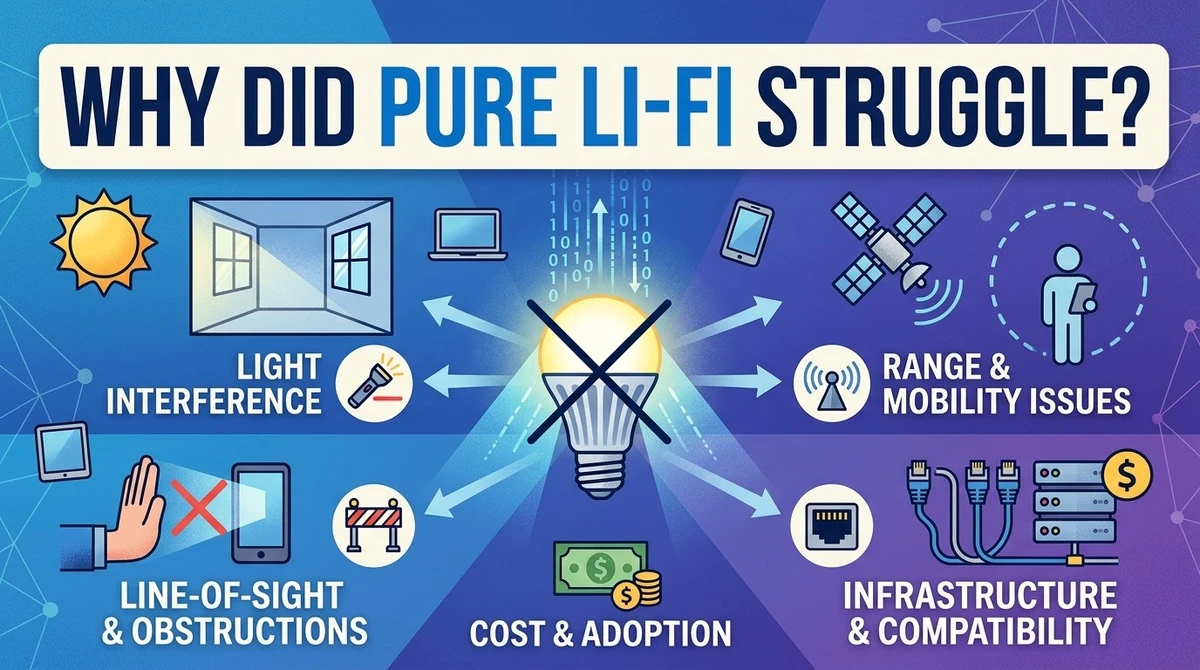
Why Did pure Li-Fi Struggle?
A technology can work exactly as its inventors intended and still struggle to become a successful business.
pureLiFi is a useful example.
The Edinburgh-based company was founded in 2012 as a spinout from the University of Edinburgh to commercialize Li-Fi, a wireless technology that transmits data using light rather than conventional radio frequencies. Over the years, pureLiFi developed products, built intellectual property, generated revenue, and attracted more than £35 million in funding.
But on August 31, 2026, the company ceased trading and entered administration, with BTG Begbies Traynor appointed as administrators. All 42 employees were made redundant. (pureLiFi)
The interesting question is not simply why the company failed.
It is why turning a technically promising technology into a scalable business proved so difficult.
pureLiFi’s story shows the gap that can exist between technological innovation and commercial success. It also demonstrates why having a good product is only one part of building a sustainable technology company.
Li-Fi Had a Real Commercial Opportunity
Li-Fi was never just a laboratory experiment.
The basic concept is relatively straightforward: instead of transmitting wireless data primarily through radio waves, Li-Fi uses rapidly modulated light to transmit information.
That approach offers some characteristics that conventional Wi-Fi cannot easily reproduce.
Light can provide highly localized connectivity. It does not normally pass through opaque walls in the same way radio signals do, which can make it useful in environments where signal containment or security matters. It can also provide another option in environments where radio-frequency spectrum is crowded.
pureLiFi pursued these potential advantages across commercial, industrial, and defense applications.
The company promoted products such as its Light Antenna ONE and Kitefin systems and highlighted applications involving secure communications and specialized environments. Its own website continues to describe Li-Fi as a technology for applications ranging from defense to broadband and device integration. (pureLiFi)
So the problem was not that there was no technological value.
The harder problem was turning that value into a sufficiently large and profitable market.
Wi-Fi Had Something Li-Fi Did Not: An Ecosystem
This is probably the most important part of the case.
A new wireless technology does not compete only against another technology. It competes against an existing ecosystem.
Wi-Fi already has an enormous installed base of compatible devices, chips, routers, software, standards, testing systems, manufacturers, installers, and consumers.
IEEE presentations on light communications have explicitly highlighted the strength of the existing Wi-Fi ecosystem as a barrier for alternative wireless technologies trying to achieve mass-market adoption. (Grouper)
That creates a difficult starting point for Li-Fi.
A consumer buying a laptop does not need to ask whether Wi-Fi infrastructure exists. It already does.
A company upgrading its office network does not need to build a completely new ecosystem around Wi-Fi.
Li-Fi therefore faced a different commercial challenge.
It did not simply need to demonstrate that light could carry data. It needed to convince manufacturers, network operators, businesses, and consumers that adding Li-Fi to their systems created enough additional value to justify the cost and complexity.
That is a much higher hurdle.
This is one reason the pureLiFi case connects closely with the economics of technology adoption. As discussed in Economic Reader’s How Technology Changes the Economy, technological innovation can create new capabilities without immediately producing broad economic benefits. Adoption, complementary investment, infrastructure, and business incentives determine how far an innovation actually spreads.
The Hardware Problem
Another challenge was hardware integration.
Wi-Fi is already built into smartphones, laptops, tablets, televisions, industrial equipment, and countless other connected products.
Li-Fi requires compatible optical hardware.
That means a manufacturer considering Li-Fi has to think about components, device design, software, power requirements, testing, supply chains, and customer demand.
The technology therefore faces a classic chicken-and-egg problem.
Device manufacturers may hesitate to add Li-Fi hardware when few customers demand it.
Customers may hesitate to adopt Li-Fi when relatively few devices support it.
And network providers may hesitate to deploy infrastructure when the compatible device market is still small.
pureLiFi tried to address this problem directly. Its Light Antenna ONE was designed as a module that could be integrated into other devices, potentially reducing some of the difficulty for manufacturers.
But developing an integration-ready component is not the same as getting millions of devices to ship with it.
That difference between technical readiness and market adoption is central to the story.
Deployment Economics Made the Challenge More Complicated
Li-Fi’s use of light creates both opportunities and constraints.
Its localized nature can be useful. A signal that is confined to a particular area can potentially provide greater control over where connectivity is available.
But the same characteristic can complicate large-scale deployment.
Traditional Wi-Fi radio signals can cover relatively broad areas and pass through some physical barriers. Li-Fi generally requires a more direct optical path, depending on the implementation.
That can mean more carefully positioned equipment in some environments.
For a customer, the question is therefore not simply:
Can Li-Fi deliver fast wireless connectivity?
It is:
How much will it cost to provide the required coverage, and what additional value will the customer receive?
That is a business question rather than an engineering question.
A technology can deliver impressive technical performance and still lose a commercial comparison if deployment is too expensive or complicated for the intended customer.
Standardization Was Progress, But Not a Guaranteed Market
Li-Fi did eventually make an important step toward broader interoperability.
IEEE 802.11bb-2023 was published in November 2023 as an amendment covering light communications within the IEEE 802.11 family. The standard specifies operation in the 800–1000 nanometer range and bidirectional throughput from 10 Mb/s to 9.6 Gb/s at the specified MAC service access point. (IEEE Standards Association)
That was significant.
A recognized standard can reduce uncertainty for manufacturers and customers. It can also make interoperability easier and give companies a common technical foundation on which to build products.
But standardization does not automatically create demand.
A standard cannot force smartphone manufacturers to add Li-Fi hardware.
It cannot make businesses redesign their wireless infrastructure.
And it cannot guarantee that consumers will pay for the resulting products.
In other words, standards can remove a barrier to adoption without creating adoption by themselves.
That distinction is important when evaluating pureLiFi’s story.
The Market Was Real, But Scaling It Was Difficult
pureLiFi was not operating without customers or products.
BusinessCloud reported that the company had developed products and generated revenue from its proprietary wireless technology. Yet that revenue was not enough to move the company into profitability before its cash ran out. (BusinessCloud)
This highlights another common deep-tech problem.
A company can have:
- functioning technology,
- paying customers,
- intellectual property,
- commercial products,
- and significant investor support,
while still being unable to reach sustainable profitability.
That can happen when the market develops more slowly than expected or when the cost of reaching scale remains too high.
For a hardware-heavy technology company, the path from early customers to mass production can be particularly expensive.
And that appears to have become an important issue for pureLiFi.
The Business Model Shift Changed the Economics
According to BTG managing partner Thomas McKay, pureLiFi’s strategic shift from licensing its patented technology to third-party manufacturers toward manufacturing its own hardware was more costly than initially anticipated. By the end of the second quarter of 2026, the company had run out of cash flow and was seeking additional investment to cover losses while it attempted to reach profitability. (BusinessCloud)
This is one of the clearest business lessons from the case.
Licensing intellectual property and manufacturing physical products are very different business models.
A licensing model can allow a technology company to monetize its intellectual property without carrying the full operational burden of manufacturing.
Manufacturing can potentially generate greater control over the product and a larger share of revenue, but it also introduces additional costs.
Those can include:
- manufacturing capacity,
- inventory,
- supply-chain management,
- quality control,
- working capital,
- production equipment,
- logistics,
- and customer support.
The change can therefore increase the amount of capital a company needs before it becomes profitable.
This is closely connected to what a business model actually does: it links the value a company creates with its customers, revenue streams, costs, resources, and operations. A change in one part of that system can materially change the economics of the entire business.
Funding Can Buy Time, But Not Unlimited Time
pureLiFi had attracted substantial financial backing.
BusinessCloud reported that the company had raised about £35 million from investors including Scottish Enterprise and the Scottish National Investment Bank. The Times reported that £15 million had been provided by the Scottish National Investment Bank, of which £14.7 million had been drawn down. (BusinessCloud)
That level of funding allowed the company to continue developing its technology and pursuing commercial opportunities for years.
But funding does not remove the underlying requirement for a sustainable business model.
If a company continues to spend more cash than it generates, it eventually needs one of three things:
- substantially higher revenue,
- lower costs,
- or additional capital.
For a venture-backed deep-tech company, timing becomes critical.
If the company is close to commercial scale, new investment may provide the bridge it needs.
If investors become unwilling to provide more capital before profitability is reached, the company can run out of options even if the underlying technology still has potential.
That appears to be what happened to pureLiFi.
What Happened to pureLiFi in 2026?
On August 31, 2026, pureLiFi ceased trading and entered administration, with BTG Begbies Traynor appointed as administrators. All 42 employees were made redundant. (pureLiFi)
BTG said the company had received significant investment, created products, and generated revenue, but ultimately ran out of money before reaching profitability.
The administrators also said the move into manufacturing had been more expensive than expected and that efforts to secure additional investment were unsuccessful. Their immediate priority included realizing value from the company’s assets, particularly its intellectual property. (BusinessCloud)
That sequence matters.
The company did not simply disappear because its technology stopped working.
The available evidence points instead to a commercial and financial failure to reach sustainable scale before available cash was exhausted.
That is a much more useful way to understand the case.
Did Li-Fi Actually Fail?
This is where the distinction becomes essential.
pureLiFi failed as a company. That does not mean Li-Fi failed as a technology.
IEEE 802.11bb exists as a formal standard for light communications, and the technology continues to be developed and explored for specialized applications. (IEEE Standards Association)
The collapse of one company therefore cannot be used as evidence that every Li-Fi business model is impossible or that the underlying technology has no future.
Technology markets often continue after individual companies disappear.
A company’s intellectual property can be acquired. Engineers can move to other firms. Research can continue. New applications can emerge. Different business models can be tested.
The more defensible conclusion is narrower:
pureLiFi struggled to commercialize Li-Fi at a scale and cost structure that could support a sustainable standalone business.
That is different from saying Li-Fi itself was a failed technology.
What Businesses Can Learn From the pureLiFi Case
The first lesson is that technical innovation and commercial innovation are different problems.
Building something that works is only the beginning.
The second is that ecosystems can be more powerful than individual product advantages.
A new technology may be technically attractive, but customers also care about compatibility, availability, installation, support, and the products they already own.
The third lesson is that business-model changes can dramatically alter a company’s capital requirements.
pureLiFi’s move from licensing technology toward manufacturing its own hardware created additional costs that, according to its administrators, were higher than expected. (BusinessCloud)
The fourth is that market timing matters.
A technology may be ready before customers are ready to change their existing systems.
And the fifth is perhaps the most important:
A company can run out of money before its technology runs out of potential.
That is a fundamental reality of deep-tech businesses.
The Difference Between Innovation and Commercialization
The pureLiFi story is ultimately bigger than Li-Fi.
It illustrates the difficult path between invention and a sustainable business.
The journey looks something like this:
Technology → Product → Ecosystem → Customers → Revenue → Scale → Profitability
A company can make significant progress through the first several stages and still fail to complete the final steps.
pureLiFi developed proprietary technology, created products, attracted substantial investment, generated revenue, and contributed to the broader development of Li-Fi. But it ultimately ran out of cash before reaching profitability, according to its administrators. (BusinessCloud)
That makes the case valuable for business readers.
The most important question for a new technology is not simply:
Can it work?
It is:
Can enough customers adopt it, at a price that covers the cost of producing and delivering it, quickly enough for the company to survive and scale?
Those are very different questions.
pureLiFi’s experience shows why a technically promising innovation can struggle when ecosystem effects, hardware costs, deployment economics, customer adoption, and funding requirements all interact.
Li-Fi may continue to evolve without pureLiFi.
But the company’s collapse provides a broader business lesson: successful commercialization requires more than a strong invention. The technology, market, ecosystem, cost structure, business model, and timing all have to work together.