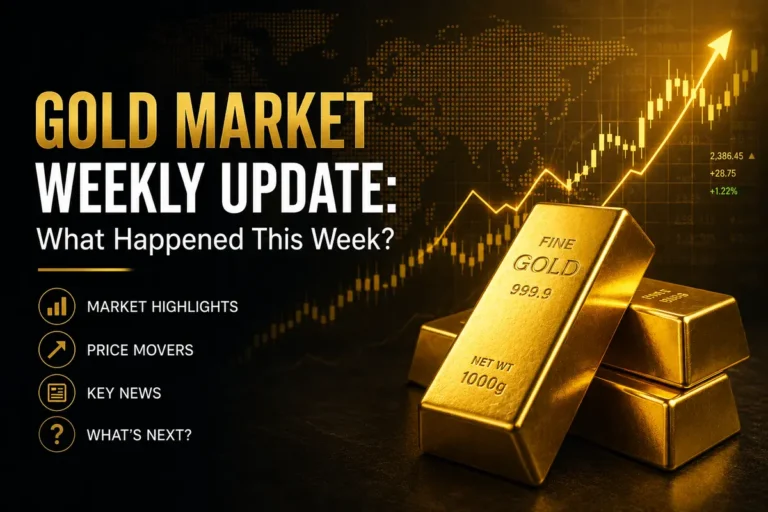
Gold Market Weekly Update: What Happened This Week? (July 20 – 24, 2026)
Gold Market Weekly Update: Key Highlights
The gold market experienced a volatile week from July 20 to July 24, 2026, recovering from mid-week selling pressure and ending the week slightly higher.
Gold prices moved sharply throughout the week as investors reacted to changes in Federal Reserve interest rate expectations, US dollar movements, and global economic uncertainty.
The week started with strong momentum as gold moved higher, reaching above the $4,100 per ounce level during the middle of the week. However, prices faced a sharp decline on July 23 as investors adjusted their positions.
Despite the temporary decline, buyers returned to the market, creating a recovery before Friday’s close.
By the end of the week, gold remained above the important $4,000 per ounce level, showing that investor demand for gold remained strong.
For beginner investors, this week provided an important lesson:
Gold does not always move in one direction. Even during a strong long-term trend, short-term corrections and recoveries are normal parts of the market cycle.
Gold Market Snapshot: July 20 – 24, 2026
| Market Indicator | Performance |
| Spot Gold (Friday Close) | $4,052.78 per ounce (Approx.) |
| COMEX Gold Futures (August Close) | $4,070.80 per ounce (Approx.) |
| Weekly Trend | Slightly Positive after Recovery |
| Market Sentiment | Volatile but supported |
Gold recovered after experiencing selling pressure during the week. Although prices did not continue moving higher every day, the market showed strong support near lower price levels.
Gold Price Movement During the Week
| Date | Gold Price Movement (Approx.) |
| July 20 | $4,006 close |
| July 21 | $4,078 close |
| July 22 | $4,131 close |
| July 23 | $4,049 close |
| July 24 | $4,053 close |
Gold showed a strong rise during the first half of the week before experiencing a sharp pullback on July 23.
However, the decline attracted buyers who viewed lower prices as an opportunity to enter the market.
This helped gold stabilize and finish the week near the $4,050 level.
Key Takeaways from This Week
- Gold experienced a volatile trading week.
- Prices reached above the $4,100 level before declining.
- Buyers returned after the mid-week sell-off.
- Gold ended the week above $4,000 per ounce.
- US dollar movements and Treasury yields limited stronger gains.
- Investors continued watching Federal Reserve policy expectations.
How Did Gold Perform This Week?
Gold started the week with positive momentum as investors continued looking for protection against economic uncertainty.
During the middle of the week, gold prices moved higher and reached around the $4,130 level.
However, the market changed direction on July 23.
A stronger US dollar, changes in interest rate expectations, and profit-taking from some investors created selling pressure.
This caused gold prices to fall sharply from their weekly highs.
However, the decline did not continue for long.
Investors returned to the market, creating buying pressure near lower levels.
By Friday, gold recovered and closed nearby:
$4,052.78 per ounce
The weekly movement showed that gold remained supported, but investors were still cautious.
Why Did Gold Prices Move This Week?
1. Federal Reserve Interest Rate Expectations
Interest rates remain one of the biggest factors affecting gold prices.
Gold does not pay interest like bonds or savings accounts.
Therefore, when investors expect lower interest rates, gold often becomes more attractive.
For example:
If investors can earn higher returns from interest-paying assets, some may reduce their gold exposure.
But if interest rates are expected to decline, gold demand can increase because the opportunity cost of holding gold becomes lower.
2. US Dollar Movements Affected Gold
Gold prices are internationally measured in US dollars.
Because of this, changes in the dollar can influence gold demand.
When the dollar becomes stronger:
- Gold becomes more expensive for international buyers.
- Demand can weaken.
When the dollar weakens:
- Gold becomes cheaper for buyers using other currencies.
- Demand can increase.
During this week, dollar movements limited gold’s ability to move higher.
3. Dip Buying Supported Recovery
One of the biggest stories of the week was the recovery after the sharp decline.
Many investors considered the lower prices attractive and increased buying activity.
This is known as dip buying.
A simple example:
Imagine a product that normally costs $100.
If the price temporarily falls to $85, some customers may see it as a buying opportunity.
Gold investors often behave similarly when they believe the long-term value remains strong.
4. Safe Haven Demand Continued
Gold has historically been viewed as a safe-haven asset.
During periods of uncertainty, investors often increase exposure to gold because they see it as a store of value.
Factors supporting safe-haven demand included:
- Global economic uncertainty
- Geopolitical risks
- Market volatility
How Do Gold Prices Affect Everyday Life?
Many people think gold only matters to investors.
However, gold prices influence several areas of the economy.
Higher gold prices can affect:
- Jewelry prices
- Mining companies
- Investment products
- Central bank reserves
For example, when gold prices rise significantly, jewelry manufacturers may face higher production costs, which can eventually affect retail prices.
What Does This Mean for Beginner Gold Investors?
1. Gold Is Not a Guaranteed Profit Asset
Although gold is considered a defensive investment, prices can still move up and down.
Investors should understand that gold can experience:
- Strong rallies
- Short-term corrections
- Periods of sideways movement
2. Long Term Thinking Is Important
Many investors use gold as part of a diversified portfolio rather than focusing only on short-term price movements.
The purpose of gold is often wealth preservation rather than quick gains.
3. Understanding Market Drivers Matters
Instead of only watching whether gold goes up or down, investors should understand:
- Interest rates
- Inflation
- Currency movements
- Global events
These factors often explain why gold prices change.
Important Factors to Watch Next Week
1.Federal Reserve Policy
Investors will continue monitoring signals about future interest rate decisions.
2.US Dollar Strength
Dollar movements may influence gold demand.
3.Inflation Data
New inflation reports could change market expectations.
4.Global Events
Geopolitical developments may continue affecting safe-haven demand.
Gold Market Outlook
The short-term outlook for gold remains closely connected to interest rate expectations and global uncertainty.
Positive Factors:
- Strong demand for safe-haven assets
- Continued investor interest
- Inflation concerns
- Global economic uncertainty
Risks:
- Stronger US dollar
- Higher interest rates
- Profit-taking after recent gains
Gold remains one of the most closely watched commodities in global financial markets.
Frequently Asked Questions (FAQ)
1.Why did gold fall on July 23, 2026?
Gold declined because of market adjustments, stronger dollar movements, and investors taking profits after earlier gains.
2.Did gold have a negative week?
No. Gold experienced volatility but recovered and ended the week slightly higher.
3.Why do investors buy gold during uncertain times?
Many investors view gold as a store of value and a defensive asset during periods of uncertainty.
4.Does a stronger dollar hurt gold prices?
Yes. A stronger US dollar can make gold more expensive for international buyers, which can reduce demand.
5.Is gold a good investment for beginners?
Gold can be part of a diversified portfolio, but investors should understand the risks and consider their own financial goals.
Final Thoughts
The Gold market experienced a volatile but slightly positive week from July 20 – 24, 2026.
Gold Market recovered after a sharp mid-week decline and ended the week near $4,052.78 per ounce.
The main lesson from this week is:
Gold market can remain strong even when prices experience short-term declines. Understanding why prices move is more important than focusing only on daily changes.
For beginner investors, learning how interest rates, currencies, and global uncertainty influence gold prices can help build a better understanding of the precious metals market.
Click here to view last week Gold market update
Author Note: This article is crafted by “The Economic Reader editorial team”, dedicated to analyzing the latest market trends, financial updates, and global economic shifts to keep you informed with accurate and comprehensive insights.
Disclaimer: The information provided on this website is for educational and informational purposes only and should not be construed as professional financial, investment, or legal advice. Always consult with a certified financial advisor or professional before making any financial decisions based on this content.