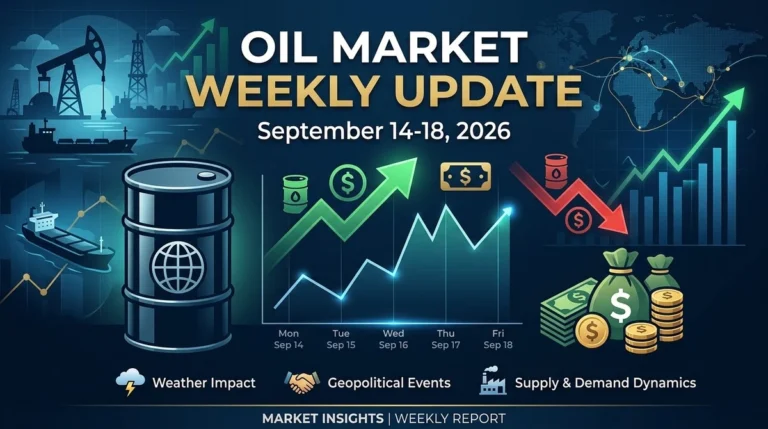

Oil Market Weekly Update: What Happened This Week? (August 3–7, 2026)
Oil Market Weekly Update: Market Overview
The Oil Market Weekly Update for August 3–7, 2026, highlights another highly volatile week for global crude markets. Oil prices experienced a sharp sell-off at the beginning of the week as investors reacted to renewed hopes of a diplomatic resolution to the U.S.-Iran conflict. However, those hopes weakened as uncertainty surrounding the Strait of Hormuz continued, allowing crude prices to recover later in the week.
On Monday, Brent crude fell about 7% to around $83.77 per barrel, while U.S. West Texas Intermediate (WTI) dropped to approximately $80.34 per barrel. The decline followed the decision by U.S. President Donald Trump to cancel a planned attack on Iran in favor of pursuing a possible diplomatic solution.
The market then reversed part of that decline during the rest of the week. On Thursday, concerns that Iran could restrict shipping through the Strait of Hormuz pushed Brent to $82.49 and WTI to $77.29.
By Friday, Brent had gained more than $1 and settled at $83.55 per barrel, while WTI rose 89 cents to $78.18.
The result was a market driven less by traditional supply-and-demand fundamentals and more by geopolitical risk, shipping disruption, and uncertainty over the future of the U.S.-Iran conflict.
Oil Market Snapshot (August 3–7, 2026)
| Market Indicator | Weekly Data |
| Brent – August 3 Close | $83.77/bbl |
| Brent – August 7 Close | $83.55/bbl |
| WTI – August 3 Close | $80.34/bbl |
| WTI – August 7 Close | $78.18/bbl |
| Brent Weekly Change | ≈ -0.3% |
| WTI Weekly Change | ≈ -2.7% |
| Thursday Brent Level | $82.49/bbl |
| Thursday WTI Level | $77.29/bbl |
| Weekly Trend | Highly Volatile / Mixed |
| Main Driver | U.S.-Iran conflict and Strait of Hormuz uncertainty |
| Market Sentiment | Cautious / Geopolitically Sensitive |
The Oil Market Weekly Update data shows an important distinction between the two major benchmarks.
Brent ended the week close to where it began after recovering from Monday’s sharp decline. WTI, however, remained lower than Monday’s settlement.
The headline weekly change therefore does not fully capture what happened during the week. The more important story was the large intraday and day-to-day volatility created by changing expectations about the possibility of a U.S.-Iran agreement and the future reopening of the Strait of Hormuz.
Weekly Price Action Summary
Monday: Sharp Oil Price Collapse
The week began with one of the largest moves in the recent oil market.
Brent fell approximately 7% to $83.77, while WTI dropped around 5.1% to $80.34.
The main reason was a sudden reduction in geopolitical risk.
Trump’s decision to cancel a planned attack on Iran raised hopes that negotiations could eventually lead to a reopening of important oil-shipping routes.
However, Iran denied that formal negotiations were taking place, meaning the market’s initial reaction may have been stronger than the underlying diplomatic evidence justified.
Tuesday–Wednesday: Volatility Remains Elevated
Oil markets remained sensitive to every new development surrounding the conflict.
Investors attempted to determine whether diplomatic progress could actually result in a sustained reopening of major shipping routes.
This created a difficult trading environment.
The market was essentially balancing two opposing scenarios:
Peace agreement → more oil supply → lower prices
versus
Conflict continues → shipping disruption → higher prices
That tension kept crude prices highly volatile.
Thursday: Hormuz Risk Returns
The market’s attention shifted back toward the Strait of Hormuz on Thursday.
Reports that Iran was considering restrictions affecting U.S., Israeli and other vessels increased concerns about global energy transportation.
Brent rose approximately 3.83% to $82.49, while WTI climbed about 2.75% to $77.29.
This rebound demonstrated how quickly geopolitical risk could reverse the previous week’s price direction.
Friday: Oil Recovers Further
Friday brought another positive session for crude.
Brent rose more than $1 and settled at $83.55 per barrel, a gain of approximately 1.3%.
WTI gained 89 cents and closed at $78.18 per barrel.
The market remained focused on uncertainty over whether the Strait of Hormuz could eventually reopen fully and under what conditions.
Market Sentiment Analysis
The Oil Market Weekly Update shows that sentiment remained cautious and highly dependent on geopolitical headlines.
Unlike a normal supply-and-demand driven market, traders were reacting rapidly to diplomatic statements, shipping developments, and potential changes in regional oil flows.
Bullish Factors
- Continued uncertainty around the Strait of Hormuz
- Risk of further shipping disruption
- Reduced Gulf oil exports
- Ongoing geopolitical conflict
- Tight physical oil markets
Bearish Factors
- Hopes for a U.S.-Iran agreement
- Potential reopening of shipping routes
- Possible increase in available oil supply
- OPEC+ production increases
- Concerns about global economic demand
This created a two-sided market, with neither bullish nor bearish forces able to maintain control for long.
Technical Market Analysis
Oil’s technical structure remained highly volatile.
Brent Crude
Brent found renewed buying interest after falling toward the low-$80s.
Key Resistance
$85–$87 per barrel
A sustained move above this zone could indicate that geopolitical risk is once again being priced aggressively into crude.
Key Support
$80–$82 per barrel
This region became an important short-term support area following the early-week sell-off.
A sustained break below $80 could indicate that traders are placing greater confidence in a diplomatic resolution.
WTI Crude
WTI ended Friday at $78.18 per barrel.
Key Resistance
$80–$82
A move back above $80 would strengthen the short-term recovery structure.
Key Support
$75–$77
This zone is important because WTI traded around $77.29 on Thursday before recovering.
Why Did Oil Prices Move This Week?
1. U.S.-Iran Diplomatic Developments
The biggest driver was the changing probability of a diplomatic solution to the U.S.-Iran conflict.
On Monday, oil prices dropped sharply after Trump canceled a planned attack on Iran and indicated an interest in pursuing negotiations.
However, Iran disputed the idea that formal talks were already underway.
That uncertainty prevented oil prices from continuing their initial decline.
2. Strait of Hormuz Risk
The Strait of Hormuz remained the most important geopolitical factor for oil markets.
Any restrictions on shipping through the waterway can create a significant risk premium because of its importance to global energy transportation.
On Thursday, reports concerning possible restrictions on certain vessels helped push oil prices sharply higher.
By Friday, uncertainty remained over the conditions required for commercial shipping to resume normally.
3. Global Oil Supply
Supply concerns remained elevated.
Goldman Sachs said global visible oil inventories had recently fallen significantly, while Gulf exports remained well below pre-conflict levels.
This means that even if diplomatic progress lowers the geopolitical risk premium, the physical supply situation could still provide some support for prices.
4. OPEC+ Production
OPEC+ also remained an important factor.
The group had announced a modest production increase for September, but actual supply availability remained constrained by the broader geopolitical situation and transportation disruptions.
For traders, this creates an important distinction between official production capacity and oil that can actually reach global consumers.
Institutional Flow Analysis
Institutional investors are closely monitoring the balance between geopolitical risk and potential supply normalization.
The major questions include:
- Will the Strait of Hormuz reopen fully?
- Will Gulf exports recover?
- Will OPEC+ continue increasing production?
- Will global inventories remain tight?
- Will the U.S.-Iran conflict continue?
- How quickly can disrupted supply return?
Goldman Sachs expects Brent to remain around the $80–$90 range until there is either a confirmed U.S.-Iran agreement or a major escalation in the conflict.
Citi also raised its third-quarter 2026 Brent forecast to $80 per barrel from $75, citing the prolonged uncertainty surrounding the conflict.
These forecasts highlight how geopolitical developments remain central to institutional oil-market positioning.
How Does This Affect Investors?
The Oil Market Weekly Update demonstrates why crude oil can be particularly difficult to trade during geopolitical crises.
Oil Can Move Before Physical Supply Changes
Prices often react to expectations.
If traders believe a major shipping route will reopen, prices can fall before additional barrels actually reach the market.
Likewise, if traders believe the route could close further, prices can rise before physical supply is materially reduced.
Energy Stocks Can Also Be Affected
Higher oil prices can support the revenue outlook for many exploration and production companies.
However, higher energy costs can negatively affect:
- Airlines
- Transportation companies
- Manufacturers
- Chemical producers
- Consumer businesses
Therefore, oil-price movements can influence the broader economy and stock market.
Biggest Market Stories This Week
Oil Falls Sharply on Monday
Brent fell around 7% after hopes of a diplomatic solution reduced the immediate geopolitical risk premium.
Hormuz Uncertainty Reverses Part of the Decline
Concerns over shipping restrictions helped crude recover later in the week.
Brent Ends at $83.55
Brent gained more than $1 on Friday and settled at $83.55 per barrel.
WTI Ends at $78.18
WTI rose 89 cents Friday to close at $78.18.
Forecasts Remain Geopolitically Sensitive
Goldman Sachs expects Brent to remain within approximately $80–$90 until there is clearer evidence of either a U.S.-Iran agreement or major escalation.
Key Risks Ahead
1. Strait of Hormuz Disruption
Any further restrictions on shipping could rapidly push oil prices higher.
2. Diplomatic Breakthrough
A genuine U.S.-Iran agreement could remove a significant geopolitical premium and cause oil prices to fall sharply.
3. OPEC+ Supply Growth
Higher production could put downward pressure on crude if geopolitical disruptions ease.
4. Global Economic Demand
A weaker global economy could reduce demand for oil and pressure prices.
5. Extreme Volatility
The biggest short-term risk may simply be the speed of price movements.
Oil traders are reacting to geopolitical headlines almost immediately, making sudden multi-dollar moves possible.
Oil Market Outlook
Short-Term Outlook
The Oil Market Weekly Update points to a volatile and headline-driven market rather than a clear one-directional trend.
Brent’s ability to remain above the $80 area is important.
If diplomatic negotiations make meaningful progress and shipping restrictions ease, crude could face renewed selling pressure.
On the other hand, any escalation around the Strait of Hormuz could quickly restore a significant geopolitical risk premium.
Medium-Term Outlook
The medium-term outlook depends on whether the current supply disruption becomes temporary or prolonged.
Bearish Scenario
If:
- U.S.-Iran negotiations succeed
- Strait of Hormuz traffic normalizes
- Gulf exports recover
- OPEC+ production increases
then oil prices could move lower.
Bullish Scenario
If:
- Conflict continues
- Shipping restrictions remain
- Gulf exports stay depressed
- Physical inventories tighten further
then oil prices could move back toward the upper end of the recent trading range.
The market therefore remains heavily dependent on geopolitical developments.
Frequently Asked Questions (FAQ)
1. Why did oil prices fall sharply on August 3, 2026?
Oil prices fell sharply because hopes for a diplomatic solution to the U.S.-Iran conflict reduced immediate fears of further supply disruption. Brent fell about 7%, while WTI dropped about 5.1% on Monday.
2. What was Brent crude’s closing price on August 7?
Brent crude settled at approximately $83.55 per barrel on Friday, August 7, 2026.
3. What was WTI crude’s closing price on August 7?
U.S. WTI crude settled at approximately $78.18 per barrel on August 7.
4. Why is the Strait of Hormuz important for oil prices?
The Strait of Hormuz is a critical energy-shipping route. Any significant disruption can reduce the amount of oil reaching international markets and increase the geopolitical risk premium in crude prices.
5. Will oil prices rise or fall next week?
The direction will largely depend on developments surrounding the U.S.-Iran conflict and the Strait of Hormuz. A credible diplomatic breakthrough could pressure prices lower, while renewed disruption could push them higher.
Final Thoughts
The Oil Market Weekly Update for August 3–7, 2026, demonstrates just how quickly crude oil prices can change when geopolitical expectations shift.
Brent crude began the week with a sharp decline toward $83.77 per barrel as investors reacted to hopes of a diplomatic solution. WTI similarly fell toward $80.34.
But the market quickly regained some of its lost ground as uncertainty surrounding the Strait of Hormuz returned.
By Friday, Brent had recovered to $83.55, while WTI closed at $78.18.
The most important lesson from this week’s market action is that oil prices are currently being driven by a combination of geopolitical risk, physical supply constraints, shipping conditions, OPEC+ policy, and expectations for diplomatic developments.
For investors and businesses, the next major catalyst will be whether the U.S.-Iran conflict moves toward a genuine resolution or remains unresolved.
Until that becomes clearer, the oil market is likely to remain highly volatile, headline-sensitive, and difficult to predict with confidence.
Read last week’s Oil Market Weekly Update
Author Note: This article is crafted by “The Economic Reader editorial team”, dedicated to analyzing the latest market trends, financial updates, and global economic shifts to keep you informed with accurate and comprehensive insights.
Disclaimer: The information provided on this website is for educational and informational purposes only and should not be construed as professional financial, investment, or legal advice. Always consult with a certified financial advisor or professional before making any financial decisions based on this content.