Gold Market Weekly Update: August 24-28, 2026. What Happened This Week?
Gold Market Weekly Update: August 24-28, 2026
Gold had a week of two very different stories.
The precious metal started with strong momentum, climbing to a more than three month high as investors responded to a weaker U.S. dollar, Treasury market developments and expectations surrounding Federal Reserve policy.
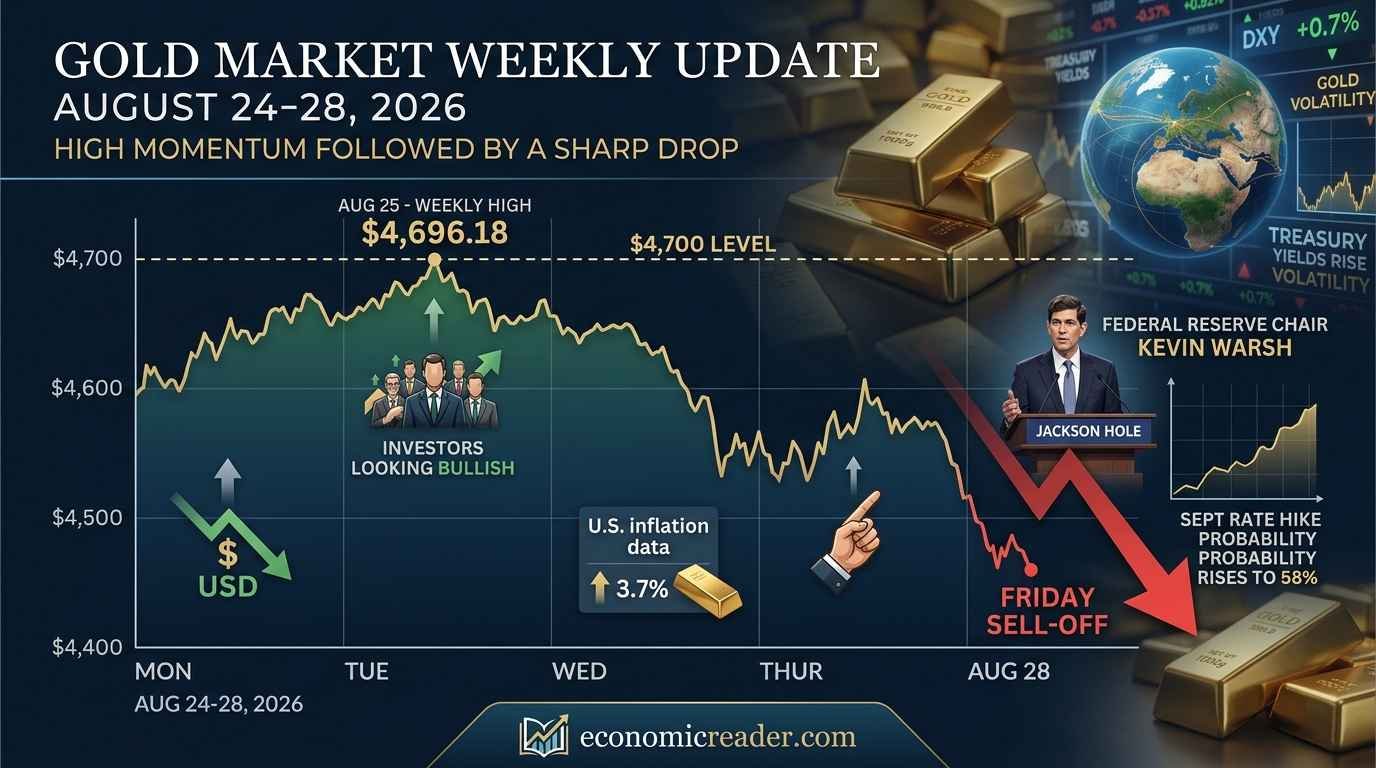
By Tuesday, spot gold had reached $4,696.18 an ounce, putting the metal within striking distance of the important $4,700 level.
Then the mood changed.
U.S. inflation data remained above the Federal Reserve’s 2% target, and Federal Reserve Chair Kevin Warsh’s Jackson Hole comments later in the week pushed investors toward a more cautious view of interest rates.
Spot gold fell sharply on Friday, ending the week around 2.9% lower. September gold futures declined more than spot gold over the week, highlighting why the two measures should not be treated as identical.
The bigger story was not simply that gold finished lower.
Gold started the week looking like a market ready to break higher. It ended the week facing a much tougher interest rate environment.
Gold Starts the Week With Strong Momentum
Gold entered August 24 with a favorable combination of market forces.
Spot gold rose about 0.8% to $4,639.49 an ounce on Monday, reaching its highest level in more than three months. (Reuters)
The U.S. dollar was relatively soft, while investors were also watching developments in the Treasury market and the outlook for monetary policy.
Gold had already been showing renewed strength during August. The previous weekly update also highlighted how the metal had recovered from temporary selling pressure and remained above important price levels. Gold Market Weekly Update: July 20-24, 2026
The early week rally therefore looked like an extension of an existing recovery rather than an isolated one day move.
For investors, the combination of a weaker dollar and expectations around future interest rates was particularly important.
Gold does not pay interest, so its attractiveness often changes when investors reassess the returns available from cash and bonds.
Tuesday Takes Gold Near $4,700
The rally continued into Tuesday.
Spot gold climbed to approximately $4,696.18 an ounce, its highest level since mid May. The move brought the metal very close to the psychologically important $4,700 threshold. (Reuters)
That level became an important reference point for the rest of the week.
Gold had already risen significantly, and traders were beginning to consider whether the market had enough momentum to push decisively above $4,700.
Instead, investors began taking a more cautious approach.
The market was waiting for two important developments:
- U.S. inflation data
- Kevin Warsh’s Jackson Hole speech
Both had the potential to change expectations about Federal Reserve policy.
That made Tuesday’s high more than just another daily price point.
It became the week’s peak.
Inflation Gives Gold a New Headwind
Wednesday brought an important economic test.
The U.S. Personal Consumption Expenditures Price Index rose 3.7% year over year through July, slightly above the 3.6% forecast in a Reuters poll. (Reuters)
The number was not dramatically above expectations, but it reinforced a concern that inflation was still running well above the Federal Reserve’s 2% objective.
That matters for gold because inflation and interest rates can affect the metal in opposite ways.
Higher inflation can increase demand for assets such as gold as investors look for protection against declining purchasing power. But if persistent inflation causes the Federal Reserve to maintain or increase interest rates, higher yields can make non yielding gold less attractive.
This relationship is explained in more detail in Economic Reader’s What Is Inflation?.
The market reaction was relatively quick.
Spot gold fell about 1.3% to $4,595.93 on Wednesday, while the U.S. dollar strengthened.
Traders also increased the probability of a September rate hike from roughly 36% to around 40%.
The pressure on gold was beginning to build.
Thursday Offers a Temporary Recovery
Gold did not continue falling at the same pace on Thursday.
Spot gold recovered around 0.4% to $4,607.90, helped partly by a weaker dollar as investors waited for Warsh’s speech. (Reuters)
The move was relatively small, but it was significant because it showed that buyers were still willing to enter the market after the previous day’s decline.
The bullish case for gold had not disappeared.
Investors were simply waiting for a clearer signal about the direction of monetary policy.
That signal arrived on Friday.
Friday Completely Changes the Tone
Friday became the defining session of the week.
Federal Reserve Chair Kevin Warsh used his Jackson Hole speech to emphasize the importance of controlling inflation and indicated that the Federal Reserve still had work to do if underlying inflation was not moving convincingly toward its 2% objective.
Markets reacted strongly.
According to Reuters, the probability of a September rate hike increased to about 58%, from approximately 36% before Warsh’s comments. (Reuters)
The U.S. dollar also strengthened.
Both developments were negative for gold.
Spot gold fell 2.9% to approximately $4,567.23 an ounce, its lowest level since August 20.
The decline erased much of the week’s earlier advance and left spot gold approximately 2.9% lower for the week. (Reuters)
The reaction showed how sensitive gold remains to changes in interest rate expectations.
For investors who want a broader explanation of why the Fed has such an influence on financial markets, Economic Reader’s What Is the Federal Reserve? provides useful background.
Spot Gold and Gold Futures Tell Different Stories
One important detail from this week’s market data is the difference between spot gold and futures.
Spot gold represents the price of gold for immediate delivery and is commonly used to describe the underlying bullion market.
Gold futures are exchange traded contracts for future delivery. Their prices can differ from spot prices because of interest rates, financing costs, market positioning and other factors.
That distinction matters this week.
Spot gold declined approximately 2.9% over the week.
September gold futures, meanwhile, fell approximately 3.25%, ending the week around $4,478.10.
Both measures showed a weak week, but they were not identical.
For this article, spot gold is used as the primary measure when discussing the main price story, while futures are clearly identified separately.
That keeps the weekly performance data consistent instead of mixing different benchmarks.
The U.S. Dollar Becomes a Bigger Problem
The dollar was one of gold’s biggest supporting factors early in the week.
When the U.S. dollar weakens, gold can become relatively cheaper for investors using other currencies. That can help support international demand.
By Friday, however, the relationship reversed.
The dollar strengthened as investors reassessed the likelihood of higher U.S. interest rates.
That created another headwind for gold.
A stronger dollar can make dollar denominated bullion more expensive for international buyers, while higher interest rates increase the opportunity cost of holding an asset that does not generate interest income.
This is why gold investors often watch the dollar and Treasury yields almost as closely as the metal itself.
Treasury Policy Remains Part of the Bigger Picture
Treasury market developments were another important background factor during the week.
Earlier in the week, investors were paying attention to the U.S. Treasury’s approach to longer dated government debt and its expanded buyback operations.
These developments mattered because concerns about government borrowing, fiscal deficits and longer term bond market conditions can influence demand for gold.
Gold is not tied to the creditworthiness of a particular government, which is one reason investors sometimes use it as a portfolio diversifier during periods of fiscal uncertainty.
But Treasury yields create a competing force.
When yields rise sharply, investors have more incentive to hold income producing assets instead of gold.
This creates an important balance:
Fiscal concerns can support gold, while higher yields can pressure it.
Which force wins can change from week to week.
Is Friday’s Sell Off a Warning Sign?
It is too early to say that the broader gold recovery has ended.
A 2.9% one day decline is significant, especially after gold reached a new three month high only a few days earlier.
But sharp corrections are not unusual in strong markets.
The more important question is what happens after the decline.
If buyers return and gold stabilizes around lower levels, Friday’s move could eventually look like a normal correction.
If gold continues falling while the dollar and Treasury yields remain strong, the market could enter a deeper consolidation phase.
That distinction matters more than the Friday decline itself.
Long term investors should therefore focus on whether the underlying demand for gold remains intact rather than reacting to one trading session.
The $4,696 High Is Now an Important Reference Point
Tuesday’s $4,696.18 high has become an important level for the market.
Gold came extremely close to $4,700 but failed to establish a sustained move above it.
A future breakout above the August 25 high would strengthen the bullish case and suggest that buyers have regained control.
On the other hand, repeated failures near that level could encourage additional profit taking.
Gold does not need to break $4,700 immediately.
A period of consolidation could allow the market to absorb the recent gains and establish stronger support before another attempt higher.
What Could Drive Gold in September?
The September outlook will depend on several forces pulling the market in different directions.
Federal Reserve Policy
The Federal Reserve is likely to remain one of the biggest short term drivers of gold.
If investors continue increasing the probability of higher interest rates, gold could remain under pressure.
If economic data causes rate expectations to decline, the metal could recover.
Inflation Data
Inflation will remain closely watched.
The July PCE reading of 3.7% showed that price pressures remain above the Fed’s 2% objective.
Future inflation data could therefore have an immediate effect on rate expectations and gold prices.
Treasury Yields
Higher Treasury yields can make gold less attractive because bonds provide income while gold does not.
A decline in yields could create a more favorable environment for bullion.
The U.S. Dollar
A sustained dollar rally could limit gold’s ability to recover.
A weaker dollar could provide another source of support.
Geopolitical Risk
Gold’s safe haven role remains important.
A major increase in geopolitical uncertainty could create fresh demand even if interest rate conditions remain challenging.
What This Week Really Tells Gold Investors
The biggest lesson from August 24-28 is that gold’s long term bullish story is facing stronger short term resistance.
The first half of the week demonstrated that investors are still willing to buy gold near historically elevated levels.
The second half showed that those buyers can become cautious very quickly when monetary policy expectations change.
That makes the current market more balanced than it appeared on Tuesday.
Gold still has support from fiscal uncertainty, currency concerns, portfolio diversification and its traditional defensive role.
But higher rate expectations, a stronger dollar and elevated Treasury yields can create significant short term pressure.
Understanding these relationships is more useful than focusing only on whether gold is rising or falling.
What Gold Investors Should Watch Next
Investors should focus on several indicators rather than a single price target.
Gold’s reaction around the mid $4,500s: This will help show whether buyers are returning after Friday’s sell off.
The $4,696.18 high: A break above this level could restore bullish momentum.
Federal Reserve expectations: Any major change in the probability of a September rate move could quickly affect gold.
Inflation data: New PCE and other inflation readings will influence the Fed outlook.
Treasury yields: Rising yields could continue to pressure gold.
The U.S. dollar: Continued dollar strength could make a recovery more difficult.
Geopolitical developments: Unexpected events can rapidly increase safe haven demand.
Gold Enters September at a Crossroads
The week ended very differently from how it began.
Gold started with strong momentum and climbed toward $4,700.
Inflation data then reminded investors that price pressures remain above the Federal Reserve’s target.
Finally, Warsh’s Jackson Hole comments triggered a much stronger reassessment of interest rate expectations.
The result was a sharp Friday decline and a negative week for gold.
Yet the broader picture is more complicated.
The reasons investors buy gold have not disappeared. Fiscal concerns, currency uncertainty, diversification needs and geopolitical risks remain relevant.
At the same time, the market now has to deal with a potentially less favorable monetary policy environment.
That tension is likely to define the gold market as September begins.
Frequently Asked Questions
1. How did gold perform during August 24-28, 2026?
Spot gold ended the week approximately 2.9% lower after reaching a three month high earlier in the week. The sharp Friday decline following Kevin Warsh’s Jackson Hole comments was the main reason for the weekly loss. (Reuters)
2. What was gold’s highest price during the week?
Spot gold reached $4,696.18 per ounce on Tuesday, August 25, its highest level since mid May. The price came close to the psychologically important $4,700 level. (Reuters)
3. What happened to U.S. inflation during the week?
The U.S. PCE Price Index increased 3.7% year over year through July, compared with the 3.6% forecast in a Reuters poll. The reading reinforced concerns that inflation remained above the Fed’s 2% target. (Reuters)
4. Why did gold fall sharply on Friday?
Gold fell after Kevin Warsh’s Jackson Hole comments increased expectations for a September U.S. rate hike. The probability of a September hike rose to approximately 58% from 36% before his comments, while a stronger dollar added further pressure. (Reuters)
5. What should gold investors watch in September?
Investors should watch Federal Reserve rate expectations, inflation data, Treasury yields, the U.S. dollar, geopolitical developments and gold’s ability to stabilize after Friday’s sharp decline.
Final Thoughts
The August 24-28 gold market was a week of changing expectations.
Gold began strongly and reached $4,696.18 an ounce, coming close to $4,700.
Then inflation data reinforced concerns about monetary policy.
Finally, Kevin Warsh’s Jackson Hole comments pushed interest rate expectations sharply higher and triggered a major Friday sell off.
The decline does not automatically mean that gold’s broader recovery is over.
But it does show that the next stage will be more difficult.
Gold now has to balance strong long term demand against a potentially less favorable interest rate environment.
If buyers return and the metal stabilizes after Friday’s decline, the sell off could prove to be a normal correction.
If the dollar and Treasury yields remain strong while rate hike expectations increase, gold could remain under pressure for longer.
For now, the most important reference point remains the recent $4,696.18 high, while the market’s reaction after the Friday sell off will help reveal whether buyers are prepared to defend the broader recovery.
Gold’s long term story remains intact, but the market now needs to prove that the rally can survive a tougher Federal Reserve backdrop.
If you want to read last week’s
- Oil Market Weekly Update: please click here.
- Gold Market Weekly Update: please click here.
- Stock Market Weekly Update: please click here.
- Crypto Market Weekly Update: please click here.
Author Note: This article is crafted by “The Economic Reader editorial team”, dedicated to analyzing the latest market trends, financial updates, and global economic shifts to keep you informed with accurate and comprehensive insights.
Disclaimer: The information provided on this website is for educational and informational purposes only and should not be construed as professional financial, investment, or legal advice. Always consult with a certified financial advisor or professional before making any financial decisions based on this content.