
Oil Market Monthly Update: August 2026 Middle East Supply Risks Keep Crude Above $90
Oil Market Monthly Update: August 2026
August was a month in which the oil market repeatedly had to choose between two competing stories.
One was relatively bearish: weaker demand expectations, uncertainty around the global economy and hopes that U.S.-Iran diplomacy could eventually restore more normal energy flows.
The other was much more immediate. The longer the conflict persisted, the greater the risk that shipping through the Strait of Hormuz could be disrupted and that a geopolitical risk premium would remain embedded in crude prices.
By the final trading days of the month, the second story had regained control.
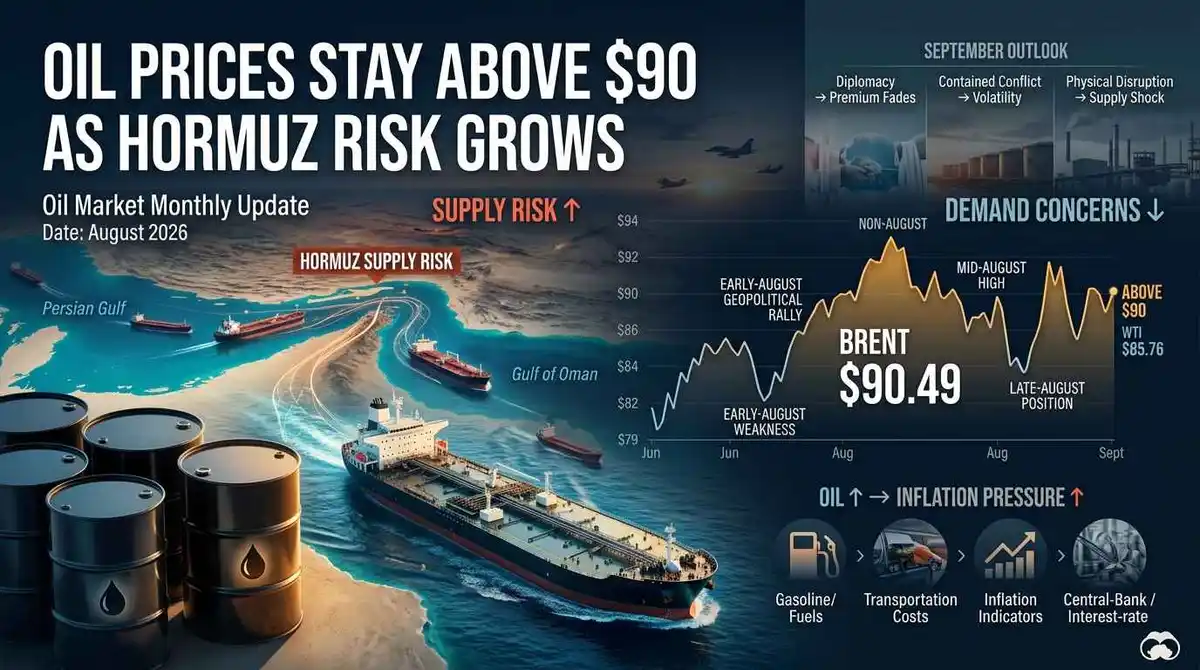
Brent crude finished August around $90 a barrel, while West Texas Intermediate (WTI) settled near $86. That was a sharp change from the beginning of the month, when Brent had briefly fallen below $80 as markets focused on the possibility of progress in efforts to end the U.S.-Iran conflict.
The month therefore offered a useful reminder about how oil markets behave during geopolitical crises: prices do not need a complete supply shutdown to move sharply higher. Sometimes the possibility of disruption is enough.
August began with an oil market looking for relief
The first week of August brought some of the clearest signs that traders were willing to price in a less disruptive outcome.
On August 4, Brent settled at $79.36 a barrel and WTI at $75.77, both around three-week lows. The decline followed a sharp sell-off as investors assessed diplomatic developments and the possibility that negotiations could eventually reduce the risk surrounding Middle Eastern oil supplies. (Reuters)
That weakness did not last.
By August 6, oil prices were already responding to renewed concerns over the Strait of Hormuz after an Iranian parliamentary committee discussed possible restrictions involving U.S. and Israeli vessels. Brent and WTI both gained roughly $3 that day as traders began rebuilding a geopolitical premium into crude.
The pattern would define much of August: optimism about diplomacy pushed prices lower, while signs of military escalation or shipping disruption quickly pushed them back up.
That made the oil market unusually sensitive to headlines.
The Strait of Hormuz became the market’s central concern
For oil traders, the most important geographic location during August was not simply the Middle East as a whole. It was the Strait of Hormuz.
The waterway is a critical route for global energy trade, connecting the Persian Gulf with the Gulf of Oman. Any sustained disruption would have implications far beyond the countries directly involved in the conflict.
This is why even relatively limited attacks or threats against shipping could have an outsized impact on crude prices.
The market did not necessarily need evidence that millions of barrels had already disappeared from global supply. Traders were pricing the possibility that the disruption could become worse.
That distinction matters.
Oil prices reflect expectations about future physical availability as well as current supply and demand. When the perceived probability of a major disruption rises, refiners, traders and financial investors can react before an actual shortage appears.
By mid-August, that risk premium had become much more visible.
Brent moved from the high $70s to the mid $90s
The price journey tells the story better than any single percentage figure.
Brent was around $79 a barrel early in the month. By August 12, it had climbed close to $89 as doubts over a U.S.-Iran agreement increased supply concerns. (Reuters)
On August 14, Brent settled at $88.52 while WTI finished at $82.40. Brent gained about 6% for that week, reflecting growing concerns that the conflict could continue without a near-term diplomatic breakthrough.
The rally continued into the following week.
On August 17, Brent reached $90.87 and WTI $84.50. By August 21, Brent had risen to $94.39 while WTI reached $87.06.
At that point, the market was no longer trading as though a quick return to normal supply conditions was guaranteed.
Yet the rally also had limits.
Oil demand remained an important counterweight to the geopolitical premium. Concerns about economic growth and weaker consumption forecasts prevented traders from treating every supply-risk headline as the beginning of an unlimited price surge.
This tension between geopolitical supply risk and demand weakness remained at the heart of the August market.
Why oil could not simply keep rising
It would be easy to look at the conflict and conclude that crude prices should have moved dramatically higher throughout August.
The market did not behave that way.
One reason was the demand outlook.
A Reuters survey of 31 analysts at the end of August put the expected 2026 average price at about $85.08 a barrel for Brent and $80.20 for U.S. crude. The survey also highlighted weaker Chinese crude imports, with July imports down 24.3% from a year earlier. (Reuters)
That matters because China is one of the world’s largest oil consumers. A weaker demand environment can absorb some of the bullish effect of geopolitical supply risks.
The broader global demand outlook was also becoming less supportive. The same Reuters report noted that the International Energy Agency expected global oil demand growth to weaken substantially in 2026.
In other words, the market was dealing with two opposing forces:
Supply risk was pushing prices higher, while demand concerns were limiting how far the rally could go.
That helped explain why Brent repeatedly moved into the $90s but struggled to establish a sustained move substantially above that level during most of the month.
Diplomacy briefly pulled prices back
The second half of August demonstrated how quickly crude can reverse when traders see even a small chance of de-escalation.
After reaching the mid-$90s, Brent fell back toward $90 and then below it as expectations around talks improved.
On August 27, Brent settled at $89.70 and WTI at $83.53 after three consecutive sessions of losses. Markets were increasingly focused on the possibility that negotiations could ease Middle Eastern supply concerns. (Reuters)
The following day, oil remained under pressure as traders assessed both diplomatic developments and signals from U.S. monetary policy. (Reuters)
This was an important part of August’s story.
Oil was not being driven exclusively by military developments. Traders were also watching the potential economic consequences of higher energy prices, the Federal Reserve’s interest-rate outlook and the possibility that weaker demand could eventually outweigh the geopolitical premium.
For investors, this is one of the more important lessons from the month: geopolitical risk can lift oil prices quickly, but the rally still has to survive the underlying demand picture.
The final days changed the tone again
August ended with another escalation.
On August 31, oil prices jumped after renewed U.S.-Iran military activity. Brent settled at $90.49, up 2.7%, while WTI gained 2.8% to $85.76. (Reuters)
The move was particularly significant because it came after several days of falling prices.
The renewed fighting revived concerns about the security of energy shipments through the Strait of Hormuz. Reuters reported that shipping activity through the waterway had slowed, reinforcing concerns that the conflict could once again threaten physical oil flows. (Reuters)
That left Brent back above $90 as August closed.
The market had therefore travelled a considerable distance during the month from sub-$80 Brent at the beginning of August to above $90 by month-end.
But the path was anything but straightforward.
The physical supply question is more important than the headline price
The most important issue heading into September is whether geopolitical risk turns into a sustained physical supply disruption.
That distinction could determine the next major move in crude.
If shipping through Hormuz remains possible and oil producers are able to maintain enough exports, the geopolitical premium could gradually fade. In that scenario, weaker demand and concerns about economic growth could regain control of the market.
If shipping becomes materially restricted for a sustained period, the calculation changes.
A disruption to one of the world’s most important energy corridors would create a much more serious supply problem, potentially forcing refiners and governments to draw on inventories and alternative supply sources.
This is also where the U.S. Strategic Petroleum Reserve becomes relevant. Reuters reported at the end of August that U.S. emergency crude stocks had fallen to about 286.6 million barrels, the lowest level since November 1982. (Reuters)
That does not mean the United States is without an emergency buffer. It does mean that the cushion is considerably smaller than it once was.
For a market already dealing with geopolitical uncertainty, that matters.
Oil and inflation are becoming increasingly connected
Oil’s importance goes well beyond energy markets.
A sustained rise in crude prices can feed into gasoline, diesel, transportation and production costs. That can make inflation more difficult for central banks to control.
This creates a potentially uncomfortable feedback loop.
Higher oil prices can raise inflation expectations. Higher inflation can make central banks more cautious about cutting interest rates. Higher borrowing costs can weaken economic activity and, eventually, oil demand.
For investors, the relationship between energy prices and inflation is therefore worth watching closely.
Economic Reader’s guide on how inflation affects your money provides further context on how changing prices can affect households, businesses and investors.
The oil market’s August behaviour showed why energy prices can become a monetary-policy issue even when the original catalyst is geopolitical.
What could happen next?
There are three broad possibilities for the oil market as September begins.
1. A diplomatic breakthrough
If U.S.-Iran negotiations make meaningful progress and shipping conditions improve, the geopolitical premium could unwind.
In that scenario, Brent could come under pressure as traders focus again on demand growth, inventories and the possibility of additional supply.
2. A prolonged but contained conflict
This may be the most complicated scenario.
If military tensions remain high but major oil flows continue, crude could stay volatile around elevated levels without developing into a full-blown supply shock.
That would leave prices heavily dependent on daily headlines, shipping activity and expectations surrounding negotiations.
3. A major physical disruption
This represents the biggest upside risk for crude.
A sustained interruption to oil shipments through Hormuz could overwhelm the market’s existing demand-side cushion and push prices significantly higher.
The Reuters analyst survey at the end of August estimated a potential global oil-market deficit of roughly 1.65 million to 3.5 million barrels per day under current conditions, highlighting how sensitive the balance could become if supply losses deepen. (Reuters)
For September, therefore, watching actual barrels moving through the market may be more important than simply watching the next geopolitical headline.
What August tells investors about the oil market
August 2026 was not simply a story about oil becoming more expensive.
It was a demonstration of how quickly crude prices can move when geopolitical risk interacts with an already-sensitive supply-demand balance.
Brent’s move from around $79 early in the month to above $90 at the end reflected a substantial repricing of supply risk. At the same time, weaker demand expectations prevented the market from behaving like a straightforward shortage scenario.
That balance will remain crucial.
Investors following crude should pay particular attention to the Strait of Hormuz, tanker traffic, diplomatic developments, inventories, Chinese demand and the response of major oil producers.
The next major move in oil may not be determined by the loudest headline. It may be determined by whether the world’s physical oil supply is actually becoming harder to move.
Frequently Asked Questions
FAQ 1: What happened to oil prices in August 2026?
Oil prices were highly volatile. Brent crude fell below $80 early in the month before climbing into the $90s as U.S.-Iran tensions and concerns about supply disruptions increased. Brent ended August around $90.49 a barrel, while WTI finished near $85.76. (Reuters)
FAQ 2: Why did oil prices rise in August 2026?
The main driver was increased concern about Middle Eastern supply disruption, particularly risks surrounding shipping through the Strait of Hormuz. Renewed military activity repeatedly pushed a geopolitical risk premium into crude prices.
FAQ 3: Why didn’t oil prices rise even more?
Demand concerns acted as a counterweight. Expectations for weaker global oil demand, particularly weaker Chinese imports, limited the market’s ability to sustain an unrestricted rally. (Reuters)
FAQ 4: Why is the Strait of Hormuz important for oil prices?
Hormuz is a major route for oil shipments from the Persian Gulf. A sustained disruption could reduce the amount of crude reaching international markets and potentially create a significant supply shock.
FAQ 5: What should investors watch in September?
The most important indicators are the security of Hormuz shipping, U.S.-Iran negotiations, actual oil export volumes, global inventories, Chinese demand and any further military escalation. The direction of crude prices will depend heavily on whether geopolitical risk remains a premium or becomes a genuine physical supply disruption.
Final Thoughts
August left the oil market in an unusual position.
Crude was expensive enough to keep inflation concerns alive, but not so expensive that demand destruction had become the dominant story. Supply risks were clearly elevated, yet actual physical flows had not disappeared entirely.
That makes September particularly important.
If diplomacy improves and energy shipments normalize, some of August’s geopolitical premium could disappear quickly. If the conflict spreads or Hormuz becomes materially less reliable, the market could face a much more serious supply problem.
For investors, the key question is therefore not simply whether oil is above or below $90.
It is whether the risk being priced into crude is still a risk or is becoming a physical shortage.
Read July Month’s Market Reports:
- Oil Market Monthly Update: click here.
- Gold Market Monthly Update: click here.
- Stock Market Monthly Update: click here.
- Crypto Market Monthly Update: click here.
Author Note: This article is crafted by “The Economic Reader editorial team”, dedicated to analyzing the latest market trends, financial updates, and global economic shifts to keep you informed with accurate and comprehensive insights.
Disclaimer: The information provided on this website is for educational and informational purposes only and should not be construed as professional financial, investment, or legal advice. Always consult with a certified financial advisor or professional before making any financial decisions based on this content.