Oil Market Weekly Update: $100 Oil Is Back as Supply Risks Deepen | September 7-11, 2026
Oil Market Weekly Update: September 7-11 2026
Oil markets entered the week with Brent crude already carrying a significant geopolitical premium. By Friday, that premium had pushed both major benchmarks back above $100 a barrel.
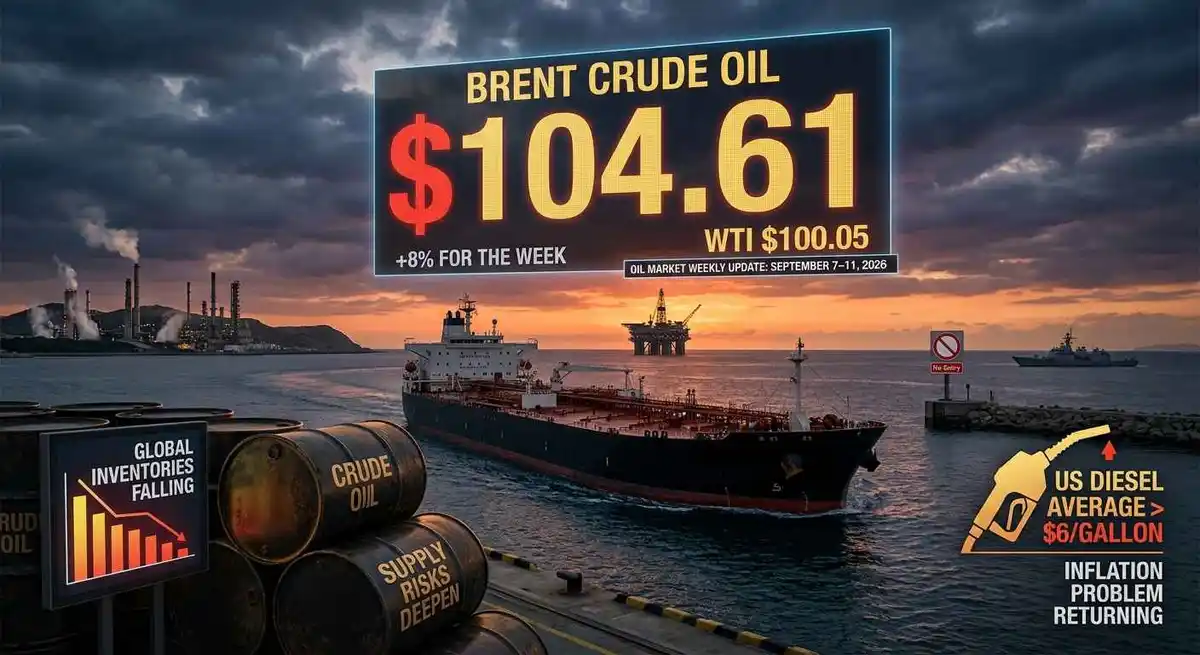
Brent crude settled at $104.61 on September 11, while U.S. West Texas Intermediate (WTI) finished at $100.05. Both benchmarks pulled back on Friday after reports of possible diplomatic efforts around the Strait of Hormuz, but the retreat did little to change the week’s broader picture. Brent was still up more than 8% for the week and had reached roughly $110 during trading. (Reuters)
The important story, however, is not simply that oil returned above $100.
The more important question is whether the market is pricing a temporary geopolitical risk premium or the beginning of a more serious physical supply problem.
That distinction matters because the oil market is becoming increasingly dependent on the movement of actual barrels through some of the world’s most important shipping routes. Attacks on energy infrastructure and tankers, falling inventories, weaker Gulf exports and record diesel prices are making the market more vulnerable to another disruption.
At the same time, there are forces working against an uncontrolled price surge. Higher energy costs can weaken demand, non-OPEC production remains important, and alternative transportation routes are helping some Middle Eastern crude reach international buyers.
For investors and businesses, the next phase of the oil market may therefore depend less on the next headline and more on whether global energy flows can return to something resembling normal.
$100 Oil Returned for a Different Reason
The move above $100 this week was not driven by a sudden increase in global oil demand.
Instead, the market was reacting to a worsening supply and transportation story.
Brent moved above $100 as concerns surrounding the Strait of Hormuz intensified. The waterway is critical to global energy markets, and the disruption has made traders increasingly concerned about whether crude and refined products can move reliably from the Gulf to international buyers. Reuters reported that Brent had risen roughly 25% from the previous month by September 9 as the conflict disrupted supply and reduced confidence in Middle Eastern energy exports. (Reuters)
That change in perception is important.
Oil prices can rise when traders fear a possible future shortage. But the market behaves differently when refiners, shipping companies and physical buyers begin to worry that barrels may actually become harder to obtain or transport.
The second situation tends to create a more persistent premium.
A refinery does not simply need crude oil to exist somewhere in the world. It needs the right grade of crude, delivered to the right location, at the right time.
When shipping becomes uncertain, the effective supply available to a refinery can fall even if total global reserves have not changed dramatically.
That is why transportation disruption can tighten the oil market faster than headline production numbers suggest.
Hormuz Is More Than a Geopolitical Headline
The Strait of Hormuz has been at the center of the oil story for months, but this week’s developments showed why the waterway matters so much.
Before the current conflict, the strait handled roughly one-fifth of global daily oil and liquefied natural gas supplies. Reuters reported that vessel traffic through the waterway had fallen sharply, with preliminary data showing only seven transits on Thursday compared with 11 the previous day. (Reuters)
The significance is not limited to the number of ships passing through the strait.
Energy markets depend on predictable transportation.
When shipping becomes difficult or dangerous, companies may need to use longer routes, transfer cargo between vessels or delay deliveries. Each adjustment raises costs and reduces the efficiency of the global energy system.
Some Middle Eastern producers have been trying to compensate through alternative routes and other logistical arrangements. Reuters reported that significant volumes of crude and refined products were still being exported from the region despite the disruption. (Reuters)
But workarounds cannot completely eliminate the risk.
The longer normal shipping remains disrupted, the more expensive and complicated global energy logistics become.
That is one reason oil prices have remained so sensitive to every new development around the Gulf.
The IEA’s Supply Warning Changed the Picture
One of the week’s most important developments was not a daily oil-price move at all.
It was the latest assessment from the International Energy Agency.
The IEA said global oil supply in 2026 is now expected to decline by 5.7 million barrels per day, or about 6%, because of continuing disruptions in the Middle East and elsewhere. That represents a much larger decline than the agency’s earlier forecast. (Reuters)
Saudi Arabia is particularly important.
According to the IEA figures reported by Reuters, Saudi crude supply fell by about 2.3 million barrels per day in August from the previous month, reaching around 6 million barrels per day. That was the country’s lowest level in more than three decades. (Reuters)
This changes the nature of the oil-market discussion.
The market is no longer dealing only with the possibility that future supply could be interrupted. Major producers are already experiencing substantial reductions in output.
Russia is also facing production pressure. The IEA cut its 2026 forecast for Russian crude production by 125,000 barrels per day to 8.7 million barrels per day, while August production was estimated at 8.36 million barrels per day. Ukrainian attacks on Russian energy infrastructure and refinery disruptions are contributing to the decline. (Reuters)
Taken together, the Middle East and Russia developments create a much more fragile global supply picture.
Why Oil Has Not Rallied Even Further
If supply risks are this serious, why isn’t Brent already trading dramatically above $110?
The answer is demand.
Oil prices cannot be understood from the supply side alone.
Higher crude prices eventually create their own resistance. When gasoline, diesel, jet fuel and other petroleum products become more expensive, households and businesses begin changing their behavior.
Consumers may drive less. Businesses may reduce fuel-intensive activity. Industries may invest in efficiency or alternative energy sources.
China is another important part of the equation.
Slower consumption growth, higher inventories and increasing transportation electrification can limit demand for crude. At the same time, production from countries outside OPEC, including the United States, Canada and Guyana, provides additional supply to the global market.
These forces create a natural counterweight to the geopolitical shock.
The oil market is therefore caught between two forces.
One side is saying that supply is becoming less reliable.
The other is saying that higher prices will eventually reduce demand and encourage additional production.
For now, the supply concerns are winning. But demand destruction is one reason the market has not moved continuously higher without interruption.
Inventories Are Becoming More Important
Inventories may ultimately tell investors more than the headline crude price.
The U.S. Energy Information Administration estimates that global oil inventories have already declined by about 400 million barrels during 2026. Its latest outlook expects inventories to remain under pressure through the end of the year. (U.S. Energy Information Administration)
Inventories act as the buffer between supply disruptions and consumers.
When inventories are comfortable, a temporary disruption does not necessarily create an immediate physical shortage.
When inventories are already falling, every additional disruption matters more.
The EIA expects some improvement in Middle Eastern production and exports as flows gradually recover and alternative routes are used. But the agency still expects the disruption to leave the market unusually tight in the near term. (U.S. Energy Information Administration)
That distinction is crucial.
The base case does not necessarily require a permanent supply collapse. It requires the global energy system to normalize.
The problem is that the timing of that normalization remains uncertain.
Diesel May Be a Bigger Economic Problem Than Crude
One of the most important developments this week was the behavior of refined fuel prices.
The U.S. national average diesel price moved above $6 per gallon for the first time, according to GasBuddy data cited by Reuters. Gulf shipping constraints and disruptions at Russian refineries have combined to tighten refined-product markets. (Reuters)
This matters because crude oil gets most of the attention, but refined products are what businesses and consumers actually use.
Diesel is particularly important for trucking, agriculture, construction, manufacturing, mining and freight transportation.
A rise in diesel prices can therefore spread through the economy more quickly than a comparable move in crude.
The latest EIA outlook adds to the concern. The agency expects U.S. distillate inventories, which include diesel, to fall below 100 million barrels in September and remain below the five-year range through the end of 2026 and much of 2027. (U.S. Energy Information Administration)
This is one reason the current oil story should not be reduced to “Brent is above $100.”
The bigger economic problem could be the cost and availability of refined fuels.
The Inflation Problem Is Returning
Oil’s economic importance becomes even greater when inflation is already elevated.
Higher crude prices affect inflation directly through gasoline and energy costs, but the second-round effects can be more important.
Transportation becomes more expensive.
Shipping costs rise.
Airlines face higher jet-fuel expenses.
Manufacturers pay more to move raw materials and finished goods.
Businesses may eventually pass part of those costs on to consumers.
That creates a difficult environment for central banks.
The United States was already heading into the September Federal Reserve meeting with inflation concerns. August CPI rose 0.4% month over month, while the sharp rise in oil prices added another potential source of future inflation pressure. The 10-year Treasury yield briefly approached 5%, showing how closely energy prices and inflation expectations were becoming connected to interest-rate expectations. (Reuters)
For the oil market, this creates an unusual feedback loop.
Higher oil prices can increase inflation.
Higher inflation can keep interest rates higher.
Higher interest rates can weaken economic growth.
Slower growth can reduce oil demand.
Oil can therefore create the conditions that eventually work against its own rally.
The EIA Still Sees a Path Back Toward Lower Prices
Despite the severe supply risks, the latest EIA outlook does not assume that $100-plus oil becomes the permanent new normal.
The agency’s current outlook expects Brent prices to fall substantially as global supply recovers and inventory conditions improve. Its latest forecast puts average Brent prices at about $74 per barrel in the third quarter of 2026, although the outlook remains highly sensitive to how quickly Middle Eastern production and exports recover. (U.S. Energy Information Administration)
This provides an important counterargument to the most extreme bullish scenarios.
The oil market does not necessarily need a huge increase in production to bring prices down.
It may only need:
- More reliable shipping through the Gulf
- Recovery of damaged energy infrastructure
- Higher Middle Eastern exports
- Continued growth from non-OPEC producers
- Slower oil demand
- Stabilization or rebuilding of inventories
If several of those developments happen at the same time, today’s geopolitical premium could unwind quickly.
That is why oil remains unusually headline-sensitive.
A credible diplomatic agreement could push prices lower even before physical supply fully normalizes.
Conversely, another major attack on energy infrastructure or shipping could quickly push prices higher.
What Oil Investors Should Watch Next
The most useful way to follow the oil market now is to watch several indicators together rather than focus only on Brent.
First, watch Strait of Hormuz traffic. A sustained recovery in tanker movements would suggest that some of the geopolitical premium can begin leaving crude prices.
Second, watch Saudi and other Gulf production. A recovery in output would provide evidence that the physical supply shock is beginning to ease.
Third, watch diesel inventories and refined-product prices. Continued strength in diesel would suggest that the supply problem is spreading beyond crude into the wider energy system.
Fourth, watch global inventories. With inventories already under pressure, another major drawdown would make the market more vulnerable to a fresh disruption.
Fifth, watch diplomatic developments. Oil prices have repeatedly shown that expectations about future conflict can matter almost as much as current production.
Finally, watch demand. If expensive energy begins to weaken transportation, manufacturing or consumer activity, the demand side could eventually become the market’s strongest bearish force.
What This Week Changed About the Oil Market
The September 7-11 week changed the conversation around crude.
Earlier in the year, the dominant question was often whether geopolitical tensions would eventually fade and allow oil prices to normalize.
This week, the more important question became whether the physical energy system can operate normally while critical production and shipping infrastructure remain under pressure.
That is a more serious question.
Brent above $100 by itself is not proof of a structural shortage. Prices can rise rapidly when traders add a geopolitical risk premium, and they can fall just as quickly when that premium disappears.
But the combination of declining inventories, reduced Saudi output, disrupted shipping, Russian refinery problems and record diesel prices suggests that the market has less room for error than it did earlier in the year. (Reuters)
The EIA still sees a path toward lower prices as supply recovers. The IEA, however, is warning that the 2026 supply decline could be considerably larger than previously expected.
Those views are not necessarily contradictory.
One describes a path toward normalization.
The other highlights how severe the disruption could become if normalization is delayed.
That tension is likely to define the next phase of the oil market.
Why $100 Oil Matters Beyond the Energy Market
The biggest mistake investors could make now is treating $100 oil as a commodity-market story only.
It is increasingly becoming a macroeconomic story.
If crude remains around $100 while diesel and other refined fuels stay elevated, inflation could prove more persistent. That could affect central-bank policy, bond yields, currencies and equity valuations.
Businesses would also face a different cost environment.
Energy-intensive industries could see margins squeezed. Transportation companies could face higher operating costs. Airlines could face renewed pressure from fuel expenses. Consumers could have less disposable income after paying more for gasoline, transportation and other energy-related costs.
At the same time, energy producers and companies with direct exposure to higher oil prices could benefit from stronger revenue and cash flows.
This creates an unusual market environment in which the same oil price that benefits one group of companies can hurt another.
That is why investors should look beyond the headline crude price.
The real economic question is how long the current price level lasts.
A brief move above $100 would be very different from several months of oil trading around or above that level.
The Market Is Waiting for Physical Evidence
The oil market has already priced a significant amount of geopolitical risk into crude.
The next move may depend on whether the physical market confirms those fears.
If tanker traffic improves, Gulf production recovers and inventories stabilize, Brent could retreat even if geopolitical tensions remain elevated.
If shipping remains constrained, production losses continue and inventories keep falling, the market could become considerably tighter.
That makes the weeks ahead unusually important.
The current oil rally is not simply about whether Brent can stay above $100.
It is about whether the global energy system can continue supplying enough crude and refined products while critical infrastructure and shipping routes remain under pressure.
For investors, that is the signal worth watching.
The oil market has moved from pricing the possibility of disruption to dealing with its consequences. Whether that becomes a temporary shock or a longer-lasting supply problem will determine what happens next to crude prices, inflation and the wider global economy.
For broader context, Economic Reader’s Oil Market Monthly Update: August 2026 and Oil Market Weekly Update: August 31–September 4, 2026 provide the preceding market context.