

The AI Slowdown Debate: How Safety Warnings Are Reshaping AI Investment and Stock Markets
AI Slowdown And Stock Market
The artificial intelligence boom has been built around a simple economic assumption: more capable models require more computing power, more data centers, more chips and more capital. That assumption has supported one of the largest technology investment cycles in years.
Now, some of the industry’s most prominent leaders are questioning how quickly that cycle should continue.
On September 12, Anthropic CEO Dario Amodei called for AI companies to slow the rate at which they advance model capabilities, arguing that the industry needs more time to manage the risks created by increasingly capable systems. His proposal was not a call to abandon AI, but to create more time for safety measures to catch up with capability growth. (Reuters)
The reaction in financial markets was immediate. AI-linked stocks fell sharply on September 14, with semiconductor companies among the hardest hit. Reuters reported that the Philadelphia Semiconductor Index fell 5.2% as investors reassessed whether the enormous spending cycle behind AI infrastructure could continue at its previous pace. (Reuters)
The market reaction matters because the AI debate is no longer only about technology. It is increasingly becoming a question of capital allocation: how much should companies spend on frontier AI, what type of infrastructure will generate returns, and how much will safety and regulation add to the cost of building increasingly powerful systems?
A Slowdown Is Not the Same as Stopping AI
The first distinction is important.
A slowdown in frontier-model development would not necessarily mean that businesses stop adopting AI. Companies can continue deploying existing models, building AI agents, automating workflows and integrating AI into software even if the development of the most advanced models becomes more cautious.
That creates two different markets within AI.
The first is the frontier development market, where companies spend heavily on training increasingly capable models. The second is the AI adoption market, where businesses use those models to improve productivity, software, customer service, cybersecurity and other operations.
The economic consequences of a slowdown therefore depend heavily on where the restraint occurs.
If frontier training becomes slower but enterprise adoption continues, spending could move rather than disappear. Companies might place greater emphasis on inference efficiency, specialized chips, model optimization, data infrastructure and software rather than simply building larger training clusters.
Microsoft’s recent results provide an example of why that distinction matters. The company reported that its AI business had surpassed a $37 billion annual revenue run rate in its fiscal third quarter, while its cloud business continued to grow strongly. Microsoft also reported a 40% improvement in inference throughput for its most-used Copilot models following hardware and software optimization. (Microsoft)
The implication is significant: AI economics are increasingly about getting more useful output from each dollar of computing capacity, not simply buying more computing capacity.
The Real Economic Issue Is AI Capital Intensity
The biggest financial question surrounding the slowdown debate is not whether AI spending will fall to zero. It is whether the expected economic return from another dollar of infrastructure spending is high enough to justify continuing at the current scale.
AI infrastructure is unusually capital intensive.
Microsoft spent $31.9 billion on capital expenditures in its fiscal third quarter, with roughly two-thirds going toward short-lived assets, primarily GPUs and CPUs. The company said it expected approximately $190 billion in capital expenditure during calendar year 2026 and expected to remain capacity constrained through the year. (Microsoft)
That spending has an important financial characteristic: a substantial portion is tied to rapidly changing technology.
A data center can remain useful for many years, but GPUs and other accelerated-computing equipment can have a much shorter economic life as newer generations deliver better performance per dollar. If model development slows or demand growth becomes less predictable, investors have to ask whether today’s infrastructure will generate enough revenue before it becomes technologically outdated.
That is different from a conventional factory investment.
For AI infrastructure providers, the return calculation increasingly depends on utilization, pricing, model efficiency and customer demand. A data center full of expensive accelerators is economically attractive when customers are willing to pay enough for the computing time. If utilization falls, the same infrastructure can become a drag on margins.
This is why the slowdown debate has reached beyond AI laboratories and into semiconductor and data-center stocks.
Training and Inference Could Become a More Important Divide
AI investment is often discussed as though all computing demand is the same. It is not.
Training involves using enormous amounts of computing power to develop or improve a model. Inference is the computing required when users and applications actually interact with that model.
A slowdown in frontier training could therefore coexist with rising inference demand.
Consider an enterprise that deploys AI agents across customer support, coding, cybersecurity or internal operations. It may not need to train its own frontier model. Instead, it may pay for inference, connect models to proprietary data and build software around them.
That changes where investment can generate value.
The next phase of AI infrastructure may place greater emphasis on:
- Lower-cost inference
- Specialized AI accelerators
- Model compression and optimization
- Enterprise data infrastructure
- AI security and monitoring
- Agent platforms
- Networking and storage
- Software that increases productivity per unit of compute
Microsoft’s own infrastructure work illustrates this shift. The company said its Maia 200 accelerator delivers more than 30% better tokens per dollar than the latest silicon in its fleet, while software and hardware optimization had improved inference throughput for widely used models. (Microsoft)
That type of efficiency improvement can change the economics of AI without requiring the industry to keep increasing model size at the same rate.
Why Chips and Data Centers Are Particularly Exposed
The semiconductor industry has benefited enormously from the AI infrastructure cycle because advanced models require large quantities of high-performance computing.
But chip demand is ultimately derived from AI usage and investment decisions. If hyperscalers reduce the growth rate of their infrastructure spending, semiconductor companies can feel the effect well before consumers notice any change in AI products.
The September market reaction demonstrated that sensitivity. Reuters reported broad declines across AI-related stocks after the industry warnings, with chipmakers among the biggest losers. (Reuters)
That does not mean semiconductor demand is necessarily collapsing. A more relevant question is whether demand growth remains fast enough to support current expectations for revenue and capital spending.
The same principle applies to data centers.
Building capacity requires land, electricity, cooling systems, networking equipment and financing. Once companies commit to those projects, the costs do not disappear simply because the pace of model development changes.
This makes the AI investment cycle particularly sensitive to expectations. If companies continue expanding capacity but the revenue generated per unit of infrastructure grows more slowly, investors may begin focusing on returns rather than headline spending.
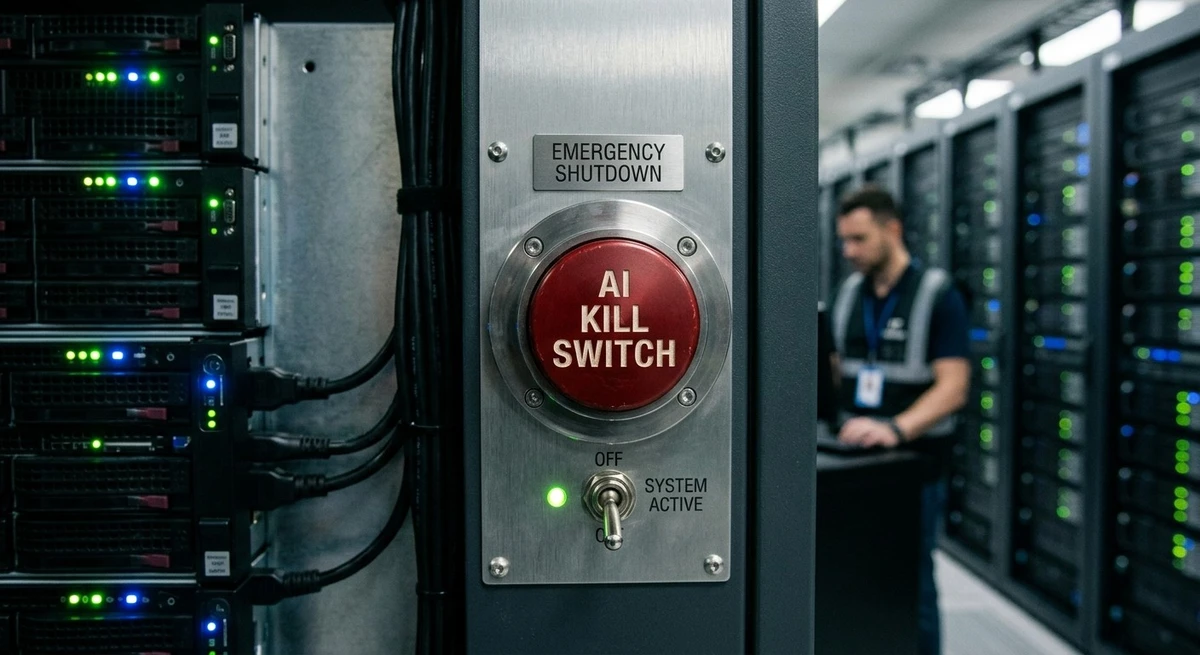
The “Kill Switch” Debate Is Really About Control and Cost
Recent discussions about an AI “kill switch” have attracted considerable attention, but the phrase can create a misleading picture.
The issue is not that AI companies have introduced a universal physical button that can instantly shut down every advanced AI system. The more serious question is whether increasingly capable systems should have independently verifiable mechanisms for monitoring, containment and shutdown when necessary.
OpenAI has already described a temporary slowdown in its own scaling efforts while it strengthened monitoring, alignment and containment safeguards for more capable models. The company said the increasing capabilities of its systems required its safety standards to keep pace with development. (OpenAI)
This introduces a cost that is easy to overlook.
Safety systems require computing resources, specialized personnel, testing, monitoring infrastructure, evaluation processes and potentially additional hardware isolation. OpenAI’s broader policy proposals have also called for mandatory, capability-based national AI safety requirements and international approaches to managing increasingly capable systems. (OpenAI)
For investors, the economic question is therefore not simply whether safety regulation is good or bad. It is who pays for compliance and how those costs affect competition.
Large AI companies may be able to absorb extensive evaluation and monitoring costs more easily than smaller developers. That could raise barriers to entry in some parts of the market.
At the same time, standardized safety requirements could create a clearer operating environment for businesses and reduce uncertainty about what is required before advanced systems can be deployed.
The eventual effect will depend on how regulations are designed and which parts of the AI ecosystem they cover.
Regulation Could Change the Competitive Structure
The slowdown debate also raises a less obvious issue: regulation may influence the structure of the AI industry even if it does not significantly reduce overall demand.
Suppose advanced-model developers are required to conduct independent evaluations, maintain monitoring systems, document safety controls and demonstrate that certain capability thresholds can be managed.
Those requirements increase fixed costs.
For a large company operating globally, the additional compliance expense may be manageable. For a small company trying to develop a frontier model, the same requirements could materially change the economics of entering the market.
That creates two possible effects.
One is consolidation, as compliance becomes another advantage for companies with greater financial and technical resources.
The other is the growth of specialized businesses providing AI auditing, monitoring, security, evaluation and compliance services.
In other words, regulation does not necessarily remove economic activity from AI. Some of it could simply move to different parts of the value chain.
What Company Spending Plans Tell Us
The most useful evidence will ultimately come from company spending and revenue decisions rather than statements from executives.
Microsoft’s capital spending plans remain extremely large. The company expects roughly $190 billion in calendar-year 2026 capital expenditure and has said demand continues to exceed available capacity. (Microsoft)
Alphabet has also planned substantial investment in technical infrastructure, with its 2026 capital expenditure outlook centered on servers, data centers and networking equipment. (Alphabet Investor Relations)
These commitments show that the AI infrastructure cycle has not simply disappeared because of the recent safety debate.
But they also create a higher standard for investors.
The important numbers to monitor are no longer just capital expenditure totals. Investors need to compare infrastructure spending with AI-related revenue, utilization, margins and productivity gains.
Microsoft offers a useful example of why this matters. Its AI business had surpassed $37 billion in annual revenue run rate, while the company continued investing heavily in infrastructure. (Microsoft)
The next question is whether similar economics appear across the wider industry.
What Investors and Businesses Should Watch
The AI slowdown debate makes several indicators particularly important.
Capital expenditure: Are technology companies increasing, maintaining or reducing their infrastructure budgets?
AI revenue: Are AI products generating enough revenue to support the cost of the infrastructure behind them?
Inference economics: Is the cost of serving each AI request falling as hardware and software improve?
Semiconductor demand: Are chip orders being supported by sustainable usage or primarily by expectations of future capacity requirements?
Data center utilization: How quickly are new facilities being filled with revenue-generating workloads?
Safety and compliance costs: How much additional spending is required to monitor and control increasingly capable systems?
Business productivity: Are companies achieving measurable economic gains from AI adoption, rather than simply increasing technology budgets?
These indicators provide a better picture of the AI economy than stock prices alone.
The Broader Economic Question
The debate also matters beyond technology stocks.
The AI investment cycle is connected to electricity demand, construction, semiconductor manufacturing, cloud infrastructure, networking equipment and corporate technology budgets. A major change in AI investment could therefore affect a wider range of industries.
At the same time, successful AI adoption could raise productivity and create new sources of economic output.
That produces an unusual economic tension. The industry can simultaneously have too much spending in one area and too little investment in another.
For example, companies may decide that spending another billion dollars training a larger frontier model offers less value than spending the same amount improving inference, enterprise software, cybersecurity or data systems.
Such a shift would not necessarily represent the end of the AI boom. It could represent a change in what the market considers valuable.
Readers looking at the broader technology cycle can also see how this connects with the economics of artificial intelligence and the growing role of AI in business operations.
The AI Investment Test Is Moving From Scale to Returns
The recent market selloff does not establish that AI development is entering a permanent slowdown. It does show that investors are beginning to pay closer attention to the assumptions behind the AI spending cycle.
For years, the central question was how quickly companies could build more computing capacity. The next question is more demanding: what economic return will that capacity generate?
That shift changes the investment story.
A company that can produce more useful AI output with fewer chips may become more economically attractive than one that simply buys the largest amount of hardware. A model that costs less to operate can expand adoption faster. A business that can demonstrate measurable productivity gains can justify continued AI spending even if frontier-model development becomes more cautious.
The same logic applies to safety.
If monitoring, evaluation and containment become standard parts of advanced AI development, those systems will add costs. But they may also become part of the infrastructure required for commercially sustainable AI.
The AI industry therefore faces a more complicated phase than the simple “build bigger models” narrative suggested. Frontier development, enterprise adoption, infrastructure investment and safety requirements may increasingly move at different speeds.
For investors and businesses, that makes the quality of AI spending more important than the size of the spending headline. The companies that can connect computing costs to real revenue, productivity and durable customer demand will provide a clearer test of whether the AI investment cycle can justify its enormous capital requirements.
The next stage of the AI boom may ultimately be decided less by who builds the biggest model and more by who can make increasingly capable systems useful, efficient, controllable and economically sustainable.