What Is an Economic Cycle? Understanding the Economic Cycle, Its Stages and Causes
What Is an Economic Cycle?
Economies do not grow at the same speed forever.
Businesses expand production, households increase spending, companies invest in new capacity, and employment grows. Then, at some point, growth may slow. Consumers may become more cautious, businesses may postpone investment, credit conditions may tighten, or an unexpected shock may disrupt production. A slowdown can deepen into a recession before economic activity eventually turns upward again.
These recurring fluctuations are known as the economic cycle or business cycle.
The basic idea is easy to understand, but the forces behind the cycle are more complicated. Economic activity can change because of consumer demand, business investment, credit, interest rates, government policy, inventories, expectations, technological change, or supply shocks. Several of these forces can operate at the same time.
Understanding those connections makes the business cycle more useful than simply memorizing four stages.
It also helps explain why a slowdown is not necessarily a recession, why unemployment can continue rising after a recession has ended, and why financial markets can turn before official economic data confirm a change in direction.
Economic Cycle vs. Business Cycle: Are They the Same?
In most economic discussions, economic cycle and business cycle refer to essentially the same idea: fluctuations in broad economic activity over time.
The term “business cycle” is especially common when discussing production, employment, income, spending and investment.
The National Bureau of Economic Research (NBER), which maintains the official U.S. business-cycle chronology, identifies peaks and troughs in overall economic activity. A peak marks the end of an expansion, while a trough marks the end of a recession and the beginning of a new expansion. (National Bureau of Economic Research)
That approach is broader than simply looking at GDP.
The NBER considers measures including employment, real personal income, personal consumption, industrial production and real sales. It also uses quarterly GDP and gross domestic income when determining quarterly turning points. (National Bureau of Economic Research)
This matters because the economy is too large and diverse to be described accurately by one number.
A manufacturing slowdown may occur while services remain strong. Employment may continue rising even as GDP growth weakens. Consumer spending may hold up while business investment falls.
The business cycle is therefore about the direction and breadth of economic activity, not whether every part of the economy is moving in exactly the same direction.
The Four Stages of the Business Cycle
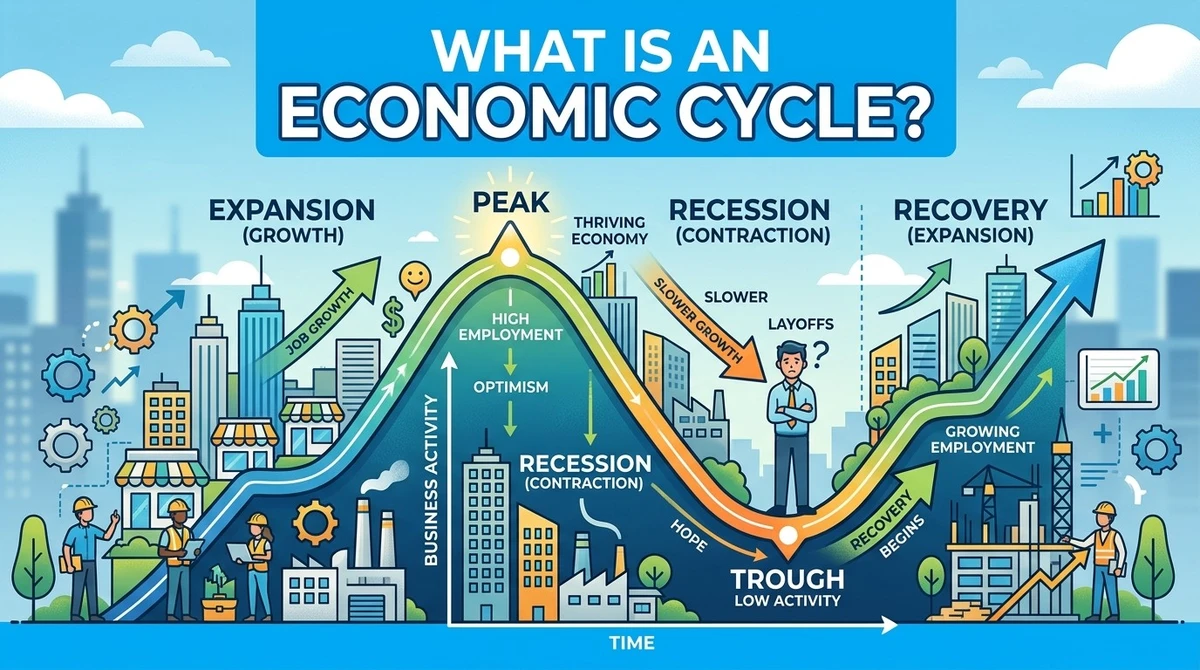
The traditional business-cycle model divides the cycle into four broad stages:
- Expansion
- Peak
- Contraction or recession
- Trough
The sequence then begins again with a new expansion.
This model is useful as a map, but real economies do not move through each stage according to a fixed timetable. The length and intensity of each phase can vary considerably. NBER’s historical chronology shows substantial differences between U.S. expansions and recessions. (National Bureau of Economic Research)
Expansion: When Activity Builds
Expansion is the phase in which economic activity is generally increasing.
Businesses experience stronger demand and may respond by producing more, hiring additional workers and investing in equipment, technology or facilities. Higher employment can increase household income, supporting further consumer spending.
That can create a reinforcing cycle:
Higher demand → stronger sales → more production → more employment → higher income → additional demand.
An expansion does not mean every economic indicator improves continuously.
Housing construction might weaken while consumer spending remains strong. Manufacturing could slow while services continue growing. Inflation might rise even as employment remains healthy.
That is why economists look at several indicators together.
A useful companion to this concept is Economic Reader’s article on what economic growth means, which explains the longer-term increase in an economy’s productive capacity and output. The business cycle is different: it focuses on shorter-term fluctuations around that broader growth path.
Peak: The Turning Point
A peak is the point at which an expansion reaches its highest level of overall economic activity before a contraction begins.
Importantly, the peak does not necessarily look like a dramatic economic event.
Growth might slow from 4% to 2%, then to 1%, while businesses are still hiring and consumers are still spending. The economy may appear relatively healthy even though the direction has changed.
This is one reason business-cycle turning points are difficult to identify in real time.
NBER determines peaks and troughs retrospectively because it waits for enough data to establish that a broad change in economic activity has actually occurred. (National Bureau of Economic Research)
Contraction: When Activity Turns Down
During a contraction, broad economic activity declines.
Businesses may experience weaker sales and reduce production. Investment plans can be postponed, hiring can slow, and layoffs may increase. Households may cut discretionary spending if they become concerned about employment or income.
Financial conditions can make the downturn worse.
A company facing falling sales may delay a factory expansion. A lender facing higher credit risk may become more cautious. A household worried about income may avoid taking on new debt.
Those decisions can reinforce one another.
A recession is a significant and broad decline in economic activity. In the U.S., NBER does not define a recession simply as two consecutive quarters of falling real GDP. It considers the depth, duration and spread of the decline across the economy, using multiple indicators. (National Bureau of Economic Research)
That distinction is important when interpreting recession headlines.
Trough: When the Decline Ends
The trough is the low point of the contraction and the turning point toward a new expansion.
It does not mean the economy immediately becomes strong.
Employment may remain weak. Businesses may still have unused capacity. Household finances can take time to recover.
NBER’s determination of the June 2009 trough illustrates this distinction. The committee concluded that the recession had ended and a new expansion had begun, but it did not claim that economic conditions had immediately returned to normal. (National Bureau of Economic Research)
The trough therefore describes a change in direction, not a return to prosperity.
What Actually Makes an Economic Cycle Move?
The four stages describe what happens. They do not fully explain why it happens.
There is no single cause behind every business cycle.
One downturn may begin with a financial crisis. Another may follow a sharp increase in energy prices. A different cycle may be driven by excessive investment, falling consumer demand, tighter monetary policy, a housing collapse or an external shock.
The most useful way to understand the cycle is to look at the forces that connect those events to the wider economy.
Consumer Spending Is a Major Transmission Channel
Household spending can accelerate an expansion or contribute to a slowdown.
When employment and income are rising, households may spend more on homes, vehicles, travel, restaurants and other goods and services. Businesses respond to stronger demand by increasing production and hiring.
But households can also change direction quickly.
Higher borrowing costs, falling asset values, weaker income expectations or concerns about job security can encourage people to postpone major purchases and increase savings.
That reduction in spending affects businesses.
A retailer sells fewer products. The retailer orders less from suppliers. Manufacturers reduce production. Companies may then reduce hiring or postpone investment.
The original change in household behavior has moved through several parts of the economy.
Business Investment Can Magnify the Upswing
Investment is particularly important because businesses make decisions based on expected future demand.
A company may build a new factory when it expects sales to rise for years. It may purchase new machinery, expand a warehouse or invest in software because management expects the additional capacity to generate higher future profits.
When many businesses make those decisions at the same time, investment can become a powerful source of economic growth.
But investment can reverse quickly.
If companies become less confident about future demand, they can postpone projects even before current sales collapse.
That makes business investment an important turning-point indicator. A decline in investment expectations can appear before the broader economy enters a recession.
This relationship also connects the business cycle with longer-term productivity and innovation. Economic Reader’s article on how technology changes the economy explores how investment in technology can affect productivity and productive capacity beyond the short-term cycle.
Credit Can Amplify Booms and Downturns
Credit connects financial markets with households and businesses.
During strong economic periods, banks may be more willing to lend because borrowers appear financially healthier and default risks seem lower. Businesses can borrow to expand, while households can finance homes, vehicles and other purchases.
More credit can support more spending.
The reverse can happen during a downturn.
If lenders become worried about defaults, they may tighten lending standards. Borrowers may also become less willing to take on new debt.
That can reduce consumption and investment at the same time.
Credit therefore does more than finance economic activity. Changes in lending conditions can amplify the direction in which the economy is already moving.
This is particularly important during financial crises, when problems in the financial system can quickly spill into the real economy.
Interest Rates Can Change the Pace of the Cycle
Central banks influence economic activity through monetary policy.
When inflation is too high, a central bank may raise interest rates to make borrowing more expensive and reduce demand. When economic activity is weak and inflation pressures are subdued, it may lower rates to support spending and investment.
The Federal Reserve explains that changes in the federal funds target range influence other short-term interest rates, which then affect household and business spending and have implications for economic activity, employment and inflation. (Federal Reserve)
The effect is not immediate.
A rate increase does not instantly change every mortgage, business loan or investment decision. Existing loans may have fixed rates, while other borrowing costs adjust at different speeds.
That creates a lag between monetary-policy decisions and their broader economic effects.
It also means policymakers must consider where the economy may be heading rather than simply reacting to today’s data.
Government Policy Can Support or Restrain Demand
Fiscal policy is another force in the business cycle.
Government spending, taxation and transfer payments can affect household incomes, business demand and overall economic activity.
During a downturn, increased government spending or temporary transfers can help support demand. During stronger periods, changes in taxes or spending can have different effects depending on the policy design and economic conditions.
Fiscal policy can therefore influence the strength and duration of an economic downturn or recovery.
Its effect, however, depends on timing.
A policy introduced after a downturn has already begun may work differently from one introduced when the economy is already operating near capacity.
Supply Shocks Can Change the Story
Not every downturn begins because consumers suddenly stop spending.
A supply shock can disrupt production even when demand remains relatively strong.
Examples include:
- Energy-price spikes
- Natural disasters
- Wars and geopolitical disruptions
- Supply-chain interruptions
- Severe weather
- Major changes in production technology
Supply shocks are especially difficult for policymakers because they can push inflation and economic weakness in opposite directions.
For example, a sudden energy-price increase can raise transportation and production costs while reducing consumers’ purchasing power.
That is very different from a conventional demand-driven slowdown.
Understanding the difference between demand and supply forces is also useful when reading inflation news. Economic Reader’s guide to how technology changes the economy and its coverage of how foreign trade affects the economy provide additional context on how productivity, trade and external conditions can influence economic performance.
Inventories Create Another Layer of Volatility
One of the less obvious forces behind economic fluctuations is inventory management.
Businesses rarely know exactly how much customers will buy.
Suppose retailers expect strong demand and build large inventories. If customers spend less than expected, retailers may stop placing new orders until excess stock is cleared.
Manufacturers then receive fewer orders.
Production falls.
The initial change in consumer demand has created a larger movement in manufacturing activity.
The opposite can happen when inventories unexpectedly become too low. Businesses may rush to replenish them, temporarily increasing production and orders.
Inventory cycles can therefore produce sharp short-term swings, particularly in manufacturing.
Expectations Can Become Part of the Cycle
Economic activity is influenced not only by what households and businesses experience today, but also by what they expect to happen tomorrow.
A company that expects weaker sales may reduce investment today.
A household worried about unemployment may save more today.
An investor expecting higher interest rates may change the allocation of capital before the central bank actually raises rates.
Those decisions can affect the economy themselves.
This creates an important feedback mechanism:
Expectations change behavior → behavior changes economic activity → new data change expectations again.
That is one reason turning points can develop before official recession statistics make them obvious.
Why Economic Cycles Do Not Follow a Fixed Schedule
It is tempting to think of the business cycle as a predictable sequence that repeats every few years.
History does not support that idea.
U.S. expansions and recessions have varied substantially in length. The expansion that ended in February 2020 lasted 128 months, making it the longest in the NBER’s historical chronology at the time. The recession that followed ended at the April 2020 trough. (National Bureau of Economic Research)
The 2007–09 recession, by contrast, lasted 18 months. (National Bureau of Economic Research)
The difference is significant.
There is no rule saying that an expansion must eventually end after a particular number of years. Nor does a recession have a predetermined duration.
The trigger, financial system, policy response, household balance sheets, business conditions and global environment all affect how a cycle develops.
How Economists Identify Where the Economy Is in the Cycle
Because turning points are difficult to identify in real time, economists monitor several groups of indicators.
Leading Indicators
Leading indicators tend to change before broader economic activity.
Examples include:
- New orders
- Building permits
- Credit conditions
- Consumer expectations
- Financial conditions
- Initial unemployment claims
These indicators can provide clues about where the economy may be heading.
But they are not perfect forecasting tools. A leading indicator can weaken without a full recession following.
Coincident Indicators
Coincident indicators provide information about what is happening now.
Employment, personal income, industrial production and sales are examples.
These measures are particularly useful when determining whether economic activity is already weakening rather than simply showing signs of a possible future slowdown.
Lagging Indicators
Lagging indicators respond after broader economic conditions have already changed.
Unemployment is a classic example.
The unemployment rate can continue rising after the economy reaches its trough because businesses may remain cautious about hiring even after production begins recovering.
NBER specifically notes that unemployment can continue rising for months after a recession has ended. (National Bureau of Economic Research)
That is why economic recovery can begin before the labor market feels fully recovered.
Why GDP Alone Cannot Tell You the Whole Story
GDP is one of the most widely used measures of economic activity, but it is not the entire business cycle.
A country can record weak GDP growth while employment remains strong. Another economy can experience strong GDP growth driven by a particular sector while other industries struggle.
Even the official U.S. recession-dating process does not rely solely on GDP. NBER considers a broader collection of monthly and quarterly measures when identifying turning points. (National Bureau of Economic Research)
This is also why the popular rule that “two consecutive quarters of negative GDP equals a recession” should not be treated as the official U.S. definition.
NBER explicitly states that some U.S. recessions have not involved two consecutive quarters of declining real GDP. (National Bureau of Economic Research)
The broader lesson is simple: economic conditions need to be viewed as a system, not a single statistic.
What the Economic Cycle Means for Businesses
Businesses do not experience the cycle equally.
A luxury retailer may be highly sensitive to household confidence. A utility company may have more stable demand. A construction company may be especially exposed to interest rates, housing activity and credit conditions.
Companies often respond to changing economic conditions by adjusting:
- Hiring
- Inventory levels
- Capital investment
- Pricing
- Marketing spending
- Borrowing
- Cash reserves
During an expansion, a company may prioritize capacity and market share.
As growth slows, protecting cash flow and controlling costs may become more important.
This is why business-cycle analysis can influence real corporate decisions rather than remaining purely academic.
What It Means for Investors
Financial markets do not always move at the same time as the broader economy.
Investors are forward-looking.
Stocks can fall before a recession is officially identified because markets may already be pricing in weaker corporate earnings.
Likewise, stocks can begin recovering before unemployment reaches its peak because investors are looking beyond current weakness toward future economic conditions.
Bond markets can also react to expectations about inflation and monetary policy before those changes appear clearly in economic data.
The cycle therefore cannot be read directly from stock prices.
A falling stock market does not automatically mean a recession has begun, just as a rising stock market does not prove that the economy has fully recovered.
Why the Business Cycle Matters Beyond Recessions
The business cycle is useful because it connects economic events that otherwise look unrelated.
A change in interest rates can affect borrowing.
Borrowing conditions influence housing and business investment.
Investment affects production and employment.
Employment affects household income.
Income affects spending.
Spending affects business revenue.
And business revenue influences future investment decisions.
That chain is what makes economic cycles powerful.
The cycle is not simply a four-part chart moving from expansion to recession and back again. It is a network of feedback effects involving households, businesses, financial institutions, governments and global markets.
That also explains why economic cycles can be difficult to predict. A change that begins in one part of the economy can spread through several other channels before its full effect becomes visible in the data.
Economic Cycles Are Patterns, Not Timetables
Economic cycles are a normal feature of modern economies, but no two cycles are identical.
One downturn may begin with a financial crisis. Another may follow an energy shock. Another may develop after excessive investment, a collapse in housing demand, a sudden change in consumer behavior or a combination of several forces.
The four-stage model remains useful because it provides a simple map:
Expansion → Peak → Contraction → Trough → New Expansion
But the map is only the starting point.
The more useful question is what is driving the movement between those stages.
If credit is tightening, investment may weaken before employment does. If households reduce spending, business revenues may deteriorate before production falls. If inflation remains elevated, interest rates may stay restrictive even while growth slows. If a supply shock is responsible, policymakers may face a completely different set of trade-offs.
That is why understanding the economic cycle requires looking beyond GDP or a single recession headline.
The real story is found in the connections between demand, investment, credit, employment, expectations, productivity and policy.
Once those relationships become clearer, economic data become easier to interpret. A slowdown looks different from a recession, a recession looks different from a trough, and an early recovery can look surprisingly weak even while the direction of the economy has already changed.
That is the real value of understanding the business cycle: not predicting exactly when the next recession will arrive, but recognizing the economic forces that can push growth forward, slow it down, and eventually set the stage for the next expansion.