
Oil Market Monthly Review: September 2026 – Supply Disruptions, Tight Fuel Markets and a New Oil Price Reality
Oil Market Monthly Review: September 2026
September 2026 changed the character of the global oil market.
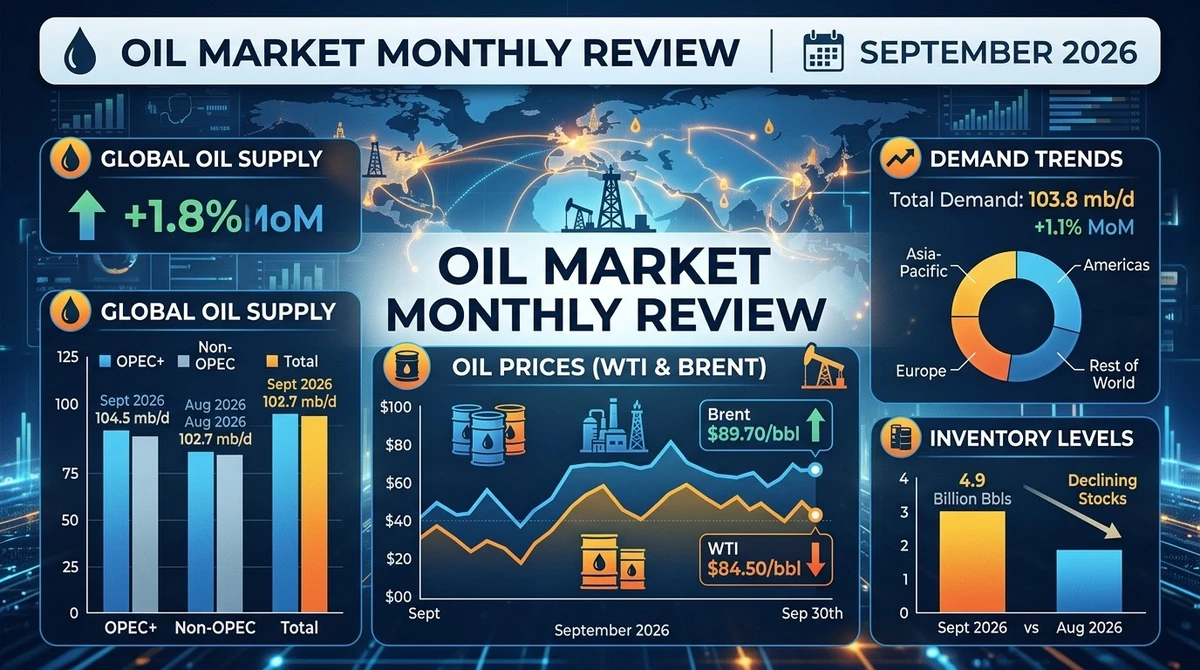
Brent crude gained about 14% during the month, while West Texas Intermediate (WTI) rose about 5%. On September 30, Brent November futures settled at $103.50 a barrel and WTI settled at $90.42. Reuters attributed the late-month strength to stalled U.S.-Iran talks and tightening U.S. fuel markets. (Reuters)
The bigger story, however, was not simply that crude became more expensive.
Supply disruptions were spreading through inventories, shipping, refining and fuel markets. The International Energy Agency reported that global observed oil inventories fell another 95 million barrels in August, taking cumulative draws since February to 507 million barrels. (IEA)
That combination left the global market with less room to absorb another major disruption.
September Oil Market at a Glance
| Market Indicator | September 2026 |
| Brent crude | About +14% |
| WTI crude | About +5% |
| Brent on Sept. 30 | $103.50/barrel |
| WTI on Sept. 30 | $90.42/barrel |
| Global oil supply forecast for 2026 | 100.7 mb/d |
| 2026 global oil-demand forecast | -2.5 mb/d |
| August global inventory draw | 95 million barrels |
| August global refinery throughput | 81.4 mb/d |
The price difference between Brent and WTI remained substantial, reflecting differences in geography, transportation and the impact of international supply disruptions on globally traded crude.
Yet the monthly story extended well beyond the two benchmarks. The physical condition of the oil system became increasingly important.
From Geopolitical Risk to Physical Supply Pressure
Oil markets had already been carrying a geopolitical premium, but the disruption increasingly affected actual production and exports.
The IEA’s September 2026 Oil Market Report estimated that global oil production fell by 1.6 million barrels per day month over month to 100.1 million barrels per day in August. More than 10 million barrels per day of Gulf output remained shut in amid heightened security risks. The agency projected total 2026 supply at 100.7 million barrels per day, 5.7 million barrels per day below the previous year.
That is materially different from a market where traders are simply adding a temporary risk premium to otherwise comfortable supply conditions.
Physical production, shipping routes and export capacity all determine whether crude is actually available to refiners.
A barrel produced in one region cannot necessarily compensate immediately for a barrel that cannot reach another region. Transportation capacity, insurance costs, shipping security and refinery location all affect how quickly the market can adjust.
The September market was therefore increasingly about physical availability, not just price expectations.
Inventories Became the Market’s Buffer
Inventories provide the oil market with a cushion when production or imports are disrupted.
When stocks are high, buyers can draw down stored crude and products while supply problems are resolved. When inventories are already falling, another disruption can have a much larger effect on prices.
The IEA reported that global observed oil inventories declined by 95 million barrels in August alone. Cumulative draws since February reached 507 million barrels, equal to an average decline of about 2.8 million barrels per day. (IEA)
The inventory trend therefore became one of the most important indicators entering the fourth quarter.
A temporary supply disruption is easier to absorb when storage is comfortable. A similar disruption becomes more dangerous when inventories are already being depleted.
The Refining Market Was Tighter Than the Crude Market Alone Suggested
One of the most important developments was the strength of refined-product markets.
The IEA reported that global refinery throughput reached 81.4 million barrels per day in August, up 960,000 barrels per day from July but still 4.2 million barrels per day below the same month a year earlier. Refining margins in the Atlantic Basin reached record levels, led by sharply higher diesel cracks. (IEA)
That distinction matters because consumers and businesses do not normally buy crude oil directly.
They buy gasoline, diesel, jet fuel and other petroleum products.
Refineries convert crude into those products, and disruptions to refinery operations, product exports or transportation can create fuel shortages even when crude availability looks less severe.
The IEA reported that refined-product and LPG exports from Gulf countries remained nearly 60%, or 3.7 million barrels per day, below February levels. (IEA)
That helps explain why fuel markets could remain under pressure even when crude prices temporarily moved lower.
U.S. Inventories Offered Only Partial Relief
U.S. petroleum data presented a more mixed picture.
According to the EIA Weekly Petroleum Status Report, commercial U.S. crude inventories increased by 922,000 barrels in the week ending September 25 to 427.32 million barrels.
Distillate inventories, meanwhile, fell to 105.18 million barrels from 107.43 million the previous week. (EIA)
The numbers show why one crude-inventory figure cannot describe the entire petroleum market.
Crude stocks can rise while refined-product inventories fall. Refinery utilization, exports, seasonal demand and regional supply conditions all influence the availability of gasoline and diesel.
For consumers and businesses, the cost and availability of finished fuel can matter more than the direction of crude inventories in any individual week.
Why Oil Prices Rose Despite Weaker Demand Expectations
The oil market faced two opposing forces.
Supply conditions were tightening, while the demand outlook was weakening.
The IEA forecast that global oil demand would decline by 2.5 million barrels per day in 2026, 940,000 barrels per day more than estimated in its previous report. It expects demand to recover by 2.6 million barrels per day in 2027. (IEA)
Higher oil prices can weaken demand because households spend more on fuel and businesses face higher transportation and operating costs.
But weaker demand also limits how far prices can rise.
That creates a self-correcting pressure within the market: supply disruptions push prices higher, while higher prices eventually encourage consumers and businesses to use less oil.
The question entering Q4 is how quickly that demand response can develop relative to the pace of supply recovery.
OPEC+ Remained a Key Supply Variable
OPEC+ added another layer of uncertainty.
On September 6, Saudi Arabia, Russia, Iraq, Kuwait, Kazakhstan, Algeria and Oman agreed to maintain their September 2026 required production levels for October. The group also reaffirmed its commitment to market stability and said it would continue reviewing conditions through monthly meetings. (OPEC)
The timing matters because OPEC+ will be making its next decision while inventories have fallen sharply and physical supply remains disrupted.
Additional production could help relieve pressure if shortages persist. At the same time, the group has to consider weaker demand expectations, compliance and the possibility that supply conditions could normalize later.
The October decision will therefore provide an important signal about how OPEC+ views the balance between supply disruption and demand weakness.
Brent’s September Gain Was More Than a Price Move
Brent’s roughly 14% monthly gain tells only part of the story.
The price increase was also a signal about the value traders were placing on reliable physical supply.
Geopolitical risk, disrupted shipping routes, lower production and tighter refined-product markets all contributed to that premium. Reuters reported that Brent’s September gain was its strongest monthly increase since July, supported by stalled U.S.-Iran negotiations and tighter U.S. fuel markets. (Reuters)
WTI’s smaller monthly gain reflected a somewhat different balance of U.S. supply, refining and transportation conditions.
The Brent-WTI relationship is useful for understanding regional market conditions, but the broader monthly question is whether global oil flows can normalize quickly enough to rebuild inventories and reduce the physical premium embedded in prices.
Oil Became a Larger Inflation Problem
Higher oil prices also became a broader economic issue.
Energy costs affect households directly through gasoline and heating expenses. Businesses feel the impact through trucking, aviation, agriculture, manufacturing and logistics.
Those costs can move through supply chains.
A trucking company paying more for diesel may face higher operating expenses. A manufacturer may pay more to transport raw materials. Retailers can face higher distribution costs. Some of those increases can eventually reach consumers.
Economic Reader’s How Interest Rates Affect the Economy explains how higher costs and inflation can interact with monetary policy and financial conditions.
The connection became particularly relevant as the Federal Reserve kept monetary policy relatively tight while energy prices were rising. Higher oil prices do not directly determine Fed policy, but they can make the inflation environment more complicated.
Higher Prices Also Started Changing the Demand Story
A prolonged oil shock eventually affects consumption.
The first response is financial: households spend more on fuel and businesses absorb higher operating costs.
Over time, behavior can change as well.
Households may reduce discretionary spending. Businesses may optimize transportation routes, improve fuel efficiency or delay expansion. Energy-intensive industries can face weaker margins.
The IEA’s September report reflected this pressure. Its 2026 demand forecast was reduced by a further 940,000 barrels per day from the previous month, with losses concentrated in middle distillates and petrochemical feedstocks. (IEA)
High prices therefore contain part of their own resistance.
The market can tighten, prices rise, and those higher prices begin weakening demand.
What September Revealed About the Oil Market
The most important lesson from the month was that crude prices alone were not enough to describe the oil market.
Three layers were interacting:
Physical supply: Middle Eastern production and exports remained heavily disrupted.
Inventories: Global stocks fell sharply, reducing the buffer available to absorb another shock.
Refined products: Diesel and other fuel markets became particularly tight, increasing the economic impact of the crude disruption.
Together, those conditions created a market that was more fragile than a simple crude-price chart would suggest.
The central question became how long the global energy system could operate below normal capacity before high prices began destroying enough demand to restore balance.
What the Oil Market Is Watching in October
Several developments will determine whether September’s pressure carries into Q4.
OPEC+ policy: The October 4 meeting will be closely watched for changes to production plans. (OPEC)
Middle East supply: The pace at which Gulf production and exports recover remains central to the global balance.
Strait of Hormuz: Any major change in shipping conditions could quickly alter the market’s risk premium.
Inventories: Further global stock draws would indicate that the physical market remains tight.
Refined products: Diesel and other middle-distillate markets deserve particular attention because they can affect businesses and consumers even if crude prices stabilize.
Global demand: Prolonged high fuel prices could accelerate demand destruction, particularly if economic growth weakens.
U.S. production and inventories: Domestic crude output, refinery activity and petroleum stocks will help determine how much of the global supply pressure reaches the U.S. market.
Where the Oil Market Stands Entering Q4
September left the global oil market in an unusual position.
Prices were high because physical supply remained constrained, yet those same high prices were beginning to weaken demand. Inventories were falling, refined-product markets were tight, and geopolitical uncertainty continued to influence the movement of barrels.
The result was a market with less room for another major disruption.
The next phase will depend on whether supply normalizes faster than demand weakens. If Middle Eastern production and shipping flows recover, inventories could begin rebuilding and the geopolitical premium could fade. If disruptions persist while inventories continue falling, the market could remain vulnerable to another sharp price move.
For Q4, the central oil-market question is not simply whether Brent remains above $100.
It is whether the global energy system can restore enough physical supply and inventory capacity to ease the pressure without triggering a much larger slowdown in oil demand.