
Inflation vs Gold vs Stocks: Which Investment Performs Better During Inflation?
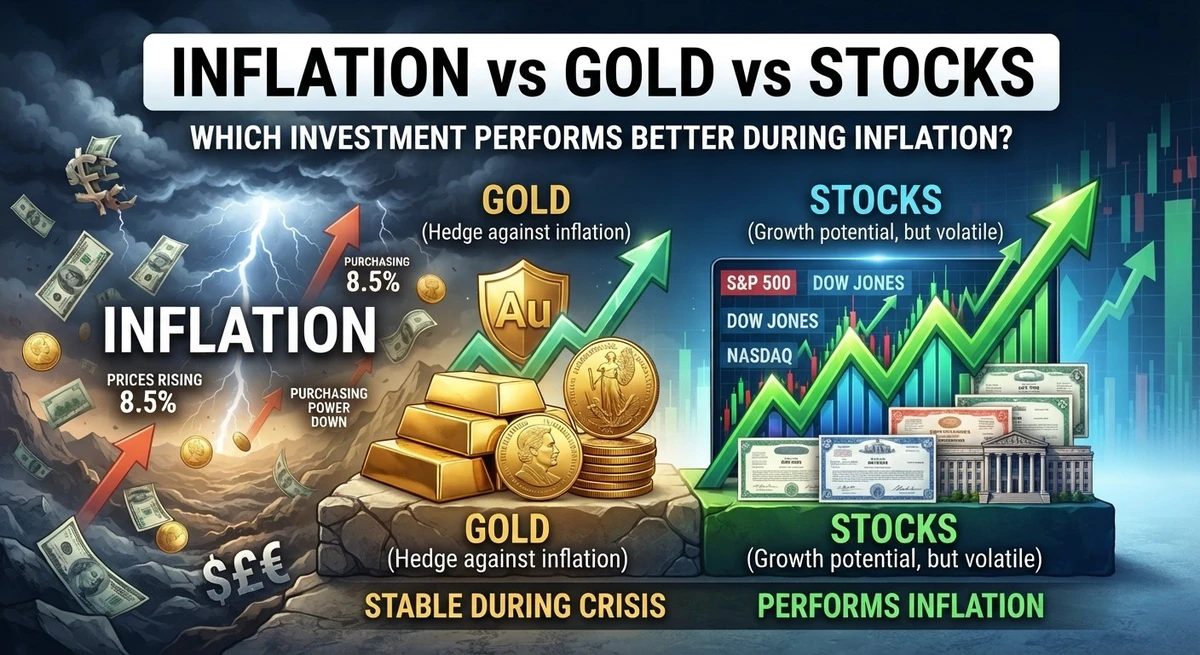
Inflation vs Gold vs Stocks
Inflation creates a difficult environment for investors because the value of money is falling while financial markets are simultaneously trying to price what comes next.
That makes a common question “Is gold or the stock market better during inflation?” more complicated than it sounds.
Gold has a reputation as an inflation hedge. Stocks represent ownership in businesses that can potentially raise prices, grow earnings, and increase dividends over time. Yet neither asset automatically benefits whenever inflation rises.
Gold can gain during inflation, but its short-term relationship with consumer prices is not consistent. Stocks can also perform well during periods of rising prices, but higher inflation can squeeze profit margins and push interest rates higher, which can pressure valuations.
The more useful comparison is therefore not simply gold vs. stocks.
It is about understanding how inflation reaches each asset, what happens to real returns, and why the same inflation rate can produce very different market outcomes.
Inflation Changes the Meaning of an Investment Return
An investment can make money in dollar terms while still losing purchasing power.
Suppose an investment earns 6% in a year when inflation is 2%. The investor has increased purchasing power.
Now suppose the same investment earns 6% while inflation is 7%. The account balance has still increased, but the investor’s purchasing power has declined.
That is the difference between a nominal return and a real return.
Investor.gov identifies inflation as a major investment risk because rising prices reduce purchasing power, particularly for investments producing fixed returns. (Investor.gov)
This is why inflation should be part of any investment comparison.
An asset that rises 8% is not necessarily creating the same economic result when inflation is 2% as when inflation is 7%.
Economic Reader’s How Inflation Affects Your Money explains the broader effect of rising prices on savings, spending, and investment returns.
For investors comparing gold and stocks, the key question is therefore:
Did the investment generate enough return to preserve or increase purchasing power?
Gold Has a Strong Inflation Reputation but the Relationship Is Not Automatic
Gold’s reputation as an inflation hedge has a historical basis.
Unlike a company, gold does not depend on earnings or future cash flows. Unlike cash, its supply is limited by physical availability and mining. Investors have therefore used it as a store of value across different monetary and economic environments.
The World Gold Council’s 2026 research finds that gold has outpaced U.S. and global consumer prices since 1971 and has historically performed strongly during periods of higher inflation. (World Gold Council)
But there is an important distinction between long-term inflation protection and short-term CPI tracking.
Gold does not simply move upward whenever the CPI rises.
Interest rates, real yields, the U.S. dollar, investor demand, geopolitical risk, and expectations about future inflation can all affect gold prices. The World Gold Council’s 2026 research also emphasizes that inflation alone does not determine gold’s performance. (World Gold Council)
That explains why gold can sometimes rise strongly when inflation is relatively moderate and fall during periods when inflation remains elevated.
Inflation is one of gold’s drivers.
It is not the entire pricing mechanism.
Stocks Experience Inflation Through Corporate Earnings
Stocks face a completely different inflation mechanism.
Buying a stock means owning part of a business. The business earns revenue, pays expenses, generates profits, and potentially distributes some of those profits through dividends.
When prices rise, companies may be able to increase the prices of their products and services.
That can increase nominal revenue.
But the same inflation can also increase:
- Labor costs
- Energy expenses
- Raw-material costs
- Transportation costs
- Borrowing costs
- Operating expenses
So higher revenue does not automatically mean higher profits.
Consider a manufacturer whose selling prices increase 6% while its labor and material costs increase 8%.
Its revenue may look stronger.
Its profit margin may not.
This distinction is central to understanding why stocks can react negatively to inflation even when companies are reporting higher nominal sales.
The Federal Reserve’s research on inflation and stock returns found that higher-than-expected inflation can lead investors to expect weaker nominal cash-flow growth while discount rates rise. The research also found that companies with greater market power can be better positioned than companies with weaker pricing power when inflation acts as a cost shock. (Federal Reserve)
Pricing Power Can Matter More Than Inflation Itself
Not every company experiences inflation in the same way.
A business with strong pricing power may be able to pass higher costs to customers without losing much demand.
A company selling a highly differentiated product may have more flexibility than a business operating in a crowded market where customers can easily switch to competitors.
That creates an important distinction for stock investors.
During inflation, the question is not simply:
“Are prices rising?”
It is:
“Can the companies I own protect their economics while prices are rising?”
Investors may therefore pay attention to profit margins, pricing power, debt levels, cash flow, competitive advantages, and valuation.
Economic Reader’s What Is Stock? provides the basic explanation of how stock ownership connects investors to company growth, earnings, and dividends.
The inflation discussion starts from that foundation but goes one step further: what happens to the economics of those businesses when the cost of everything around them changes?
Interest Rates Can Change the Inflation Equation
Inflation rarely operates by itself.
When inflation remains elevated, central banks may keep interest rates higher or raise them further. That response can change the relative attractiveness of different investments.
For stocks, higher rates can increase borrowing costs and reduce the present value investors assign to future earnings.
This can be particularly important for companies whose valuations depend heavily on profits expected many years in the future.
Gold has a different problem.
Gold does not pay interest or dividends. When yields on other assets rise, the opportunity cost of holding a non-income-producing asset can increase.
That creates an important chain:
Higher inflation → tighter monetary policy → higher rates and yields → pressure on some stocks and gold.
But the effects are not identical.
A company can respond to higher rates through stronger earnings, cost control, or pricing power.
Gold does not have an operating business behind it.
Its price depends on what investors are willing to pay for the metal relative to alternative assets and the broader economic environment.
This is why the relationship between inflation and gold can become more complicated once monetary policy enters the picture.
Inflation Expectations Matter More Than One CPI Report
Markets are forward-looking.
Investors do not simply react to today’s inflation rate. They are constantly estimating what inflation, interest rates, economic growth, and corporate earnings might look like months or years ahead.
That means two periods with the same CPI inflation rate can produce very different market reactions.
Imagine inflation is running at 5%.
In one scenario, investors expect it to fall toward 2% within a year.
In another, investors expect it to remain around 5% for several years.
The second environment could produce much more persistent pressure on interest rates, wages, business costs, and valuations.
Gold may respond differently because inflation expectations can influence demand for a store of value.
Stocks may respond differently because investors must reassess future earnings and the discount rate applied to those earnings.
The inflation number matters.
What investors believe that number means for the future can matter just as much.
A Temporary Inflation Shock Is Not the Same as Persistent Inflation
The source and duration of inflation also matter.
A sudden energy-price shock can push inflation higher without creating the same investment environment as several years of broad-based price increases.
A temporary supply shock may increase costs quickly while companies struggle to adjust prices.
Persistent inflation gives businesses more time to change prices, renegotiate contracts, adjust wages, and alter investment decisions.
The investment response can therefore depend on whether inflation is:
- Temporary or persistent
- Demand-driven or supply-driven
- Accompanied by strong growth or weak growth
- Combined with rising or falling real yields
- Expected to accelerate or decline
This is one reason broad statements such as “gold performs well during inflation” or “stocks perform badly during inflation” can be misleading.
The economic regime matters.
Gold and Stocks Do Not Have to Move in Opposite Directions
Another common mistake is treating gold and stocks as if one must rise whenever the other falls.
They can move in the same direction.
Stocks can rise during inflation if businesses generate stronger-than-expected earnings and investors remain confident about future growth.
Gold can rise at the same time because investors are concerned about purchasing power, geopolitical risk, currency conditions, or financial uncertainty.
The two assets have different return drivers, which is one reason gold is sometimes used as a portfolio diversifier.
The World Gold Council’s 2026 research describes gold as an asset with historically different characteristics from major risk assets and highlights its role in diversification and periods of market stress. (World Gold Council)
That does not mean gold must outperform stocks.
It means the two investments can respond to different parts of the economic environment.
When Gold May Become More Relevant
Gold may become more attractive to investors when inflation is combined with broader uncertainty.
Potential supporting conditions include:
- Persistent inflation expectations
- Falling real yields
- Currency concerns
- Geopolitical uncertainty
- Financial-market stress
- Strong investment demand for safe-haven assets
The important point is that inflation does not have to act alone.
For example, the World Gold Council noted in 2026 that a renewed period of high inflation would not automatically guarantee a major gold rally; real rates, the dollar, growth expectations, Asian demand, and central-bank behavior could all influence the outcome. (World Gold Council)
That is a useful reminder for investors.
Gold can provide diversification, but it is not an automatic insurance policy against every inflation shock.
When Stocks May Have the Stronger Long Term Case
Stocks have an advantage gold does not have in the same way:
Businesses can grow.
A successful company can increase sales, enter new markets, improve productivity, launch new products, and generate larger cash flows.
That gives stocks a long-term wealth-building mechanism that does not depend entirely on preserving the value of an existing asset.
But stock returns still depend heavily on the price investors pay.
A company can grow earnings and still produce disappointing returns if its stock was already priced for extremely strong growth.
Likewise, a company with modest growth can produce strong returns if the market had underestimated its future earnings.
Inflation therefore becomes one part of a larger equation involving:
earnings + margins + valuation + interest rates + expectations.
That is why simply choosing stocks because inflation is rising is not enough.
The 1970s Are Useful but They Are Not a Template
The 1970s are often cited when investors discuss inflation and gold.
Inflation remained high, energy prices were volatile, interest rates eventually rose sharply, and economic growth weakened at points.
The period demonstrates that inflation can create unusual conditions for both financial assets and the broader economy.
But it should not be treated as a guaranteed template for the present.
Today’s economy has a different industrial structure, monetary-policy framework, financial system, technology sector, global supply chain, and investor base.
Historical periods are useful because they show what can happen.
They do not tell investors exactly what will happen next.
That distinction is especially important when comparing assets based on a single historical episode.
Real Return Is the Better Scorecard
Suppose an investor compares three outcomes during an inflationary year:
- Gold: +8%
- Stocks: +10%
- Cash: +5%
If inflation is 7%, the nominal numbers can be misleading.
The approximate real returns would be:
- Gold: about +1%
- Stocks: about +3%
- Cash: about -2%
The calculation is simplified, but the concept is important.
An investment return has to be judged against the purchasing power it creates, not simply the percentage printed on an account statement.
Investor.gov makes the same broader point when discussing inflation risk: returns that do not keep pace with rising prices can lose purchasing power over time. (Investor.gov)
For investors, this means comparing gold and stocks requires more than looking at which price rose more.
Taxes, fees, volatility, and the investor’s time horizon can all affect the actual outcome.
Current Inflation Shows Why the Comparison Matters
The issue is not purely historical.
According to the U.S. Bureau of Labor Statistics, U.S. CPI inflation was 3.4% year over year in August 2026, while core CPI increased 2.4%. (Bureau of Labor Statistics)
That is well below the extreme inflation rates associated with historical inflation crises, but it is still high enough to matter for investors thinking about purchasing power.
It also illustrates why today’s environment cannot be reduced to one simple inflation trade.
Investors have to consider what inflation means for interest rates, corporate margins, real yields, the dollar, and future economic growth.
Recent gold-market activity provides a good example. Economic Reader’s Gold Market Monthly Review: September 2026 showed gold responding not only to inflation concerns but also to oil prices, Treasury yields, the U.S. dollar, and Federal Reserve policy.
The market reaction demonstrated how several forces can push gold in opposite directions at the same time.
The Existing Portfolio Changes the Answer
The right comparison also depends on what an investor already owns.
Someone with a portfolio heavily concentrated in stocks already has substantial exposure to corporate earnings and economic growth.
Adding gold could introduce a different source of return and potentially reduce reliance on equity-market performance.
Someone who already owns a large gold position faces a different portfolio problem.
The question is therefore not simply:
“Which asset performs better during inflation?”
It is:
“What does my portfolio currently depend on, and what risk am I trying to reduce?”
Economic Reader’s Best Investments During Inflation looks more broadly at stocks, real estate, TIPS, commodities, and other approaches investors may consider when purchasing power is under pressure.
This article takes a narrower approach by focusing on the different economic mechanisms behind gold and stocks.
Gold and Stocks Can Serve Different Jobs
Gold and stocks are often compared as competing investments, but they can play very different roles.
Gold can provide exposure to a scarce physical asset and may help diversify a portfolio when financial or geopolitical uncertainty rises.
Stocks provide ownership of productive businesses. Their long-term return can come from earnings growth, dividends, and changes in valuation.
Those characteristics mean the two assets do not need to be treated as substitutes.
A long-term portfolio could use stocks for exposure to economic and corporate growth while using a measured gold allocation for diversification.
The appropriate balance depends on an investor’s goals, time horizon, risk tolerance, and existing holdings. Investor.gov likewise emphasizes that asset allocation should reflect an investor’s time horizon and ability to tolerate losses rather than a single market forecast. (Investor.gov)
So, Which Performs Better During Inflation?
There is no universal winner.
Gold has a stronger direct inflation-protection role, particularly over long periods and in certain high-inflation or uncertainty-driven environments. But its short-term performance depends on much more than CPI, including real yields, the dollar, investor demand, and economic expectations. (World Gold Council)
Stocks have a stronger long-term growth mechanism because businesses can increase earnings, cash flows, and dividends. But inflation can pressure stocks when rising costs weaken margins or higher interest rates reduce valuations. Federal Reserve research provides evidence that unexpected inflation can create pressure through both cash-flow expectations and discount rates. (Federal Reserve)
The better way to think about the comparison is therefore not “gold or stocks?”
It is:
What kind of inflation is occurring? What are interest rates doing? Can businesses protect their margins? What are real yields doing? And what role does the asset need to play in the portfolio?
That framework is more useful than chasing whichever asset has recently risen the most.
Inflation changes the investment environment, but it does not create a permanent rule for what investors should own. Understanding the economic mechanism behind each asset is more valuable than assuming one investment will always win when prices rise.